

If you have been following the Indian stock markets, you might have observed that the Sensex consistently shows a higher numerical value than the Nifty. For instance, (as of May 22, 2025) the BSE Sensex is approximately 80,800, while the NSE Nifty 50 stands around 24,600.
Both are major stock market indices and serve as a benchmark, so why does this difference exist?
Let’s break this down in a simple and relatable way.
1. Different base years and base values
The main reason Sensex appears ‘higher’ than Nifty comes down to how they started:
Sensex was launched in 1986, but its base year is 1978-79, and it was set at a base value of 100.
The Nifty 50, managed by the National Stock Exchange (NSE) was introduced in 1996, with a base year of 1995 and a base value of 1000. (It covers 50 companies from various sectors, including financial services, consumer shares, and more.)
So, even though the Sensex looks like it has grown more, it’s simply had a longer runway (more years) to rise from a lower starting point. That’s like comparing two athletes who started running at different times and from different points on the track.
2. Different number of companies
The Sensex tracks 30 companies listed on the BSE (Bombay Stock Exchange bse).
The Nifty 50 represents 50 companies on the NSE.
Because Nifty includes more stocks, it gives a slightly broader picture of the market. But that doesn't affect the numerical value directly; it’s just that the total market cap of these stocks is calculated and indexed differently.
3. Base formula differences
Even though both indices use the free float market capitalisation method (which considers only publicly traded shares), the calculation is based on different base market caps and base values.
Here’s the formula in simple terms:
Index Value = (Total Free-Float Market Cap / Base Market Cap) × Base Index Value
For the Sensex, the base index value is 100.
For Nifty, the base index value is 1000.
This difference alone creates a big gap in index values. So, Sensex hitting 80,000 doesn’t mean it’s performing better than Nifty at 24,000 they are just scaled differently.
4. Think percentages, not numbers
Instead of comparing the Sensex and Nifty by the number, compare them by percentage movement. So, if Sensex moves from 80,000 to 81,600, that’s a 2% rise. And, if Nifty moves from 24,000 to 24,480, that’s also a 2% rise.
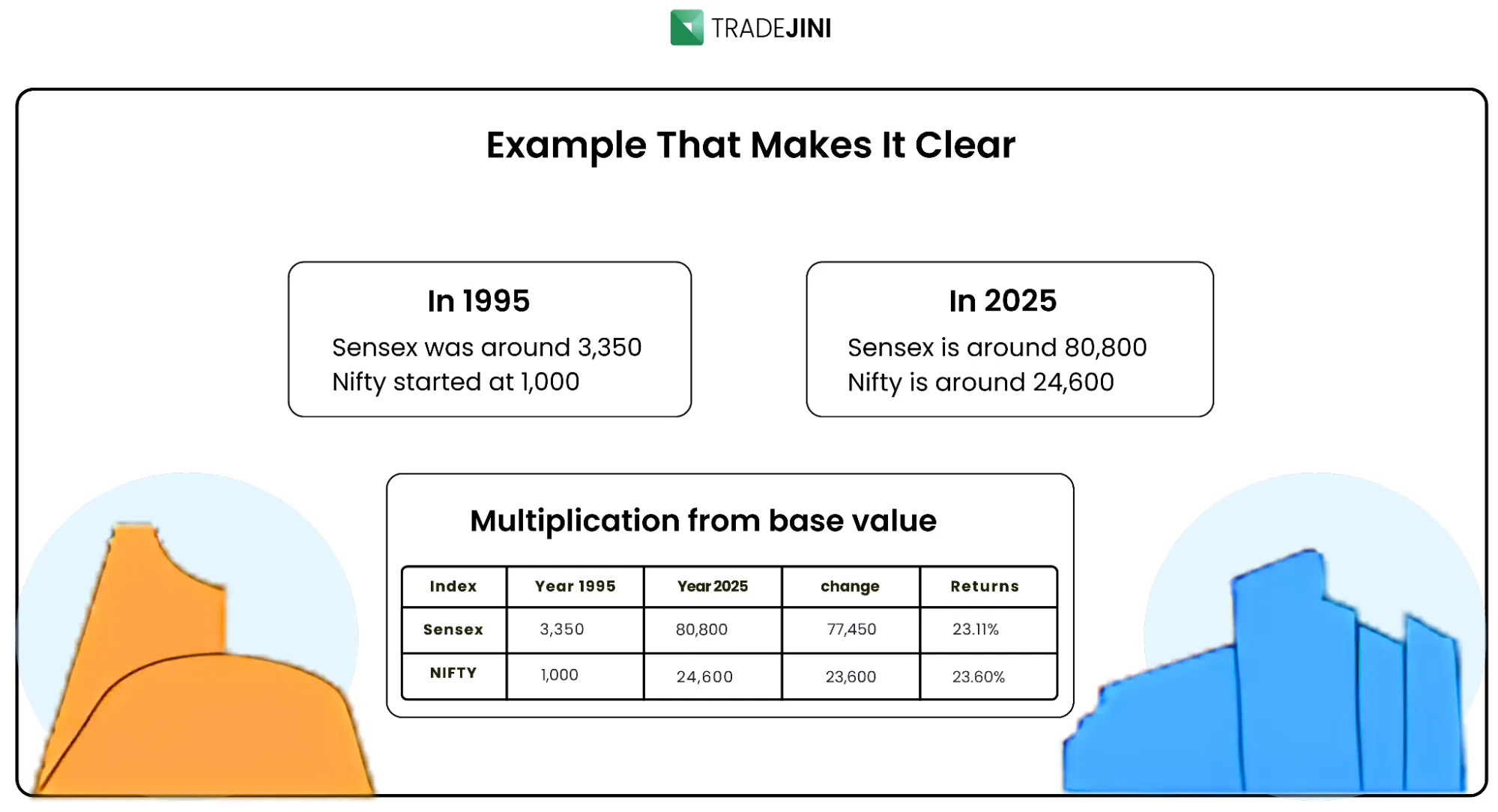
At first glance, it may look like Sensex has grown more, but it just had a lower base value, which makes the end number appear bigger.
5. Overlapping stocks, same direction
A number of listed stocks like Reliance Industries, HDFC Bank, Infosys, TCS, and even the newly listed Zomato (Eternal) are now part of both the Sensex and Nifty. Because the same key players have an impact on both indices, they typically move in the same direction.
This also means you can track either index to get a sense of how the Indian stock market is doing.
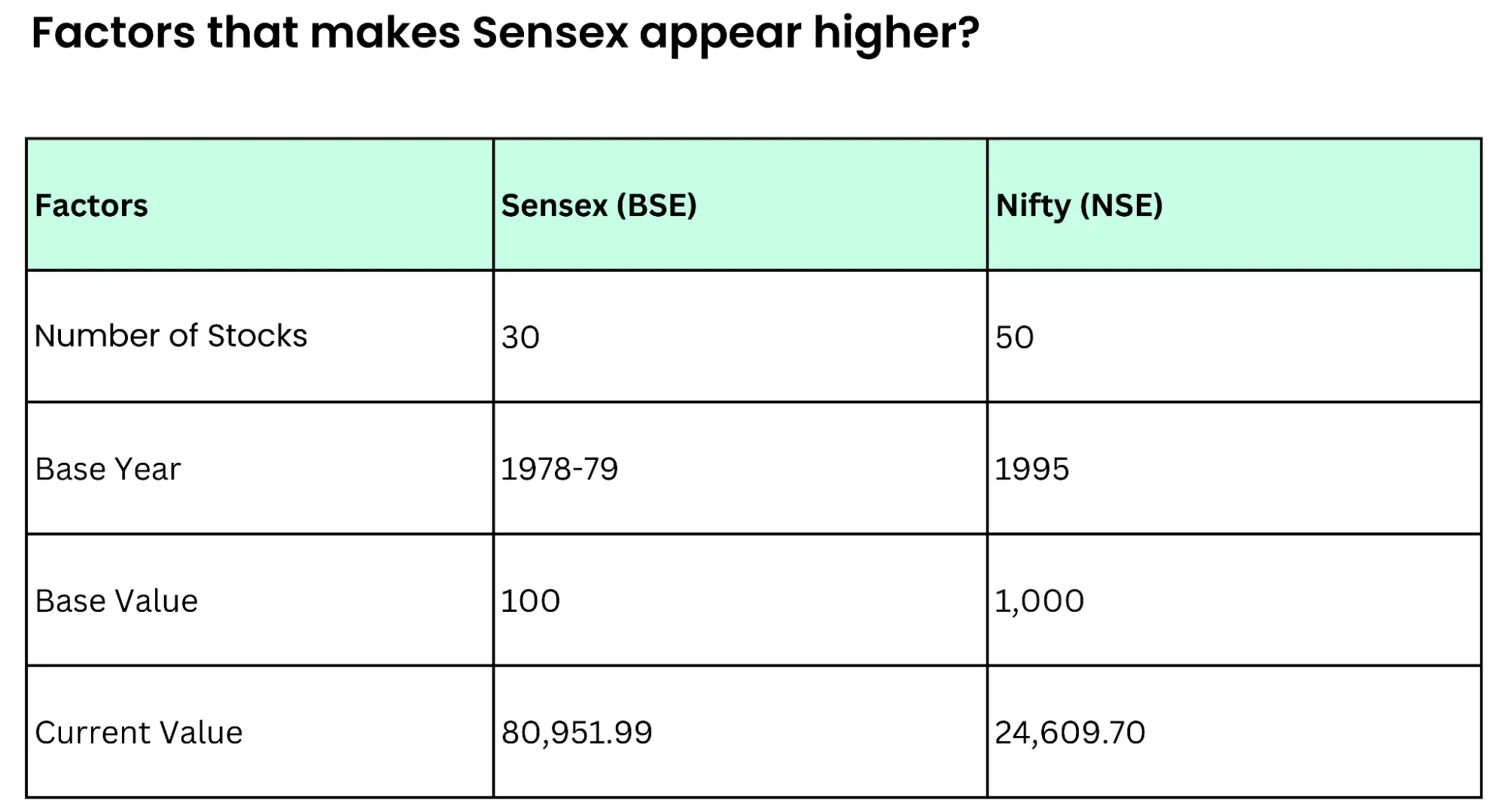
The higher numerical value of the Sensex compared to the Nifty is primarily due to its lower base value of 100 (set in 1978-79) versus the Nifty's base value of 1,000 (set in 1995). This difference in base values, along with the distinct starting points, results in the Sensex having a higher current numerical value than the Nifty.
It’s not about performance, it’s about the math
The Sensex is higher than the Nifty only in terms of the number, not in terms of performance. It’s like comparing two thermometers with different scales, both measure market sentiment, just differently.
So the next time someone asks, ‘Why is Sensex so much higher than Nifty?' you know the answer. It's all about starting points, the number of stocks, and index formulas, not better or worse performance.
Want to know how to invest or trade in Nifty or Sensex?
👉 Open your Tradejini account today and start saving on every trade!
.webp%3Falt%3Dmedia%26token%3D0ead9799-20bc-4d1e-ae8f-d75ab18921b5&w=3840&q=75)