The stock market may still open at 9:15 AM, but the 15 minutes before the opening bell have now become more structured. From September 7, 2026, the pre-open session framework has been revised to make the process of price discovery more systematic and closer to the auction mechanism used at the end of the trading day. For investors, the change is in how orders are handled between 9:00 AM and 9:15 AM. Pre-Open Session is essentially a price discovery period. Instead of orders being matched continuously as they arrive, buy and sell orders are collected and then matched at an equilibrium price. This helps determine a fair opening price based on the demand and supply available before regular trading begins.
What has changed?
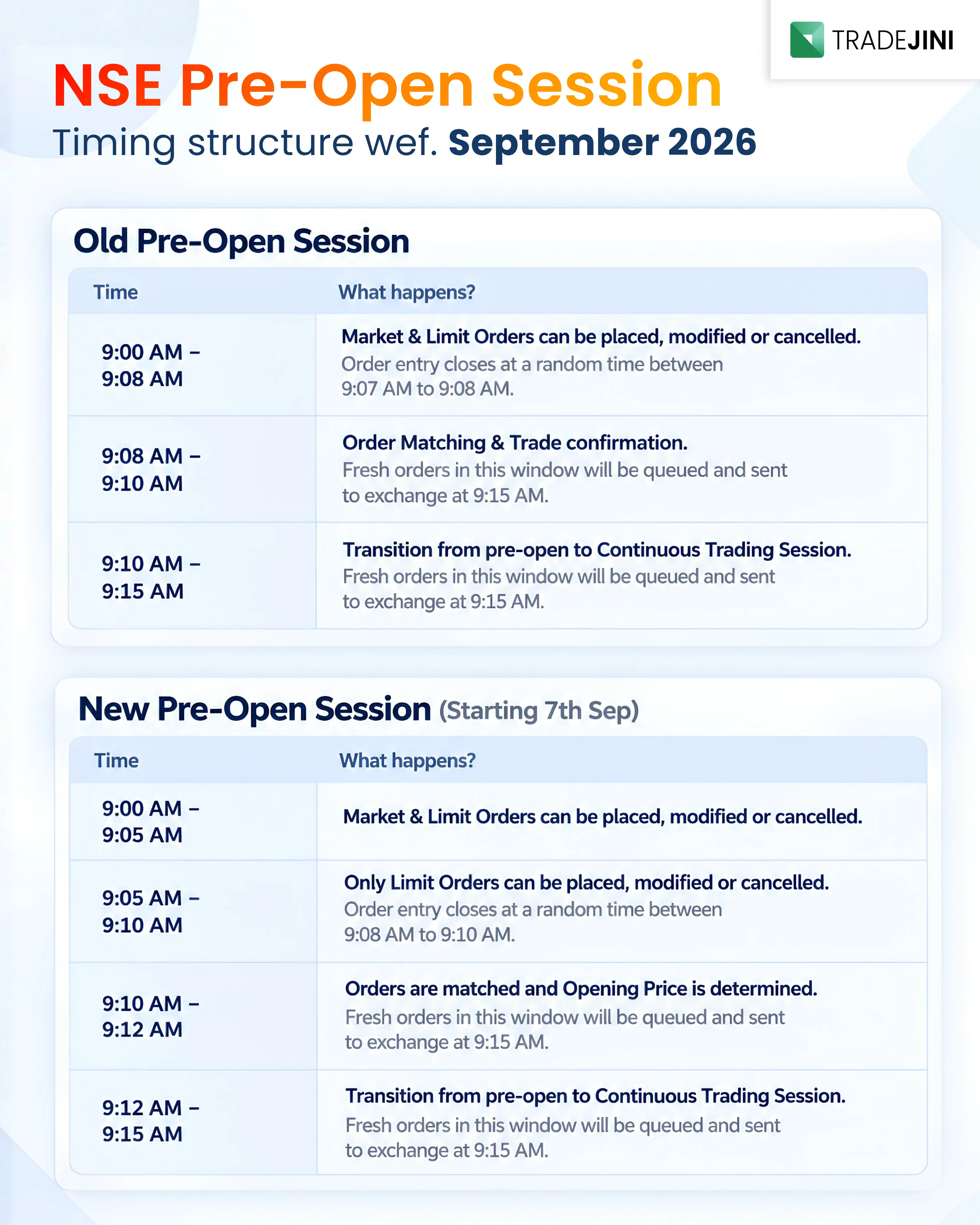
The 15-minute session is now divided into four clear stages. From 9:00 AM to 9:05 AM, investors can place, modify, or cancel both market and limit orders. From 9:05 AM to 9:10 AM, only limit orders can be placed, modified, or cancelled. The order-entry period will close at a random time between 9:08 AM and 9:10 AM, so traders cannot rely on a fixed cut-off time. From 9:10 AM to 9:12 AM, the exchange moves into the order-matching phase. Orders are matched, and the opening price is determined. Investors cannot modify or cancel orders during this stage. The final three minutes, from 9:12 AM to 9:15 AM, act as a transition period before normal continuous trading begins at 9:15 AM.
Old vs. New Pre-Open Session
Why does the opening price matter?
Imagine a stock closed yesterday at ₹1,000. Overnight, positive news creates strong buying interest. Before the market opens, some investors may be willing to buy at ₹1,040, while sellers may be willing to sell around ₹1,050. The exchange uses the orders available during the auction to determine an equilibrium price at which the maximum possible quantity can be matched. This means the stock does not simply open at yesterday's closing price. The opening price reflects the demand and supply captured during the Pre-Open Session.
What is the Indicative Equilibrium Price?
During the auction, investors can see an Indicative Equilibrium Price, which provides an estimate of where the stock could open based on the orders received so far. It is useful because it gives investors a sense of the potential opening price before the auction is completed. However, it is only indicative. As more orders enter or existing orders are modified or cancelled, the equilibrium price can change before the final opening price is determined.
What does this mean for investors?
The revised framework makes the first few minutes of the trading day more structured. Investors need to understand that 9:00 AM to 9:05 AM is different from 9:05 AM to 9:10 AM. The type of order that can be entered and the ability to modify or cancel orders changes after 9:05 AM.
Another important point is that certain order types, including Stop Loss, IOC, Disclosed Quantity and Iceberg orders, are not permitted during the Pre-Open Session. Unmatched eligible orders are carried forward to the regular market according to the applicable exchange rules.
Market orders also need particular attention. At the exchange level, market orders are permitted during the first five minutes of the revised session. Broker platforms may use their own price-protection mechanisms for market orders, so the way an order is handled can depend on the broker.
Disclaimer: The information provided in our blogs is for informational purposes only and should not be construed as financial, investment, or trading advice. Trading and investing in the securities market carries risk. Always conduct your own research and consult with a qualified financial advisor before making any investment decisions. Past performance is not indicative of future results. Copyrighted and original content for your trading and investing needs.
© 2026 — Tradejini. All Rights Reserved.