

Picture this: it is 9 PM and you have just finished reading a company’s quarterly results. The numbers are strong, the stock looks attractive, and you want to buy at tomorrow’s open. But the market closed hours ago, and you have a 9 AM meeting you cannot miss. What do you do?
This is precisely the gap that the After-Market Order (AMO) fills. It lets you place your buy or sell instructions outside regular trading hours, so by the time the market opens, your order is already in the queue, waiting to execute.
What is After Market Order?
An AMO is a pre-scheduled trade instruction that you submit after 4:00 PM when the post-closing session ends and before the AMO window closes. The exchanges do not execute these orders immediately. Instead, your broker holds them and releases them to the exchange at the start of the pre-opening session (9:00 AM), where they may execute if the price is matched, otherwise they enter the regular trading session at 9:15 AM.
What is the AMO window timing for NSE and BSE?
The AMO window for equity (cash segment) and equity derivatives (F&O) opens at 4:00 PM and closes at 8:59 AM the following trading day. During the pre-opening session, price discovery happens through an order collection between 9:00 AM and 9:07 AM followed by the order matching process. AMO orders participate in this pre-opening price discovery, which means they can execute before the regular trading session even begins. Your AMO does not simply wait for 9:15 AM. If your price is matched during the pre-opening session (9:00 AM to 9:07 AM), the order can execute there itself. If unmatched, it carries over to the regular session. Also note that AMO market orders are converted into limit orders at the discovered opening price, unlike a regular order placed at 9:15 AM.
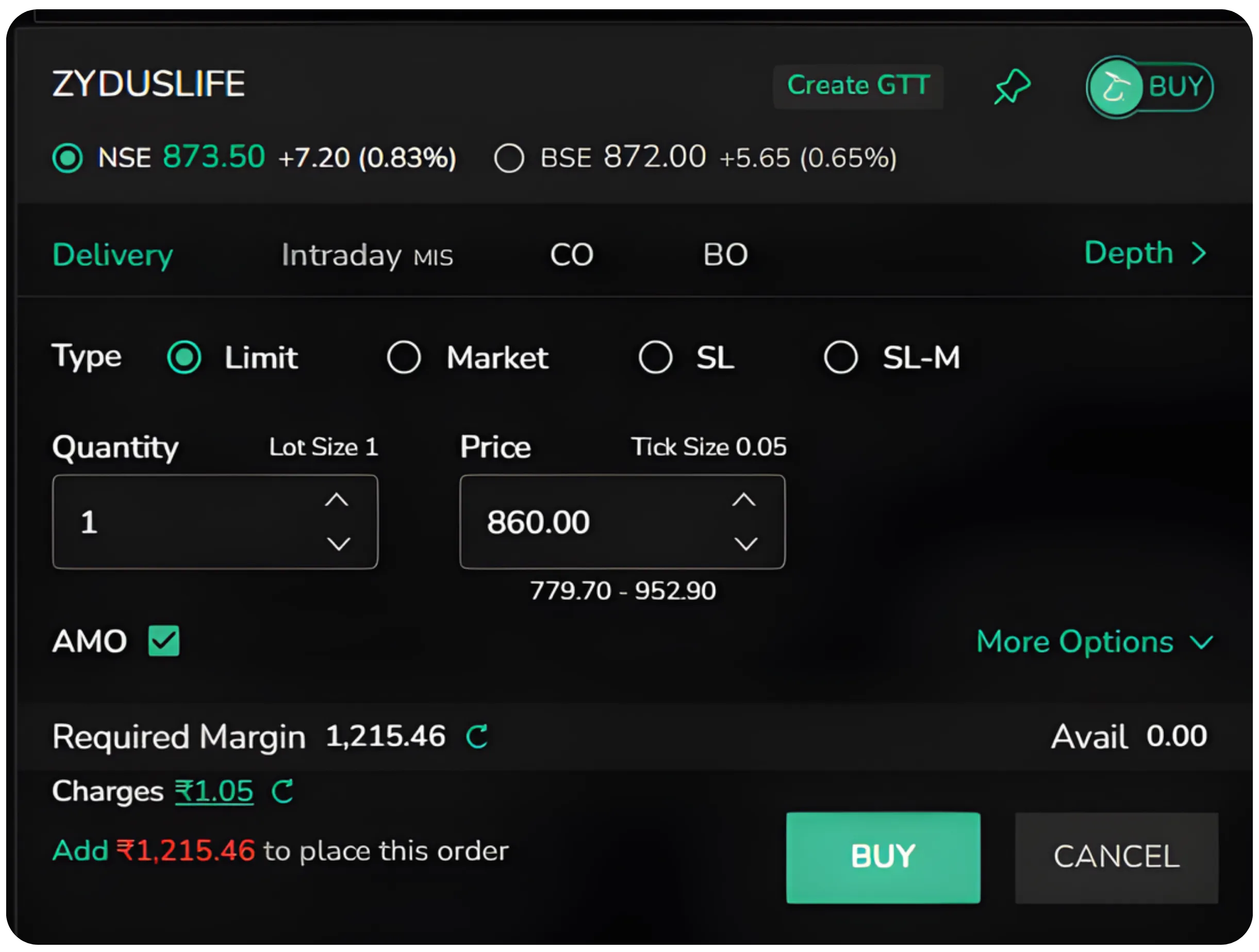
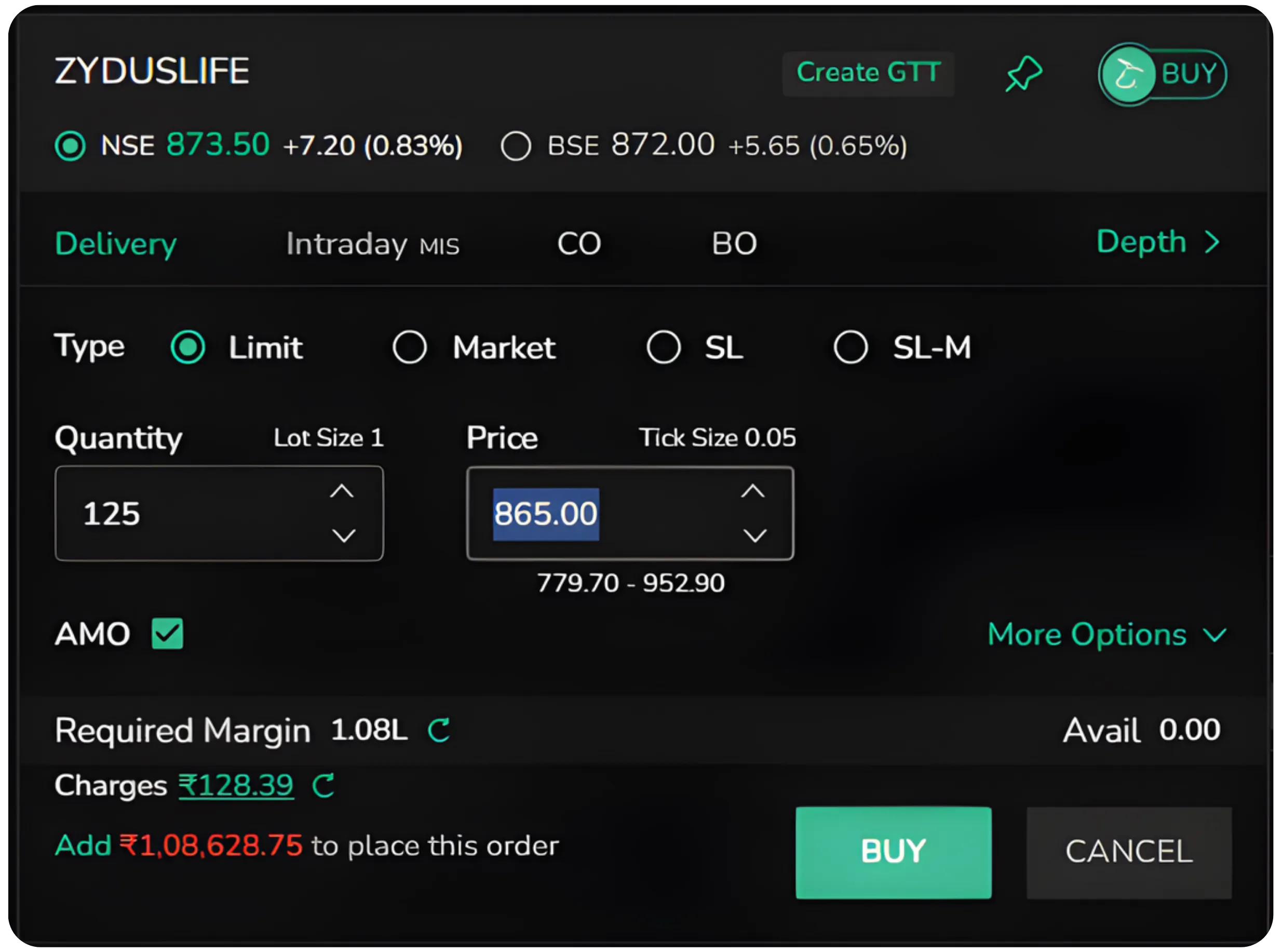
Seen in the image above: The AMO checkbox is enabled at the bottom of the CubePlus Order pad for ZYDUSLIFE, at a limit price of ₹860 against a live market price of ₹873.5. This is a classic AMO setup: placing a buy below the current market, hoping to catch a dip at open.
Why does this matter for retail investors?
Most retail investors are working professionals. Between 9:15 AM and 3:30 PM, they are in meetings, classrooms, or otherwise unavailable to watch the markets. AMO removes this dependency entirely. You do your research in the evening, decide your price, place the order and let the system do the rest.
This also removes a subtle but real behavioural problem: the temptation to act on market noise during the day. When you place an AMO the night before based on deliberate analysis, you are less likely to get swayed by intraday price movements or panic headlines the next morning.

Practical use cases for the everyday investor
| Use Case | Scenario |
|---|---|
| Post-earnings entry | A company reports strong Q4 results at 7 PM. Place an AMO tonight at your target buy price before you sleep. |
| Planned profit booking | Your stock hit a target zone but you're travelling tomorrow morning. Place an AMO sell tonight at your exit price. |
| Support zone buying | A stock has strong support at ₹850. It's trading at ₹871. Place an AMO limit buy at ₹851 to catch a dip at open. |
| Stop-loss placement | Hold a position and need protection before the opening bell. Place an AMO SL order overnight to guard your downside. |
| SIP-style equity buying | Every Sunday night, review your watchlist and pre-load AMO orders at disciplined limit prices for the week ahead. |
| Reacting to global cues | US markets fell sharply overnight. You expect Indian markets to open lower. Place an AMO buy at a lower price before you sleep. |
How to Place a CubePlus AMO Order
On CubePlus, the AMO order feature is available directly from the order pad; you simply tick the AMO checkbox before confirming.
- Search for the stock: Open the CubePlus app or web platform and search for the equity or F&O contract you want to trade.
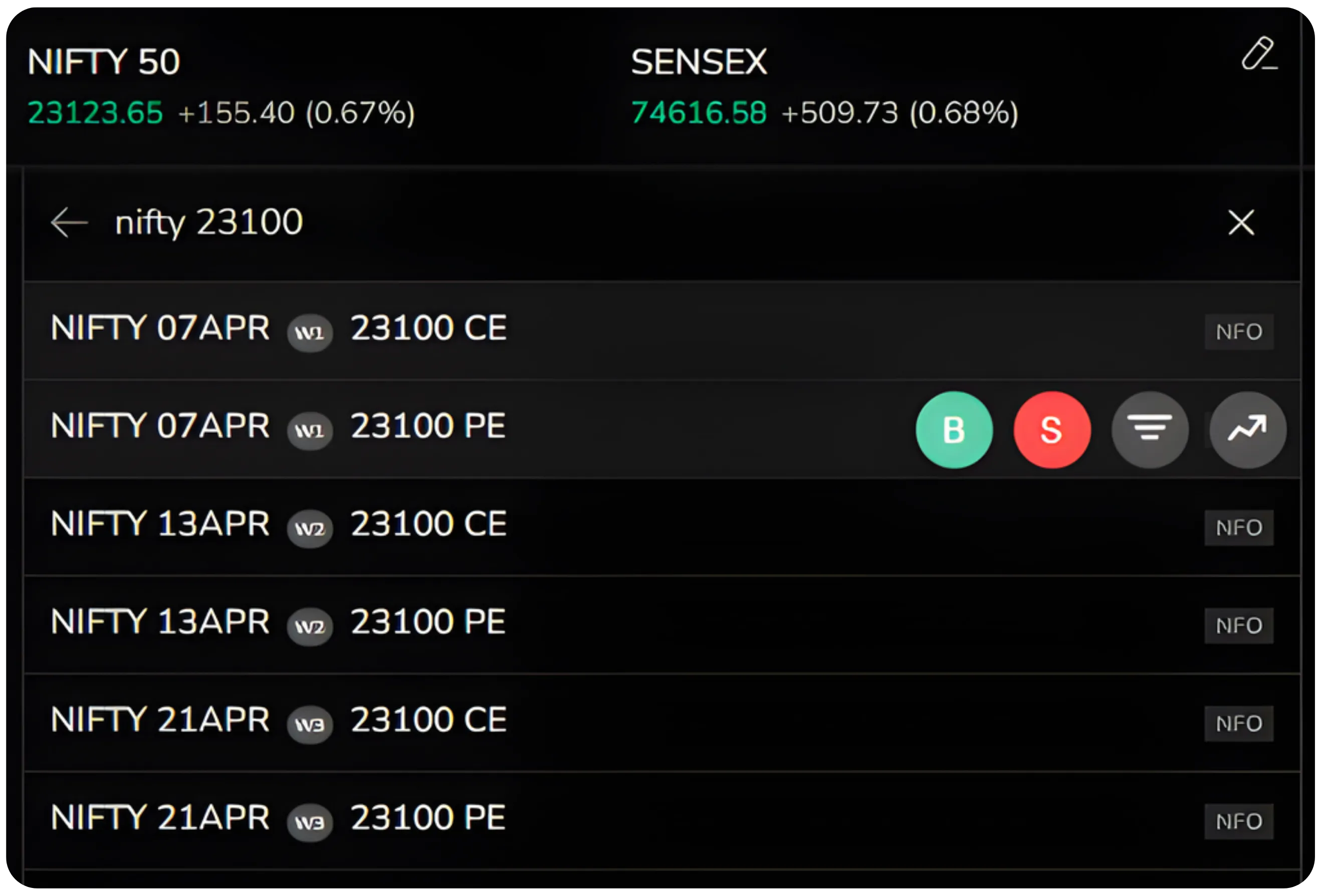
- Open the order window: Click Buy or Sell. Select Delivery for equity holdings you intend to hold overnight or longer, or Intraday (MIS) for positions you plan to square off the same day. Intraday versus delivery AMO selection affects your margin requirement and product type.
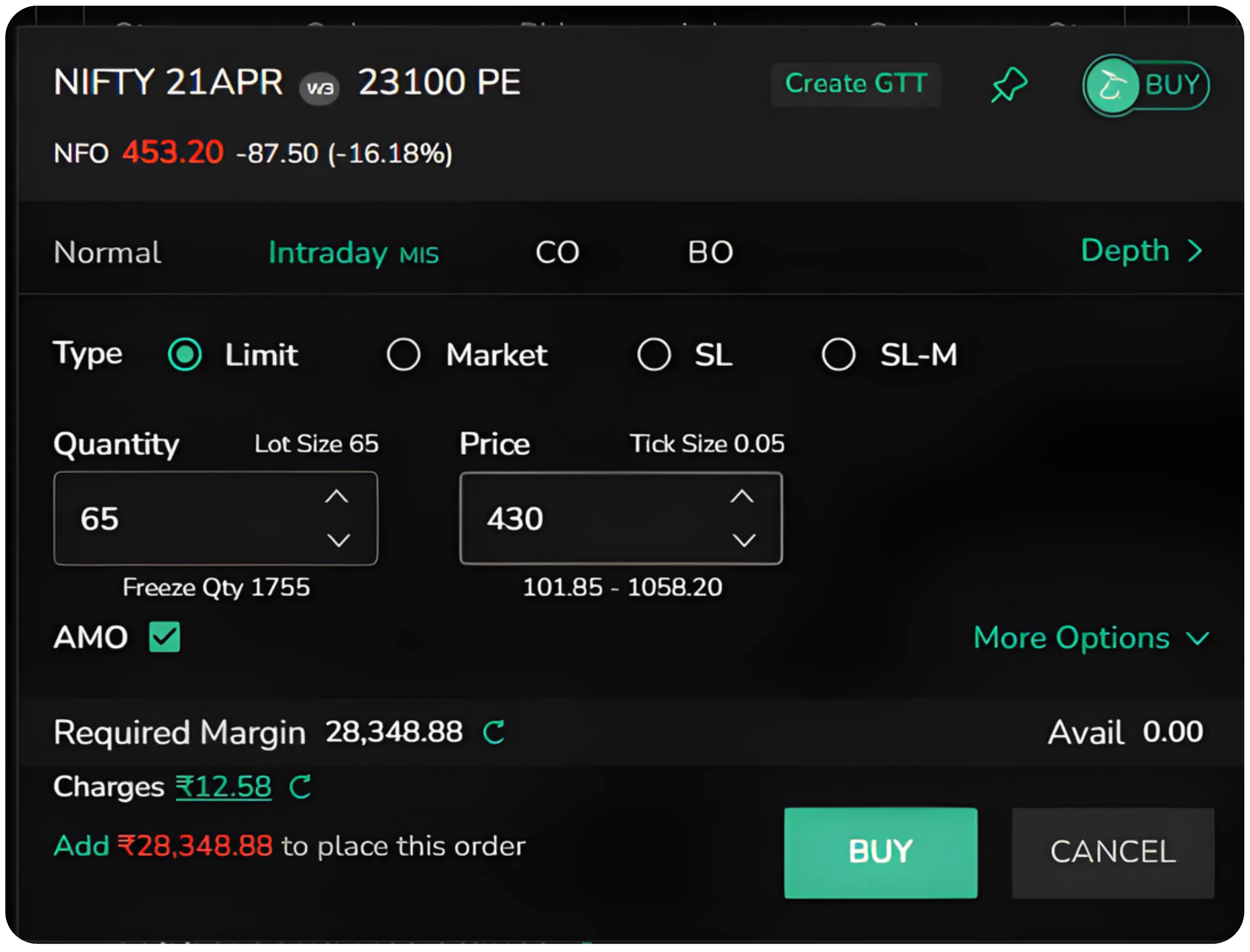
- Choose Limit order type: Limit is most common for AMO since you want a specific price. Enter your quantity and entry price.
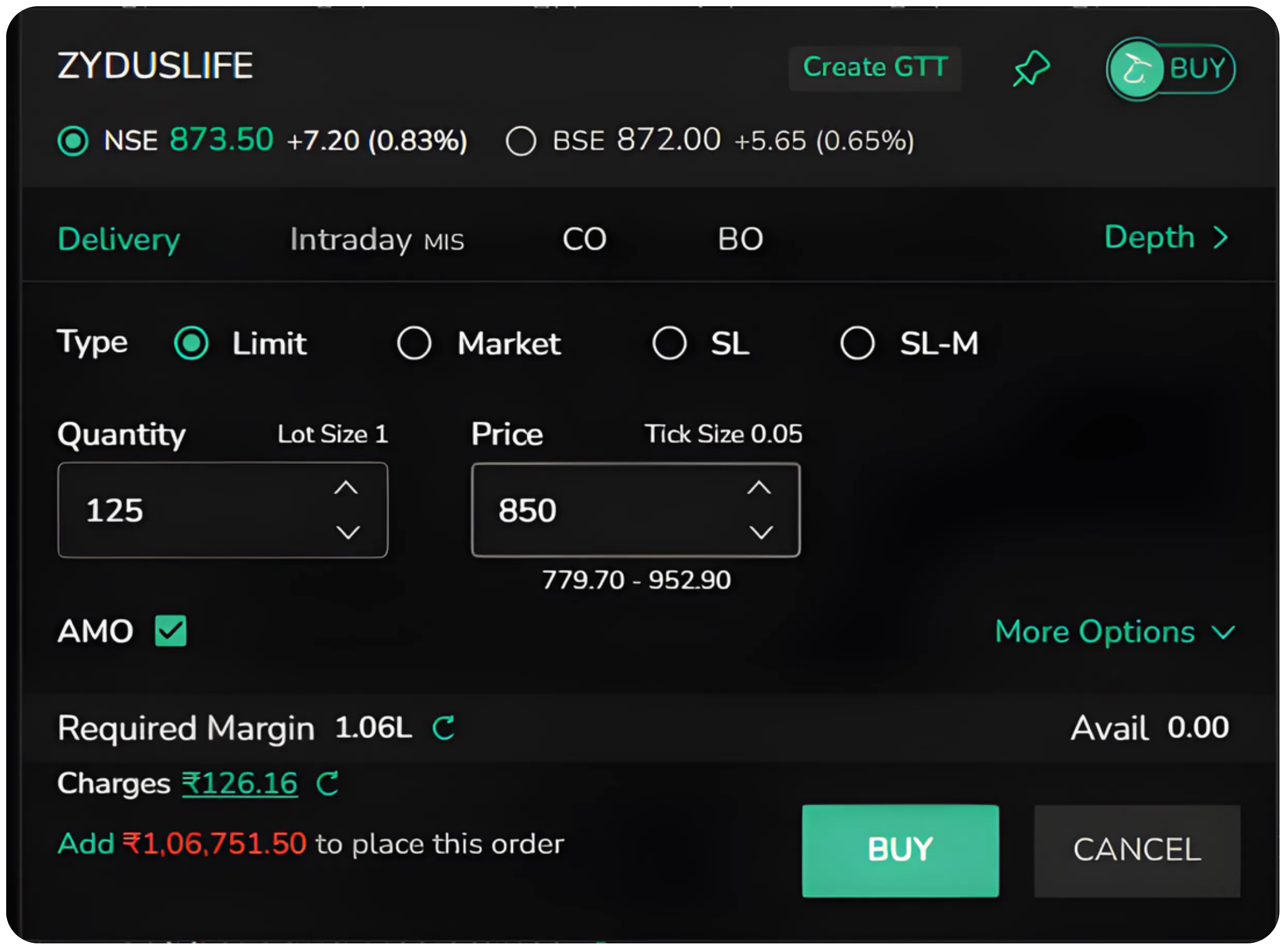
Check the AMO box: Tick the AMO checkbox at the bottom of the order form. The required margin will be displayed. Ensure you have sufficient balance.
Review and confirm: Your order will appear in the Orders tab with status “open” until markets begin. You can modify or cancel it anytime before 9:00 AM. Your order will appear in the Orders tab with status 'open.' You can carry out AMO order modification or AMO order cancellation anytime before 9:00 AM by navigating to the Orders section on CubePlus.

AMO order types
| Order type | When to use | Execution risk |
|---|---|---|
| Limit | Buy/sell only at a specific price or better. Most suitable for AMO. | Low — no adverse execution |
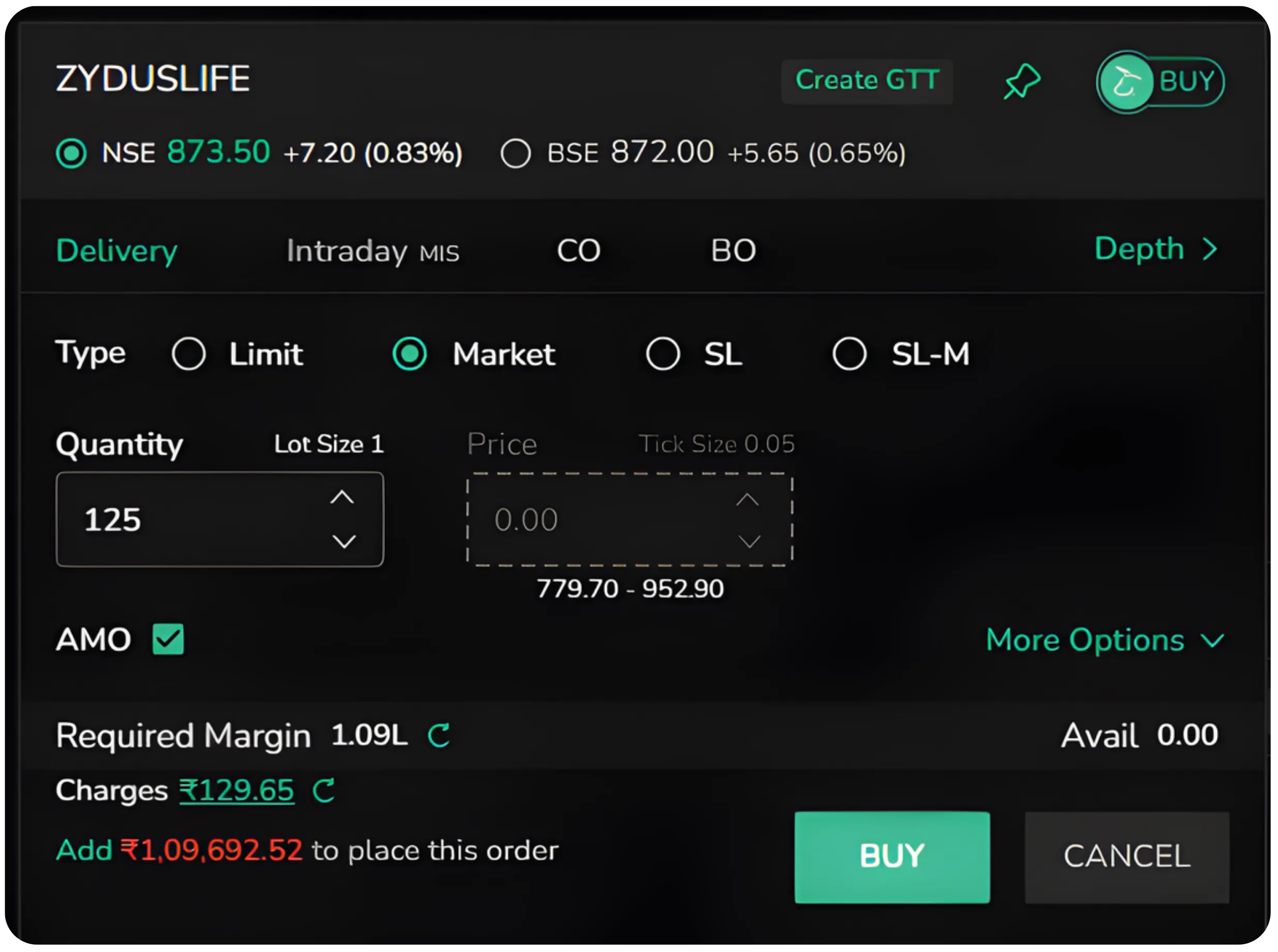
| Market | Execute at any available price at open. Risky if the stock gaps sharply. | High — price uncertainty at open |
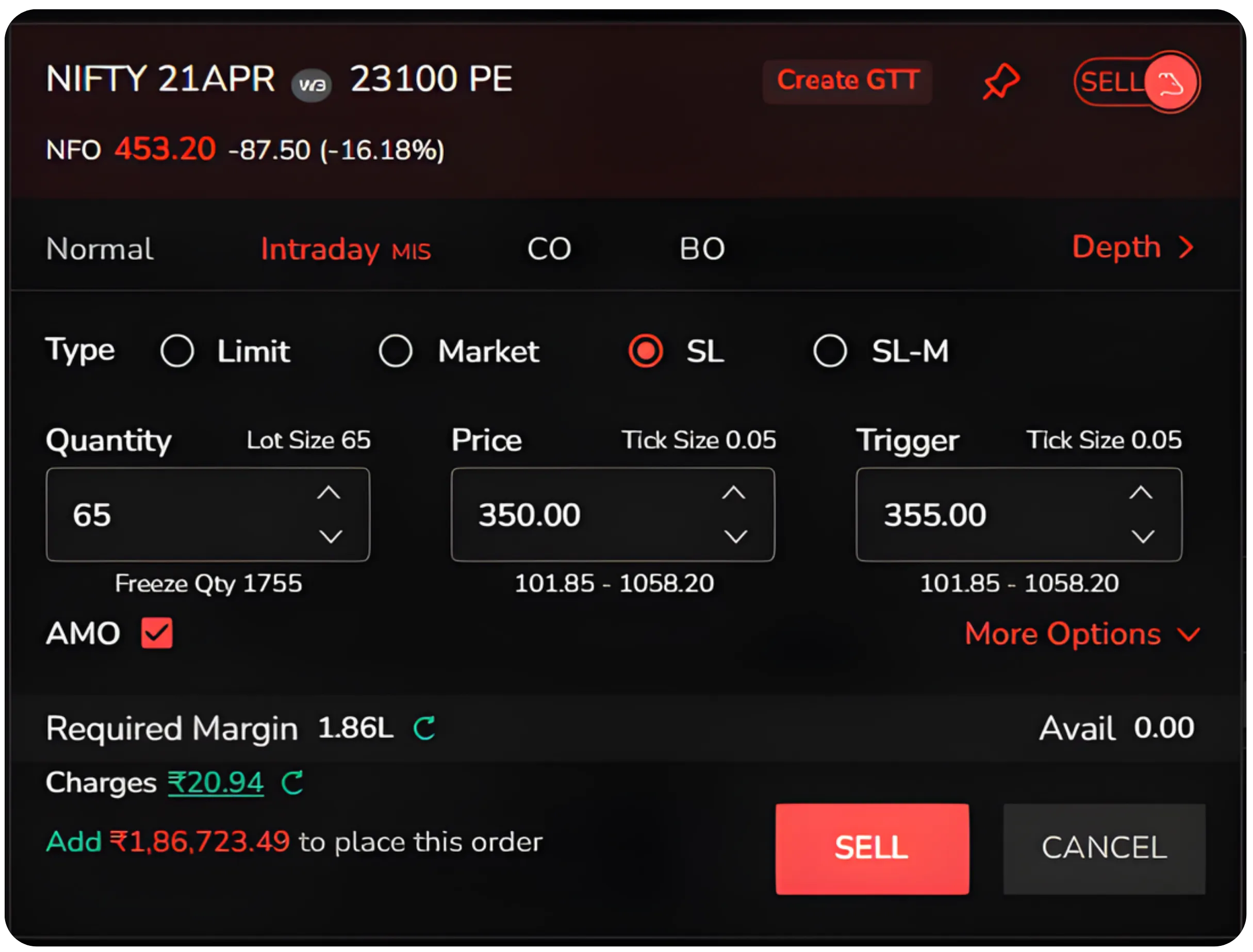
| SL | Exit a position if the price falls to a trigger level. Good for overnight protection. | Medium — triggers at your level |
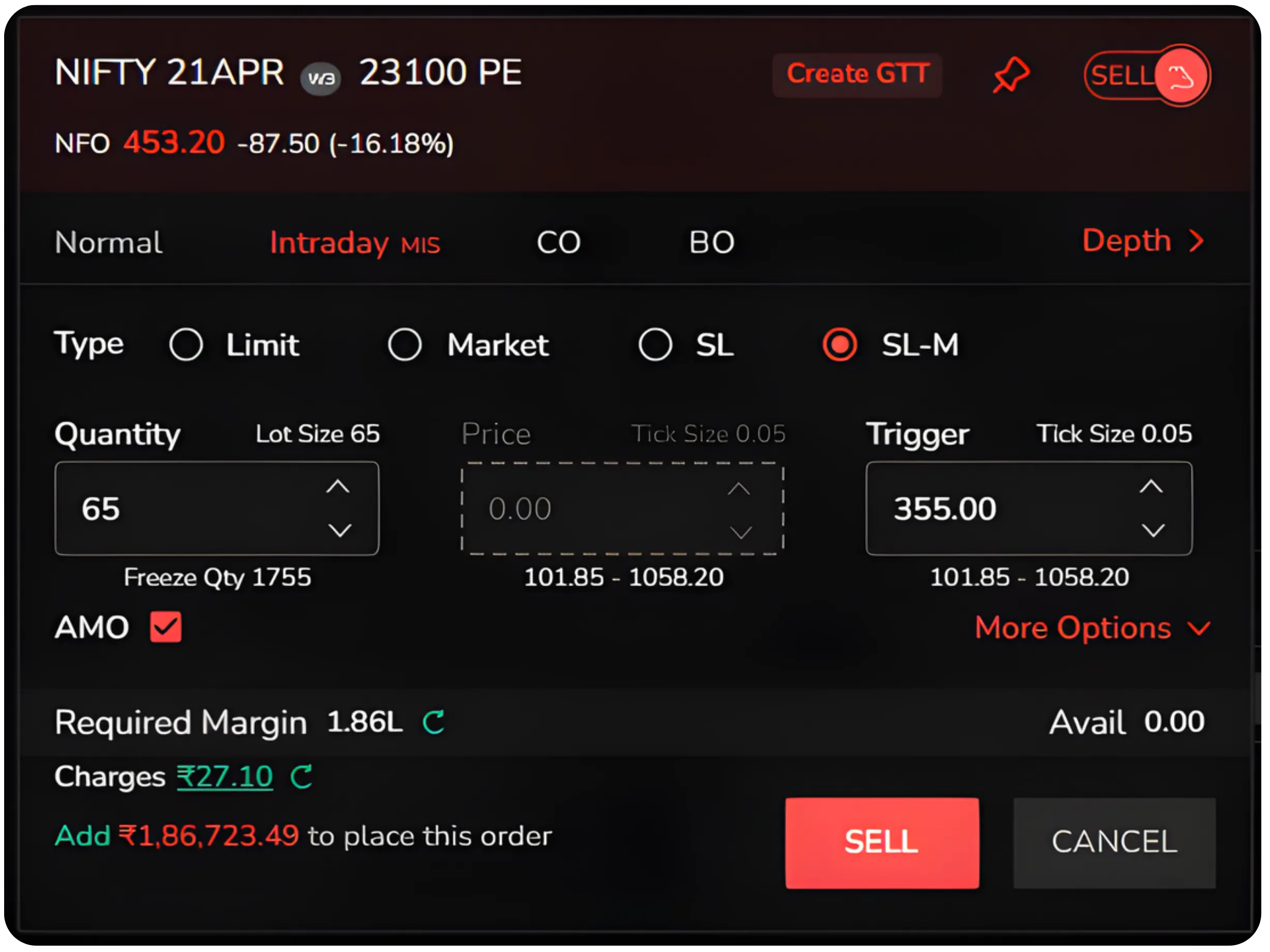
| SL-M | Stop-loss with market execution once triggered. Fast exit, but no price guarantee. | High — [slippage](https://www.tradejini.com/finance-kickstarter/slippage) possible |
An AMO limit order is the most commonly used type because it protects you from unexpected price gaps at open. An AMO market order, by contrast, executes at whatever price is available; useful only when speed matters more than price. An AMO stop-loss order is ideal for investors who hold overnight positions and want downside protection before the opening bell.
Limit Order
Market Order
Stop Loss Sell Order
Stop Loss Market
A word of caution on Market AMOs:
If there is significant overnight news (a corporate event, a global shock, or a large gap opening) a market order AMO can execute at a price far from what you expected. Always prefer a Limit AMO unless you are indifferent to the exact price.
Common misconceptions about AMO
Many investors assume AMO orders guarantee execution at their stated price. They do not. A limit AMO at ₹860 for a stock that opens at ₹875 may remain unexecuted or get cancelled at end-of-day, depending on order validity. This is actually a feature, not a bug: you are protected from buying higher than you intended.
Another common confusion is around F&O AMO timing. For futures and options, the relevant window and margin requirements may differ. Always check the specific timing and margin rules applicable to the segment you are trading. If your limit price is never reached during the session, the AMO order is cancelled at end of day automatically; no action is needed from your side
Finally, remember that the margin is blocked the moment you place the AMO. If your available balance is insufficient at the time of placement, the order will be rejected — not at open. Plan accordingly.
AMO discipline investing
Beyond convenience, AMO encourages a healthier relationship with the markets. When you are forced to decide your price the evening before (rather than in the heat of a volatile opening session) you tend to make better decisions. There is no ticker anxiety, no FOMO from watching green candles shoot up, no panic from opening red.
Many seasoned investors use AMO not as a workaround for being busy, but as a deliberate discipline tool; a way to pre-commit to a plan before the noise begins. From a behavioural investing standpoint, AMO removes the two most common decision-making errors: FOMO-driven buying at open and panic selling during intraday noise.
Disclaimer: The information provided in our blogs is for informational purposes only and should not be construed as financial, investment, or trading advice. Trading and investing in the securities market carries risk. Always conduct your own research and consult with a qualified financial advisor before making any investment decisions. Past performance is not indicative of future results. Copyrighted and original content for your trading and investing needs.
© 2026 — Tradejini. All Rights Reserved.


