From Crisis to Churning: Samudra Manthan — India’s ₹84,000 Crore Bet on Energy Security
Imagine waking up one morning to news that oil prices have suddenly jumped.
Within days, petrol and diesel become more expensive. Transportation costs rise. Airlines face higher fuel bills. Businesses pay more to move goods. And eventually, the impact reaches the common man's pocket.
But here is the uncomfortable part:
India doesn't completely control the oil that powers its economy.
India imports nearly 80% of the crude oil it consumes. That means a war thousands of kilometres away, a disruption in a major shipping route, or a sudden jump in global oil prices can quickly become India's problem.
And this is where the story of Samudra Manthan begins.
The Problem: India Needs More Energy Than It Produces
Think of India as a family that needs 10 buckets of water every day but can produce only 2 of them.
The remaining 8 buckets have to come from somewhere else.
Now imagine that the price of those 8 buckets keeps changing depending on what is happening in another country.
That is, in a simplified way, India's energy challenge.
India is one of the world's largest consumers of crude oil, but a large portion of its requirement is met through imports. The country spends enormous amounts of money every year importing crude.
As India's economy grows, its energy requirement is also expected to rise.
More cars.
More factories.
More flights.
More roads.
More electricity.
More businesses.
All of them need energy.
So the question becomes:
Can India find more energy within its own borders or more precisely, beneath its own waters?
Enter Samudra Manthan
In Indian mythology, the gods and demons churned the ocean in search of something valuable.
India's modern-day Samudra Manthan has a somewhat similar idea.
But instead of gods and demons, there are geologists, engineers, drilling companies, technology providers and energy companies.
And instead of searching for amrit, India is searching for something equally important to a modern economy:
Oil and natural gas.
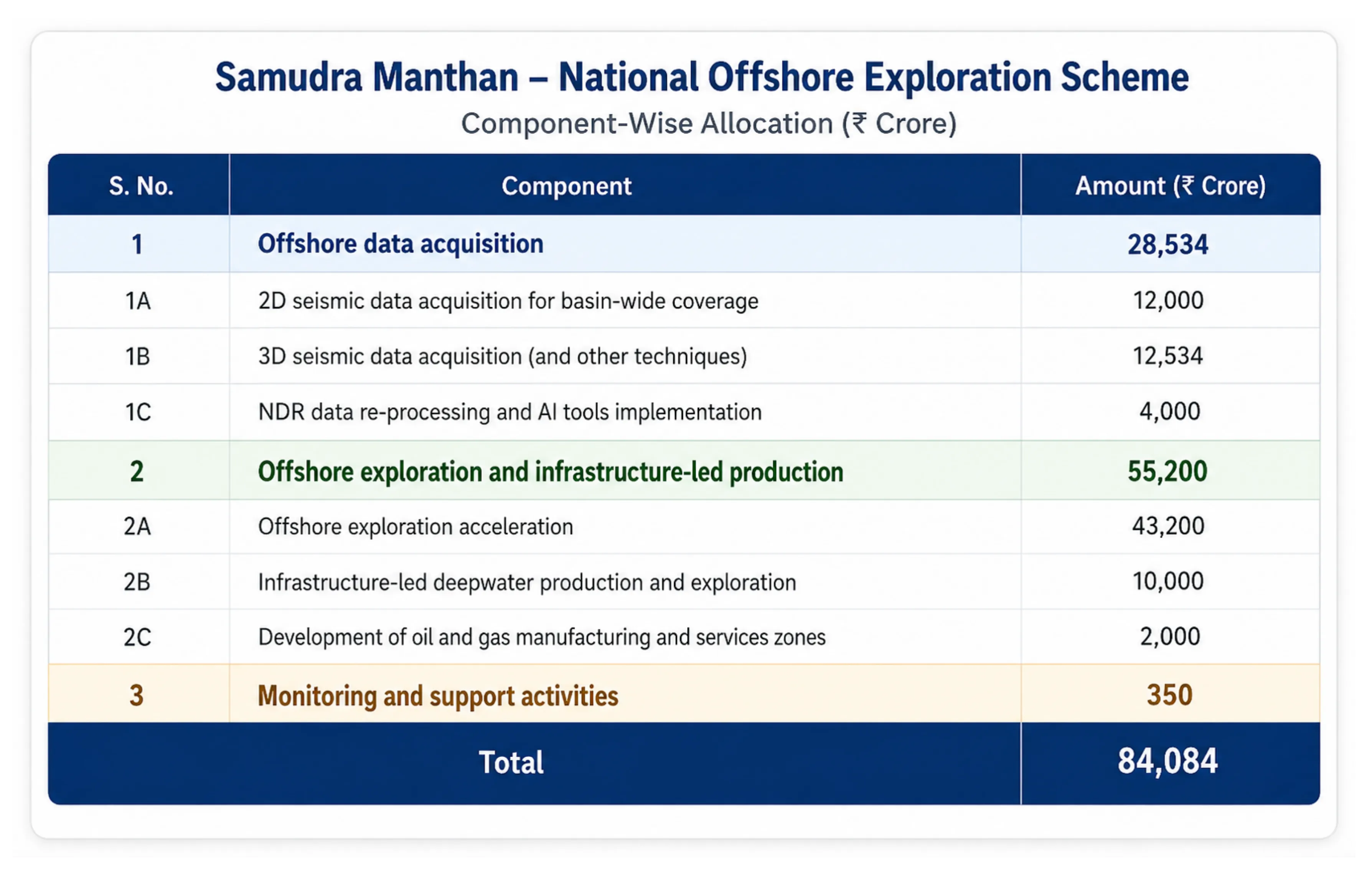
The government has announced a massive ₹84,084 crore Phase-I programme up to FY 2030–31 to accelerate offshore exploration.
The objective is simple:
Explore more. Discover more. Produce more. Import less.
Why Search Under the Ocean?
For years, India has already been exploring for oil and gas on land and in relatively accessible offshore areas.
But some of the country's potentially valuable resources lie much deeper beneath the sea.
The problem?
Deepwater exploration isn't cheap.
A company may spend hundreds of crores drilling a well and still discover nothing commercially useful.
That's a huge risk for private companies.
So the government is effectively saying:
“If exploration is too risky for companies to do alone, let's share some of that risk.”
That is the thinking behind Samudra Manthan.
Where Will the ₹84,000 Crore Go?
The money isn't simply being handed over to oil companies.
It is being spread across different parts of the exploration ecosystem.
1. First, Find Out What Lies Beneath
Before drilling begins, scientists need to understand what is beneath the ocean floor.
This is where seismic surveys come in.
Think of it as taking an X-ray of the Earth's underground layers.
Large-scale 2D and 3D seismic surveys will receive around ₹28,534 crore.
Modern technology and AI are also expected to help process and interpret this enormous amount of geological data faster.
In simple terms:
Before drilling, India wants to improve its chances of knowing where to drill.
2. Then Comes the Big Gamble - Deepwater Drilling
Finding a promising location on a seismic map is only the beginning.
The real test is drilling.
The scheme has allocated around ₹43,200 crore for drilling 60 deepwater and ultra-deepwater wells.
The government will provide financial support covering up to 50% of eligible drilling costs, subject to a ceiling of ₹675 crore per well.
Why?
Because drilling a deepwater well is like making a very expensive bet.
You can spend hundreds of crores and discover a commercially viable reserve or you can come up empty-handed.
By sharing some of that risk, the government hopes to encourage more exploration.
3. Finding Oil Is Not Enough
Now imagine that a company discovers oil under the sea.
Great news.
But there is another problem.
How do you bring it to shore?
Offshore production requires pipelines, processing facilities, storage systems and other infrastructure.
Building all of this individually can be extremely expensive.
That's why the government has allocated around ₹10,000 crore for common offshore infrastructure in selected basins.
The idea is simple:
If companies can share infrastructure, the cost of developing discoveries can come down.
And that could make some previously uneconomical discoveries worth developing.
4. Build the Equipment in India
There is another important part of the story that is easy to miss.
Exploration doesn't happen with just an oil rig.
It requires engineering companies, equipment manufacturers, repair facilities, warehouses, technology providers and specialised services.
The scheme therefore includes around ₹2,000 crore for an Oil and Gas Manufacturing and Services Zone.
The broader goal is to develop more of this capability within India.So instead of simply importing expensive offshore equipment and technology, India wants to build a stronger domestic ecosystem.
That means:
Explore in India → Build in India → Produce in India.
What Does India Hope to Get From All This?
The government has set an ambitious target.
Samudra Manthan aims to help increase India's hydrocarbon reserves by more than 600 MMTOE, taking the resource base from around 1.6 billion to 2.2 billion tonnes of oil equivalent.
Domestic production is also targeted to rise from roughly 62 MMTOE to 80 MMTOE annually.
If these targets are achieved, the benefits could go beyond the oil industry.
Higher domestic production could potentially reduce India's dependence on imports and save foreign exchange.
It could also create jobs and generate business opportunities for companies involved in:
- Drilling
- Engineering
- Offshore construction
- Seismic surveys
- Equipment manufacturing
- Oilfield services
- Pipelines and infrastructure
In other words, the money could move through an entire ecosystem.
And Then Come the Companies
Whenever the government announces a large programme, investors naturally ask:
“Which companies could benefit?”
There are several names worth watching.
Jindal Drilling & Industries
Offshore exploration requires specialised drilling rigs and services.
If drilling activity increases significantly, companies operating in this space could see higher utilisation and potentially stronger demand.
But investors need to remember that higher government spending doesn't automatically mean higher profits. Orders, utilisation, pricing and margins still matter.
Engineers India
Engineers India operates across engineering and consultancy services for the energy sector.
A bigger exploration and infrastructure pipeline could create opportunities for companies providing engineering and project-management expertise.
Again, the benefit is more indirect than for a drilling company.
ONGC
As India's largest upstream oil and gas producer, ONGC already has extensive experience in offshore exploration.
If India's offshore exploration programme succeeds, ONGC could potentially play a major role in converting those discoveries into actual production.
The Modern-Day Samudra Manthan
Perhaps that's why the name Samudra Manthan is so appropriate.
The original story was about churning the ocean to bring something valuable to the surface.
India is now attempting its own version.
There may be no mythical Mount Mandara or serpent Vasuki this time.
Instead, there are seismic ships, drilling rigs, engineers, artificial intelligence, offshore platforms and billions of rupees of investment.
And the treasure India is searching for is not mythology.
It is energy security.
The journey will not be easy, and there is no guarantee that every exploration well will produce a success.
But if the churning works, India could gain much more than oil and gas.
It could gain lower import dependence, stronger domestic manufacturing, new jobs, a deeper energy ecosystem and greater control over its own energy future.
And perhaps that is the real amrit India is looking for.
Not just more oil beneath the ocean—but more control over its own destiny.
Disclaimer: The information provided in our blogs is for informational purposes only and should not be construed as financial, investment, or trading advice. Trading and investing in the securities market carries risk. Always conduct your own research and consult with a qualified financial advisor before making any investment decisions. Past performance is not indicative of future results. Copyrighted and original content for your trading and investing needs.
© 2026 — Tradejini. All Rights Reserved.