Mutual funds have a long history of mutual funds starting in the 18th century. In India, they began in 1963 with the Unit Trust of India (UTI). This article covers the origins, key milestones, and growth of mutual funds globally and in India.
Key Takeaways
- The establishment of UTI Mutual Fund in 1963 marked the beginning of the mutual fund industry in India, focusing on fostering a culture of savings and investments.
- The introduction of public and private sector mutual funds in the late 1980s and 1990s diversifying investment options and increasing competition within the market.
- Since 2014, the mutual fund industry has experienced significant growth driven by digital platforms and investor awareness, leading to enhanced participation and innovation.
Establishment of UTI Mutual Fund in India

The genesis of the mutual fund industry in India can be traced back to 1963, with the establishment of the Unit Trust of India (UTI). UTI was set up with the vision to inculcate a habit of savings and investments among the Indian populace, especially the burgeoning middle class. The history of mutual fund industry is marked by the Reserve Bank of India initially regulating UTI, ensuring that it adhered to the highest standards of financial prudence.
The launch of UTI’s first investment scheme, the Unit Scheme 1964 (US-64), marked a significant milestone. This scheme was not just the first mutual fund scheme in India but also a pioneering step in the creation of a structured investment avenue for small investors. US-64 provided an opportunity for individuals to pool their resources and invest in a diversified portfolio, thereby mitigating risks and enhancing returns.
UTI’s efforts bore fruit as mutual fund investments gained popularity among middle-class Indians. By 1988, UTI’s total assets under management (AUM) had grown to Rs. 6,700 crores. This growth demonstrated the trust and confidence investors had in UTI, paving the way for the mutual fund industry’s expansion in India.
Also Read: What Is a Mutual Fund?
Entry of Public Sector Mutual Funds
The Indian mutual fund industry began to diversify significantly with the entry of public sector mutual funds. Until 1987, UTI enjoyed a monopoly in the mutual funds space, but this changed with the establishment of the SBI Mutual Fund in June 1987, the first mutual fund created by a public sector bank in India. This move signaled the opening up of the market, encouraging other public sector banks to follow suit.
Canara Bank launched its mutual fund in December 1987, and soon, Punjab National Bank and Bank of Baroda entered the fray. These public sector mutual funds significantly broadened investment options for Indian investors, encouraging wider participation in capital markets. Their establishment also underscored the role of mutual funds in promoting a culture of savings and investments across society.
Introducing public sector mutual funds brought significant changes to the financial markets. It not only diversified the mutual fund products available but also enhanced investor confidence by offering more choices. This era laid the groundwork for the robust growth and development of the mutual funds industry in India.
Private Sector Mutual Funds Take Off

The year 1993 was a watershed moment for the Indian mutual fund industry, as it marked the entry of private sector mutual funds. This development was made possible by SEBI’s regulations permitting private companies to enter the mutual fund sector. The entry of private sector mutual funds catalyzed rapid growth and innovation within the industry.
Private sector mutual funds brought with them a wave of new investment strategies and products, tailored to meet the diverse needs of investors. A major innovation during this period was the introduction of Systematic Investment Plans (SIPs). SIPs transformed the investment landscape by making it easier for retail investors to participate in the capital markets regularly and systematically, thereby democratizing investment opportunities through mfs investment management and investment advisory services.
The rapid growth of private sector mutual funds boosted the industry’s AUM and intensified competition, resulting in improved services and products for investors. This period saw a proliferation of new mutual fund schemes, each vying to attract investors with innovative solutions and promising returns.
Consolidation and Market Maturity
The period from 2003 to 2014 was marked by significant consolidation within the mutual fund industry. During this era, there were many acquisitions in the mutual fund sector. Notable instances include Principal Mutual Funds acquiring PNB Mutual Funds and Birla Sun Life taking over Alliance Mutual Funds. The need to achieve economies of scale and enhance market presence drove these mergers and acquisitions.
The government also played a crucial role during this period, especially in 2002, when it intervened to address the financial crises affecting UTI. This intervention led to significant restructuring within the industry, further promoting professional management, consolidation, and market maturity.
The 2009 global financial crisis significantly affected investor sentiment, altering stock market dynamics and highlighting the need for robust market risks management practices in securities markets to safeguard investors and protect investors.
The bifurcation of UTI and subsequent mergers among private sector funds underscored the industry’s maturation. These consolidations helped stabilize the market, enhance investor confidence, and pave the way for more structured and efficient mutual fund operations.
Modern Era: Growth and Innovation
Since 2014, the mutual fund industry has experienced a resurgence in growth, driven by increased inflows and a rise in investor accounts. Key highlights as of August 2024 include:
- The industry boasted 20.45 crore folios.
- A significant portion of investments are in equity, hybrid, and solution-oriented schemes.
- The industry’s Assets Under Management (AUM) has grown sixfold from ₹10.13 trillion in August 2014, making it one of the largest mutual fund sectors in the country.
This growth reflects robust investor confidence in the industry.
The rise of Systematic Investment Plans (SIPs) has been a game-changer, with assets under management reaching an all-time high of Rs 13.54 lakh crore in 2024. Greater investor awareness and the advent of digital investment platforms have greatly contributed to this growth. These platforms have made investing in mutual funds more accessible and convenient for retail investors, helping them achieve their financial goals.
Sectoral and thematic mutual funds have also drawn substantial investor interest, with a remarkable 79% increase in their assets in 2024. Additionally, passive investment options like index funds and ETFs have seen a 23% growth in assets, indicating a growing preference for diversified and low-cost investment avenues.
Key Milestones in the Mutual Fund Industry
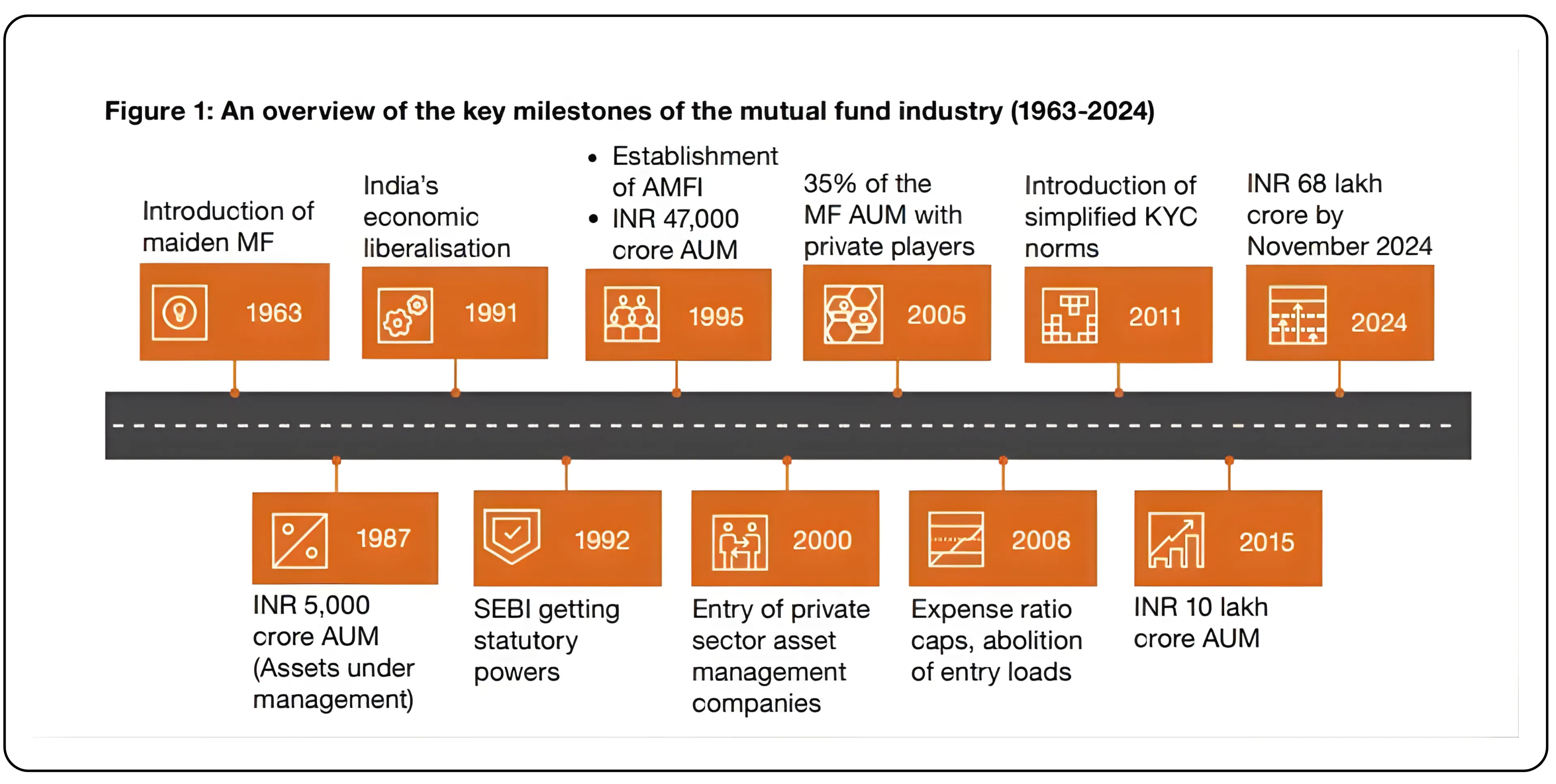
The Indian mutual funds industry has witnessed several key milestones that have shaped its evolution. One significant milestone was the crossing of 10 crore folios in May 2021, reflecting the growing investor base and confidence in mutual fund schemes. This landmark achievement highlighted the increasing acceptance of mutual funds as a preferred investment avenue among Indians.
Following the financial crisis in 2009, the financial institution industry faced challenges, including a loss of investor confidence and slow growth in assets. Despite these hurdles, the mutual fund industry has played a crucial role in promoting financial literacy. Organizations such as the Association of Mutual Funds in India (AMFI) have spearheaded numerous educational initiatives to boost investor awareness and understanding of mutual fund investments, with the guidance of a fund manager.
Impact of Mutual Funds on the Indian Economy

Mutual funds have had a profound impact on the Indian economy by mobilizing household savings and channeling them into productive investments. By providing accessible investment options, mutual funds have enabled individuals, especially the middle class, to participate in the financial markets. UTI’s efforts to foster savings and investments among various investor classes laid the foundation for this widespread participation.
The pooling of investments by mutual funds facilitates capital formation, which is essential for economic growth. This capital is crucial for businesses seeking pooled money for expansion, thereby driving industrial growth and development. Mutual funds also enhance the efficiency of capital markets through their active trading, which aids in liquidity and price discovery.
Debt mutual funds play a significant role in government borrowing programs by investing in government bonds. This investment finances fiscal deficits and supports the government’s developmental and welfare initiatives. Overall, mutual funds have contributed to the stability and growth of the Indian economy, including the impact of debt funds.
Future Trends in Mutual Funds

The future outlook for mutual funds in India is promising, with more people learning about and investing in them. Despite potential market volatility, the mutual fund industry is projected to continue its growth trajectory, driven by strong economic fundamentals. The focus in the coming years is expected to be on innovation and education to enhance retail participation.
Digital platforms are playing a crucial role in making mutual fund investments easier and more accessible. These platforms provide tools for improved access and transaction efficiency, thereby encouraging more people to invest in mutual funds. The Securities and Exchange Board of India (SEBI) continues to promote measures to enhance mutual fund participation among retail investors and mutual fund distributors.
As mutual funds become a common choice for many Indians looking to grow their money, the modern mutual fund industry is likely to see further innovations and improvements. This evolution will not only benefit investors but also contribute to the broader economic development of the country.
Summary
The journey of mutual funds in India has been one of growth, innovation, and resilience. From the establishment of UTI in 1963 to the dynamic growth and digital transformation in recent years, mutual funds have played a pivotal role in democratizing investments and fostering economic growth. Key milestones and the entry of public and private sector mutual funds have significantly shaped the industry.
Looking ahead, the future of mutual funds in India appears bright, with continued growth and innovation on the horizon. As more people embrace mutual funds as a viable investment option, the industry is set to contribute even more to the financial well-being of individuals and the broader economy. The mutual fund industry stands as a testament to the power of collective investments and the potential for financial inclusion.
Start your smart investing on CubePlus and take control of your financial goals.
Disclaimer: The information provided in our blogs is for informational purposes only and should not be construed as financial, investment, or trading advice. Trading and investing in the securities market carries risk. Always conduct your own research and consult with a qualified financial advisor before making any investment decisions. Past performance is not indicative of future results. Copyrighted and original content for your trading and investing needs.
© 2025 — Tradejini. All Rights Reserved.