

The IPO listing price is the final price of the IPO shares, decided after the bidding period ends, at which it is traded on a stock exchange. It is determined in association with the stock exchange, the issuing company, and the underwriter, through a pre-opening session, from 9:00 am to 9:45 am, which matches buy and sell orders to find an equilibrium price. It may differ from the initial ‘issue price’ decided before the listing, depending on the market demand and sentiment.
It helps in ascertaining the public valuation of the shares and sets the starting price for further trading. The variance between the listing price and the issue price indicates whether the IPO was well-received by the market, which is used to calculate IPO listing gains.
What Determines the Price for an IPO?
The IPO price is not a random number, it is the result of careful financial analysis, market research, and investor feedback. Here is what goes into it
1. The Company's Financial Health
Merchant bankers analyse at least three years of audited financials revenue growth, profitability, debt levels, and cash flow. Strong and consistent financials command a higher price. Erratic earnings or high debt pulls it down.
2. Valuation Methods
A combination of methods is used to arrive at a fair value:
Comparable Company Analysis - Compares the company to listed peers using P/E and EV/EBITDA multiples. Most widely used method
Discounted Cash Flow (DCF) - Estimates present value of future cash flows. Forward-looking but assumption-heavy
Net Asset Value (NAV) - Assets minus liabilities. Useful for asset-heavy businesses as a floor value
Price to Sales (P/S) - Used when the company isn't yet profitable, common in tech and startup IPOs Precedent Transaction Analysis - Based on past acquisition prices of similar companies, typically yielding higher valuations
3. Growth Potential
Markets pay for the future. A company with a large addressable market, scalable model, and strong order book can justify a higher price than one with no clear growth story.
4. Fresh Issue vs Offer for Sale
Fresh Issue - Proceeds go to the company for growth. Viewed positively
Offer for Sale (OFS) - Existing shareholders cash out. The company receives nothing and investors often question why insiders are exiting now
5. Investor Demand Through Book Building
The final price is determined by actual demand. QIB participation is the strongest signal of valuation confidence. Anchor investor subscriptions a day before the IPO opens set the tone for retail demand that follows.
6. SEBI Disclosure Requirements
SEBI requires every IPO to include a "Basis for Issue Price" section in the offer document- covering peer comparisons, KPIs, and full valuation rationale. It is one of the most useful tools for investors and one of the most overlooked.
Factors Influencing Listing Price
The listing price is influenced by factors that reflect market sentiment and the perceived value of the company:
Investor Demand and Sentiment: If the demand for the shares is high, it reflects strong investor confidence, and the listing price is likely to be higher than the issue price.
Company-driven Factors: When a private company goes public, investors thoroughly review a company’s financial reports. Therefore, the financial performance, growth potential, and competitive advantage drive investors’ interest and, thus, the listing price.
Market and Economic Conditions: The performance of the stock market and the economic conditions may significantly impact an IPO’s success and its listing price.
Grey Market Premium (GMP): It is an unofficial indicator of the expected listing price before the shares are officially traded.
Also Read: How to Increase IPO Allotment Chances
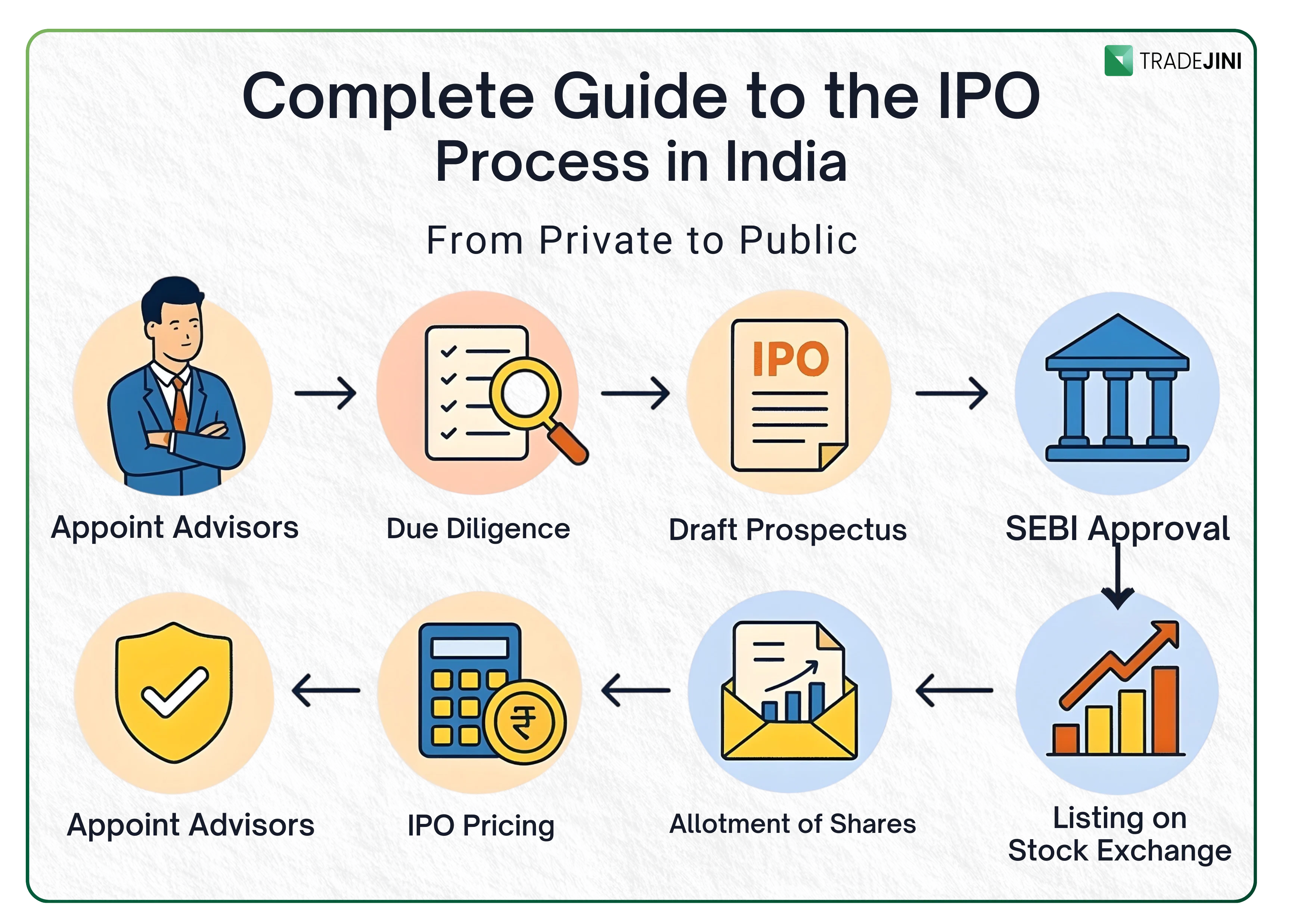
Price Discovery Mechanisms
- Bookbuilding Method: In the case of a bookbuilding IPO, the company and its underwriters set a price band, such as ₹147 to ₹152 per share, within which investors place their bids for shares. The final issue price is determined after the bidding period ends, based on the demand at various price levels.
If the demand for the shares is high, then the final issue price is likely to be higher than the initial price.
For example, Shreeji Global FMCG IPO price band is ₹120 to ₹125 per share. The final price to be determined on 12 November 2025, when it is scheduled to list on NSE SME.
- Fixed Price Method: In the case of the fixed price method, the company and underwriters pre-determine a fixed price for the shares before the IPO opens for subscription.
For example, Greenleaf Envirotech IPO was a fixed price issue at ₹136 per share.
Role of Underwriters in Pricing
The underwriters’ role in the IPO includes advising on the issue price, financial and market analysis, and measuring investors’ demand based on the roadshow.
Financial and market analysis: The underwriters or lead managers assess the company’s financials, its competitive position, and future growth opportunities to determine a fair valuation of the IPO shares, while also considering industry trends and macroeconomic factors.
Demand assessment: They are responsible for conducting roadshows and marketing campaigns to ascertain investors’ interest. The feedback from these activities helps in refining the price range and ensuring the IPO is well perceived by the market.
Pricing strategy: Based on the analysis and investor feedback, the underwriters help to set the final offer price in association with the stock exchange. This stage can be sensitive, as the underwriters may slightly underprice the stock to ensure a successful sale and strong initial performance.
Book-building management: They manage the entire book-building process, where investors place bids for shares within the price band. The lead manager collects the bid applications to measure the demand and set the final price. Next, they allocate the shares based on demand and level of subscription.
Also Read: What is Securities Transaction Tax (STT), and how is it calculated?
Investor Strategies
Listing Gains Strategy: Some investors apply for IPO shares with a goal of selling them immediately on the listing day to book quick profits, that is, listing gains, if the stock lists at a premium.
Long-Term Investment Strategy: Other investors conduct thorough research of the company’s fundamentals and growth potential, while planning to hold the shares for a long term, regardless of initial listing performance.
Monitoring Demand: The astute investors monitor the IPO’s subscription status and Grey Market Premium (GMP) to measure probable listing performance and decide their course of action accordingly.
Bidding at the Cut-off Price: In book-built IPOs, retail investors can bid at the cut-off price, which is the upper band price, to maximise their chances of allotment, as shares are often allotted at this price when the demand is high.
Conclusion
The IPO listing price reflects how the market values a company when it offers its shares to the public. It is influenced by investors’ demand, company fundamentals, and market sentiment.
A balanced price ensures a fair value for both the issuers and the investors, as high prices may raise the risk of weak performance, while low prices leave capital on the table. An effective IPO pricing, supported by the underwriters’ insights and bidding data, plays a key role in shaping an IPO’s success and market reception.
Disclaimer: The information provided in our blogs is for informational purposes only and should not be construed as financial, investment, or trading advice. Trading and investing in the securities market carries risk. Always conduct your own research and consult with a qualified financial advisor before making any investment decisions. Past performance is not indicative of future results. Copyrighted and original content for your trading and investing needs.
© 2026 — Tradejini. All Rights Reserved.
.webp%3Falt%3Dmedia%26token%3D0ead9799-20bc-4d1e-ae8f-d75ab18921b5&w=3840&q=75)


