

Every month, Meera sets aside ₹5,000 from her salary and invests it in a mutual fund through an SIP. It’s a habit she started in 2020, nudged by a colleague who swore by the magic of compounding. Over the years, she’s been consistent, well, mostly. There were months she skipped due to unexpected expenses, and a couple of times she withdrew some funds for emergencies.
Now in August 2025, her investment has grown, and she’s curious, how well has it actually performed? But as she starts digging, the numbers don’t quite add up. The returns shown on her app seem too simplistic. The CAGR looks off, and the absolute return feels misleading.
What Meera doesn’t realize yet is that her investment journey, marked by staggered entries and occasional exits, needs a different way of measuring success. Something that looks at not just how much she invested, but when she did it.
This is where XIRR comes in.
XIRR (Extended Internal Rate of Return) is a method used to calculate the annualised return on investments that have multiple, irregular cash flows such as SIPs, lump sums, and redemptions by factoring in all the three amounts and timing of each transaction.
Why Traditional Metrics Fall Short
Most of us know about absolute return, the simple difference between what you put in and what it’s worth today. Useful, yes, but it ignores time. Then there’s CAGR, which calculates the average annual return assuming you invested everything at once and let it grow steadily. That’s great for lump-sum investments, but not practical when your investments are scattered over months or years.
Let’s say you started an SIP in early 2022, paused it for six months in 2023, added a lump sum in 2024, and redeemed part of it earlier this year. By August 2025, your portfolio has seen multiple cash flows in and out—making it nearly impossible for CAGR to tell the full story.
That’s exactly the kind of scenario XIRR is built for.
What Makes XIRR Useful in 2025
XIRR or Extended Internal Rate of Return gives you an annualised return that considers both how much and when money entered or exited your portfolio. It treats monthly SIPs, top-ups, redemptions, and even skipped investments as part of one continuous timeline.
And unlike IRR, which assumes regular cash flows, XIRR is designed for the irregular, real-world investing that most of us do.
At a time when investors are combining SIPs, SWPs, and lump sums across multiple mutual funds and strategies, XIRR gives a consistent way to measure performance, one that reflects the true growth rate of your money.
To learn more about investing in Tradejini Mutual Funds, click here.
How to Calculate It
If you invest through mutual fund SIPs, the SIP XIRR calculator is perfect for measuring your true growth rate. Let’s say you invested ₹10,000 every year, starting from January 2021. Using the XIRR formula, you can measure the real annual return considering timing and amount. After four years of consistent investing, by January 2025, your investment will have grown to ₹60,000.
At first glance, it looks like you turned ₹40,000 (₹10,000 x 4) into ₹60,000, a good gain. But, what was your actual annual return considering the exact timing of each investment?
That’s where XIRR comes in. It tells you the true annualized return by factoring in when and how much you invested, not just the start and end value. You can also use XIRR Excel to run quick calculations if you have a record of all cash flows.
Using Tradejini’s XIRR calculator, you will see that the effective annual return on this investment is 16.88%.
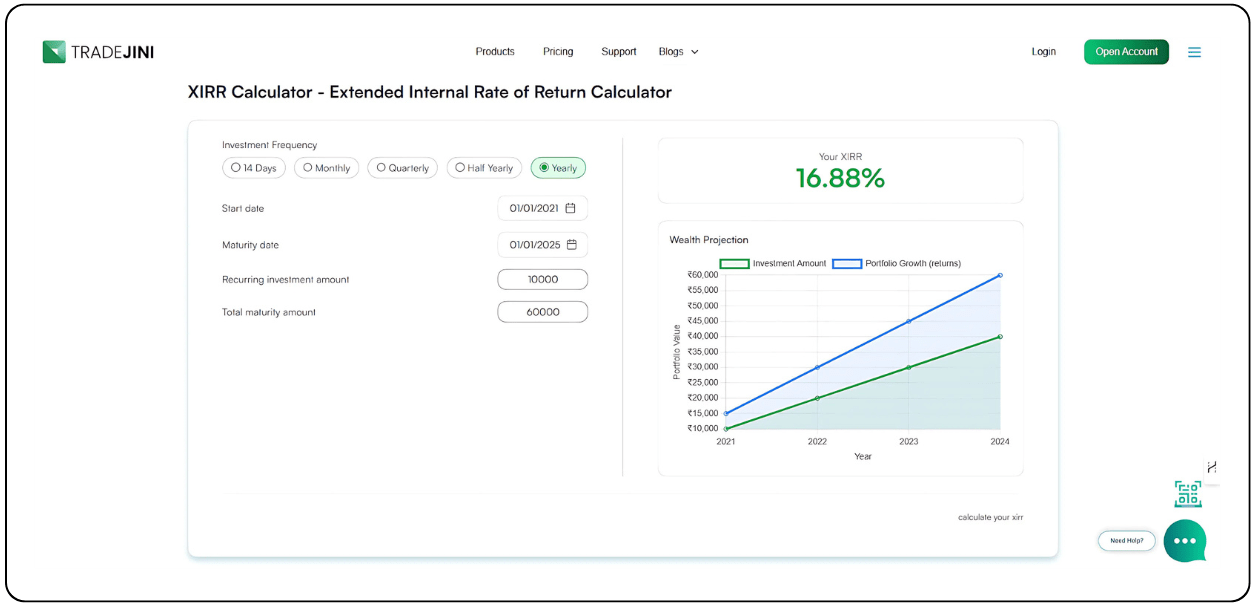
What does this mean?
So, while your total investment over four years was ₹40,000, XIRR shows your returns weren’t just about the final value—they were about consistency and time. It gives you a far clearer picture of performance than basic CAGR or total gain. The XIRR formula in Excel is widely used by investors to manually calculate performance before confirming with online tools.
To calculate XIRR for your own investments, check out the Tradejini XIRR Calculator. It's quick, simple, and does all the math for you.
Why Use XIRR?
- XIRR handles irregular investments and non-uniform dates
- It works well for SIPs, lump sums, redemptions, and even dividend reinvestments
- It’s the most accurate way to compare investment performance
What’s a Good XIRR in Today’s Market?
There’s no one-size-fits-all benchmark. For equity mutual funds, an XIRR of 12–15% over the long term is generally considered strong, especially in today’s market. For debt funds, a more modest 6–8% XIRR might be acceptable, given the lower risk profile.
Instead of chasing a number, it’s better to use XIRR to check if your investments are meeting your financial goals and how they compare to similar funds in their category. While XIRR is for measuring mutual fund and portfolio returns, income-focused investors may also track highest dividend yield stocks for passive income.
Why it matters more than ever
In 2025, personal finance is no longer linear. Investors are experimenting, reallocating, reacting to news, pausing SIPs, and topping up during dips. Amid this complexity, XIRR helps cut through the noise and tells you the one thing that matters:
‘How efficiently is your money growing over time?’
Whether you are investing ₹500 or ₹5 lakh, XIRR brings clarity to your returns and helps you invest with confidence.
Sign up for CubePlus and get access to the tools, insights, and calculators designed to help you trade better.
© 2025 — Tradejini. All Rights Reserved.


