In the ever-evolving landscape of options trading, the Jade Lizard options strategy and its counterpart, the Reverse Jade Lizard, stand out as strategic approaches. These complementary three-legged strategies offer traders unique advantages: the ability to collect premium while eliminating unlimited risk on one side of the trade, making them valuable options trading strategies for different market outlooks and conditions
Both strategies are essentially short strangle options with built-in protection on opposite sides. The traditional Jade Lizard provides upside protection, making it ideal for neutral-to-moderately bullish scenarios, while the Reverse Jade Lizard offers downside protection, suiting neutral-to-moderately bearish outlooks. This dual approach allows sophisticated traders to adapt their income strategies to varying market conditions while maintaining disciplined risk management.
The strategic rationale
The Jade Lizard addresses one of the biggest challenges in options trading: managing unlimited risk and maintaining income potential. While traditional short strangles are profitable in sideways markets, they expose traders to unlimited upside risk. The Jade Lizard solves this problem by capping the upside through the long call, creating what many traders call a “short strangle with a helmet.”
This modification transforms an inherently risky strategy into a more manageable one, particularly suitable for traders who want to benefit from time decay without worrying about gap-up scenarios that can devastate short call positions.
Optimal market conditions
The Jade Lizards thrives under specific market conditions that maximize its effectiveness:
Elevated implied volatility: The strategy works best when implied volatility is rich, typically above the 50th percentile. Higher IV inflates option premiums, allowing traders to collect sufficient credit. This makes it easier to meet the key requirement of the strategy: protecting against upside risk.
Range-Bound Markets: Stocks or indices that trade within established ranges provide excellent opportunities, as the strategy profits from time decay when the price remains within the expected zone.
A Jade Lizard should be deployed when one has a neutral to moderately bullish outlook, while a reverse Jade Lizard should be deployed when one has a neutral to moderately bearish outlook.
Profit and loss mechanics of the Jade Lizard
The Jade Lizards offer a unique and straightforward profit profile.
Maximum Profit: For both strategies, the maximum profit equals the total credit collected upfront. This occurs when all options expire worthless, meaning the underlying finishes between the short put and short call strikes.
Protected Side Advantages: A key advantage is that when designed correctly, each strategy eliminates unlimited risk on one side. The traditional Jade Lizard carries no loss potential on the upside-even if the underlying rallies significantly beyond the long call strike, the maximum loss is zero (breakeven). Conversely, the Reverse Jade Lizard eliminates unlimited downside risk- if the underlying falls dramatically below the long put strike, losses are capped with potential for profit due to the protective put spread.
Exposed Side Behavior: The strategies behave differently on their unprotected sides. The traditional Jade Lizard behaves like a short put below the short put strike, with losses accumulating point-for-point as the underlying falls, offset by the initial credit collected. The Reverse Jade Lizard behaves like a short call above the short call strike, with losses accumulating point-for-point as the underlying rises beyond the upside breakeven level.
This complementary nature makes the Jade Lizard suitable for neutral-to-bullish outlooks (protecting against upside gaps while remaining exposed to significant downside moves), while the Reverse Jade Lizard works for neutral-to-bearish outlooks (protecting against downside crashes while remaining exposed to significant upside moves).
Critical construction rule
The “no upside/downside risk” characteristic is achieved only when the credit collected equals or exceeds the call/put spread width. This mathematical relationship ensures that even if the underlying rallies or plummets beyond the long call strike or the long put strike respectively, the initial credit covers any potential loss on the call or bull spread. If this rule is violated, the strategy retains some upside risk, defeating its primary advantage. Many experienced traders adjust their strike selections or wait for better premium conditions rather than compromise this fundamental requirement.
Practical implementation example
Consider implementing a Jade Lizard options strategy on Reliance Limited trading at ₹1387 on 1st August, 2025
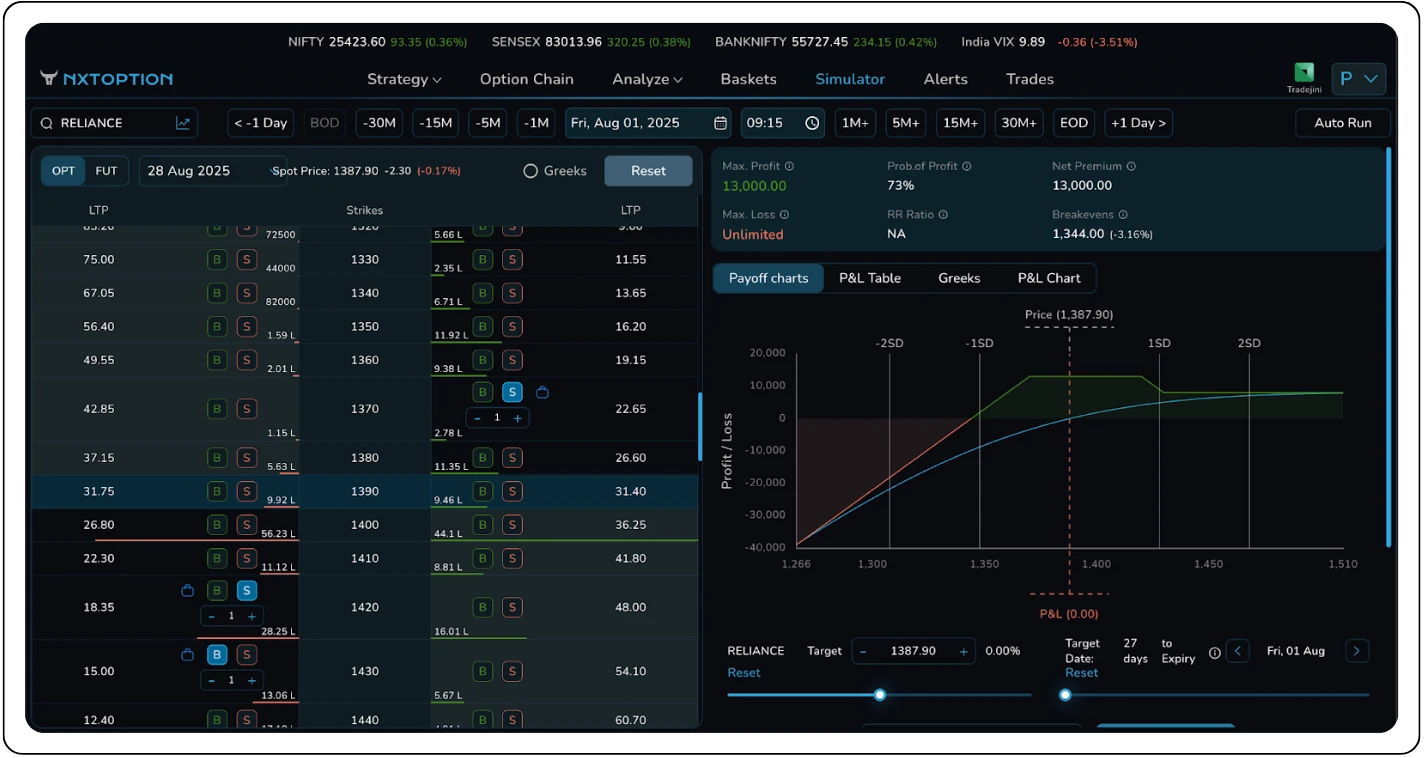
On 1st August 2025, Reliance was trading near ₹1,388. With a neutral-to-slightly-bullish outlook, we deployed a Jade Lizard by:
- Selling 1,370 put at ₹22.65
- Selling 1,420 call at ₹18.35
- Buying 1,430 call at ₹15.00
This created a Jade Lizard with a net credit of ₹26 (22.65 + 18.35 – 15). The call spread width was 10 points, and since the premium collected (₹26) was greater than the spread width (₹10), the upside carried no risk.
- Maximum profit: ₹26 per share (₹13,000 for a lot size of 500), realized if Reliance stays between 1,370 and 1,420 till expiry.
- Downside breakeven: 1,370 – 26 = ₹1,344. Below this, the position behaves like a short put with losses increasing point for point.
- Upside payoff: Flat beyond 1,430 since the long call caps the short call.
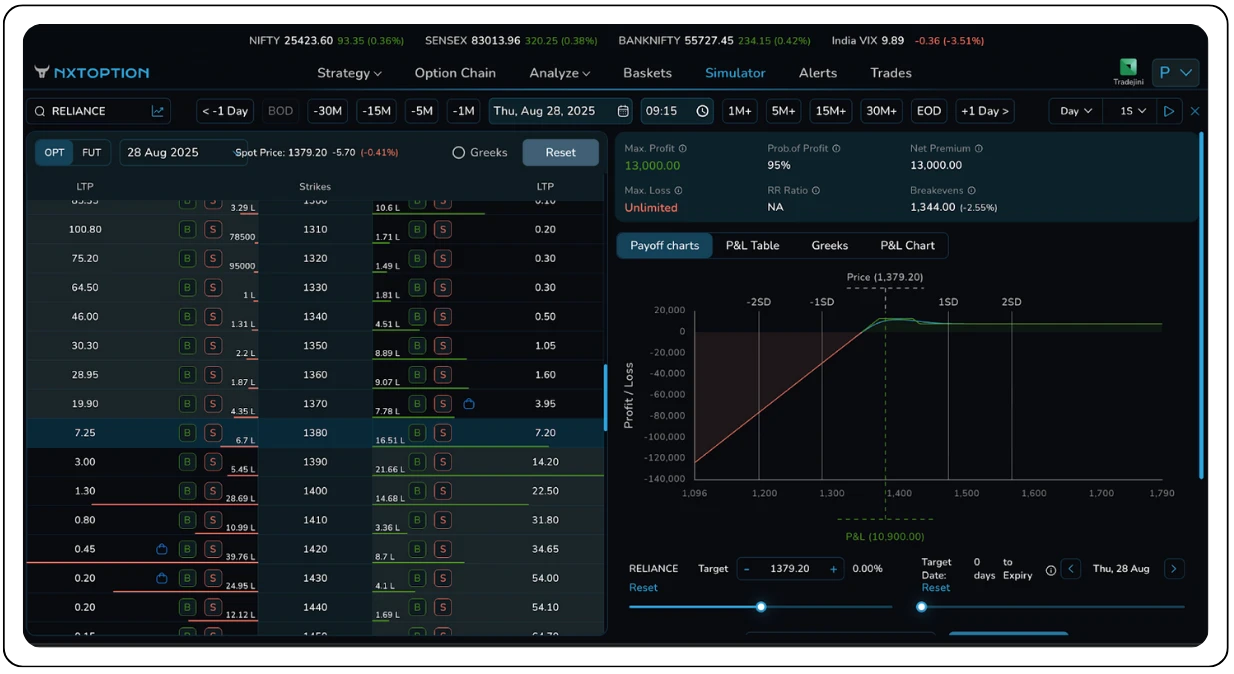
By expiry on (28th August 2025), Reliance settled near ₹1,379. The short put expired worthless, while the call spread also decayed, allowing us to realize a gain of ₹10,900. This highlights the advantage of Jade Lizards in range-bound or mildly bullish markets - profits from time decay and rich put premiums, while still being protected against large upside moves.
Let us also understand the Reverse Jade Lizard by implementing it on IEX on 1st September, 2025. The reverse Jade Lizard is the mirror image.
- Sell one out-of-the-money call (naked short call)
- Sell one out-of-the money put (short)
- Buy a lower strike put (creates a bull put spread and caps downside risk)
The rule that matters here is that the collected net credit is greater than or equal to the put-spread width to neutralize downside risk. If that holds, you remove unlimited downside loss and leave the upside exposed instead.
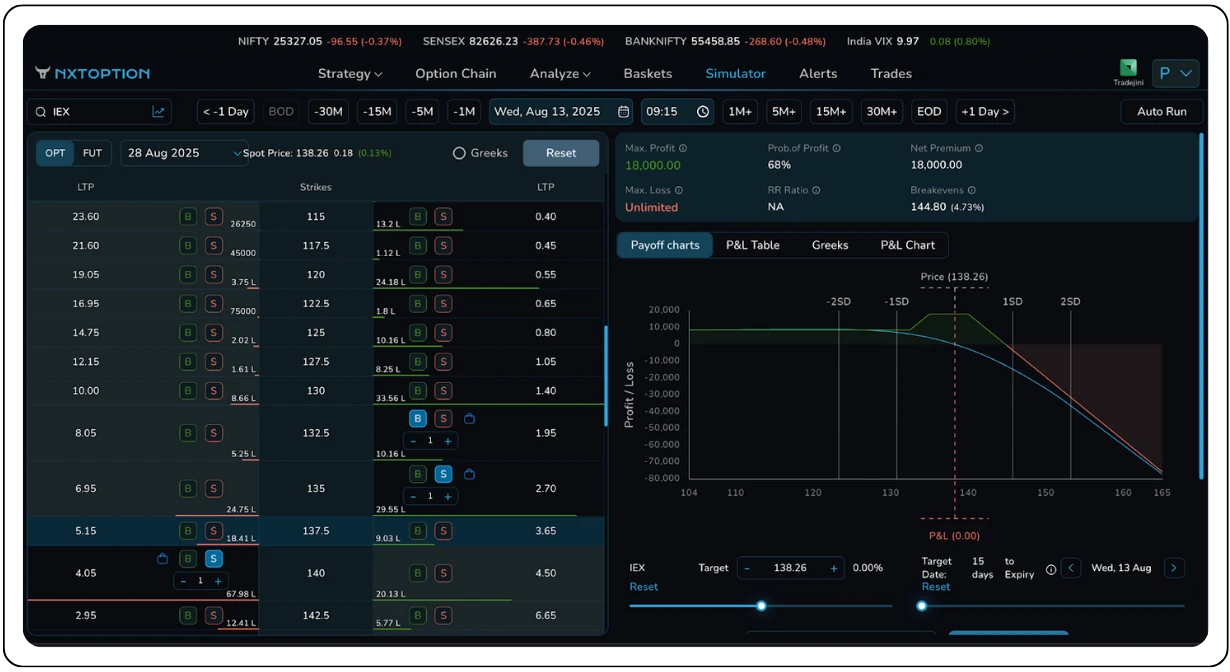
IEX was trading near ₹138 on 13th August, 2025. With a neutral-to-slightly-bearish outlook, we deployed a Reverse Jade Lizard by:
- Selling 135 put at ₹2.70
- Selling 140 call at ₹4.05
- Buying 132.5 put at ₹1.95
This created a Reverse Jade Lizard with a net credit of ₹4.80 (2.70 + 4.05 – 1.95). The put spread width was 2.5 points, and since the premium collected (₹4.80) was greater than the spread width (₹2.5), the downside is capped.
- Maximum profit: ₹4.80 per share (₹18,000 for a lot size of 500), realized if Reliance stays between 135 and 140 till expiry.
- Downside floor: If IEX ≤ 132.5 at expiry, the put spread hits max loss of 2.5, but you still keep credit → net P/L = 4.80 − 2.5 = ₹2.30 per share. So a deep drop still produces a profit, not a loss.
- Upside breakeven: 140 + 4.80 = ₹144.80. Above this, the short call begins to cause losses.
- Max loss: Unlimited on the upside beyond breakeven because of the naked short call.
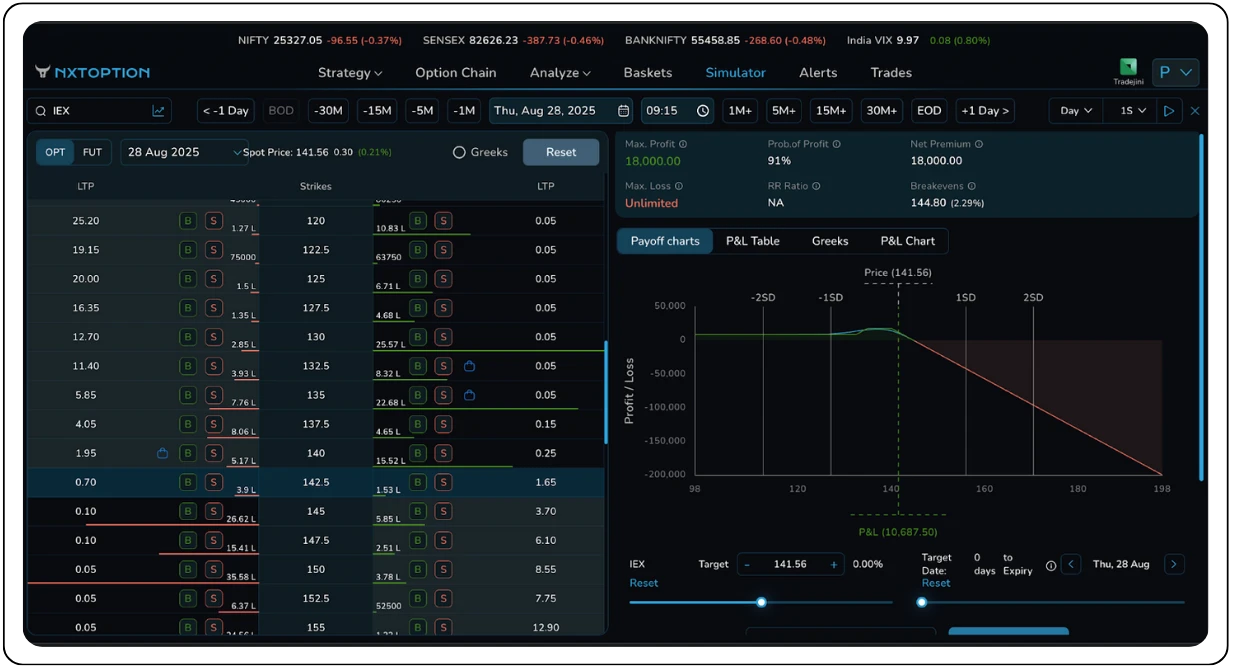
By expiry (28th August 2025), IEX settled near ₹141.56. The short call expired slightly in the money but still turned up a profit due to time decay, while the put spread also decayed, allowing us to realize a gain of ₹10,687.
Greeks analysis and risk management
Understanding the Greeks provides crucial insights for managing Jade Lizards effectively:
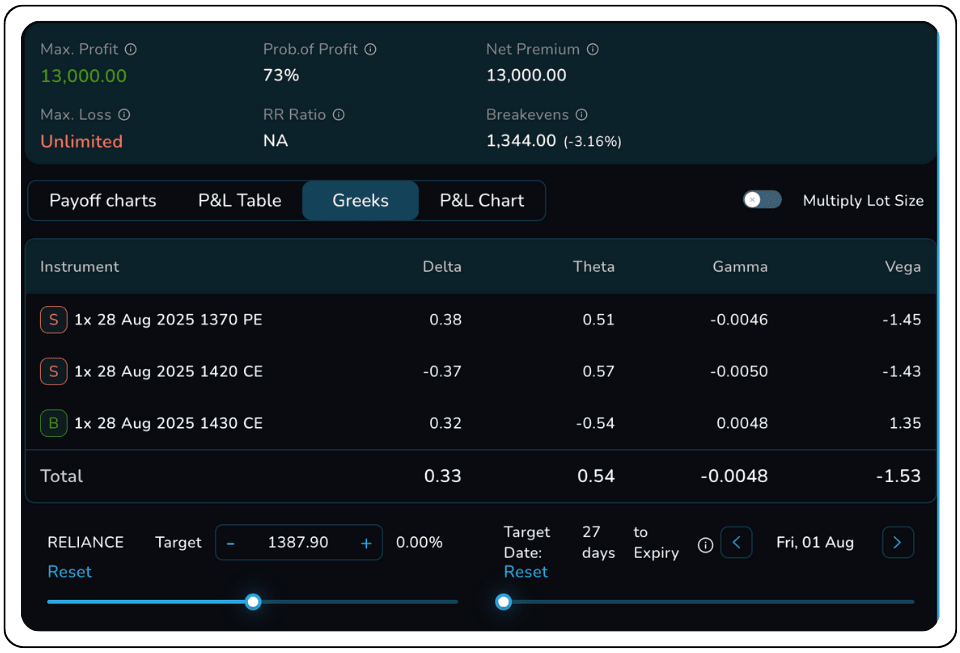
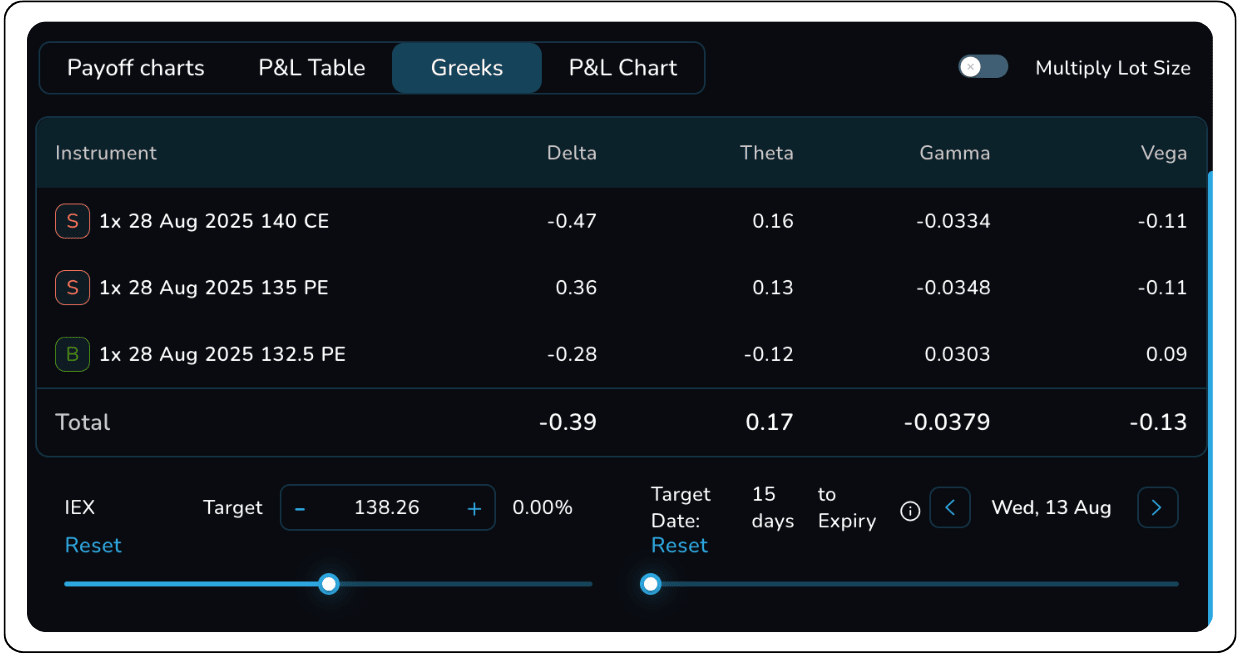
Theta (Time Decay): Both the Jade Lizard and Reverse Jade Lizard are theta positive, benefiting from the passage of time as short options decay faster than long positions. The Jade Lizard on RELIANCE generates theta income from the short strangle (put and call) while the long call provides upside protection. Similarly, the Reverse Jade Lizard on IEX benefits from short strangle decay with the long put providing downside protection.
Delta: The delta characteristics differ based on strike positioning. The Jade Lizard typically starts with a small positive delta due to the short put component, requiring monitoring for significant moves in RELIANCE in either direction. The Reverse Jade Lizard generally has a negative delta from the short call exposure, making it sensitive to upward moves in IEX, while the long put provides downside protection.
Vega: Both strategies are vega negative due to the short strangle components, benefiting from declining implied volatility after entry. This makes timing crucial for both strategies - entering when volatility is elevated optimizes the premium collection from the short options while the single long option has limited vega impact.
Gamma: Both positions carry negative gamma exposure from the short strangle, particularly as expiration approaches. For the Jade Lizard on RELIANCE, gamma risk intensifies if price approaches either short strike. For the Reverse Jade Lizard on IEX, similar gamma acceleration occurs near the short strikes, requiring active management to prevent adverse delta changes.
Conclusion
The Jade Lizard and Reverse Jade Lizard represent sophisticated evolutions of basic income strategies, offering traders complementary tools to generate consistent returns while managing risk intelligently across different market conditions. The traditional Jade Lizard's combination of income generation and upside protection makes it valuable for neutral-to-bullish scenarios, while the Reverse Jade Lizard's downside protection serves neutral-to-bearish outlooks.
Success with both variations requires attention to construction details, particularly the critical credit-spread-width relationships, and active management throughout each trade's lifecycle. The ability to deploy either strategy based on market conditions and volatility environments provides sophisticated traders with a comprehensive approach to income generation.
When implemented correctly under appropriate market conditions, these strategies provide reliable tools for generating consistent income while maintaining disciplined risk management - the Jade Lizard protecting against gap-up scenarios while remaining exposed to downside moves, and the Reverse Jade Lizard guarding against crash risk while staying vulnerable to upside breakouts.
Disclaimer: The information provided in our blogs is for informational purposes only and should not be construed as financial, investment, or trading advice. Trading and investing in the securities market carries risk. Always conduct your own research and consult with a qualified financial advisor before making any investment decisions. Past performance is not indicative of future results. Copyrighted and original content for your trading and investing needs.
© 2025 — Tradejini. All Rights Reserved.