

Support levels are not just lines on a chart. They are records of where buyers were willing to act, and when price returns to them, they become a test: will those buyers show up again? On the Deepak Fertilisers daily chart in late 2024, they did. After a correction that brought the stock back to a key support zone, a bullish reversal candle confirmed the bounce, and the uptrend resumed. With implied volatility in the lower range of its historical levels, a Bull Call Spread was the right structure for the moment, a way to participate in the next leg higher with a known cost, a capped risk, and no need to be right by more than a moderate amount.
When Does a Bull Call Spread Strategy Make Sense?
The Bull Call Spread works best when a very specific set of conditions lines up at the same time. Understanding what those conditions are and why each one matters is more important than knowing the mechanics of the strategy itself, because deploying it in the wrong environment will cost you money even if the stock eventually moves in the right direction.
The first condition is a stock already in a bull market. The Bull Call Spread is not a contrarian strategy. It is not designed to pick bottoms in a falling stock. It is built for stocks that are already trending higher, where the primary direction is up, and where you are looking to participate in the next leg of that move at a defined cost and with a defined risk.
The second condition is a correction to a known support level, followed by a bullish reversal candle. Within the broader uptrend, the stock should pull back to a level where it has previously found buyers. That level, a prior swing high, a consolidation zone, a round number, becomes your anchor. You do not enter the moment the stock touches support. You wait for confirmation. A bullish reversal candle at that support level, a hammer, a bullish engulfing pattern, a piercing line tells you that buyers showed up exactly where you expected them to. That candle is your trigger.
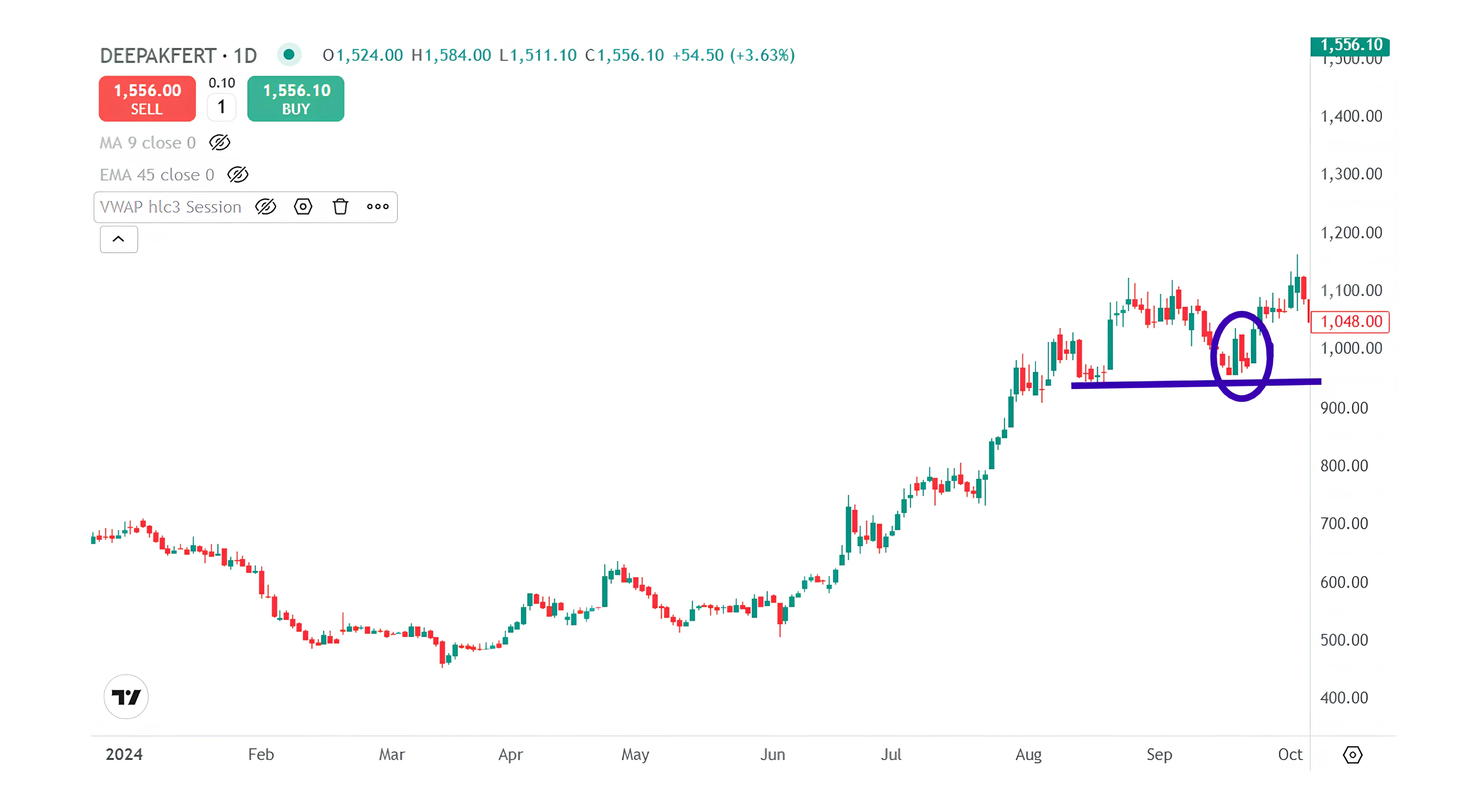
On the Deepak Fertilisers chart, this setup played out cleanly. The stock had been trending higher from mid-2024, and after a sharp correction in late September, it came back to test a support zone around the 950–960 level. A bullish reversal candle at that support confirmed the bounce, and the stock closed at 1,556, resuming its uptrend. The circled area on the chart marks precisely that moment: support held, reversal confirmed, trend intact.
What Exactly Is a Bull Call Spread?
A Bull Call Spread involves two legs, both calls, on the same underlying stock, the same expiry, and the same quantity.
You buy an ATM (At-the-Money) call or one strike ITM (In-the-Money) call. This gives you the right to buy the stock at the chosen strike and is the leg that benefits when the stock moves higher. It is where your directional exposure, your delta, comes from.
You sell a call that is 4 or 5 strikes OTM (Out-of-the-Money) from where you bought. This is the leg that brings in premium, reducing the net cost of the trade. In exchange for that premium reduction, you cap your maximum profit at the difference between the two strikes minus the net premium paid.
The result is a position where:
Maximum profit= difference between the two strikes minus the net debit paid. This is achieved if the stock closes at or above the short call strike at expiry.
Maximum loss = the net premium paid to enter the trade. This is the worst case if the stock closes below the long call strike at expiry.
Breakeven = long call strike + net premium paid.
The structure limits both your upside and your downside. You are not trying to capture an unlimited move. You are positioning for a moderate, defined move higher, at a cost that is meaningfully lower than buying a naked call.
The Greeks at Work: Delta, Theta, and Vega
Understanding how the Greeks behave in a Bull Call Spread tells you exactly why the entry conditions matter and when the strategy is most likely to work in your favor.
Delta positive. The Bull Call Spread has a net positive delta, which means the position gains value when the stock moves higher. The long ATM or ITM call has a higher delta than the short OTM call, so the net effect is directional participation to the upside. This is the primary driver of profit if the stock resumes its trend after the correction.
Theta negative. Unlike premium-selling strategies, the Bull Call Spread is a net debit position. You pay more for the call you buy than you receive for the call you sell. As a result, theta (time decay) works against you every day the trade is open. This is not a catastrophic problem, but it has a direct implication for timing: you cannot afford to enter too early in the expiry cycle and then watch time decay erode your position while the stock does nothing. The longer you hold without a move, the more theta takes away.
Vega slightly positive. The net vega of a Bull Call Spread is small but positive; the long call has more vega exposure than the short call. This means the position benefits marginally from a rise in implied volatility and is hurt marginally by a fall. In practice, this is less significant than delta or theta for most trades in this structure.
Why Low IV Is Non-Negotiable for Entry
This is the single most important condition for the Bull Call Spread, and it is the one most traders overlook.
The Bull Call Spread is a net debit strategy. You are buying premium. The amount you pay to enter the trade (the net debit) is directly driven by the level of implied volatility at the time of entry. When IV is high, options are expensive, your net debit is large, and you need a bigger move in the stock just to break even. When IV is low, options are cheaper, your net debit is smaller, and even a moderate move in the stock can produce a good return relative to what you paid.
This is the opposite of the Bull Put Spread, which benefits from entering in a high-IV environment because it is a net credit strategy. The Bull Call Spread requires low IV for the same logical reason: you want to buy cheap options, not expensive ones.
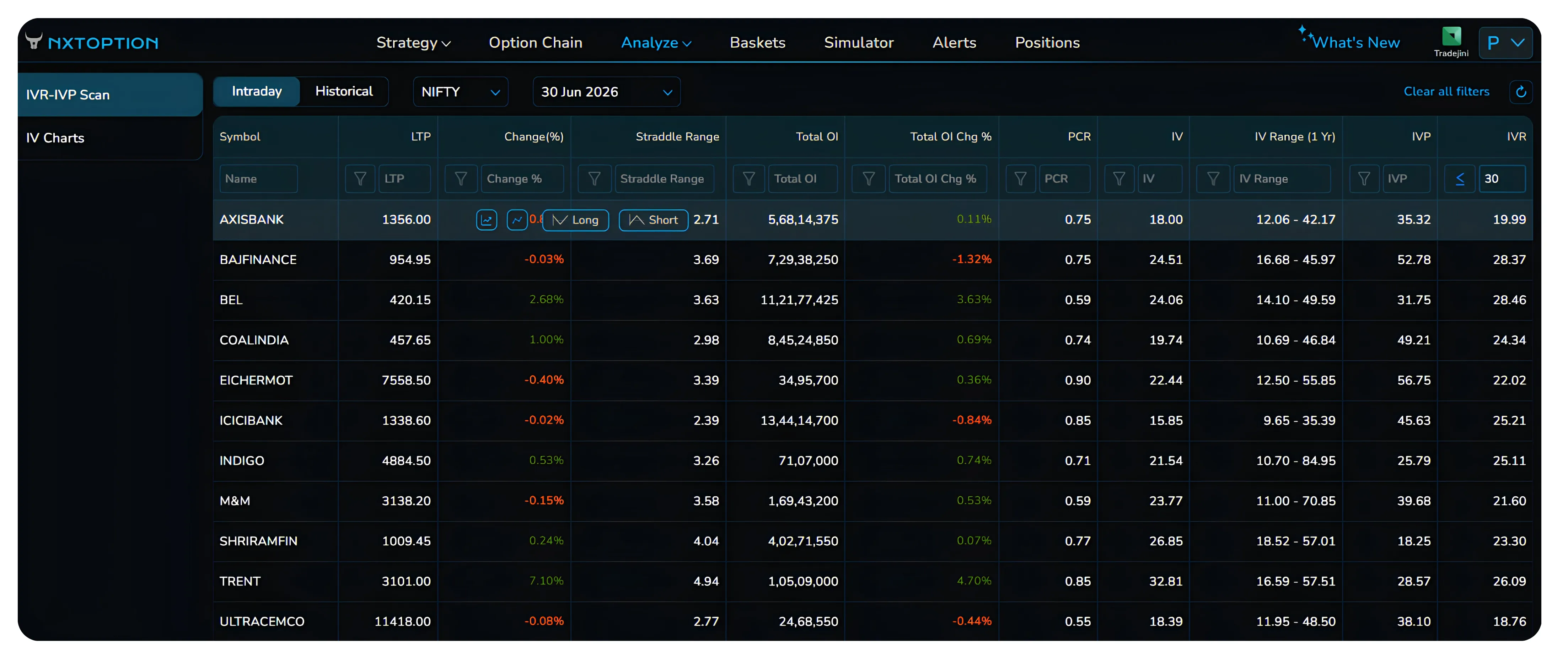
Before entering a Bull Call Spread, check the IVR (IV Rank) and IVP (IV Percentile) on NxtOption. A low IVR (ideally below 30) tells you that implied volatility is in the lower range of its historical levels. That is the environment where buying the spread makes structural sense.
Getting the Timing Right Within the Expiry Cycle
Because the Bull Call Spread is theta negative, timing within the monthly expiry cycle matters enormously.
Theta decay does not eat premium at a uniform rate. It accelerates as you approach expiry. In the first two weeks of a monthly expiry cycle, time decay is relatively slow. In the third and fourth weeks, it becomes progressively faster and for a net debit position like the Bull Call Spread, that acceleration is working against you.
The ideal entry window is between the middle of the first week and the end of the second week of the expiry month. This gives the trade enough time for the directional move to play out before the accelerating theta of the final two weeks begins to punish the position. Entering in the third or fourth week, even with a strong technical setup, shortens the runway available for the stock to move and compounds the risk if it stalls.
Building a Bull Call Spread on NxtOption
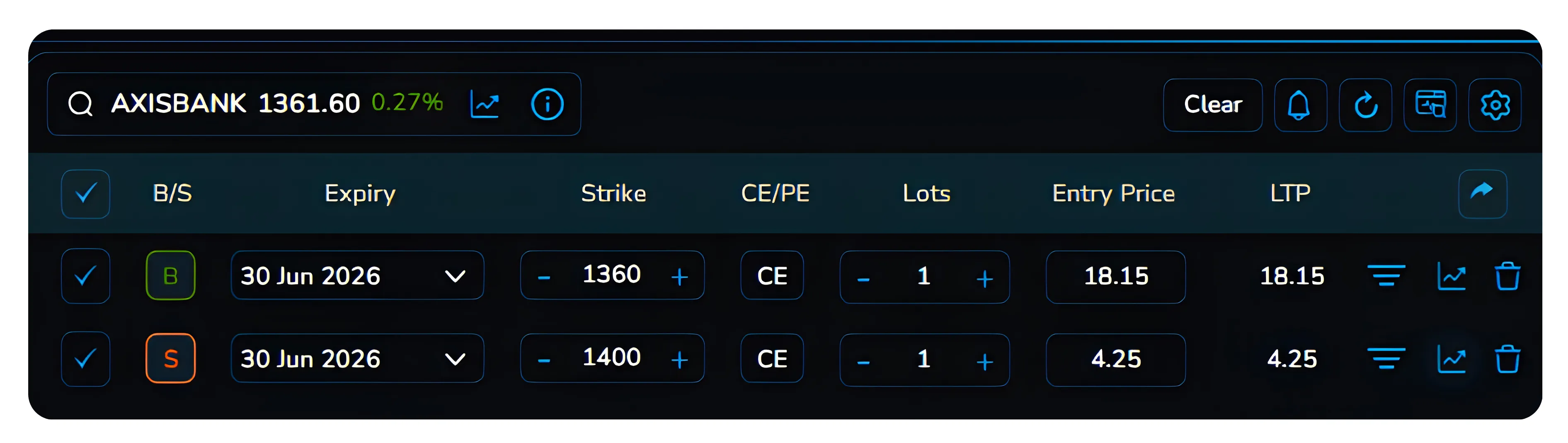
NxtOption's Strategy Builder makes it straightforward to construct the trade. Under the Bullish tab, select the Bull Call Spread as a predefined strategy. The builder will lay out both legs automatically: the long call at your chosen ATM or 1-strike ITM strike and the short call at 4 or 5 strikes OTM. You can then adjust the specific strikes, expiry date, and lot size to match your setup.
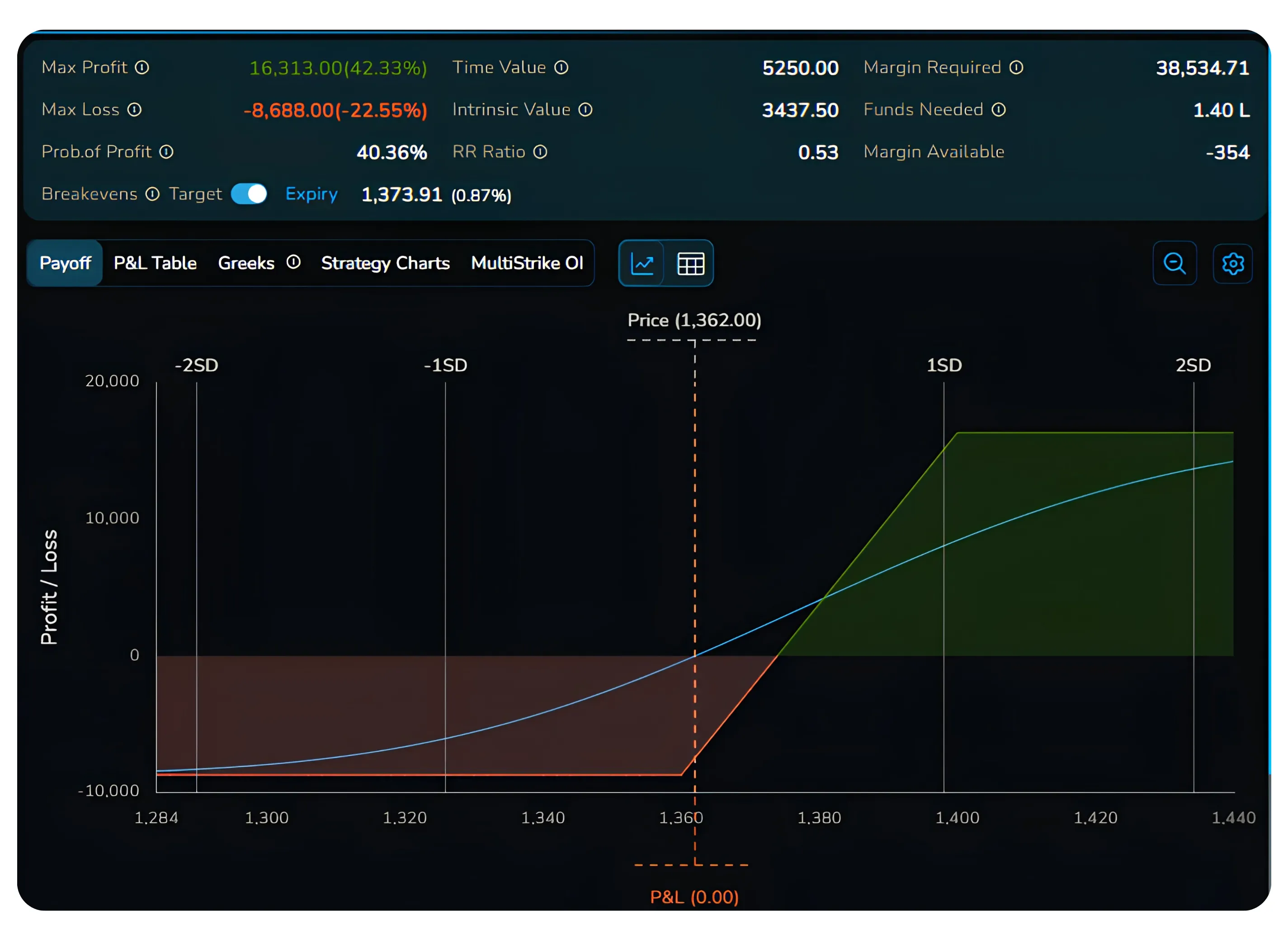
Before placing the trade, the platform shows you the full payoff chart, the breakeven level, the net premium paid, the maximum profit, and the margin required. This lets you verify that the risk-to-reward profile makes sense for the current market before you commit to the position.
Saving and Tracking Your Bull Call Spread on Strategy Watch
You can also build and save your Bull Call Spread directly from Strategy Watch. Navigate to Strategy under the top menu, select Strategy Watch, and click on Add Strategy Group.
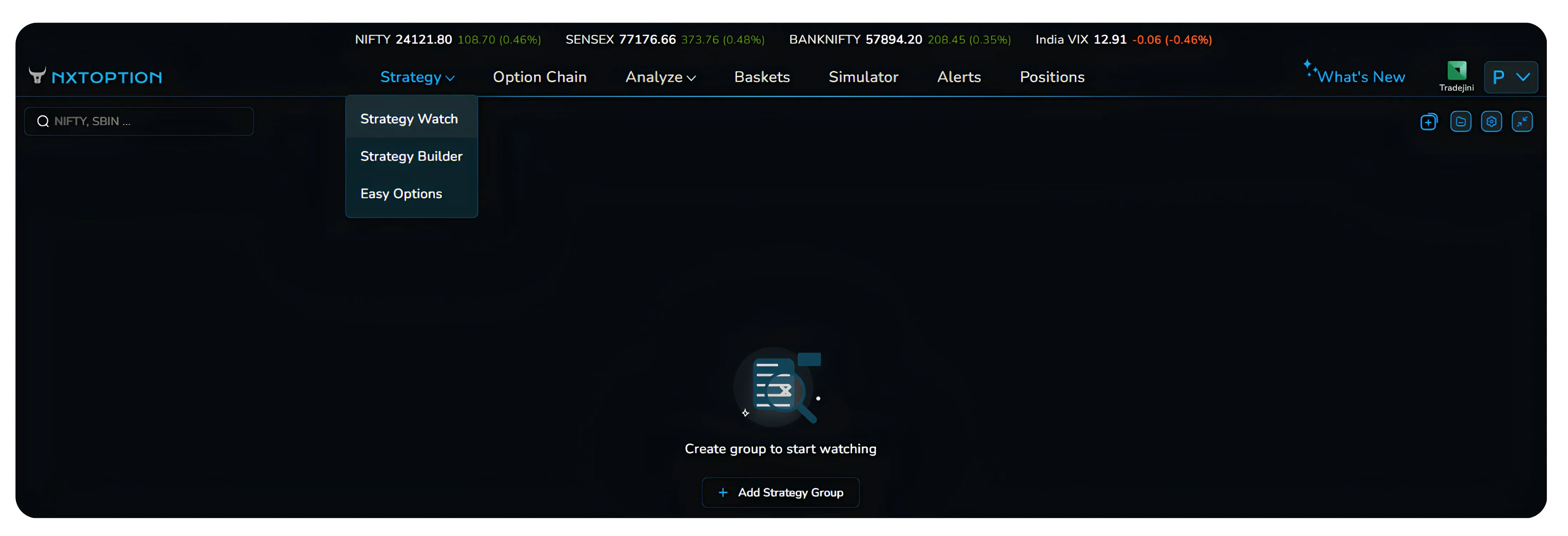
From there, you can add your buy and sell legs on the option chain, choosing buy on your ATM or ITM call and sell on your OTM call.
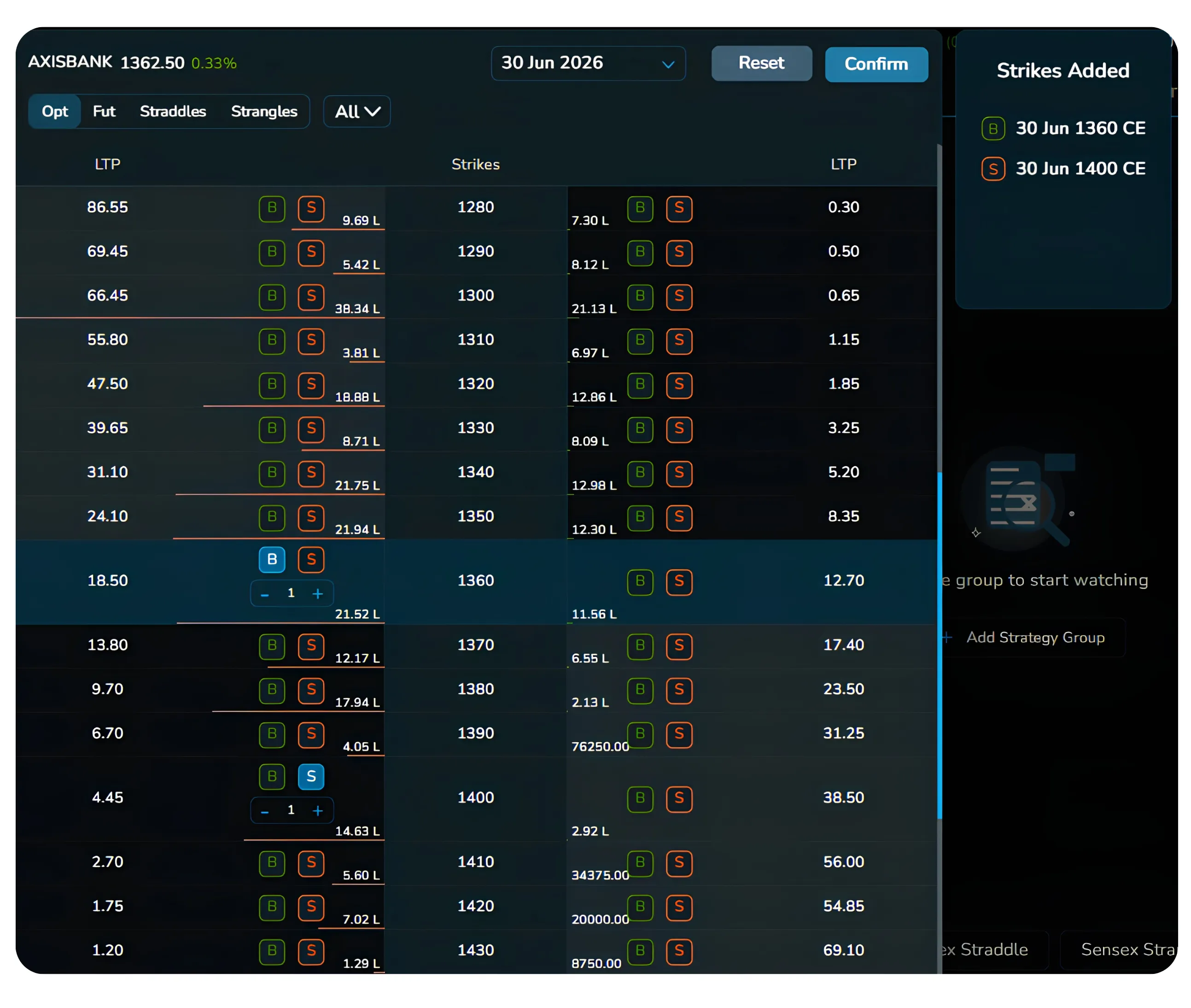
The platform instantly shows your net premium, breakeven point, and combined Greeks for the position, so the trade continues to track live premium, OI, and Greek changes without needing to rebuild it each time you check back.

Exit Rules: Time and Price
Because theta is your enemy in this trade, disciplined exit rules are essential. There are two triggers for closing the position before expiry.
Time-based exit. As a hard rule, the Bull Call Spread should be closed no later than the end of the second week of the expiry month. Do not hold it into the third and fourth weeks, regardless of how the trade is performing. The accelerating theta decay during those final two weeks means you are fighting a progressively steeper headwind. If the move has not happened by the end of week two, the trade has not worked as intended, and it is better to close it and preserve what remains of the premium paid than to watch theta destroy it week by week.
Loss-based exit. If the position loses 50% of the maximum loss at any point before the time stop, exit immediately. The logic here is probabilistic: once a spread has moved against you to the point where you have lost half of what you were willing to risk, the odds of recovering by expiry have shifted against you. Cutting at 50% of max loss preserves capital and keeps you in a position to take the next trade with a clean slate.
There is no separate profit target beyond holding to expiry if the trade is working. If the stock moves above the short call strike, the position has reached maximum profitability and will decay naturally toward that level as expiry approaches.
What Can Go Right and Wrong in a Bull Call Spread
If the stock resumes its uptrend after the correction and closes above the short call strike at expiry, the trade captures its full maximum profit. Delta drives the gain as the stock moves higher, and the defined structure means you knew exactly what you could make from the moment you entered.
If the stock breaks down further and closes below the long call strike at expiry, the trade loses the full net premium paid. This is the maximum loss, bounded and known from day one. There is no tail risk, no margin call, no scenario in which the loss can exceed what you paid to enter. That defined ceiling on downside is what makes the spread a more controlled structure than a naked long call.
The scenario that damages a Bull Call Spread the most is not a large move in the wrong direction; it is a stock that does nothing. If the stock sits flat for three weeks and IV stays low, theta decay accumulates and the net debit shrinks in value even though the directional view has not been proven wrong. This is why the time stop is not optional: if the stock has not moved by the end of the second week, the trade needs to be closed regardless of the mark-to-market PnL.
What Is the Practical Edge of a Bull Call Spread?
What makes this trade repeatable and structured is the precise alignment of conditions at entry. The chart on Deepak Fertilisers showed a stock in a clear uptrend, a correction to an identifiable support level, and a bullish reversal candle confirming that buyers had stepped back in. The IV environment was low, making the net debit affordable relative to the potential profit. And the structure itself, built in seconds using NxtOption's Strategy Builder, meant the maximum loss was capped and known from the moment the trade was placed.
This is not a trade that requires a large, dramatic move. The Bull Call Spread profits from a moderate resumption of the existing trend. If the stock moves from support back toward its recent highs, a move the chart suggested was likely, the spread captures that move with a defined cost and a defined ceiling on risk.
That is the core idea behind a low-IV, defined-risk debit spread after a correction in an uptrending stock. You are not predicting a breakout to new highs. You are positioning for a return to where the stock was before it pulled back, paying a fair price for that bet in a cheap-premium environment, and knowing exactly what you stand to make and lose before you place a single order.
Disclaimer: The information provided in our blogs is for informational purposes only and should not be construed as financial, investment, or trading advice. Trading and investing in the securities market carries risk. Always conduct your own research and consult with a qualified financial advisor before making any investment decisions. Past performance is not indicative of future results. Copyrighted and original content for your trading and investing needs.
© 2026 — Tradejini. All Rights Reserved.


