Concalls
 Annual reports
Pre-Engineered Buildings (PEBs) are factory-fabricated steel structures that are designed and engineered in advance for quick on-site assembly. These buildings offer flexibility in design, reduced construction time, and cost efficiency compared to traditional construction methods.
PEBs are widely used in industrial, commercial, and institutional applications such as warehouses, factories, healthcare facilities, and highway wayside amenities (dormitories, EV charging stations, & toll plazas). With rising demand for faster and more scalable infrastructure, PEB construction in India is growing rapidly.
One company benefiting from this trend is Interarch Building Products Ltd., a leading turnkey pre-engineered buildings solutions provider in India, well-positioned to strategically capitalize on this growth.
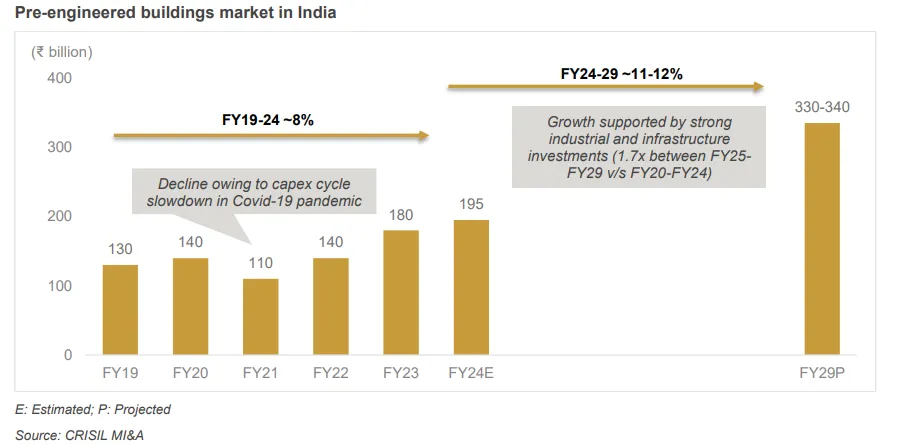
According to a report by Crisil, the pre-engineered buildings industry is currently valued at ₹195 billion in FY24. In the medium term, the industry is expected to grow at 11.0-12.0% and touch ₹ 330-340 billion by 2029
The organized sector, which constitutes 40-45% of the market, is dominated by a few key players, with Interarch Building Products holding a 15% share among them. This positions the company as the second-largest player in India’s organized PEB segment.
Room for sectoral growth
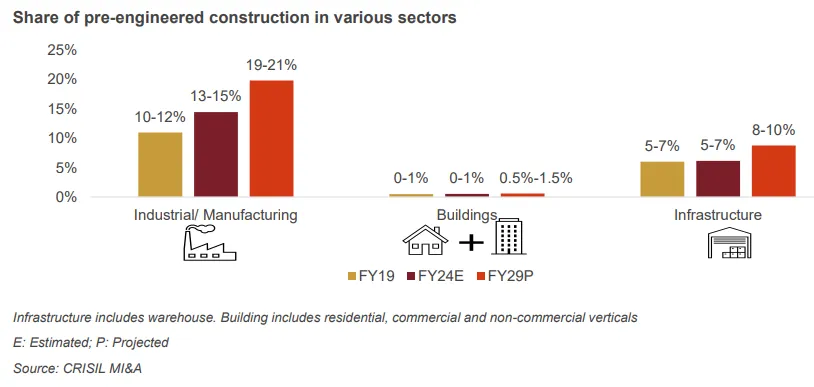
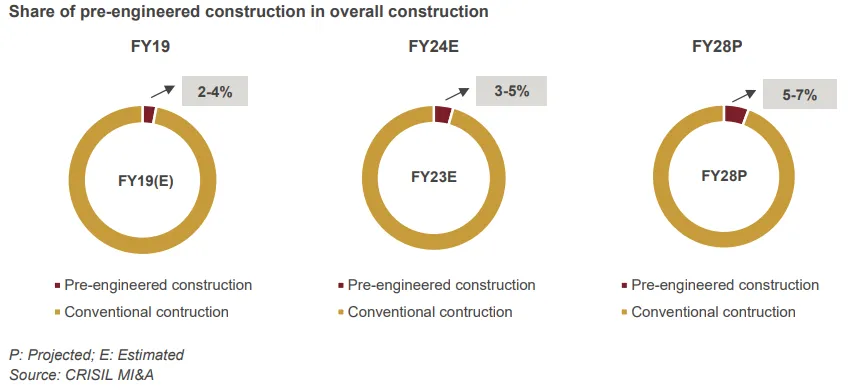
For commercial construction, 97% still rely on traditional methods, a figure that could decline to 93% by FY28. This presents a significant opportunity for pre-engineered steel building players, particularly in critical sectors such as healthcare and the warehousing segment, both of which are expected to drive demand for PEB in the building sector.
Business model and revenue streams
Interarch Building operates a business-to-business (B2B) model, primarily securing standalone purchase orders rather than long-term contracts. The Interarch company’s revenue is broadly categorized into three streams:
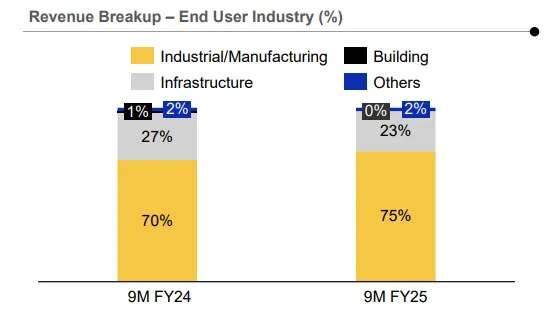
PEB Contracts: They earn 86% of the revenue from turnkey solutions, including the design, manufacturing, installation, and erection of steel structures
Building Materials: 12% of the revenue is generated from sales of metal ceilings, corrugated roofing, and structural components (under brands like “TRAC” and “TRACDEK”)
Other Services: About 2% of the revenue is from engineering and design solutions, along with scrap sales
Manufacturing and expansion strategy
Interarch currently operates five manufacturing facilities across Tamil Nadu, Uttarakhand, and Andhra Pradesh, with a total installed capacity of 161,000 MTPA. To keep pace with demand, it has undertaken aggressive capacity expansion:
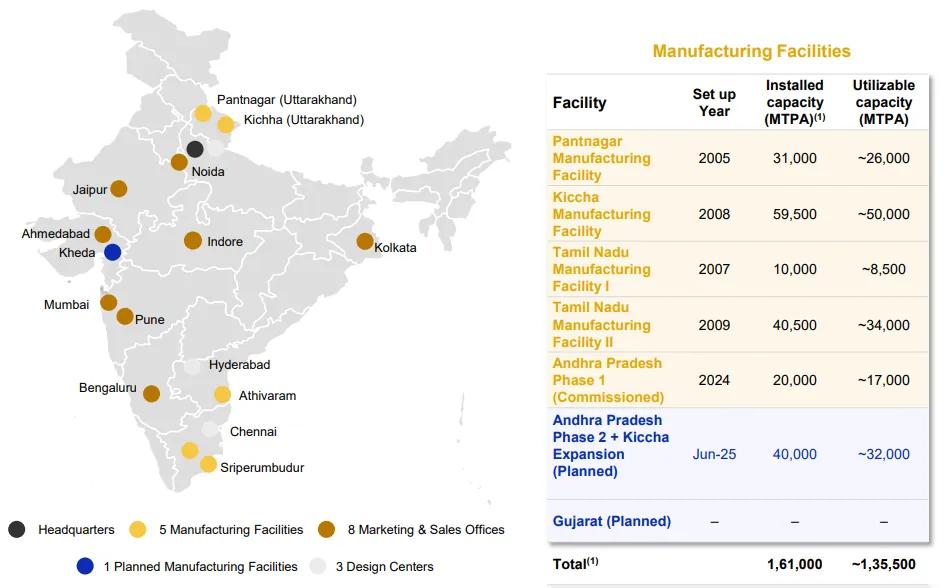
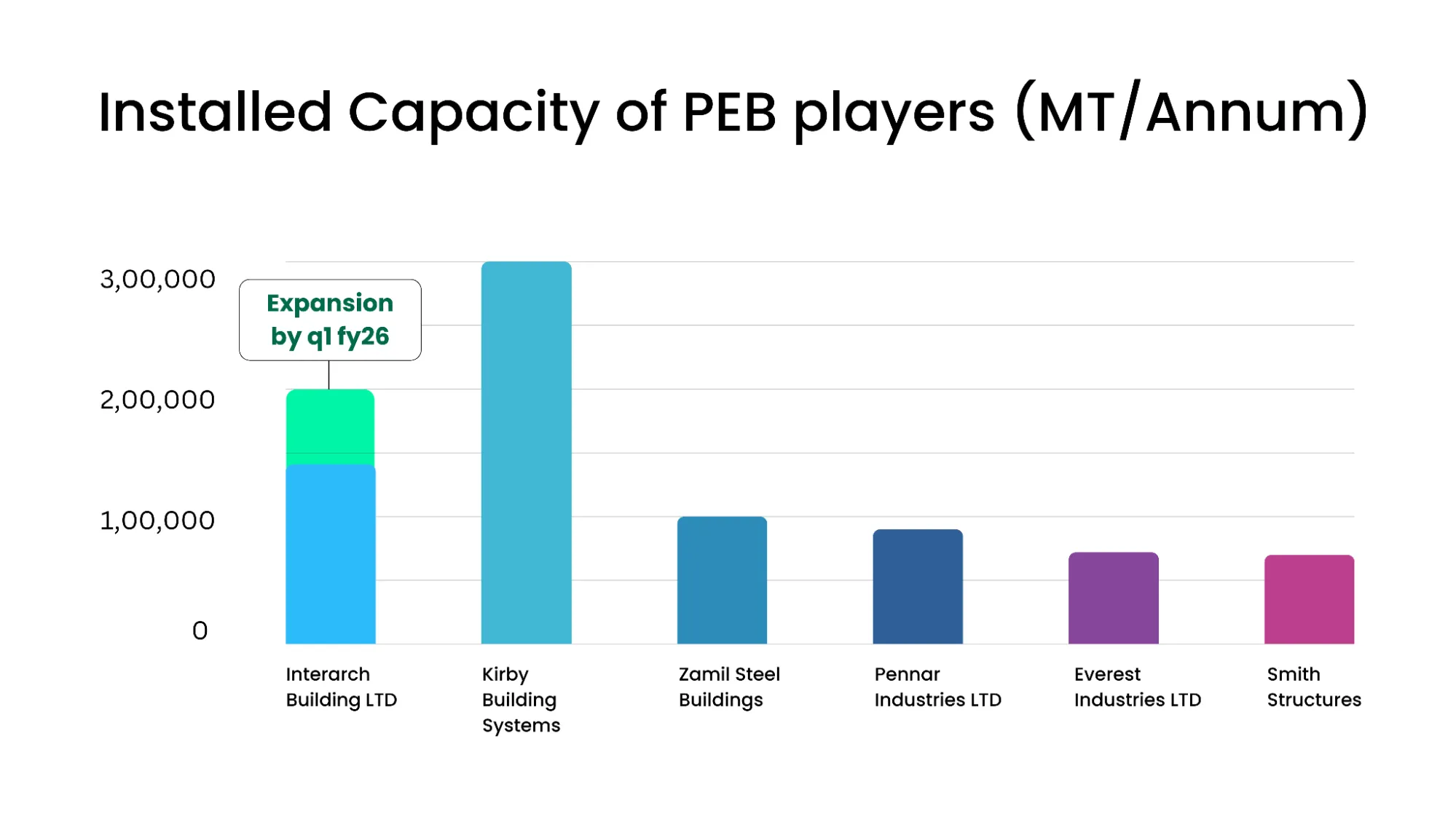
Andhra Pradesh (Attivaram): Phase 2 (40,000 MTPA) is expected to be completed by Q1 FY26, expanding the already existing 1,61,000 MT, taking the total installed capacity to around 2,00,000 MT.
Gujarat (Kheda): Plans to add 50,000-60,000 MTPA capacity post-Andhra Pradesh expansion. These expansions are expected to significantly boost production, helping Interarch achieve its goal of doubling revenue in 3-4 years.
Competitive landscape
Key clients
Competitive advantages
Interarch benefits from multiple strengths that give it an edge in the industry:
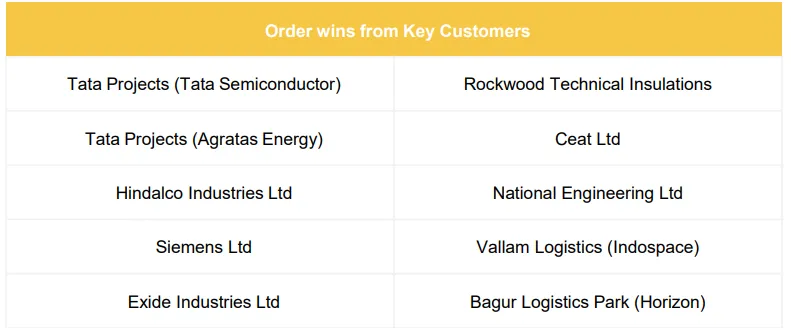
Diverse Customer Base: Serves warehousing firms (IndoSpace, Welspun), FMCG giants (HUL, Marico), automotive players, and emerging sectors like renewables (Reliance Solar, Avaada) and data centers.
Repeat Business: 80-85% of annual revenue comes from repeat customers, ensuring stability.
Operational Efficiency: The company maintains two months of steel inventory and two months of pipeline orders, reducing supply chain risks.
Strategic Partnerships: Collaborates with Jindal Steel & Power Ltd. (JSPL), which could provide cost advantages in steel procurement.
Debt-free: The company has high cash reserves and strong financial performance.
Future outlook and growth prospects
Management has provided the following guidance:
Revenue Growth: 10% in FY25, accelerating to 10-15% in FY26.
Profitability: EBITDA margins of 9-10%, with a PAT target exceeding ₹100 crore.
Volume Expansion: 15-20% growth expected in FY25, with tonnage being a key performance metric.
Financial analysis
Interarch has a strong balance sheet:
Low Debt: ₹20 crore.
High Liquidity: ₹386 crore in cash and equivalents.
Reserves: Growing consistently, indicating sustained profitability.
Current assets (₹886 crores) far exceed other liabilities (₹411 crores), indicating good short-term financial health.
The debt-to-equity ratio stands at 0.03, which is extremely low and indicates minimal financial risk.
Asset Growth
Current assets have increased 2.8x from ₹316 crore in 2019 to ₹886 crore in 2024, driven by cash, receivables, and inventory.
Valuation Metrics
Forward Price-to-Earnings (P/E) Ratio: ₹2,700 crore market cap / ₹230 crore profit = P/E of 11.74 This is attractive for the PEB sector, which typically trades at 15–20x (e.g., Pennar Industries ~15–20 P/E in 2024)
Return on Equity (ROE): With a profit estimate of ₹230 crore, ROE is around 34%, which is exceptional compared to 10–20% in the sector.
Closing Thoughts on Interarch’s Impact
With growing demand from emerging industries, expanding capacity, and strategic partnerships, Interarch is on track to strengthen its foothold in the Indian pre-engineered building market. While challenges exist, the company’s proactive approach to supply chain management, customer retention, and product diversification puts it in a strong position to deliver sustained growth.
Disclaimer: The information provided in this blog is for informational purposes only and should not be construed as financial, investment, or trading advice. Always conduct your research and consult with a qualified financial advisor before making any investment decisions. Past performance is not indicative of future results.