A CDSL Demat account is an electronic account provided by Central Depository Services Limited (CDSL) that allows you to hold your investments in digital form, fitting into the broader capital market structure of the Indian securities market. Instead of keeping physical certificates or any physical security, this account safely stores your electronic securities, bonds, mutual funds, ETFs, and other securities online. In India, there are two main depositories that manage securities in electronic format CDSL and NSDL (National Securities Depository Limited). This blog explains in simple terms everything you need to know
What is CDSL?
CDSL, or Central Depository Services Limited, is one of India’s primary depositories and the largest depository in terms of number of demat accounts. Set up in 1999 and regulated by SEBI, it is responsible for holding various securities such as shares, bonds, and mutual funds in digital, or dematerialised form, as a core market infrastructure institution. CDSL enables investors and financial institutions to carry out transactions smoothly and securely, making stock market operations more efficient. Today, anyone who wants to trade in the Indian stock market must have a demat account with either CDSL or NSDL.
How Does a CDSL Account Work?
CDSL operates through Depository Participants (DPs), who act as intermediaries between the depository and investors (also called Beneficial Owners or BOs). Here’s a simple breakdown of how a CDSL account functions:
An investor opens a Demat account with a DP that is registered with CDSL. Once the account is created, a unique 16-digit Beneficial Owner (BO) ID is assigned along with account details that allow seamless electronic access. When the investor buys shares, they are credited to the Demat account after settlement and stored in digital form. When the investor sells shares, the securities are debited from their account and transferred to the buyer’s account as part of a regulated securities transaction. Investors can view all their holdings online through their DP’s platform or via CDSL’s EASI portal.
How Does CDSL Generate Revenue?
Even though most traders and investors know what CDSL does, many are unaware of how it earns money. CDSL follows a simple and diversified revenue model.
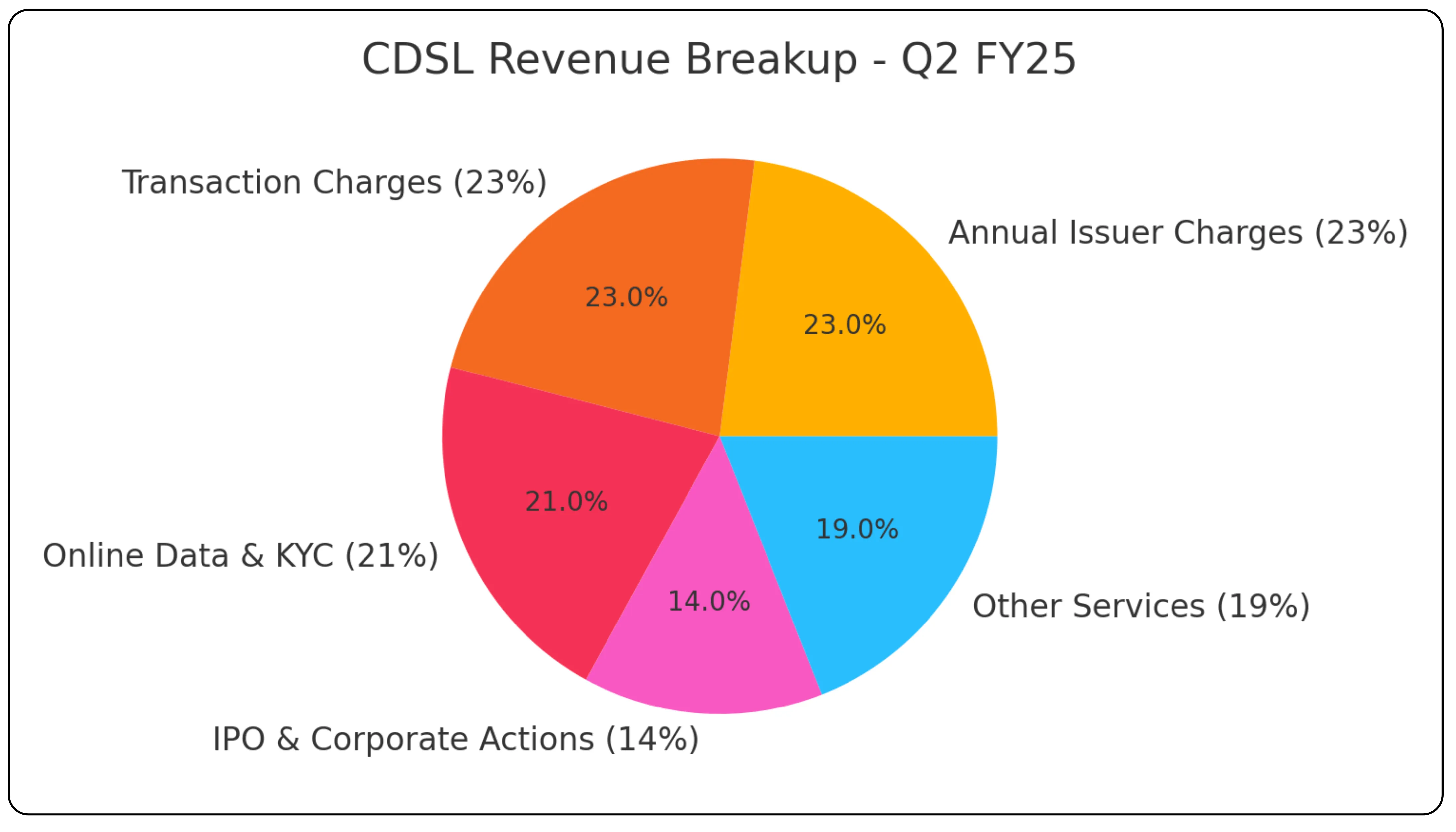
Annual issuer charges are one of the most stable and recurring sources of income for CDSL - 23% in Q2 FY25
Every company listed on the stock exchange must keep all its shares and other securities in digital form with a depository like CDSL. To maintain these records safely and accurately, SEBI requires companies to pay a yearly fee called the annual issuer charge. This fee covers important services such as storing shareholder data, updating records when shares are bought or sold, ensuring data security, and providing tools like e-voting and corporate action updates. Because every listed company pays this fee every single year regardless of market conditions this becomes one of CDSL’s most stable and reliable income sources. In fact, annual issuer charges made up 34% of CDSL’s revenue in Q2 FY26, up from 23% in Q2 FY25, meaning about one-third of CDSL’s total income now comes from this alone. This growth reflects the rising number of listed companies, increased dematerialisation, and stricter compliance requirements, all of which strengthen CDSL’s recurring revenue base.
Transaction charges are one of the most significant revenue sources for CDSL, and they are directly linked to trading activity in the market - 23% in Q2 FY25.
Every time an investor buys or sells shares, ETFs, or bonds, CDSL handles the movement of those securities from one Demat account to another through the investor’s broker or bank (known as a Depository Participant). For every such transaction, the DP pays a small fee to CDSL and then collects it from the investor. Because millions of trades happen every day, CDSL earns a tiny amount from each one adding up to a major income source. In fact, transaction charges contributed 17% of CDSL’s total revenue in Q2 FY26, compared to 23% in Q2 FY25, meaning almost one-fifth of CDSL’s income comes from these trade-based fees. Even though the share has dipped slightly, transaction charges remain a strong and steady revenue stream, supported by rising trading activity and growing retail participation in the market.
Online data and KYC services are an important revenue source for CDSL, driven by the growing number of investors entering the financial markets - 21% in Q2 FY25
CDSL also earns money by offering online data and KYC services to brokers, mutual fund houses, and other financial institutions. Whenever a new investor opens an account, their KYC details must be created, verified, and stored securely, and CDSL charges a small fee for this. Financial intermediaries also regularly access verified investor data maintained by CDSL, which generates additional income. Since KYC is mandatory for everyone entering the markets, this becomes a steady revenue stream. According to the latest figures, online data and KYC services contribute 13% of CDSL’s total revenue in Q2 FY26, down from 21% in Q2 FY25, but still representing a meaningful share roughly one-eighth of CDSL’s total income.
IPO and corporate action services are another important way CDSL earns revenue from companies - 14% in Q2 FY25
IPO and corporate action services are another major way CDSL earns revenue from companies. Whenever a company launches an IPO, CDSL is responsible for safely crediting the allotted shares into each investor’s Demat account; this requires handling large amounts of data, verifying investor details, and ensuring the right shares reach the right people. The same process applies during corporate actions like bonus shares, rights issues, stock splits, and mergers, where CDSL updates every investor’s holdings accurately and on time. Companies pay CDSL for these services because they require secure systems and precise coordination. According to the latest data, IPO and corporate action services now contribute 18% of CDSL’s total revenue in Q2 FY26, up from 14% in Q2 FY25, meaning almost one-fifth of CDSL’s income comes from these activities.
The growing number of IPOs and frequent corporate actions in India continue to strengthen this revenue stream.
Also Read: Transforming Healthcare Through Technology with Sagility Ltd
Other services also contribute to CDSL’s revenue by supporting various digital and compliance-related needs of companies and investors - 19% in Q2 FY25
Other services also contribute to CDSL’s revenue by supporting the digital and compliance needs of companies and investors. These include facilities like e-voting, which allows shareholders to vote online on company matters, and document storage services where important records and compliance papers are kept securely and accessed when needed. CDSL also provides investors with account statements and updates about their holdings. Each of these services carries a small fee, and together they create a steady additional income stream. According to the latest data, these “Other Services” contribute about 17% of CDSL’s total revenue in Q2 FY26, slightly lower than 19% in Q2 FY25, meaning around one-sixth of CDSL’s income comes from e-voting, document storage, account statements, and similar services. Even though smaller compared to other revenue sources, this segment remains consistent and reliable.
Financial Performance Analysis: Mar 2021 - TTM
Financial Summary Table
| Period | Sales | Operating Profit | OPM% | Net Profit | YoY Sales Growth |
|---|---|---|---|---|---|
| Mar 2021 | 344 | 212 | 62% | 201 | — |
| Mar 2022 | 551 | 365 | 66% | 312 | +60.2% |
| Mar 2023 | 555 | 319 | 57% | 276 | +0.7% |
| Mar 2024 | 812 | 488 | 60% | 420 | +46.2% |
| Mar 2025 | 1,082 | 625 | 58% | 526 | +33.3% |
| TTM | 1,080 | 576 | 53% | 473 | -0.2% |
Key Findings & Detailed Explanation
1. Exceptional Revenue Growth
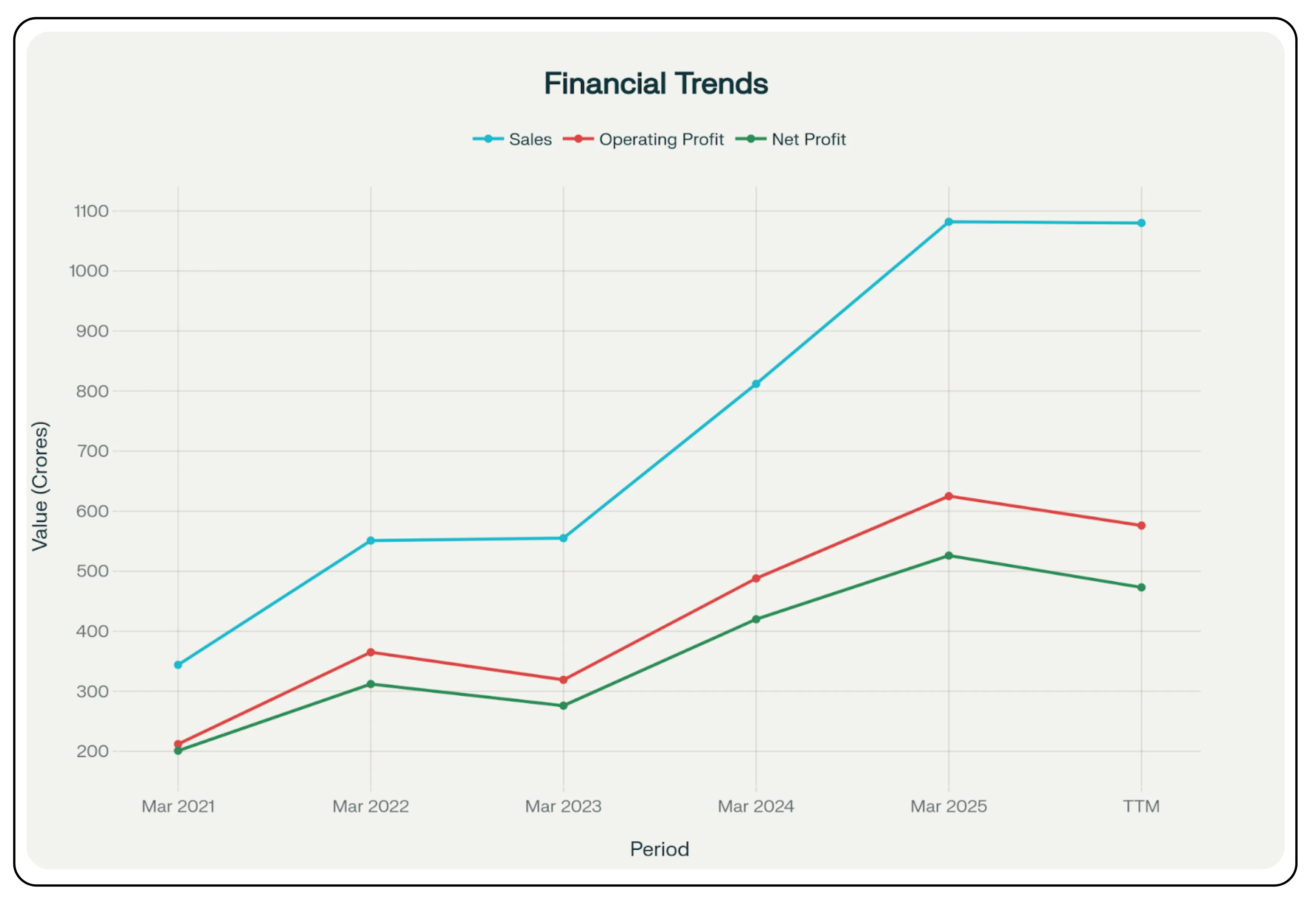
The company has demonstrated remarkable 3.15x growth in sales from ₹344 crore (Mar 2021) to ₹1,082 crore (Mar 2025). This represents a compound annual growth rate (CAGR) of approximately 33% over four years, which is significantly above typical industry averages. The most impressive jump occurred between Mar 2021-Mar 2022 (+60.2%), followed by sustained double-digit growth in subsequent years. This trajectory indicates strong market demand, successful business expansion, or aggressive market penetration strategies.
2. Operating Profit Growth with Margin Compression
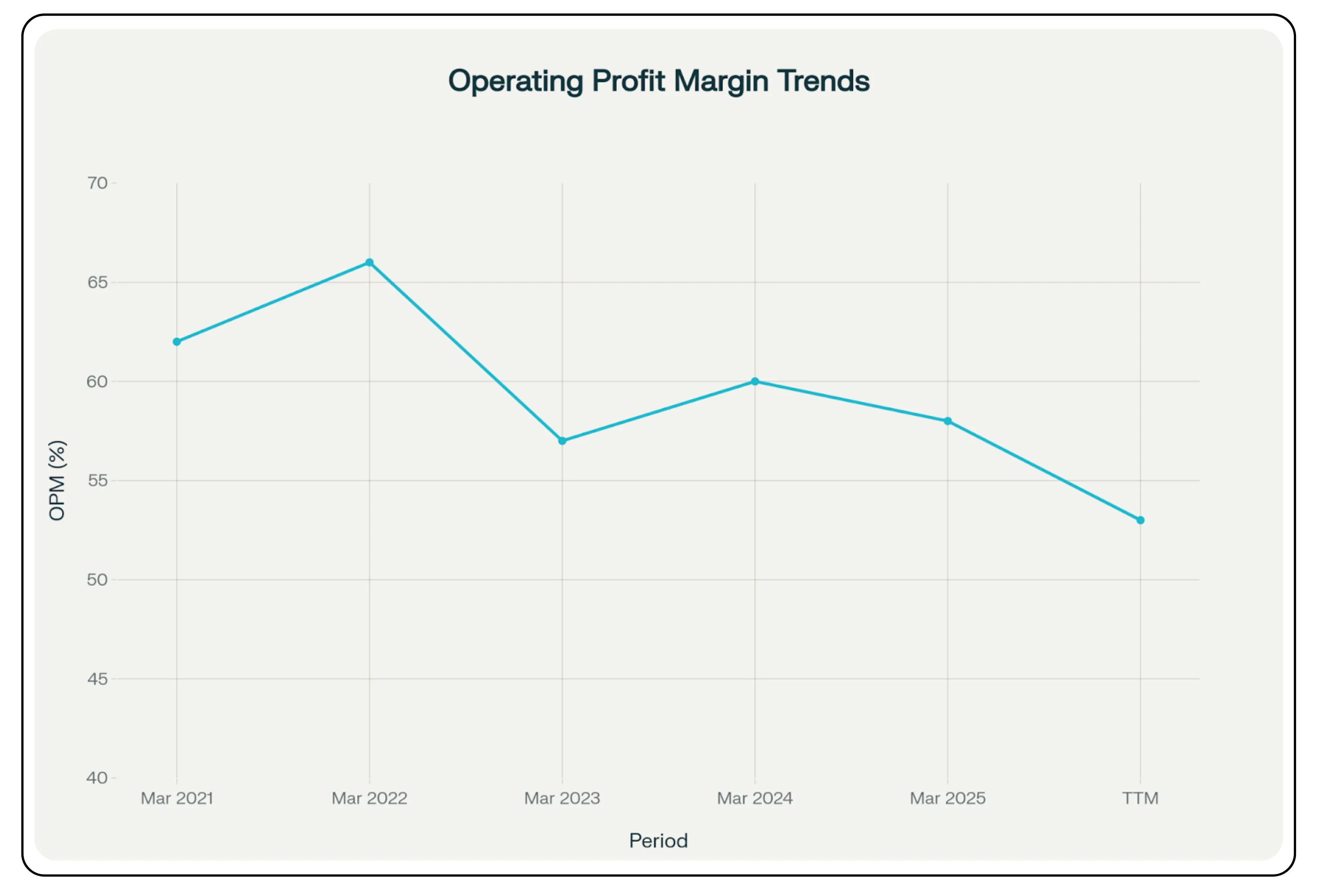
Operating profit has increased from ₹212 crore to ₹625 crore (Mar 2025), representing a 2.95x expansion in absolute terms. However, the operating margins tell a more cautionary story. The OPM peaked at 66% in Mar 2022 but has experienced a steady downward trend, declining to 53% in the TTM period. This 13 percentage point decline is significant and warrants investigation into:
- Rising input costs or raw material inflation
- Increased employee costs or wage expansion
- Operating leverage dilution due to rapid scaling
- Competitive pricing pressures in expanding markets
- Operational inefficiencies during rapid growth phases
3. Net Profit Performance
Net profit increased from ₹201 crore (Mar 2021) to ₹526 crore (Mar 2025), representing a 2.62x increase. However, like operating profit, net profit margins have been compressed. The most concerning observation is the TTM net profit of ₹473 crore, which is lower than Mar 2025's ₹526 crore by ₹53 crore. This suggests either seasonal weakness or ongoing margin pressures that are accelerating.
4. Growth vs. Profitability Trade-off
| Metric | Mar 2021 to Mar 2025 Growth | TTM Deterioration |
|---|---|---|
| Sales | +214.8% | -0.2% |
| Operating Profit | +194.8% | -7.8% |
| Net Profit | +161.7% | -10.1% |
The company is experiencing a classic growth vs. profitability trade-off. While revenues are expanding aggressively, the company's ability to convert those revenues into profits is diminishing. This is evident from:
- Net profit margin declining from 58.4% (Mar 2021) to 43.8% (Mar 2025) to 43.8% (TTM)
- Operating margin compression of 9 percentage points over four years
5. TTM Warning Signals
The TTM figures show concerning trends:
- Sales are nearly flat YoY (-0.2%), suggesting the growth momentum may be slowing
- Operating profit declined 7.8% from Mar 2025 to TTM, indicating accelerating margin pressures
- Net profit fell 10.1% from Mar 2025 to TTM, the sharpest decline in the series
6. Strategic Implications
For a trader or investor, this data presents a mixed picture:
- Positives: Strong historical growth, elevated profitability (53% OPM is still excellent), strong absolute profit levels
- Negatives: Margin compression trend, slowing growth in TTM, profitability declining faster than revenue, potential operational challenges
Key Takeaways
CDSL plays a central role in India’s capital market structure as the first depository with advanced depository services.
It securely stores shares, bonds, mutual funds, and other securities in digital form for millions of investors. Every investor who wants to trade needs a Demat account with either CDSL or NSDL.
CDSL’s revenue model is stable, diversified, and largely recurring.
It earns through annual issuer charges, transaction fees, KYC services, IPO and corporate action processing, and several value-added services like e-voting and document storage.
Transaction-based revenue is growing rapidly due to rising market participation.
With more investors and higher trading volumes in India, CDSL’s transaction charges have become one of its fastest-growing revenue contributors.
Quarterly performance shows strong long-term growth despite short-term fluctuations.
Sales and profits peaked in Sep 2024, dipped in early 2025, and showed recovery by Sep 2025—indicating overall business resilience and strong demand for its services.
Profit margins and EPS remain strong, supported by low debt and high operational efficiency.
Even with temporary margin compression in early 2025, CDSL continues to maintain high OPM (50–60%), strong cash flows, and healthy EPS growth.
Start yours with smart investing on CubePlus and take control of your financial goals. Click here to sign up
Disclaimer: The information provided in our blogs is for informational purposes only and should not be construed as financial, investment, or trading advice. Trading and investing in the securities market carries risk. Always conduct your own research and consult with a qualified financial advisor before making any investment decisions. Past performance is not indicative of future results. Copyrighted and original content for your trading and investing needs.
© 2025 — Tradejini. All Rights Reserved.