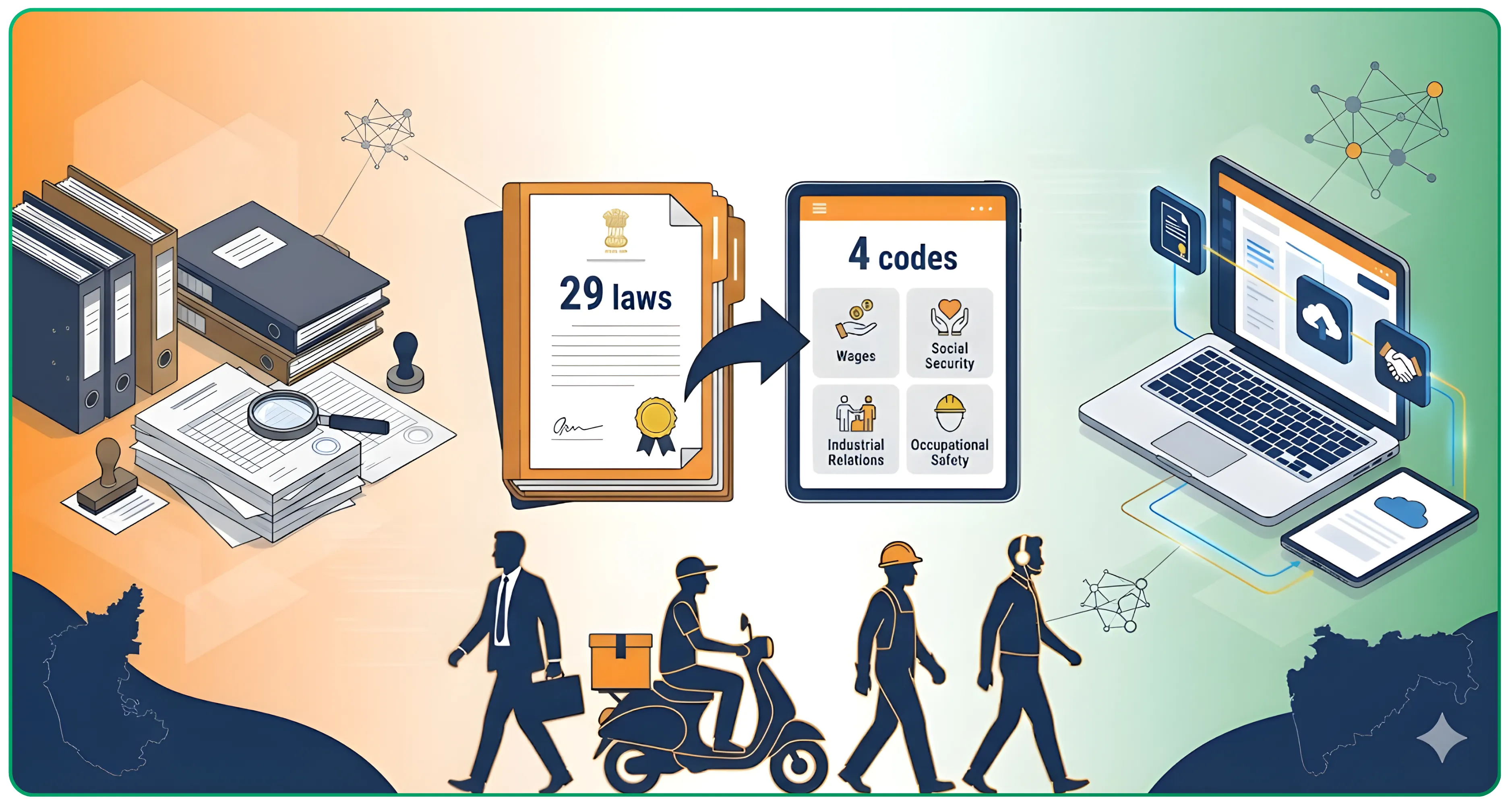
On November 21, 2025 India implemented four labour codes that consolidate 29 central labour laws accumulated over nearly a century. The Code on Wages, Industrial Relations Code, Code on Social Security, and Occupational Safety, Health and Working Conditions Code reduce approximately 1,400 rules to around 350, according to the Ministry of Labour and Employment's November 20 notification. Compliance forms drop from 180 to 73.
The implementation drew immediate opposition. Ten central trade unions organized nationwide protests on November 26, calling the reform "unilateral" and demanding withdrawal. Meanwhile, staffing companies saw sharp stock movements—TeamLease Services rose 11% on November 24.
The codes introduce several substantive changes to India's employment framework. The threshold for mandatory government approval before layoffs increases from 100 to 300 employees. Companies must now classify at least 50% of employee compensation as "basic pay" for calculating provident fund and gratuity contributions, closing a loophole where firms minimized these obligations by loading compensation into allowances.
For the first time, Indian labour law formally recognizes gig and platform workers. The Code on Social Security requires aggregators like Zomato, Swiggy, and Urban Company to contribute between 1-2% of annual turnover to a government-administered social security fund, though this amount is capped at 5% of actual worker payouts. For platforms where delivery partner costs represent a large share of revenue, the 5% cap typically binds, making the effective contribution lower than the headline rate. Fixed-term employees become eligible for gratuity after one year instead of five.
The reform also restricts labour inspections through an algorithm-driven system, replacing what businesses described as arbitrary inspector discretion. Many violations previously carrying criminal penalties have been decriminalized, with firms now receiving an "opportunity to rectify" defects before prosecution.
SBI Research released projections on November 24 estimating the codes could increase workforce formalization from 60.4% to 75.5%—adding roughly 10 crore workers to formal payrolls. The report projects 77 lakh new jobs and a ₹75,000 crore consumption increase through higher purchasing power, with social security coverage potentially reaching 80-85% within 2-3 years from the current 64.3%. These are modeling projections based on a 30% saving rate and ₹66 daily per-person consumption boost, not historical precedent.
The timeline for observable effects remains uncertain. SBI's consumption boost estimate lacks a specified lag mechanism. EPFO enrollment data would likely show inflection only after 6-12 months as businesses adjust and state rules take effect.
Implementation depends heavily on state cooperation. Labour is a concurrent subject in India's federal structure, requiring states to draft accompanying rules. Karnataka, Maharashtra, and Kerala have notified their rules. Tamil Nadu and Delhi have not completed this process, creating regulatory uncertainty in major industrial centers. Legal analysts estimate 18-24 months for complete state-level implementation.
The compliance changes create divergent impacts. MSMEs currently face 1,450 annual compliance obligations costing ₹13-17 lakh according to TeamLease RegTech data. The unified framework reduces this burden, but the mandatory 50% basic pay provision increases immediate costs by 5-7% for most employers, according to India SME Forum estimates.
Manufacturing companies face offsetting effects. Higher wage costs from provident fund contributions calculated on 50% of CTC rather than current structures increase labor expenses. The raised layoff threshold from 100 to 300 employees and streamlined compliance potentially offset these through operational flexibility.
The Industrial Relations Code also modifies strike procedures. Workers must provide 14-day notice before striking across all sectors, expanded from previous requirements limited to public utilities. Notices trigger mandatory conciliation proceedings overseen by a government officer. Strikes are prohibited while conciliation continues and for one week afterward. Union representatives argue this constrains workers' negotiating leverage.
Market analysts are monitoring EPFO enrollment data for formalization evidence, state rule notifications, and MSME earnings reports showing adaptation costs. Staffing companies anticipate increased demand as firms outsource compliance management. IT services companies face higher provident fund costs but reduced legal complexity. FMCG and consumer companies are positioned to benefit if formalization drives consumption, though the mechanism and timeline remain unproven.
The reform represents India's largest labour law overhaul since economic liberalization in 1991. Whether it achieves stated objectives depends on state cooperation, enforcement capacity, and how businesses adapt to the new cost structure. Early market reactions suggest investors are pricing in sectoral impacts, but broader economic effects will take quarters to materialize and require tracking through formal employment data.
Disclaimer: The information provided in our blogs is for informational purposes only and should not be construed as financial, investment, or trading advice. Trading and investing in the securities market carries risk. Always conduct your own research and consult with a qualified financial advisor before making any investment decisions. Past performance is not indicative of future results. Copyrighted and original content for your trading and investing needs.
© 2025 — Tradejini. All Rights Reserved.