

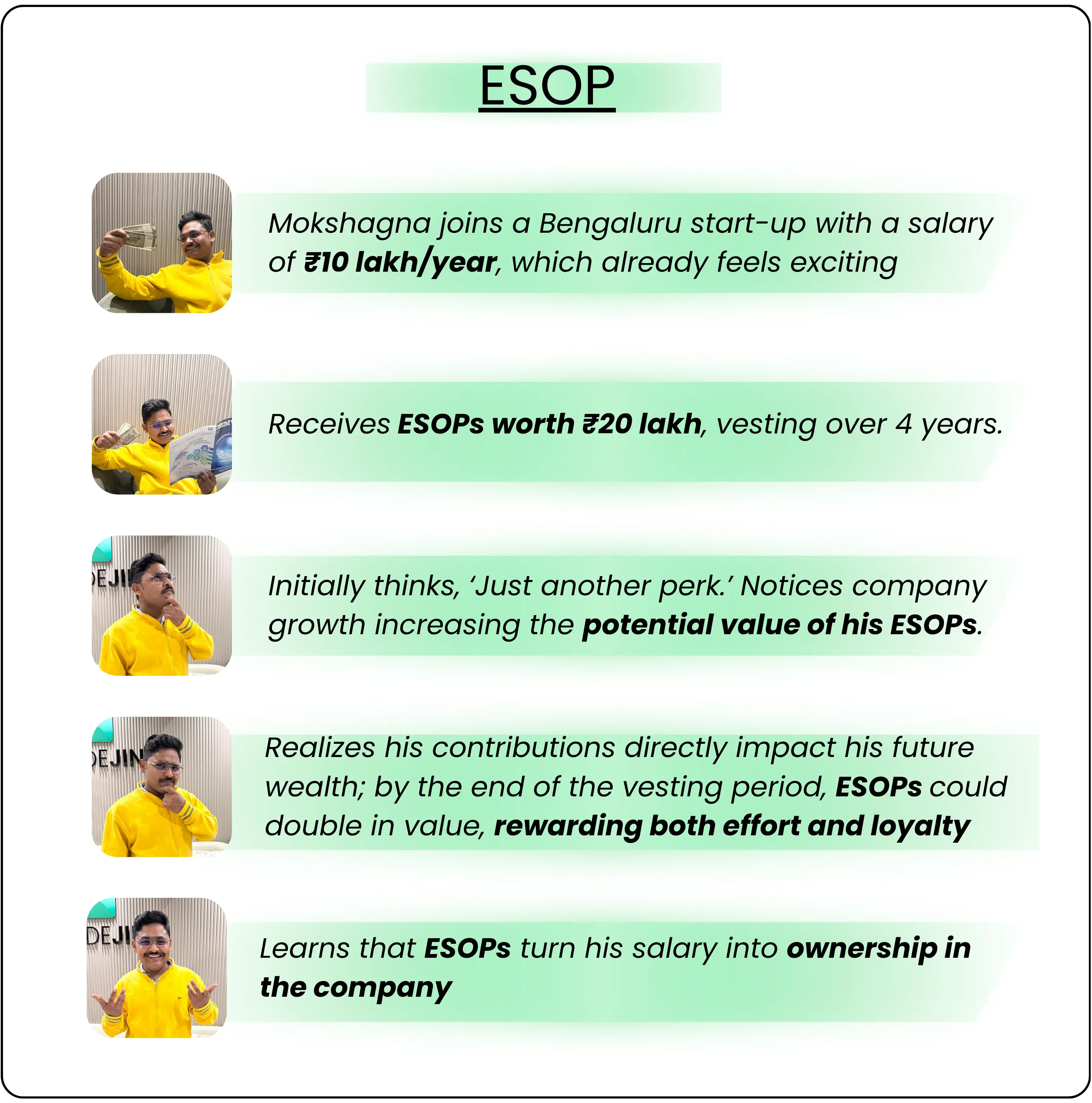
Now, are you thinking about your perks too?
It’s natural, most of us think of a fixed monthly salary and maybe an annual bonus. But today, modern compensation goes beyond that. One powerful component that can truly build long-term wealth is the Employee Stock Option Plan, or ESOP.
So, how ESOPs work in India?
An Employee Stock Option Plan (ESOP) is a benefit scheme where companies grant employees the right (but not the obligation) to buy company shares at a fixed price after a certain period. The idea is simple: if the company does well, its share price goes up. You, as an employee, benefit by having the option to buy shares at a lower, pre-decided price. It’s a way of rewarding employees while ensuring their goals are aligned with the company’s success.
Take Infosys, for example. In the 1990s, many employees were granted ESOPs. Back then, few imagined how valuable those shares would become. But for the employees who stayed on and exercised their options, the rewards were life-changing.
Why do companies offer ESOPs?
In many ways, it’s ESOP vs salary compensation. While salary gives stability, ESOPs give you a stake in the company’s future growth. Companies use ESOPs as more than just a financial perk. The logic is straightforward. If employees own part of the company, they are more likely to think and act like owners rather than just staff. That mindset shift creates a stronger bond between the individual and the organization. There’s also the retention angle. Most ESOPs come with a ‘vesting period.’
ESOP vesting period meaning: It is a mandatory wait before employees can claim their shares. This means you need to stick around for a few years before you actually benefit. It’s a neat way to reduce attrition.
Want to watch IPL for free?
Make Dividends Your IPL Ticket Sponsor
And let’s not forget start-ups. In their early days, they usually don’t have the money to pay fat salaries. ESOPs give them a way to reward talent without burning current cash flow.
Recent big ESOP news in India
| Date (Reported) | Company | ESOP Event |
|---|---|---|
| Sep 2025 | Ather Energy | Rolled out ESOPs worth ₹71 crore to employees and senior management under its 2025 plan, involving 12.7 lakh equity shares. |
| Nov 2024 | Mahindra Group | Granted a one-time ESOP as Diwali bonus to 12,000–14,000 employees, including shop-floor workers across subsidiaries. |
| Jul 2024 | Darwinbox | Conducted ESOP buyback of ~$10 million (≈ ₹86 crore), its third and largest buyback in four years. |
| Jun 2024 | Meesho | Announced the largest ESOP buyback programme worth ₹200 crore, benefiting about 1,700 employees (current and former). |
| Aug 2023 | Paytm | Founder & CEO Vijay Shekhar Sharma voluntarily surrendered 21 million ESOPs (≈ ₹1,800 crore) after SEBI scrutiny. Also reported ESOP costs significantly impacting profitability. |
| Apr 2023 | Infosys | Granted ESOPs worth ₹50–51 crore to CEO Salil Parekh under performance and ESG-linked grants. |
How do ESOPs work?
The process usually unfolds in four key stages:
- Grant of options – The company offers stock options to eligible employees.
- Vesting period – Employees must stay with the company for a minimum period (at least 1 year) before they can use the options.
- Exercise of Options – Once vested, employees can choose to buy shares at the pre-decided price, often lower than the current market value. The ESOP exercise price definition is simply this fixed price at which you can buy.
- Selling shares – Employees can sell their shares in the market (if listed) or back to the company (if unlisted). If the market price is higher than the exercise price, they make a profit.
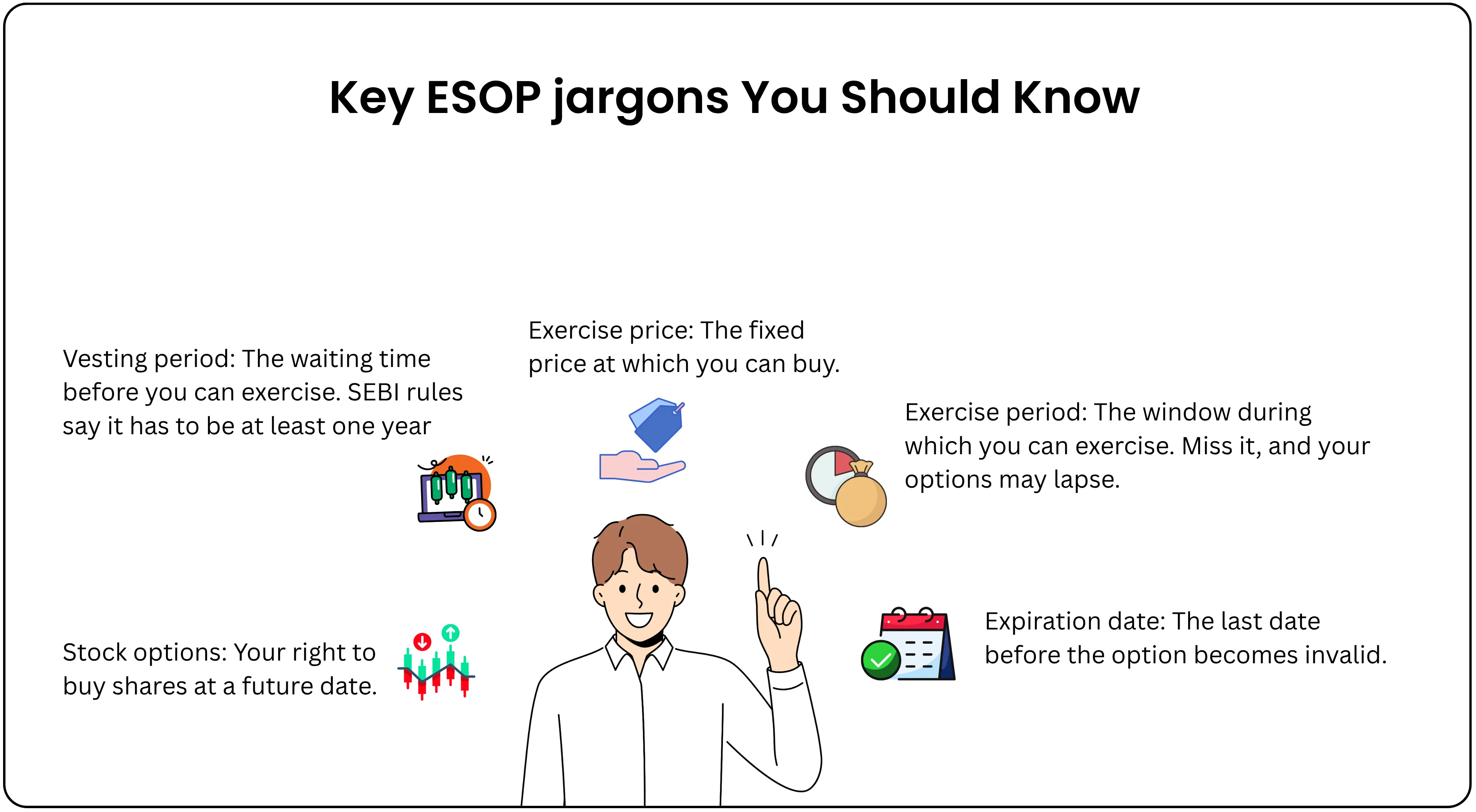
Rules and regulations
ESOPs in India are governed by:
- SEBI rules for ESOPs under the Share Based Employee Benefits and Sweat Equity Regulations, 2021 – for listed companies
- Companies Act, 2013 – for unlisted companies.
- Income Tax Act, 1961 – which covers taxation on exercise and sale.
What about taxes?
ESOP taxation in India… here’s where it gets tricky. With ESOPs, you get taxed twice:
- When you exercise: The difference between the market price and your exercise price is treated as income (a perquisite). It’s added to your taxable income and taxed as per your applicable income tax slab.
- When you sell: Any gains from selling are taxed as capital gains.
Let’s make this clearer with an example.
Say your company grants you 1,000 options at an exercise price of ₹85. By the time you are eligible, the market price is ₹150. If you exercise, the difference (₹65 × 1,000 = ₹65,000) is added to your taxable salary income.
Now, suppose you sell these shares at ₹180 a year later. The extra gain (₹30 × 1,000 = ₹30,000) is taxed as long-term capital gains. (This portion is subject to ESOP capital gains tax).
For start-ups, the government has given some relief by deferring the tax payment on exercise. You pay later. Either when you sell the shares, leave the company, or the 5-year period is counted from the date of exercise, not the grant date, whichever comes first.
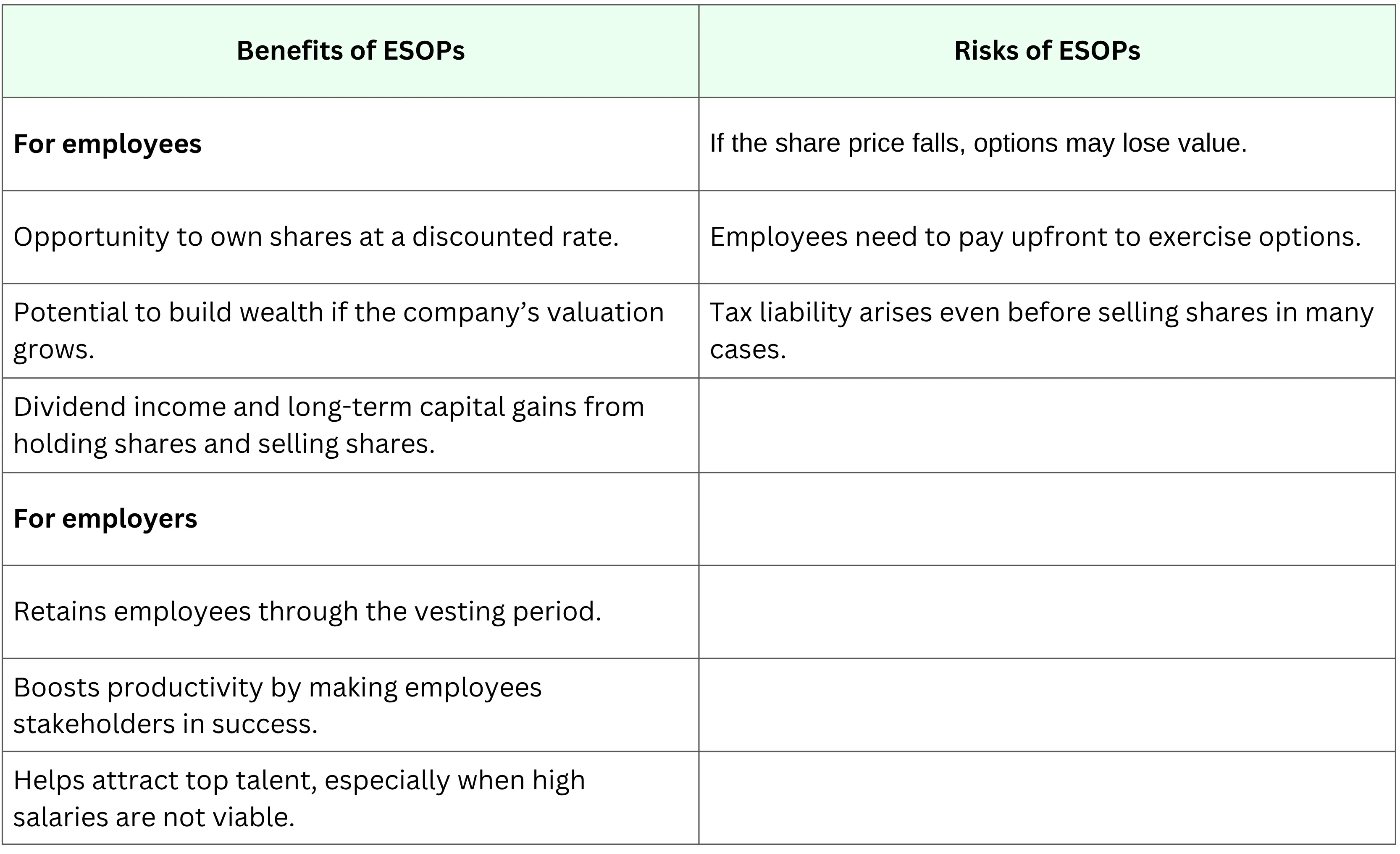
ESOP benefits for employees (ESOP risk and rewards)
ESOPs in listed vs. unlisted companies
If your company is listed, exercising and selling ESOPs is relatively straightforward, you can sell shares in the stock market whenever you want. But ESOPs in unlisted companies, things get complicated. Since the shares don’t have a ready market, the buyback is usually done by the company itself, and the valuation is determined by a merchant banker. For unlisted shares, long-term capital gains are generally taxed at 20% with indexation, subject to prevailing tax laws and holding period rules.
Rewards beyond salary packages
ESOPs are a powerful tool for wealth-creation, but only if you truly understand how they work. Don’t just look at them as a shiny addition to your pay package. Study the vesting terms, the exercise price, the company’s growth potential, and, of course, the tax angle.
When handled wisely, ESOPs can make you not just an employee, but a true stakeholder in your company’s success.
So, do you have ESOPs?
No? Well, then it’s time to start thinking about investing at least. Begin with Tradejini’s CubePlus and explore equities, mutual funds, and more.
Disclaimer: The information provided in our blogs is for informational purposes only and should not be construed as financial, investment, or trading advice. Trading and investing in the securities market carries risk. Always conduct your own research and consult with a qualified financial advisor before making any investment decisions. Past performance is not indicative of future results. Copyrighted and original content for your trading and investing needs.
© 2025 — Tradejini. All Rights Reserved.