Imagine you run a profitable family-owned restaurant. Business is steady, cash flows are healthy, and there’s no urgent need to open new branches or invest heavily for future growth. Instead of expanding, you decide to buy back a few ownership stakes from early partners who want to exit. You are not shrinking the business or reducing profits. You are simply consolidating ownership because you believe the business is worth more than what the market currently thinks.
Listed corporations do something very similar in the stock market.
Over the years, several large Indian companies have strategically announced stock buyback programs, where the company repurchases its own shares from existing shareholders. This process, known as a stock buyback or share buyback (also called a share repurchase), reduces the number of equity shares and shares outstanding in the market, redistributes excess free cash flow, and can support the company’s share price over time.
So why would a company choose to buy back shares instead of investing retained earnings elsewhere, paying dividends, or funding growth? To understand this, let us first understand how share buybacks work.
What is a Stock Buyback?
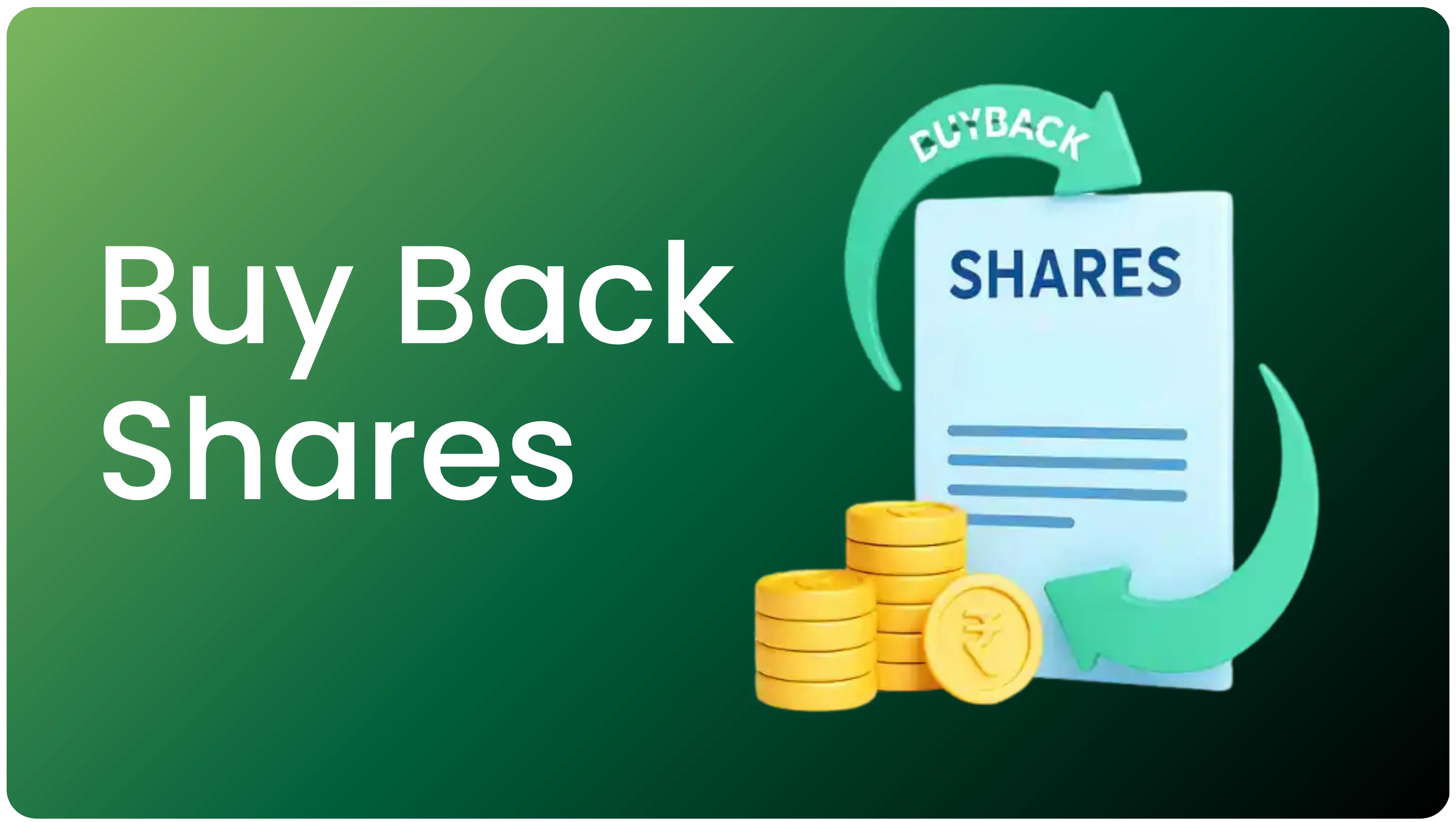
A stock buyback or sharebuyback is a corporate action where a company purchases its own shares from existing shareholders, usually at a premium to the current market price or prevailing share price range. Once bought back, these shares are either cancelled (removing shares permanently and reducing remaining share count) or held as treasury stock for future use such as employee stock options.
A company’s stock buyback directly reduces the total equity base and market cap, while potentially boosting earnings per share (EPS) by spreading the same level of profits over fewer shares outstanding, even if overall earnings are not growing rapidly. This can enhance the value of remaining shares by decreasing supply and improving capital efficiency.
Types of Buybacks in India
1. Open Market Buyback
In an open market buyback, the company buys shares directly from the stock exchange (NSE or BSE) at prevailing share prices over a specified future date or period. These buy back transactions happen like normal trading and are funded from free reserves or retained earnings.
2. Tender Offer Buyback
In a tender offer buyback, the company announces a fixed buyback price, usually at a premium to the current market price. Shareholders and investors can choose to tender or sell their shares back to the company through the exchange mechanism.
3. Dutch Auction
Under the Dutch auction method, the company specifies a price range, and shareholders indicate how many shares they are willing to sell and at what price within that range. The final share buyback price is determined based on aggregated bids.
Why Do Companies Buy Back Their Own Shares?
1. Returning Cash to Share BuyBack
When companies generate surplus cash and free cash flow beyond business requirements, they must decide whether to invest, pay dividends, or return capital through buybacks. A buyback allows the company to return money efficiently to shareholders.
Example: TCS conducted a ₹17,000 crore buyback later in 2023, approved after Q2 results, for 4.09 crore shares at ₹4,150 per share.
With strong profits, healthy cash balances, and limited immediate investment needs, the company chose to return capital instead of holding idle cash on its balance sheet.
2. Improving Financial Ratios and Boosting Earnings
By reducing shares outstanding, buybacks mechanically improve financial metrics:
- Earnings per Share (EPS): Same earnings divided by fewer shares increases EPS
- Return on Equity (ROE): Improves as equity reduces
- Price-to-Earnings (P/E) Ratio: May appear more attractive due to higher earnings per share

Example: Wipro’s 2019 share repurchase of ₹11,000 crore reduced outstanding shares, helping boost EPS from ₹16.8 to approximately ₹18.2, which improved investor perception and valuation metrics.
3. Signaling Undervaluation and Management Confidence
When promoters, executives, and management believe the company’s stock and share price are undervalued relative to intrinsic value, a buyback sends a strong signal of confidence to the market. At the same time, some investors may interpret frequent buybacks as a signal that the business lacks attractive growth opportunities, especially if reinvestment and R&D spending appear constrained.
Example:
2021 Jan 19 Buy Back of Shares 237500000 shares Bought back.
2019 Sep 10 Buy Back of Shares 323076923 shares have been bought back.
HCL Technologies announced stock buybacks to reassure investors about long-term business strength despite short-term volatility in stock prices.
4. Tax Efficiency for Investors
Buybacks can be more tax-efficient than dividends for certain shareholders and offer greater flexibility, as companies do not make a long-term promise and can adjust or pause buyback programs as market conditions change.
- Dividends are taxed in the hands of investors at applicable income tax rates
- Buyback proceeds are treated as capital gains, which may offer lower tax impact depending on the holding period.
- Post-2020 Budget, listed company buybacks incur 20% flat tax at company level (no DDT), shifting dynamics—but still often more efficient than high-slab dividends for individuals.
5. Preventing Hostile Takeovers and Increasing Control
By reducing the number of shares available in the market, buybacks can make hostile takeover attempts more expensive. They also increase promoter ownership percentage without additional investment, giving more control over the business.
6. Optimising Capital Structure
Companies may use buybacks to adjust their debt-to-equity ratio, return excess capital, and improve balance sheet efficiency. Some firms fine-tune their mix of debt and equity by borrowing at relatively low rates to fund buybacks, though excessive borrowing can increase financial risk and reduce flexibility if economic conditions weaken.
Benefits of Stock Buybacks
For the Company
- Flexible capital allocation compared to fixed dividend payouts
- Efficient use of retained earnings and free reserves
- Improvement in earnings, EPS, and equity ratios
- Increased promoter ownership and control
For Shareholders
- Opportunity to sell shares at a premium price
- Potential capital gains and higher stock price over time
- Tax-efficient returns compared to dividends
- Strong signal of management confidence
SEBI Regulations on Buybacks in India
- Maximum Limit: Up to 25% of paid-up capital and free reserves
- Minimum Gap: One year between two buyback offers
- Funding Sources: Free reserves, securities premium, or proceeds from earlier share issues
- Debt Restriction: Companies cannot use borrowed funds or debt
- Promoter Participation: Promoters may participate proportionately or abstain
- Disclosure: Detailed disclosures on price, quantity, and process are mandatory
How Does a ShareBuyback Affect Stock Price?
In the short term, buybacks often support the stock price and share price by reducing supply and improving market sentiment. Academic research suggests that the immediate price impact is usually modest and does not reverse on average, while long-term outcomes depend heavily on valuation discipline and business fundamentals. Over the long term, value creation depends on whether the company buys back shares at reasonable valuations. Buybacks at excessive prices may hurt investors despite fewer shares outstanding.
Also Read: How Do Bonus Issue of Shares Work?
Buybacks vs Dividends
| Aspect | Buybacks | Dividends |
|---|---|---|
| Flexibility | High | Low |
| Tax Treatment | Capital gains | Taxed as income |
| Signal | Undervaluation | Stable cash flow |
| Shareholder Choice | Optional participation | Mandatory payout |
| Market Impact | Can lift share price | Usually neutral |
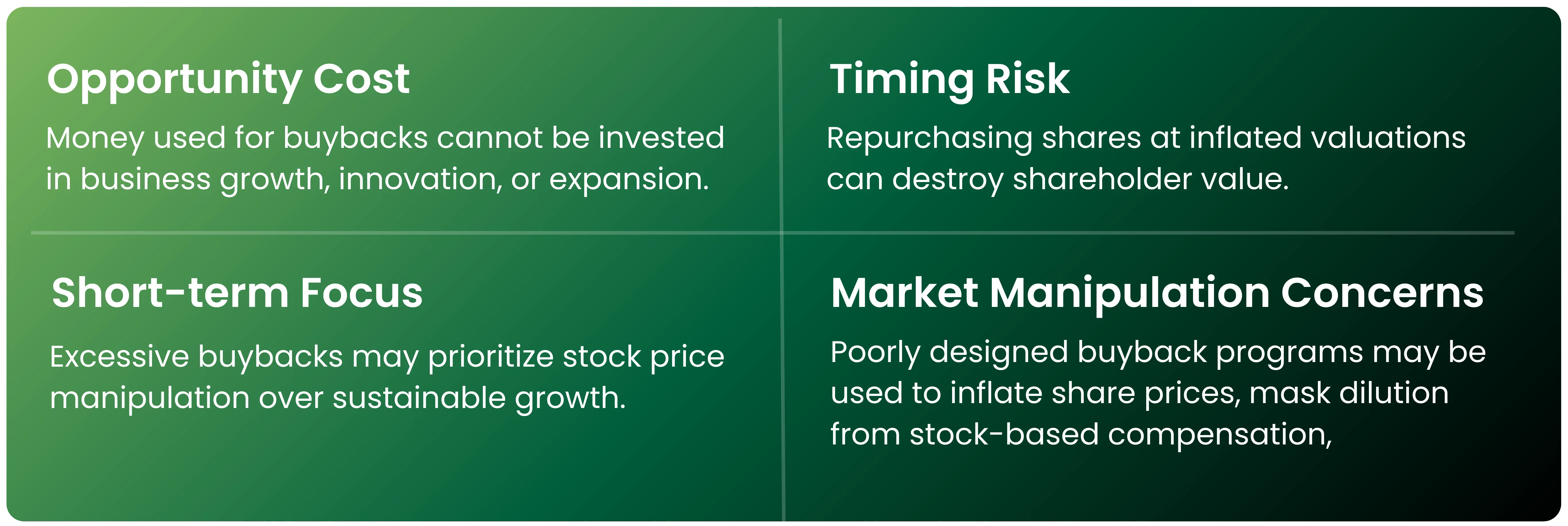
What Investors Should Watch for Share BuyBack
- Buybacks funded through debt or borrowing
- Consistent buybacks at high market valuations
- Companies avoiding growth investment in favor of buybacks
- Promoters not participating in tender offers
- Buyback announcements near market peaks
Also Read: How are bonus shares credited to a DEMAT account?
Conclusion
Globally, including in 2026, stock buybacks remain a key method for companies to return capital to shareholders, signal financial stability, and counter risks such as unwanted accumulation of controlling stakes. However, buybacks also attract criticism for prioritizing short-term earnings improvements over long-term strategic investments and for creating misaligned incentives between shareholder value and executive compensation.
In recent years, buyback activity in India has moderated. Elevated stock prices, stricter capital allocation discipline, and buyback taxes have pushed many companies to favour higher dividends. Ultimately, the best businesses create long-term value through sustainable growth, strong profits, and disciplined capital allocation. Stock buybacks should complement genuine business performance, not replace it.
Begin disciplined investing in listed shares through CubePlus and stay in control of your financial goals.
Disclaimer: The information provided in our blogs is for informational purposes only and should not be construed as financial, investment, or trading advice. Trading and investing in the securities market carries risk. Always conduct your own research and consult with a qualified financial advisor before making any investment decisions. Past performance is not indicative of future results. Copyrighted and original content for your trading and investing needs.
© 2026 — Tradejini. All Rights Reserved.
.webp%3Falt%3Dmedia%26token%3D0ead9799-20bc-4d1e-ae8f-d75ab18921b5&w=3840&q=75)