

Options trading offers a variety of strategies that traders use to lead market volatility. Among these, the straddle has become a popular choice due to its ability to benefit from significant price movements regardless of direction.
A straddle is a market-neutral strategy that involves simultaneously purchasing a call option and a put option with the same strike price and expiration date. This approach is particularly useful when a trader anticipates significant price movement in the underlying asset but is uncertain about the direction of the movement.
What makes the straddle strategy appealing is its ability to generate profits regardless of whether the market moves up or down, as long as the movement is substantial enough to offset the combined cost of the options. While this strategy offers high potential rewards, it also comes with inherent risks, such as the premium paid for both options, which could lead to losses if the market remains stagnant.
Let us explore the mechanics of the straddle strategy, its key advantages, risks, and practical applications in varying market conditions. Whether you are a seasoned trader or a curious beginner, understanding the straddle can add a powerful tool to your options trading arsenal, helping you navigate periods of heightened market volatility with confidence.
Application of strategies in real-time:
The 9.20 0 DTE Straddle Strategy: Mechanics and Timing
The 9.20 0 DTE strategy straddle is a type of straddle strategy wherein the trader enters a straddle at 9.20 AM in Indian markets, soon after the market opens. Here, 0 DTE stands for ‘zero days to expiration’. 0 DTE strategy can be built only on strikes that are expiring on the same day.
Buying both a call and a put option at the same strike price is known as a long straddle, while selling both a call and a put option at the same strike price is called a short straddle. These strategies are widely used in options trading, but they come with specific risks and limitations. There is 9.20 short straddle strategy and 9.20 long straddle strategy approach which is been used by many.
Let’s explore new 9.20 Strategy
To achieve better results in trading, it is crucial to follow a systematic approach and understand certain principles:
- Market Trend Analysis:
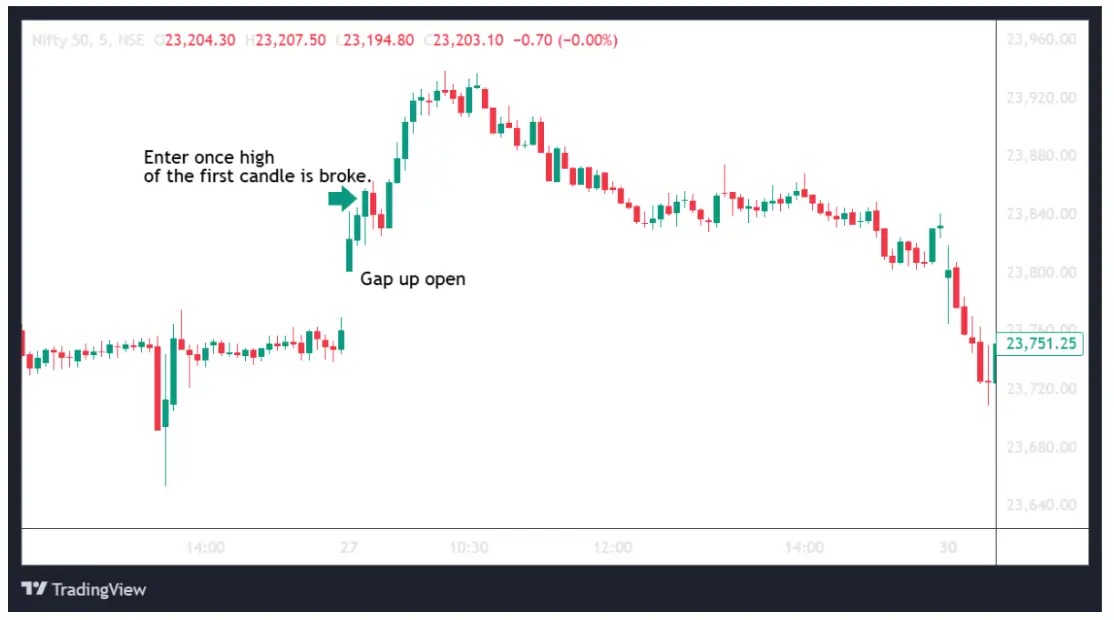
Always analyze the market trend before applying any strategy. If the market opens lower but moves upwards, the first candlestick should ideally be green (bullish). This signals an upward trend. Similarly, it could be vice-versa. - First Candle's Significance:
- For the 9.20 strategy to be effective, the first candle must close as a green candle.
- Your entry price will be based on the high of the first candle break.
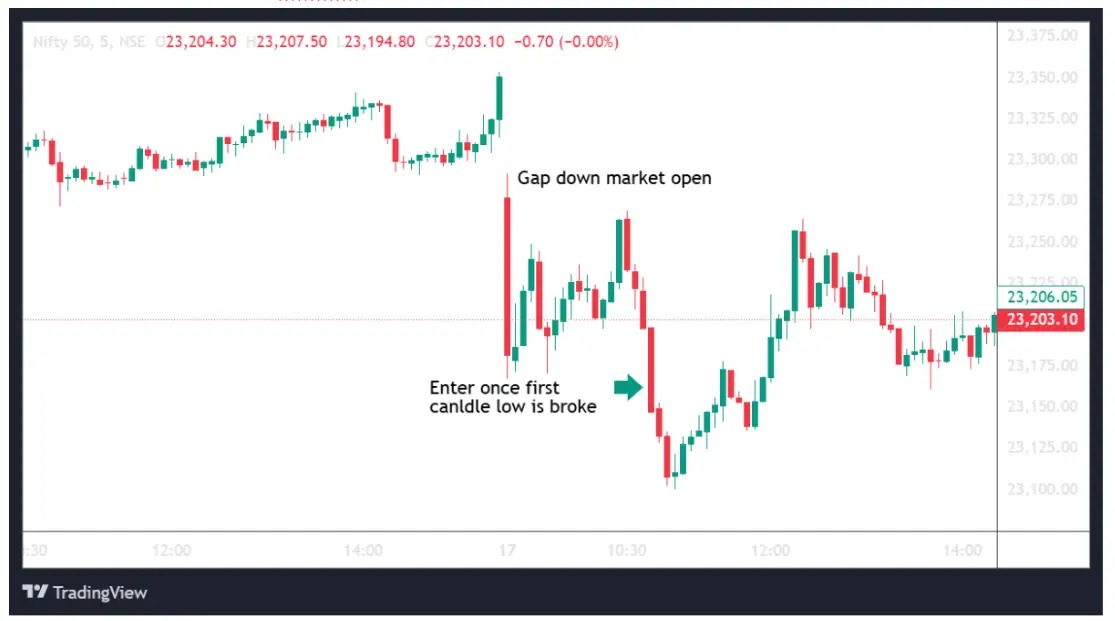
- Note that when there is significant market movement (gap up or down), the stop loss tends to be larger. Adjust your stop loss accordingly. In Gap Down, entry will be low during the first candle break.
- Stop Loss Adjustment:
- The stop loss should be dynamic and based on the market's volatility. If there is a significant gap opening, adjust your stop loss to match the market's behaviour.
- Momentum Trades:
- If the market opens with a big gap and the first candlestick is green, it signifies momentum. Enter trades cautiously, keeping in mind the potential for larger moves. For gap down, the reverse is true.
- Reduce position size when the market trend is unclear or moving against your preferred strategy.
- Market Scenarios:
- If the market opens near resistance levels or shows negative momentum (red candles), avoid aggressive entries.
- For strategies like the 9.20 approach, ensure that the trend aligns with your strategy, or else refrain from entering trades.
- Adjusting for Volatility:
- On volatile days, reduce your quantity to manage risk effectively.
- Larger gaps require smaller positions to avoid overexposure.
- Key Observations for Consistency:
- When the market trend is positive and the opening is near the previous day's highs, focus on green candles for confirmation.
- Avoid trades when market sentiment is weak or conflicting with your strategy's requirements.
- Execution and Discipline:
- Follow the strategy rules diligently to avoid unnecessary losses.
- Be patient and wait for the perfect setup, especially during uncertain market conditions.
By adhering to these principles, you can navigate the market more effectively and maximize potential gains while minimizing risks. Additionally, to achieve better results in trading, it is crucial to follow a systematic approach and understand certain principles. Download our stock trading app to execute strategies seamlessly and stay ahead in the market.
The below chart reflects Gapup's open
Below chart reflects Gapup Down.
Iron Butterfly Strategy
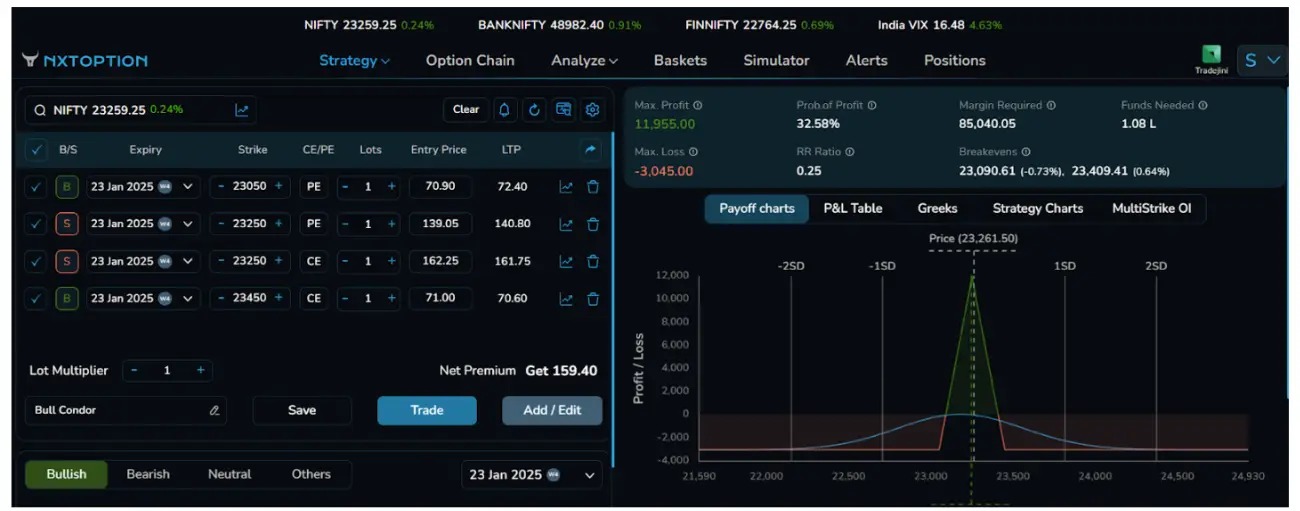
The Iron Butterfly is a popular options trading strategy designed to benefit from stable markets and time decay. It involves selling an out-of-money call-and-put option while simultaneously buying further out-of-the-money options for protection. This creates a risk-defined position with limited potential loss and profit.
The strategy profits when the underlying asset's price remains within the predefined range, allowing the sold options to expire worthless. It is favoured by traders for its balanced risk-to-reward structure and suitability for range-bound market conditions.
Key Components of the Iron butterfly Strategy:
Structure of the Trade:
- Sell 1 ATM Call: Collect premium, expecting it to expire worthless.
- Buy 1 OTM Call (further out): Protection against unexpected upward movement.
- Sell 1 ATM Put: Collect premium, expecting it to expire worthless.
- Buy 1 OTM Put (further out): Protection against unexpected downward movement.
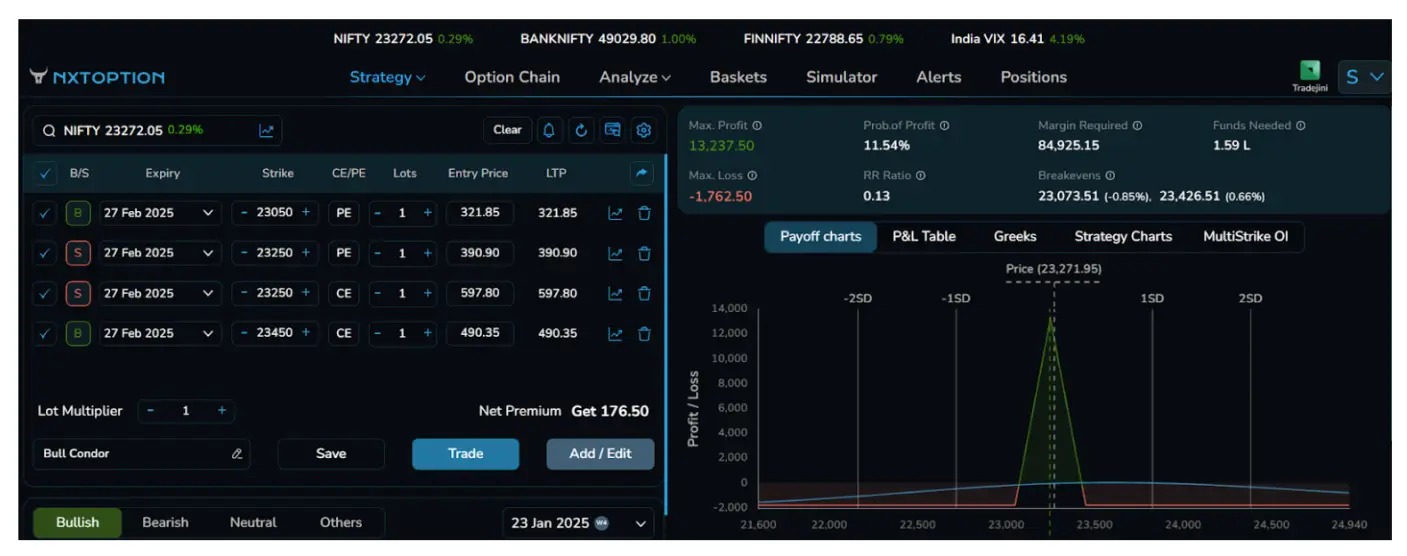
These four legs create the ‘Butterfly’ structure. As shown in the below image the Iron Butterfly can be placed through Cubeplus in one go.
Objective:
Bet that the stock price will stay within a certain range (between the short strikes) until expiration.Maximum profit occurs when all sold options expire worthless.
Profit/Loss Dynamics:
- Maximum Profit: Net premium collected (short options' premiums - cost of long options).
- Maximum Loss: The difference between short and long strikes minus the net premium collected.
- Break-Even Points:
- On the upside: Short call strike + premium received.
- On the downside: Short put strike - premium received.
Risk-Reward:
- High probability of success but poor risk-to-reward ratio.
- Maximum loss is limited by the protective long options.
How Time Decay Works for Iron Butterfly:
- Theta Decay:
- The premium of OTM options declines as expiration approaches, favouring the seller.
- Only if the stock remains in a range, sold options lose value faster than the long options, leading to profits.
Steps to Enter an Iron Butterfly:
Choose Strikes:
- For neutral trades, pick strikes with balanced probabilities
- Adjust strikes for risk/reward:
Set Expiration:
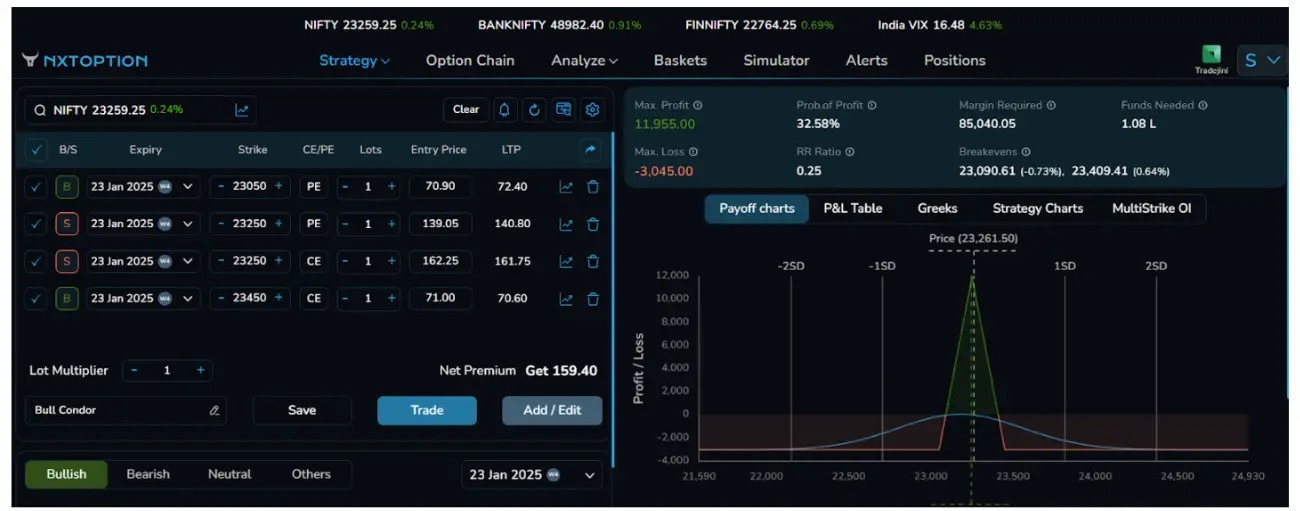
- Typically, Weekly to 45 days to expiration provides a good balance of time decay and manageable risk. Look into the difference provided in the images below where the expiration date varies in the provided images: one is immediate expiry and another image is monthly after-month expiry. Additionally, check the payoff to choose your strike price.
Execute as a basket order:
- Cubeplus from the TradeJini platform allows placing all four legs together, simplifying trade.
Monitor Breakeven Range:
- Ensure the stock price remains within your breakeven points. Avoid selecting strike prices that are unrealistically far from achievable levels, as this may prevent you from realizing a profit.
Key Takeaways:
Advantages:
- Defined risk and reward.
- Takes advantage of time decay.
- High probability of success in range-bound markets.
Disadvantages:
- It has limited profit potential.
- It requires close monitoring if the stock price approaches the breakeven point.
By understanding the dynamics and carefully selecting your strikes, the Iron Butterfly can be a powerful tool in your options trading.
Conclusion:
This strategy is optimal for taking advantage of significant market volatility in whichever direction it happens. Straddles combine both a call and a put option at the same strike price, creating an opportunity for traders to hedge and profit from strong movements in the price. It depends quite a lot on how close the volatility is forecasted to get; low volatility may not justify the premiums paid. Strategically applied, it can be a great way to manoeuvre through uncertain markets while managing risk.
Disclaimer: This blog is for informational/educational purposes only and does not constitute financial or investment advice. Readers should conduct their research and consult professionals before making any investment decisions. The author is not responsible for any financial outcomes.