

Over the past few days, traders may have noticed changes in how brokerage is being structured across the industry, with certain segments moving from zero-cost offerings to revised pricing models.
At the same time, trading costs are also influenced by statutory charges such as taxes, which are applicable across all platforms. While these may evolve over time, having a clear and consistent cost structure helps traders plan better.
At Tradejini, the focus continues to remain on keeping brokerage simple, transparent, and consistent, so that traders can stay focused on their strategies, irrespective of market conditions or regulatory changes.
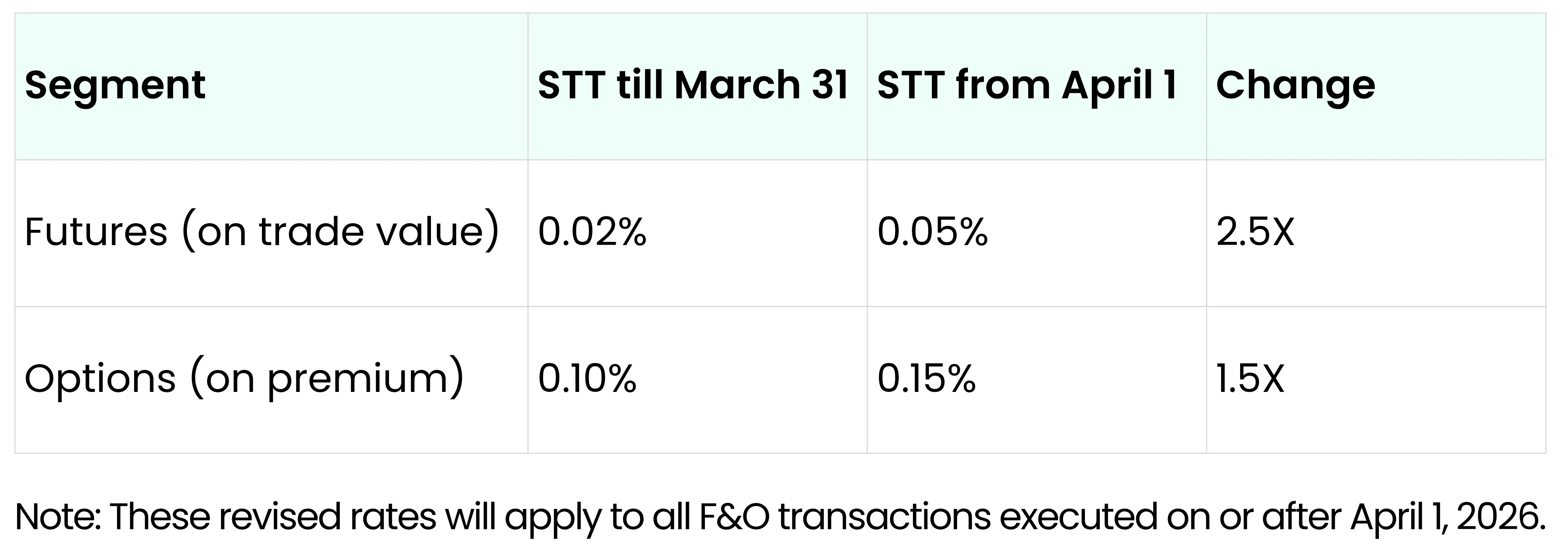
Against this backdrop, an important update comes into effect from April 1, 2026 the revision in Securities Transaction Tax (STT) for the derivatives segment.
What Changes from April 1, 2026
The revised STT rates for the derivatives segment are as follows:
What is STT?
Securities Transaction Tax (STT) is a government levy applied to the value of securities traded on stock exchanges.
It is important to note that STT is calculated on the transaction value (turnover) and not on the profit or loss from a trade.
What is F&O Trading?
Futures and Options (F&O) are derivative instruments that allow traders to take positions based on expected price movements of underlying assets such as stocks or indices. These instruments are widely used for:
- Short-term trading
- Hedging strategies
- Leveraged market exposure
Scope of the Change
- The revision applies only to the derivatives segment (F&O)
- STT rates for equity delivery, intraday equity, and other segments remain unchanged
- The change is applicable across all exchanges and brokers
With the updated STT structure:
- Transaction costs in F&O trades will reflect the revised tax rates
- The impact will be visible at the execution level, as STT is applied per trade
- Trading strategies may evolve based on overall cost considerations
‘As always, understanding cost structures is an essential part of building a well-informed trading approach’.
Disclaimer: The information provided in our blogs is for informational purposes only and should not be construed as financial, investment, or trading advice. Trading and investing in the securities market carries risk. Always conduct your own research and consult with a qualified financial advisor before making any investment decisions. Past performance is not indicative of future results. Copyrighted and original content for your trading and investing needs.
© 2026 — Tradejini. All Rights Reserved.