

Understanding the Time Value of Money
Money's value evolves over time, influenced by inflation and its potential to earn returns. This concept is essential in making informed financial decisions, as it helps evaluate investments, loans, and financial opportunities by considering the time-dependent nature of money's worth.
The Core Principle:
A Rupee today is worth more than the same Rupee in the future due to its potential earning capacity. For example, investing money today can generate interest or dividends, increasing its value over time. Conversely, a Rupee received in the future is worth less as it misses the opportunity to grow.
Key Concepts: Present Value (PV) and Future Value (FV)
1. Present Value (PV):
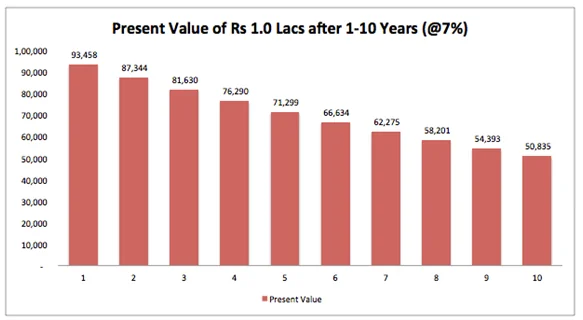
The present value determines what a future sum of money is worth today, accounting for a specific interest or discount rate. It answers the question, "How much should I invest today to achieve a certain amount in the future?"
Formula:
[ PV = \frac{FV}{(1 + r)^n} ]
Where:
- PV = Present Value
- FV = Future Value
- r = Interest or Discount Rate
- n = Number of Periods
Example:
- Option 1: Get Rs. 1000 today.
- Option 2: Get Rs. 1000 after one year.
If the interest rate is 8%, the present value of Rs. 1000 received after one year is:
[ PV = \frac{1000}{(1 + 0.08)^1} = Rs. 925.93 ]
Choosing Rs. 1000 today is better, as waiting reduces its real-time value.
2. Future Value (FV):
Future Value calculates how much an amount invested today will grow over time, given a specific interest rate.
Formula:
[ FV = PV \times (1 + r)^n ]
Where:
- FV = Future Value
- PV = Present Value
- r = Interest Rate
- n = Number of Periods
Example:
Invest Rs. 1000 today at 8% annual interest. The future value after one year is:
[ FV = 1000 \times (1 + 0.08)^1 = Rs. 1080 ]
This calculation helps investors understand how much their money will grow over time.
Visual Examples
Present Value Illustration:
Future Value Illustration:
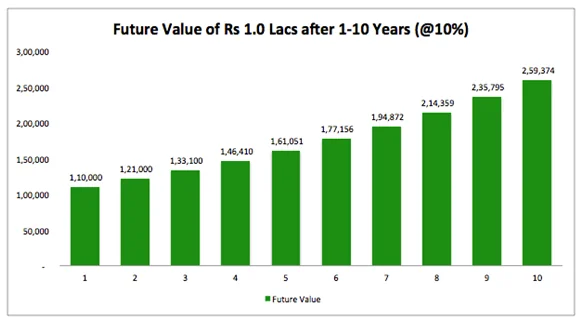
Key Takeaways:
- Inflation's Impact: Prices rise over time, reducing money's purchasing power.
- Earning Potential: Investing money today can yield returns, enhancing its future value.
- Better Decision-Making: Understanding PV and FV aids in evaluating financial choices, ensuring sound investment strategies.
Thumb Rule:
"The value of a Rupee yesterday was more than a Rupee today, and the value of a Rupee tomorrow will be less than a Rupee today."
Learn More:
For a deeper dive into financial terms and investment strategies, visit Tradejini and empower yourself with knowledge to make smarter financial decisions.