

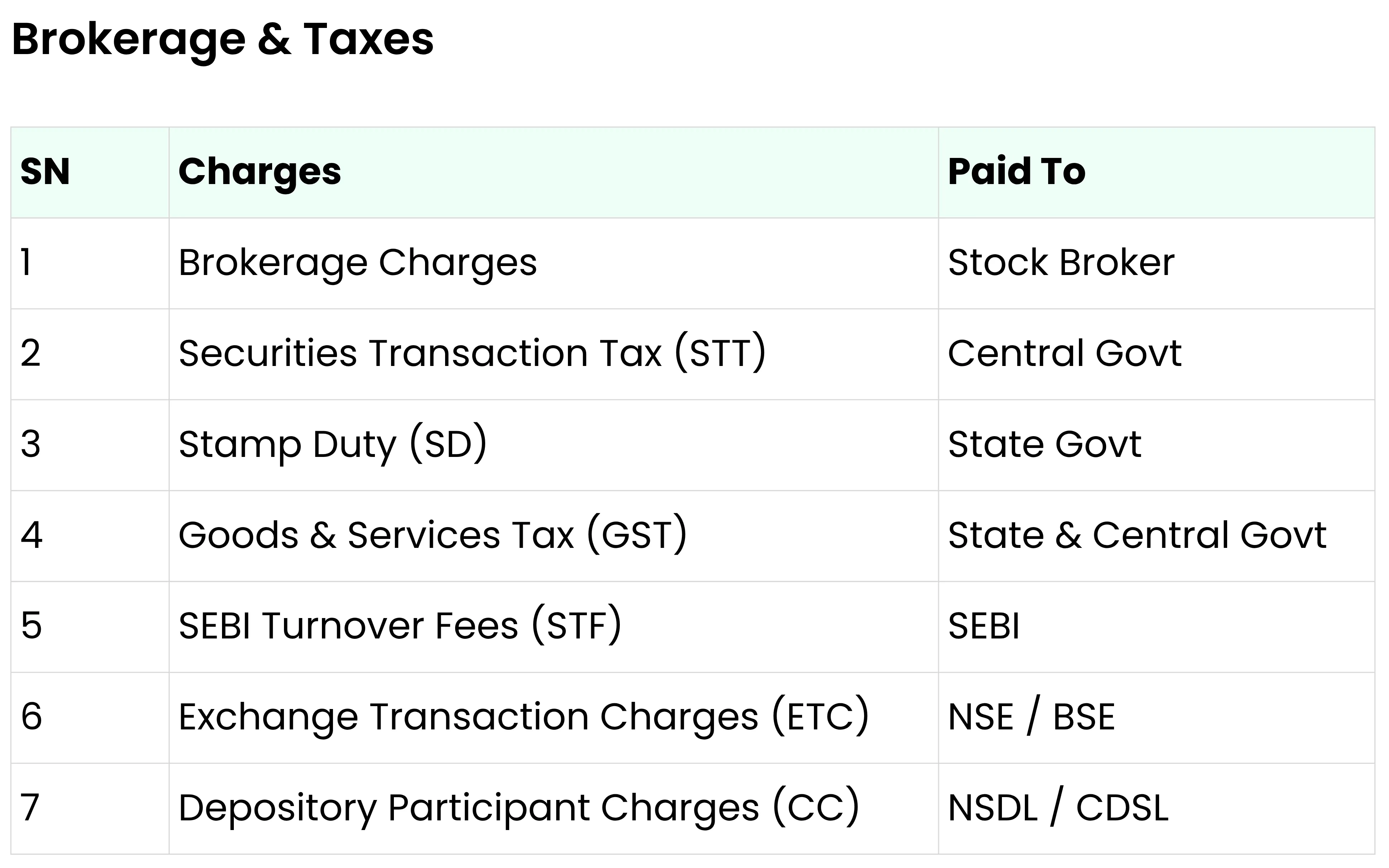
Every trade you place comes with a set of charges. Some are visible, some are layered in, but all of them affect your final returns. While the exact rates are listed above, here’s what each charge means in simple terms.
Brokerage Charges
This is the fee you pay your broker to execute a trade. It depends on the segment and the broker’s pricing model. While it may look small per trade, it adds up with frequent activity.
Tradejini follows a capped brokerage model. For equity delivery, intraday, and futures, brokerage is charged as a percentage of turnover or ₹20 per executed order, whichever is lower. Options are typically charged at a flat ₹20 per order.
The advantage becomes clear on larger trades. Once the percentage-based charge crosses ₹20, the cap applies, keeping your cost fixed regardless of order size.
STT (Securities Transaction Tax)
STT is a government tax on buying or selling securities. It applies across delivery, intraday, futures, and options, though the rates differ by segment.

Exchange Transaction Charges
These are fees charged by the exchanges like the National Stock Exchange and BSE for facilitating trades. It is a very small percentage of your trade value.
View all fees and charges
SEBI Charges
The Securities and Exchange Board of India collects a nominal regulatory fee on every transaction. This ensures the functioning and regulation of the market.
GST (Goods and Services Tax)
GST is charged only on the service components of a trade, mainly brokerage and exchange transaction charges, not on the total trade value. It is applied at 18%, while STT, stamp duty, and SEBI charges are outside the GST net.
This matters because GST moves with brokerage and transaction fees, not trade size. Segments with higher brokerage, like options, will naturally have a higher GST component.
Stamp Duty
Stamp duty is charged only on the buy side of a trade. It varies across equities and derivatives and is a state government levy on the transfer of securities.

Other Charges
There are small additional charges such as clearing or investor protection fund contributions. These are minimal but are included in your overall transaction cost.
The Safety Net Most Investors Ignore…..
IPFT protects you, even if you never need it. The NSE Investor Protection Fund Trust acts as a backstop if a trading member defaults. This is not just theoretical investors have been compensated through this mechanism. The levy is small, but the protection is real.
Calculate your charges on our brokerage calculator
Disclaimer: The information provided in our blogs is for informational purposes only and should not be construed as financial, investment, or trading advice. Trading and investing in the securities market carries risk. Always conduct your own research and consult with a qualified financial advisor before making any investment decisions. Past performance is not indicative of future results. Copyrighted and original content for your trading and investing needs.
© 2026 — Tradejini. All Rights Reserved.


.webp%3Falt%3Dmedia%26token%3D0ead9799-20bc-4d1e-ae8f-d75ab18921b5&w=3840&q=75)