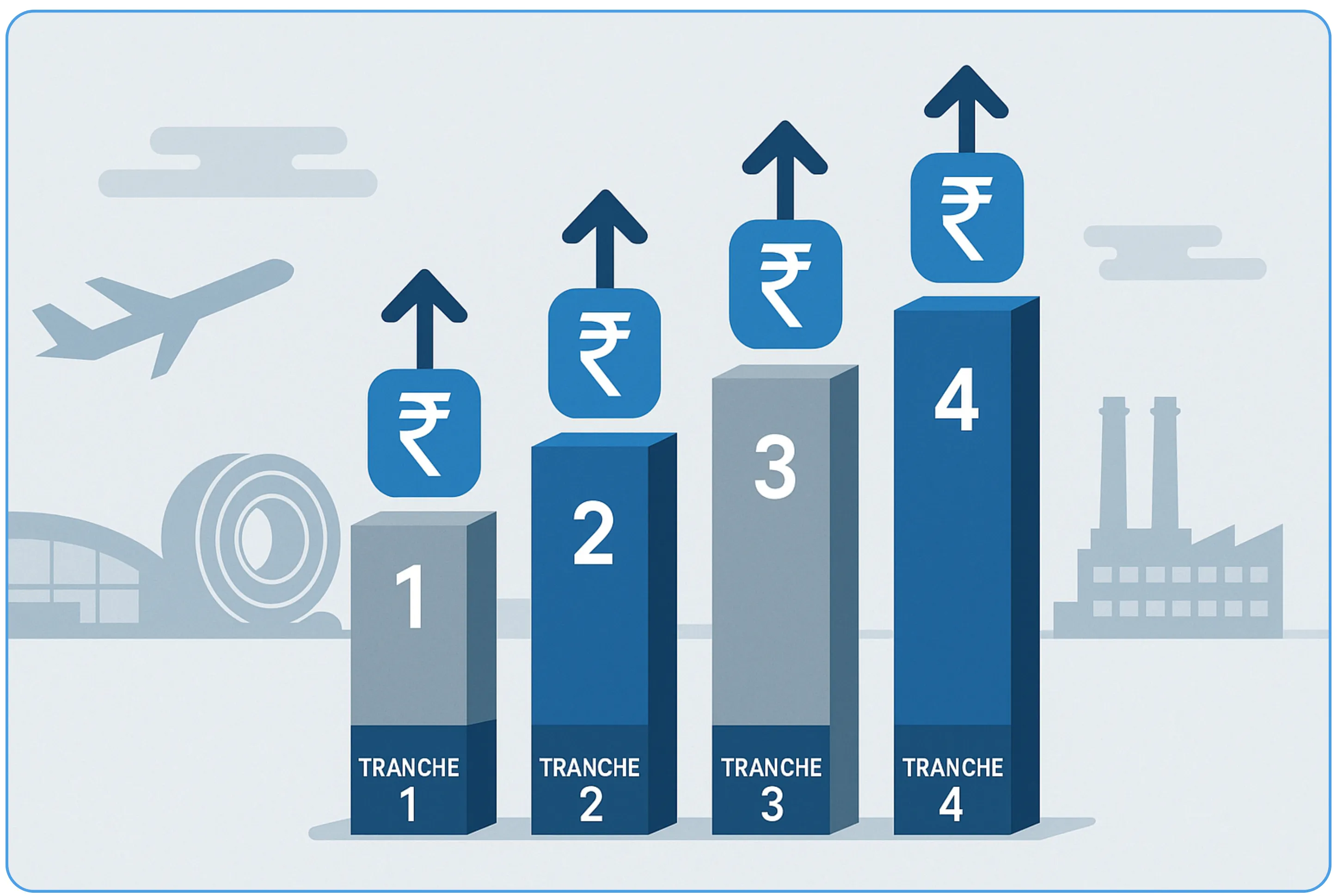
Adani Enterprises is asking shareholders for ₹25,000 crore, but not all at once. The company plans to split this massive rights issue into four separate tranches over six to eight months, a structure almost never seen in Indian capital markets. This staggered approach isn't just a technical detail; it reveals how capital-intensive infrastructure businesses navigate funding challenges when they need billions but can't afford to test investor appetite in a single shot.
On November 6, Adani Enterprises disclosed plans for this massive equity raise, with a Rights Issue Committee meeting scheduled for November 11 to finalize pricing and timing details. The company's stated purpose is straightforward: a significant portion will repay shareholder loans provided by promoters, which ballooned from ₹12,090 crore in March 2024 to ₹22,967 crore by September 2025. These loans funded capital-intensive projects including the Navi Mumbai airport and the copper business through Kutch Copper subsidiary. The company's gross debt stood at ₹92,065 crore at September-end, with net external debt nearly doubling from ₹30,966 crore to ₹60,070 crore in just six months.
This marks the company's first major public capital raise since February 2023, when it withdrew a ₹20,000 crore Follow-on Public Offer following the Hindenburg Research report.
Understanding the Four-Tranche Mechanism
The staggered structure is the most intriguing element. Instead of a single massive capital call on shareholders, Adani Enterprises will execute four separate tranches. Here's how this works: in a standard rights issue, existing shareholders receive entitlements to buy new shares proportional to their holdings, typically at a discount to market price. They must commit capital within a fixed window, usually 15-30 days.
By splitting into four tranches, the company creates flexibility on multiple fronts. Each tranche can be priced independently based on prevailing market conditions, reducing execution risk if markets turn volatile. Non-promoter shareholders can participate gradually rather than arranging large sums upfront, potentially improving subscription rates. And critically, the company can gauge investor appetite after each tranche, adjusting subsequent pricing or timing if needed.
This approach is rare in Indian markets, where rights issues typically occur as single events. It signals that Adani Enterprises expects this fundraise to take center stage in its equity story for the next 6-8 months.
The Capital Structure Transformation
Converting ₹20,000+ crore in promoter loans to equity isn't just about raising money, it's about reshaping the balance sheet. When promoters provide loans to their own company, it shows up as debt but doesn't dilute their ownership. Converting these loans to equity through a rights issue (where promoters will subscribe to their share) maintains their control percentage while improving debt ratios.
The immediate effect: Adani Enterprises' debt-to-equity ratio improves mechanically, creating headroom for future borrowing at potentially better terms. For a company deploying capital into greenfield airports (Navi Mumbai is still under construction) and entering capital-intensive businesses like copper manufacturing, this financial breathing room matters.
The sharp jump in net external debt, from ₹31,000 crore to ₹60,000 crore in six months, demonstrates the velocity of capital deployment. Airport infrastructure and metal businesses require massive upfront investment before generating returns, sometimes stretching 5-7 years for greenfield projects.
Trading and Sector Implications
For equity investors, the four-tranche structure means periodic dilution events over the next 6-8 months. Each tranche will likely create short-term pressure on Adani Enterprises' stock price as the share count increases. However, successful execution, particularly strong subscription from non-promoter shareholders, would signal restored institutional confidence after the 2023 turbulence.
Infrastructure peers like L&T and GMR Airports will watch this closely. If Adani successfully demonstrates that staggered rights issues can work for mega-cap infrastructure plays, it could become a template for others facing similar capital intensity challenges.
The key monitoring points: subscription rates for each tranche (especially from institutional investors and non-promoters), pricing discounts offered, and deployment pace on stated projects. The November 11 committee meeting should reveal the first tranche's pricing strategy, a steeper discount would suggest cautious sentiment, while modest discounts indicate confidence.
For the broader Adani Group ecosystem, successful completion would improve credit profiles across entities, potentially lowering borrowing costs for the ports, cement, and power businesses that share the conglomerate brand.
Disclaimer: The information provided in our blogs is for informational purposes only and should not be construed as financial, investment, or trading advice. Trading and investing in the securities market carries risk. Always conduct your own research and consult with a qualified financial advisor before making any investment decisions. Past performance is not indicative of future results. Copyrighted and original content for your trading and investing needs.
© 2025 — Tradejini. All Rights Reserved.