Stock prices are influenced by a complex interplay of factors, ranging from company-specific developments to broader economic conditions. Understanding these drivers is essential for investors, traders, and anyone interested in the financial markets. Below, we explore the key forces that move stock prices.
1. Company Performance and Financials
A company’s valuation, driven by metrics like revenue, earnings, and cash flow, is a cornerstone of its stock price dynamics. A company’s financial health is a primary driver of its stock price. Key metrics like revenue, earnings, profit margins, and cash flow signal how well a company is performing. Quarterly earnings reports are particularly significant, as they provide a snapshot of these metrics. Insights from a company’s earnings call often clarify the context behind quarterly results, influencing investor reactions and stock price movements. If a company exceeds expectations, say, by reporting higher-than-forecasted earnings per share (EPS), its stock price often rises due to increased investor confidence. Conversely, missing targets or showing declining profits can lead to a sell-off.
Example:
If a tech company reports a 20% revenue increase driven by strong product demand, its stock price may surge. On the other hand, a retailer reporting lower-than-expected holiday sales might see its stock price drop.
2. Market Sentiment and Investor Psychology
Market sentiments, driven by investor optimism or pessimism, often dictate short-term stock price fluctuations. Stock prices are heavily influenced by investor sentiment, which reflects the collective mood of the market. Positive news, such as a new product launch or a strategic acquisition, can boost confidence and drive prices up. Negative news, like a regulatory scandal or a failed product, can trigger fear and lead to declines.
Market sentiment also extends to broader trends. During a bull market, optimism can push stock prices higher, even for companies with average fundamentals. In contrast, bear markets can depress prices across the board, regardless of individual company performance. Speculative trading, fueled by retail investors or social media hype, can also cause dramatic price swings unrelated to fundamentals.
Example:
On July 15, 2025, Rallis India Ltd. hit a 52-week high, gaining 6.8% after reporting a near-doubling of Q1 profit, fueled by positive sentiments from strong agricultural demand and social media buzz among retail investors. In contrast, on July 17, 2025, Axis Bank Ltd. fell 6% after a weaker-than-expected Q1 result, as negative sentiments from disappointed investors and social media criticism amplified the sell-off.
3. Economic Conditions
Macros, such as interest rates, inflation, and economic growth, shape the broader environment that influences stock price movements. The broader economy plays a significant role in stock price movements. Factors like interest rates, inflation, and economic growth directly affect investor behaviour. For instance:
- Interest Rates: When central banks like the Reserve Bank of India raise interest rates, borrowing costs increase, which can reduce corporate profits and consumer spending, often leading to lower stock prices. Conversely, low interest rates tend to support higher valuations.
- Inflation: High inflation erodes purchasing power and can squeeze profit margins, especially for companies unable to pass on costs to consumers. Moderate inflation, however, may signal a healthy economy, supporting stock prices.
- Economic Data: Economic indicators, such as GDP growth, unemployment rates, and consumer confidence, can sway stock prices. Strong economic data often lifts stocks, while signs of a slowdown can trigger declines.
Example:
On July 17, 2025, the BSE Sensex fell 600 points (0.73%) to 82,259, and the Nifty 50 dropped below 24,950, driven by macros like rising global trade concerns after U.S. President Donald Trump’s tariff announcements weakened the Indian rupee to ₹85.97. Bank stocks like ICICI Bank (-0.42%) and State Bank of India (-0.35%) declined due to these indicators. Conversely, on November 1, 2024, the Nifty 50 gained 0.41% during the Diwali Muhurat trading session, reflecting optimism from strong festive indicators like retail sales.
4. Industry Trends and Competition
Stock prices are also shaped by dynamics within a company’s industry. Technological advancements, regulatory changes, or shifts in consumer preferences can impact entire sectors. For example, the rise of electric vehicles has boosted stocks like Tata Motors while pressuring traditional automakers. Similarly, an Indian pharmaceutical company gaining FDA approval for a new drug can see its stock soar, while a competitor’s denial might lead to a drop.
Competitive positioning matters too. A company losing market share to a rival may experience a declining stock price, while one gaining dominance often sees gains.
Example:
On July 14, 2025, Tata Motors Ltd. gained 2.1% after analysts upgraded it for its leadership in India’s electric vehicle (EV) market, driven by strong sales of the Nexon EV. Meanwhile, Mahindra & Mahindra Ltd. (M&M) saw a 1.5% dip as investors favoured Tata Motors’ EV dominance amid the industry’s shift to electrification. Similarly, on July 16, 2025, Dr. Reddy’s Laboratories rose 3.2% after securing U.S. FDA approval for a generic drug, while Zydus Lifesciences fell 2.4% due to delays in its regulatory pipeline.
5. Supply and Demand (Market Mechanics)
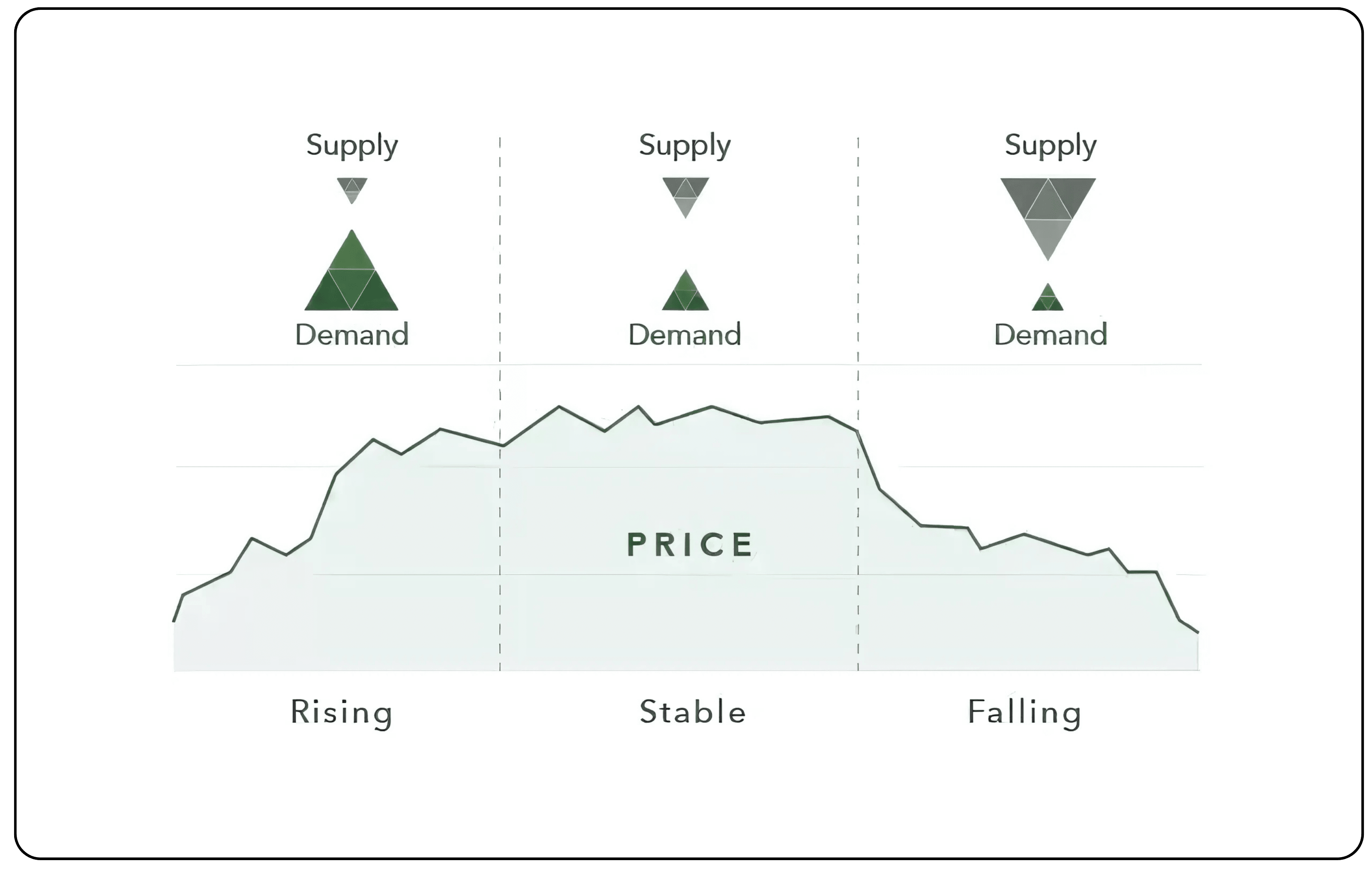
At its core, a stock’s price is determined by supply and demand in the market. When more investors want to buy a stock (demand) than sell it (supply), the price rises. Conversely, if more want to sell than buy, the price falls. This dynamic is influenced by:
- Trading Volume: High volumes of trading activity often amplify stock price movements, particularly during major news events or earnings releases.
- Share Buybacks: When a company repurchases its own shares, it reduces the number of shares available, potentially increasing the stock price.
- Institutional Investors: Large players like mutual funds or hedge funds can move prices significantly when they buy or sell large volumes. Institutional investors often employ hedging strategies, such as options or short positions, which can influence stock price stability or volatility.
Example:
On July 14, 2025, Reliance Industries Ltd. announced a ₹10,000 crore share buyback program, reducing available shares and driving a 2.5% stock price increase over the next two days due to tightened supply. On July 16, 2025, Biocon Ltd. saw high trading volumes and a 4.3% price surge after hitting a 52-week high, with institutional investors using hedging strategies via options to manage volatility, stabilizing the stock’s movement.
6. News and External Events
Unexpected events can cause rapid price changes. These include:
- Corporate News: Mergers, acquisitions, leadership changes, or lawsuits can have immediate effects. For instance, a CEO resignation might spark uncertainty, lowering the stock price.
- Geopolitical Events: Wars, trade disputes, or political instability can create market-wide volatility, impacting stock prices.
- Natural Disasters or Crises: Events like pandemics or supply chain disruptions can hit specific industries or the entire market.
Example:
On July 17, 2025, Indian Overseas Bank (IOB) dropped 3.8% amid market-wide volatility triggered by geopolitical tensions following India’s Operation Sindoor, impacting the Pakistan Stock Exchange and Indian markets.
7. Analyst Ratings and Forecasts
Analysts’ outlook on a company’s future performance, reflected in ratings and price targets, can significantly sway investor decisions and stock prices. Analysts from investment banks or research firms issue ratings and price targets that influence investor decisions. An upgrade from a prominent analyst can drive buying interest, pushing prices up, while a downgrade can trigger selling. However, these ratings are not always accurate and can sometimes reflect biases or lag behind market realities.
Example:
On July 14, 2025, Motilal Oswal rated Vishal Mega Mart a “Buy” for its strong growth outlook and cost leadership, leading to a 5.6% stock price rise. In contrast, on July 17, 2025, Emkay Global Financial reduced Wipro’s target price to ₹280, citing a muted outlook for revenue growth, causing a 2.27% stock price drop.
8. Dividends and Corporate Actions
Companies that pay dividends or undertake actions like stock splits can affect their stock price. A consistent or increased dividend signals financial stability, often attracting investors and supporting the stock price. Stock splits, while not changing the company’s overall value, can make shares more affordable, potentially increasing demand.
Example:
On July 17, 2025, Indian Hotels Company Ltd. (IHCL) announced a ₹2 per share dividend after a 32% revenue growth in Q1 FY26, leading to a 3.1% stock price increase over two days. Similarly, on July 26, 2025, Premier Energies Ltd.’s board considered an interim dividend alongside strong Q1 results, boosting its stock by 4.5% in anticipation of the announcement.
9. Speculation and Market Manipulation
In some cases, stock prices move due to speculative trading or manipulative practices. Short squeezes, where traders bet against a stock and are forced to buy it back at higher prices, can cause rapid spikes. Pump-and-dump schemes, though illegal, involve hyping a stock to inflate its price before selling off shares.
Example:
On July 4, 2025, Jane Street, a foreign institutional investor, reportedly made a ₹735 crore profit in a single day by buying Bank Nifty stocks worth ₹4,370 crore during a gap-down opening, then hedging with bearish options positions, driving a 2.3% intraday Bank Nifty surge. Conversely, on July 14, 2025, SEBI’s crackdown on suspected market manipulation involving unregistered foreign short-sellers targeting small-cap stocks like Reliance Power led to a 5.2% price drop.
Conclusion
Stock prices are driven by a mix of tangible factors, like earnings and economic conditions, and intangible ones, like investor sentiment and market speculation. While short-term movements can be unpredictable, long-term prices tend to reflect a company’s fundamental value and growth potential. For investors, understanding these drivers is key to navigating the market’s ups and downs.
Open your CubePlus account and take the first step toward smart, goal-based investing on your terms.
Disclaimer: The information provided in our blogs is for informational purposes only and should not be construed as financial, investment, or trading advice. Trading and investing in the securities market carries risk. Always conduct your own research and consult with a qualified financial advisor before making any investment decisions. Past performance is not indicative of future results. Copyrighted and original content for your trading and investing needs.
© 2025 — Tradejini. All Rights Reserved.
.webp%3Falt%3Dmedia%26token%3D0ead9799-20bc-4d1e-ae8f-d75ab18921b5&w=3840&q=75)