

The financial market serves as the backbone of any economy, enabling the smooth flow of funds between investors and institutions. It is broadly divided into two key segments: the primary market and the secondary market. Both markets are crucial for economic growth but serve different purposes in the lifecycle of securities like shares, bonds, and debentures.
What Is a Primary Market?
The primary market, also known as the new issue market, is where new securities are created and sold for the first time. It allows companies, governments, and other entities to raise fresh capital directly from investors. This process helps in financing business expansion, infrastructure projects, and debt repayment.
How It Works
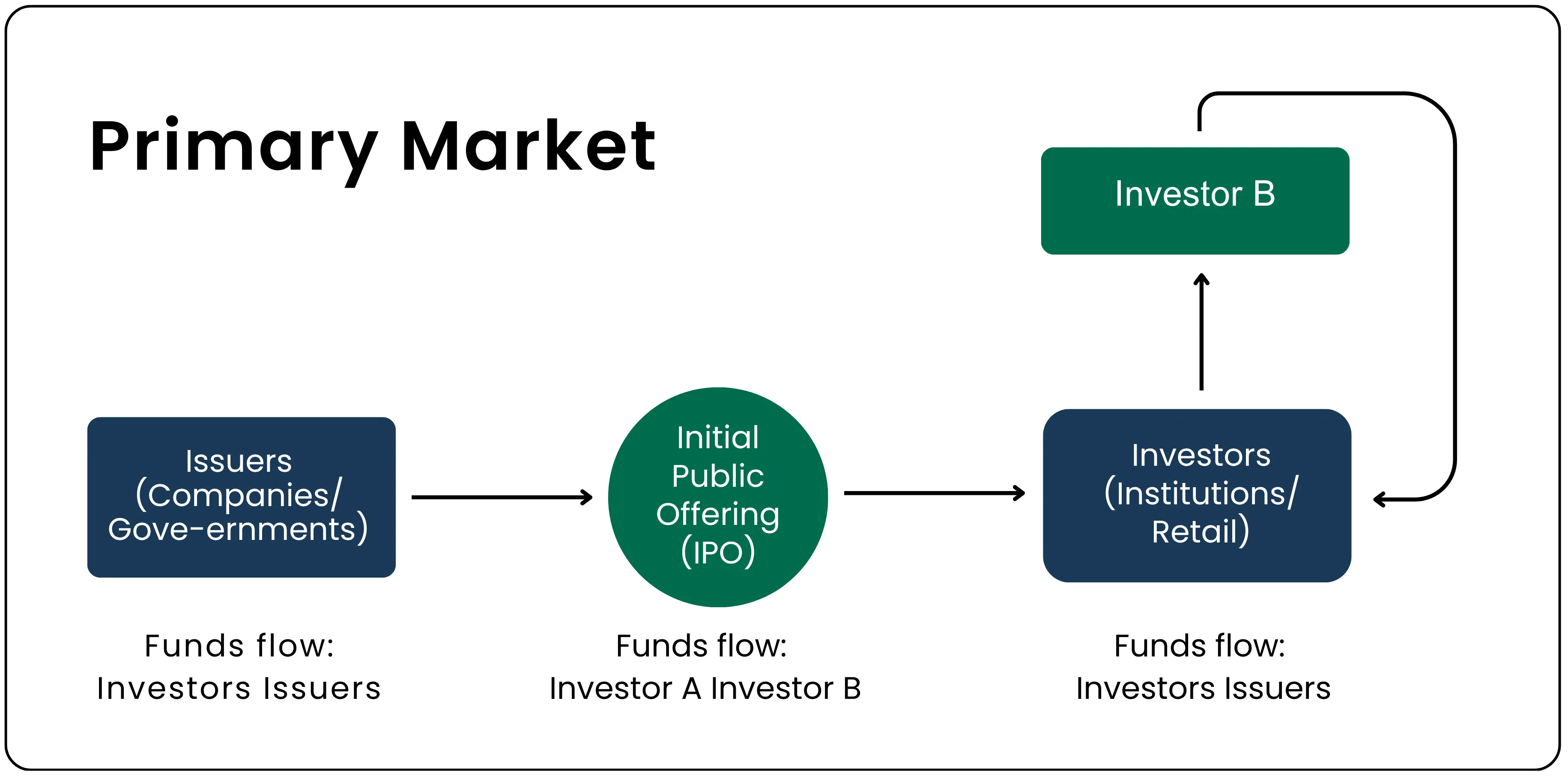
In the primary market, the issuer (company or government) directly offers new securities to investors. An underwriter (usually an investment bank) helps determine the offering price, facilitates the sale, and often guarantees the sale by purchasing any unsold shares. Investors buy these securities at the issuance price, and the funds raised go directly to the issuer.
The issuance process involves several key steps:
Issuance of New Securities: Companies and governments decide to raise capital by issuing new securities like shares or bonds.
Pricing and Underwriting: Investment banks or underwriters help determine the price and manage the sale of the securities.
Public Offering or Placement: The securities may be offered through an Initial Public Offering (IPO), Rights Issue, or Private Placement.
Subscription by Investors: Investors purchase these securities directly from the issuer, and the money collected goes to the issuing company.
Types of Issuance in the Primary Market
The primary market serves as the foundational arena where companies and governments raise capital through the issuance of new securities. Understanding its different types of issuances is integral to grasping how fresh funds flow into the economy:
Initial Public Offering (IPO): This marks the debut of a company’s shares to the public, allowing investors to purchase equity for the first time. IPOs enable companies to access significant capital for expansion and are typically underwritten by investment banks that manage pricing and regulatory compliance.
Follow-on Public Offering (FPO): Also known as a secondary or further public offering, FPOs involve the issuance of additional shares by a company that has already gone public. This method allows firms to raise more capital after the IPO to fund new projects or reduce debt.
Rights Issue: In this issuance, existing shareholders are given the option to buy additional shares, typically at a discounted price, before the shares are offered to the public. This protects shareholder value by enabling existing investors to maintain their proportional ownership.
Offer for Sale (OFS): Unlike the other types, OFS involves existing shareholders—often promoters or large investors—selling their shares to the public via the stock exchange. This does not raise new capital for the company but provides liquidity to existing shareholders.
Private Placement: Here, securities are sold directly to a select group of institutional or accredited investors rather than the general public. This approach is faster, involves less regulatory scrutiny, and is often used for raising debt or equity capital from strategic investors.
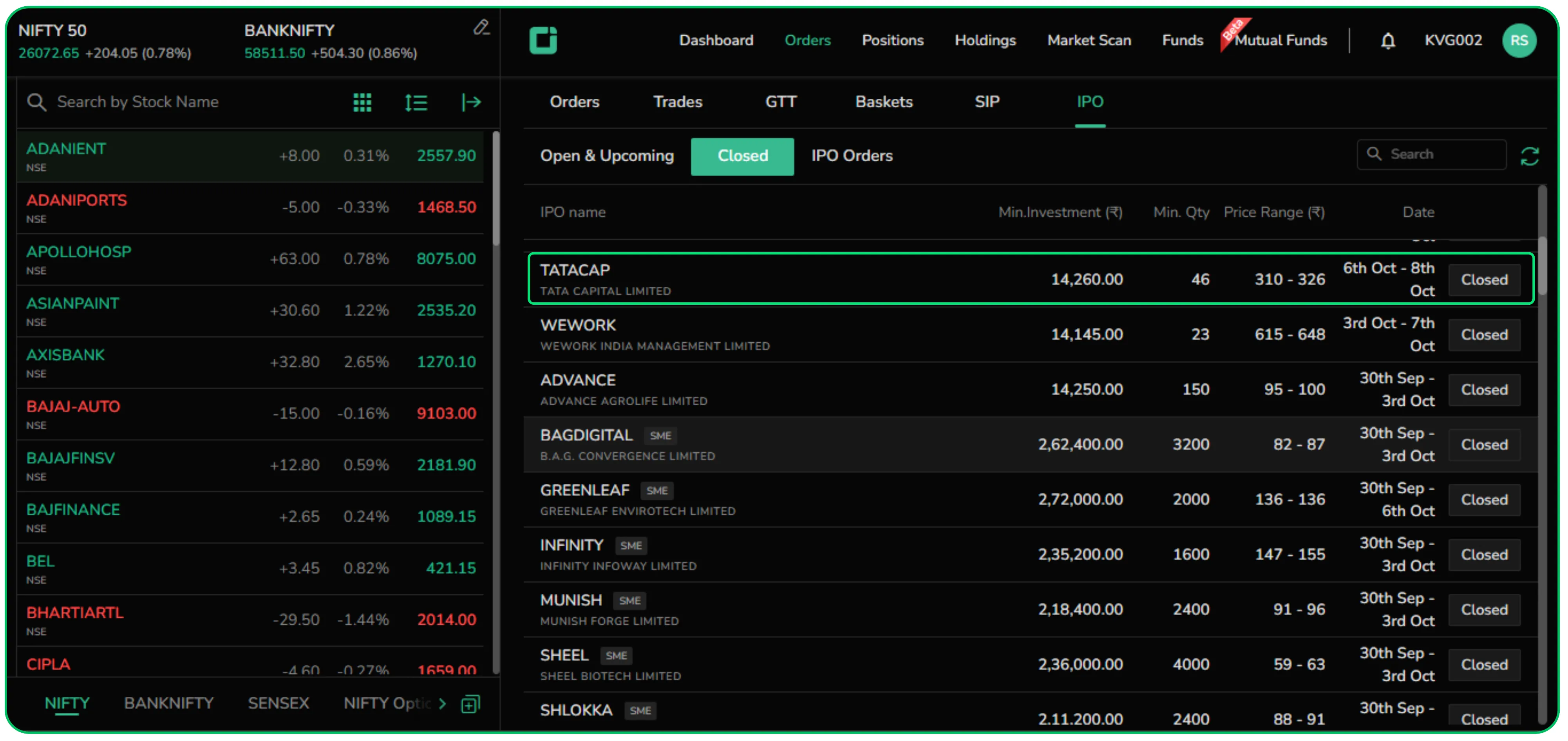
Example of a primary market
A recent example of the primary market is the IPO of Tata Capital Limited in 2025. This IPO offered equity shares to the public for the first time, providing investors with an opportunity to own stakes in one of India's leading non-banking financial companies (NBFCs).
The Tata Capital Limited IPO in 2025 was a combination of both a fresh issue and an offer for sale (OFS). The total IPO size was approximately ₹15,511.87 crore, consisting of a fresh equity issuance worth around ₹6,846 crore, where the company raised new capital, and an OFS component worth about ₹8,665.87 crore, where existing shareholders, including Tata Sons Private Limited, sold their shares to the public.
While the IPO involved an Offer for Sale (OFS) part, it was not solely an OFS. The fresh issue portion allowed Tata Capital to raise new funds for business growth and capital strengthening, which is characteristic of the primary market. The OFS portion provided liquidity to existing shareholders but did not raise new capital for the company. This mixed issuance is common in large IPOs to meet various objectives of both raising funds and providing an exit or partial liquidation option for existing investors.
Also read Tata Capital IPO
Important features and benefits
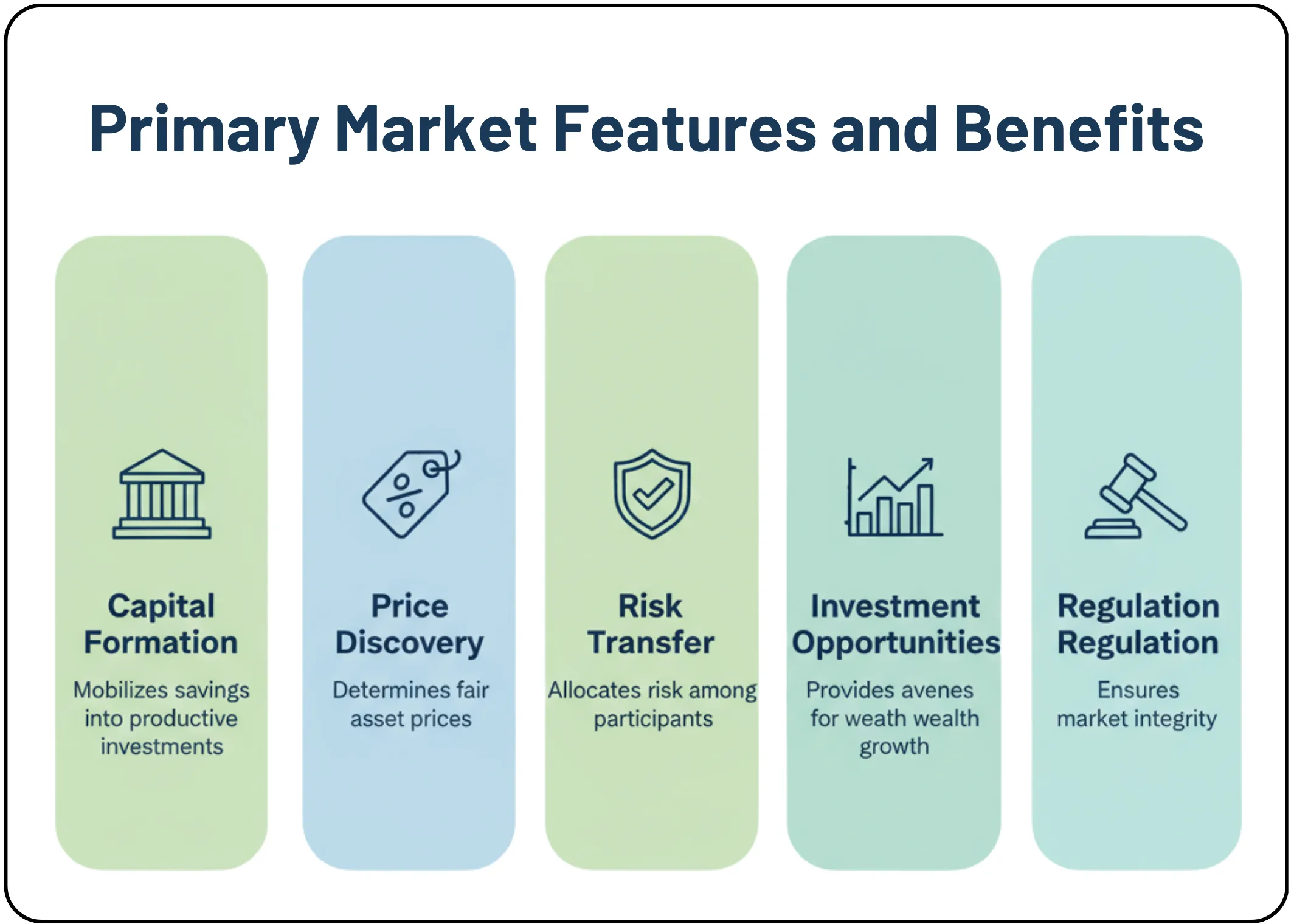
Capital Formation: It acts as a vital channel for raising fresh capital, enabling companies and governments to finance business expansion, infrastructure projects, and debt repayment. By converting savings into productive investments, the primary market fuels economic growth and development.
Price Discovery: Underwriters conduct detailed valuation processes and use mechanisms such as book-building to set a fair and market-driven offering price. This ensures that securities are neither overvalued nor undervalued at issuance, maintaining market confidence.
Risk Transfer: Through the issuance of new securities, companies effectively transfer financial risk to investors, who take on the ownership or creditor role, enabling firms to focus on growth while sharing risk.
Investment Opportunities: Investors gain access to new, often high-potential investment options before these securities become publicly traded in the secondary market. This early access allows participation in the growth stories of emerging or expanding companies.
Regulation and Investor Protection: The primary market operates under stringent regulatory frameworks—such as SEBI in India—that enforce transparency, compulsory disclosures, and fair practices. This regulatory oversight safeguards investors' interests and promotes trust in the financial markets.
What is the role and importance of the primary market in the financial system?
The primary market serves as the initial platform where companies and governments issue new securities, such as stocks and bonds, directly to investors. This market plays a critical role in capital formation, enabling entities to raise essential funds for expansion, infrastructure, and debt repayment. By providing investors early access to fresh investment opportunities, it supports emerging ventures and established businesses alike. Without the primary market, large-scale financing would be difficult to secure, and investors would have limited ways to participate in new offerings. Furthermore, it lays the foundation for the secondary market, where securities gain liquidity through subsequent trading, ensuring ongoing investment flow and healthy market dynamics.
What Is a Secondary Market?
A secondary market is a financial marketplace where investors buy and sell existing securities, such as stocks, bonds, and other financial instruments. These are securities that have already been issued in the primary market, typically through an initial public offering (IPO). In the secondary market, the issuing company is not directly involved in the trades, and the proceeds go to the selling investor rather than the company.
How Secondary Market works
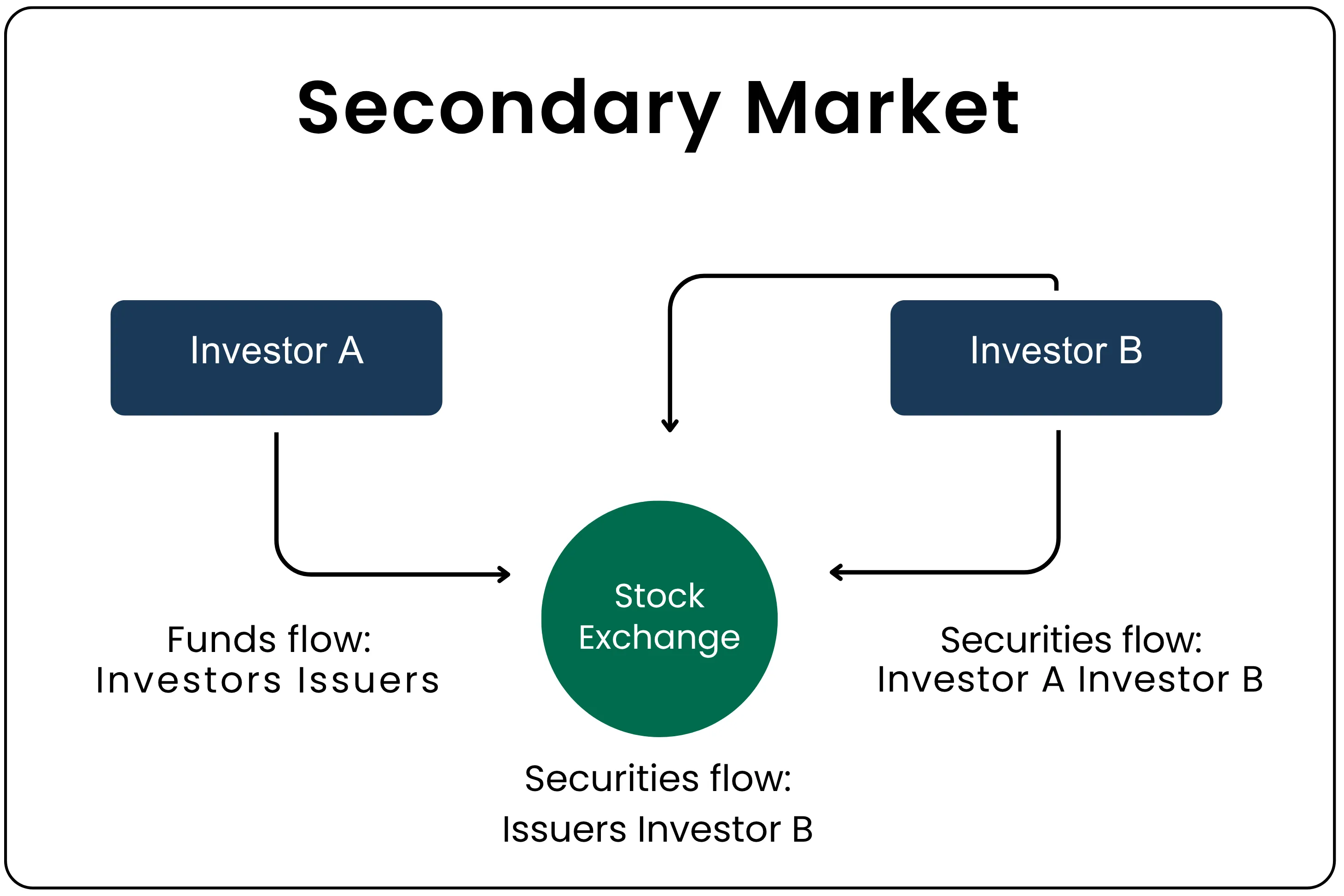
Stock Exchanges
In India, the secondary market operates mainly through stock exchanges like:
These exchanges provide regulated and organized platforms where buyers and sellers can trade securities such as stocks and bonds.
Market Participants
Several types of participants are active in the secondary market:
Individual Investors: Retail investors managing personal portfolios. Their collective actions influence market trends despite limited individual impact.
Institutional Investors: Large organizations like mutual funds and pension funds that trade large volumes, bringing stability and expertise to the market.
Traders: Individuals or firms who buy and sell for short-term profits, such as hedge funds and day traders.
Broker-Dealers: Act as intermediaries, facilitating trades for clients and trading on their own account to provide liquidity.
Market Makers: Constantly quote buy and sell prices to provide liquidity and reduce bid-ask spreads.
Clearing and Settlement Organizations: Ensure safe, efficient transfer of securities and funds, reducing counterparty risk.
Regulators: Bodies like SEBI oversee market fairness, transparency, and protect investors, maintaining market integrity.
Brokerage Firms
Investors typically don’t trade directly on exchanges. They use brokerage firms as intermediaries to execute their buy or sell orders.
Orders can be placed online through CubePlus by Tradejini
Orders can also be placed using traditional methods, by calling a broker.
Types of Orders
When placing trades, investors can choose from different order types:
Market orders: Buy or sell a security immediately at the current market price.
Limit orders: Specify the exact price at which the investor wants to buy or sell.
These order types help investors manage how and at what price they enter or exit the market.
Price Determination
Prices in the secondary market are determined by supply and demand:
When demand for a stock surpasses supply, its price rises due to increased buyer interest.
When supply exceeds demand, the price of the stock generally declines due to increased selling pressure.
Clearing and Settlement
After a trade is executed, ownership of the security and the corresponding money must be transferred. They act as intermediaries to ensure safe and efficient transfer of securities and funds.
Settlement in India typically happens on a T+1 basis, meaning one or two business days after the trade.
Depository Participant
A Depository Participant (DP) is an intermediary registered with a securities depository, acting as a bridge between investors and the depository system. In India, investors cannot interact directly with the central depositories; they must do so through DPs. These participants facilitate opening and maintaining Demat accounts, which hold securities in electronic form, and assist in trading, transferring, and pledging securities.
The two main entities under which Depository Participants operate are:
National Securities Depository Limited (NSDL), established in 1996.
Central Depository Services (India) Limited (CDSL), established in 1999.
Continuous Trading
The market hours:
NSE: 9:15 AM – 3:30 PM
BSE: 9:15 AM – 3:30 PM
MCX: 9:00 AM to 11:30 PM
Market Information
Access to real-time market data is crucial for investors: Prices, volumes, and news are shared through financial news platforms, trading apps, and online portals. Accurate information allows participants to make informed investment decisions.
Regulation and Oversight
The Securities and Exchange Board of India (SEBI) is the main regulatory authority: Ensures fair practices and prevents market manipulation. Maintains the integrity and stability of the Indian securities market.
Types of Secondary Market
The two main types of secondary markets are stock exchanges and over-the-counter (OTC) markets. An exchange is a centralized, regulated marketplace, while an OTC market is a decentralized, less-regulated network where trades are negotiated directly between parties.
Stock exchanges (Auction market)
Centralized platform: This is a regulated marketplace where investors trade securities, such as stocks, bonds, and exchange-traded funds (ETFs).
Order-driven: Exchanges typically operate on an auction model, where buyers and sellers place competitive bids and offers. A transaction occurs when a bid and offer price match.
High transparency: Due to strict regulations and a central trading location, exchanges offer a high degree of transparency and security.
Examples: Well-known stock exchanges include the NSE (National Stock Exchange) and BSE (Bombay Stock Exchange)
Over-the-counter (OTC) market (Dealer market)
Decentralized network: In contrast to exchanges, OTC markets are decentralized, with trades negotiated directly between dealers and buyers over a telecommunications network.
Quote-driven: The market is driven by dealers, also known as "market makers," who post their own buy (bid) and sell (offer) prices for securities.
Less regulated: OTC markets often handle securities that don't meet the listing requirements of stock exchanges and have fewer regulations.
Examples: This market is commonly used for trading corporate bonds, foreign exchange (forex), and derivatives.
Different Instruments in Secondary Market
The instruments traded in the secondary market can be divided into three main categories: fixed-income instruments, variable-income instruments, and hybrid instruments.
Fixed-income instruments
These are debt instruments that provide investors with a regular, fixed stream of income in the form of interest payments. The principal amount is repaid at the time of maturity. Examples of these instruments include:
Bonds: Debt securities issued by a government or corporation to raise large amounts of funds. The issuer pays regular interest at a pre-defined rate and repays the principal amount at maturity.
Debentures: Similar to bonds, these are debt instruments, but they are typically unsecured and are backed by the general creditworthiness and assets of the issuing entity.
Preference shares: These represent ownership in a company but have characteristics of both equity and debt. They have a fixed dividend rate, which must be paid before dividends can be distributed to common shareholders.
Variable-income instruments
These investments do not have a fixed rate of return. Their value and returns fluctuate based on various market factors. These instruments generally have a higher risk but also a higher potential for returns. Examples include:
Equities (Shares): These represent ownership in a company, entitling the holder to a portion of the company's profits.
Mutual funds: Investment instruments that pool money from multiple investors to invest in a diversified portfolio of other securities.
Derivatives: Financial contracts, such as futures and options, whose value is derived from an underlying asset like stocks, bonds, or commodities.
Hybrid instruments
These are financial instruments that combine the features of both fixed-income and variable-income instruments. A prime example is a convertible debenture, which starts as a debt security providing fixed interest but can be converted into equity shares of the company after a specified period.
Examples of transaction in secondary market
A prominent example of a secondary market transaction is with the shares of Zomato Ltd.
Primary Market: Zomato, the Indian food delivery company, conducted its Initial Public Offering (IPO) in July 2021. In this primary market transaction, Zomato issued new shares to the public to raise capital for the company.
Secondary Market: After the IPO was completed, Zomato's shares were listed on the National Stock Exchange (NSE) and the Bombay Stock Exchange (BSE). All subsequent trading of Zomato shares between investors takes place on these stock exchanges.
For example, if an investor wants to buy Zomato shares today, they do not buy them from Zomato as a company. Instead, they buy them from another investor who already owns them and is selling them on the NSE or BSE. This trading of existing shares among investors on an exchange is the secondary market.
Important features and benefits
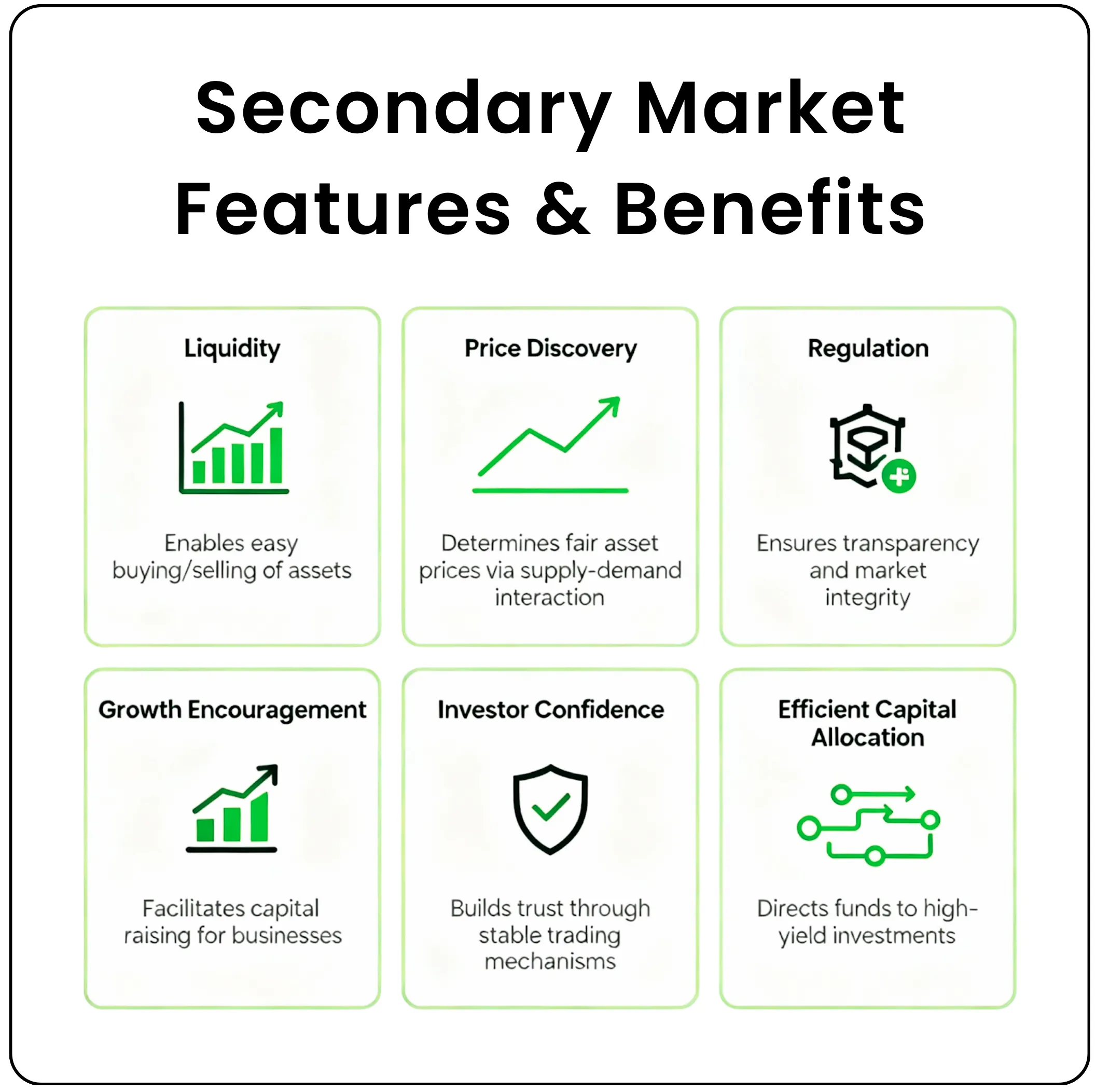
The secondary market is where investors buy and sell existing securities, such as stocks and bonds, that were previously issued. Its primary features and benefits include:
Liquidity: Investors can quickly and easily convert their investments into cash. Price Discovery: Continuous trading based on supply and demand ensures fair and transparent pricing for securities.
Regulation: Regulatory bodies like SEBI oversee stock exchanges (e.g., NSE and BSE) to protect investors and maintain market integrity.
Encourages Growth: A strong secondary market encourages new investment in the primary market, helping companies raise capital for expansion.
Investor Confidence: Transparent, regulated trading helps build and maintain investor trust in the fairness of the market.
Efficient Capital Allocation: Market forces channel investment towards companies with strong growth prospects while adjusting the value of underperforming ones.
What is the role and importance of the secondary market in the financial system?
The secondary market is vital for providing liquidity, allowing investors to easily buy and sell existing securities. Its continuous trading facilitates accurate price discovery, setting fair asset values based on supply and demand. Regulated by bodies like SEBI, the secondary market promotes investor confidence and protects against unfair practices. By offering a clear exit strategy, it encourages participation in the primary market, which is key for companies raising capital. The market's price signals also enable efficient capital allocation, directing funds toward productive companies.
Primary Market vs. Secondary Market
| Feature | Primary Market | Secondary Market |
|---|---|---|
| Transaction type | Deals with the issuance of brand-new securities, such as initial public offerings (IPOs), by a company for the first time. |
Deals with the trading of existing securities between investors after they have been initially issued in the primary market. |
| Capital flow | Money flows directly from investors to the issuing company, which uses the funds for expansion, debt repayment, or other purposes. |
Money is exchanged between investors, with the issuing company receiving no new capital from these transactions. |
| Pricing | Prices are fixed and predetermined by the company or discovered through a book-building process in consultation with underwriters. |
Prices are determined by market forces of supply and demand, causing continuous fluctuations throughout the trading day. |
| Participants | Involves the issuer (the company), investors, and intermediaries such as underwriters who guarantee the sale of securities. |
Primarily involves investors trading with each other through brokers on organized stock exchanges like the NSE and BSE. |
| Liquidity | The market offers limited liquidity, as securities can only be sold once during the initial offering. | The market offers high liquidity, allowing investors to buy and sell securities quickly and easily. |
| Purpose | To help companies and governments raise fresh capital to fuel business growth, fund projects, and facilitate capital formation. |
To provide marketability and liquidity for existing securities, allowing investors to adjust their portfolios as needed. |
| Risk | Can have higher risk for investors due to uncertainty about the company's future performance or its initial pricing. |
Risk is generally considered lower than in the primary market due to the availability of historical data and market information, though it is still subject to volatility. |
The bottom line
The primary market and secondary market are complementary segments of the financial system, with each playing a distinct yet interdependent role. The primary market enables companies to raise capital for growth by issuing new securities, while the secondary market provides liquidity and a regulated platform for investors to trade those existing securities. Together, this synergy builds investor confidence by ensuring a clear exit strategy and facilitates efficient capital allocation, directing funds toward productive companies to support overall economic expansion.
Also read How stock market works in India
Disclaimer: The information provided in our blogs is for informational purposes only and should not be construed as financial, investment, or trading advice. Trading and investing in the securities market carries risk. Always conduct your own research and consult with a qualified financial advisor before making any investment decisions. Past performance is not indicative of future results. Copyrighted and original content for your trading and investing needs.
© 2025 — Tradejini. All Rights Reserved.
.webp%3Falt%3Dmedia%26token%3D0ead9799-20bc-4d1e-ae8f-d75ab18921b5&w=3840&q=75)


