

Most investors are familiar with the idea of buying a stock at a lower price and selling it later at a higher price. But what if you could profit when the market falls? That’s where short selling comes in, a concept that seems complicated at first but is quite simple once you break it down.
What does short selling mean?
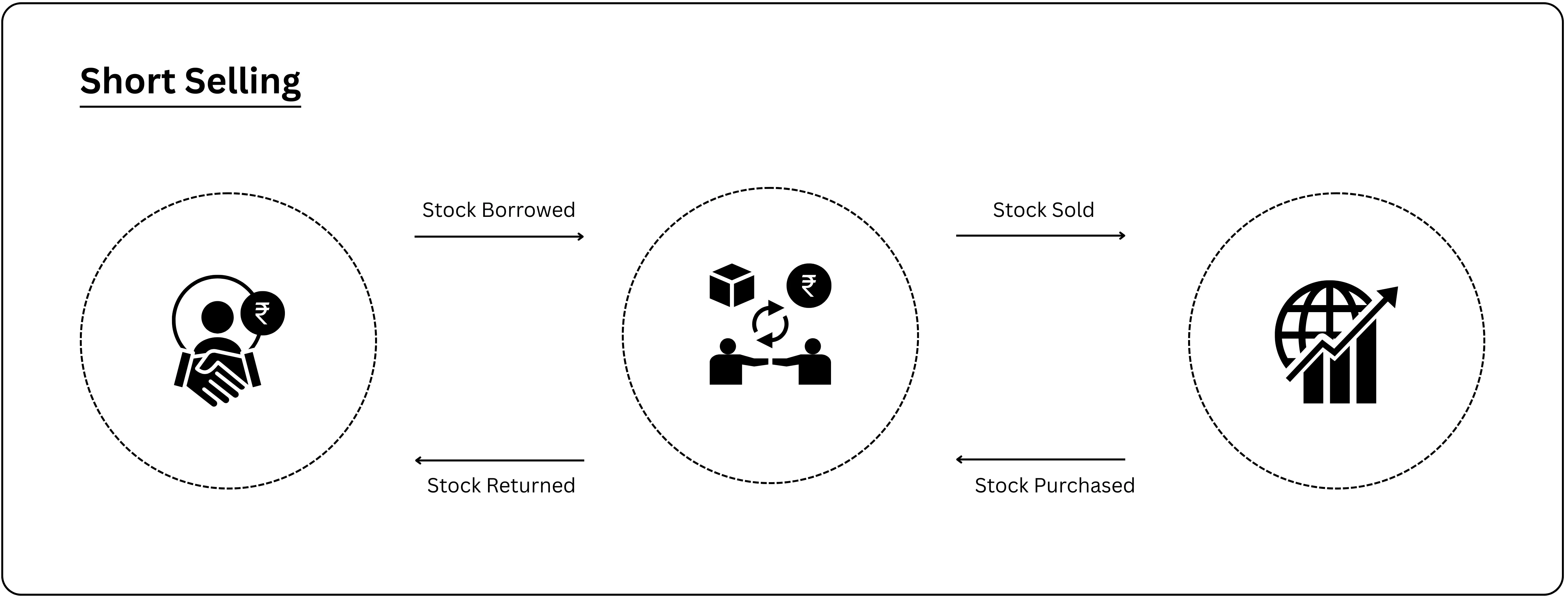
In short selling, the sequence of a normal trade is reversed. Instead of buying first and selling later, you sell first and then buy later.
Imagine this scenario:
Apples in Bangalore are selling at ₹220 per kg in the morning. You don’t have any apples, but you strike a deal with a hotel to deliver them later in the evening at ₹217 per kg. Meanwhile, you know that a large shipment of apples is arriving in the city, which will push prices down. By afternoon, the price falls to ₹180 per kg. You buy the apples from the market at ₹180 and deliver them to the hotel at the agreed rate of ₹217, making a profit of ₹37 per kg.
In this transaction, you sold first (at ₹217) and bought later (at ₹180), making a profit of ₹37 per kg. That’s essentially how short selling works in the stock market.
Why do traders short sell?
Investors normally buy stocks with the hope that prices will rise. But markets don’t always go up, sometimes they fall, and short selling lets traders benefit from that downward movement.
When you expect prices to rise: You buy low and sell high.
When you expect prices to fall: You sell high (short sell) and then buy back at a lower price.
Short Selling example
As of mid-August 2025, Reliance Industries is trading around ₹1,374 per share Let’s say you anticipate the stock will decline, so you decide to short-sell at ₹1,374. If your prediction is correct and the stock dips to ₹1,350, you can buy it back at that lower price, thus closing your short position.
Profit calculation:
Entry (sell) price = ₹1,374
Exit (buyback) price = ₹1,350
Profit per share = ₹24
This mirrors how traders profit by speculating on falling prices.
Why must short selling be squared off same day?
In India, short selling in the spot (cash) market is permitted only on an intraday basis. That means you cannot carry the position overnight. Here’s why:
When you sell a stock, the exchange records it as a sale.
The exchange expects that delivery of the sold stock must happen by the end of the trading day.
If you don’t buy back the stock, it results in a short delivery, which attracts penalties.
To avoid such situations, brokers ensure all intraday short positions are squared off before market close.
Check out our step-by-step guide on how to trade using Tradejini’s CubePlus app[click]
Three ways a short position can close
Target is hit
Example: Infosys is at ₹1,500. You are short at ₹1,500, expecting it to fall to ₹1,470. If it does, you book a profit of ₹30.
Stop-loss is hit
Since you sold at ₹1,500, your stop-loss would be above that price, say ₹1,520. If the stock moves against you and hits this level, you book a loss of ₹20.
The day ends before either is hit
If your target or stop-loss isn’t reached, your broker will square off the position before the market closes. Depending on the price at that time, you may end up with a smaller profit or a loss.
Trade smart
Short selling is popular in intraday trading because it allows traders to profit when the market falls. In the stock market, the usual order of stock trading is buy first and sell later. But in short selling, you sell first and then buy back, usually within the same day. Since short selling in India’s cash market is permitted only on an intraday basis, traders use it to short sell stocks and benefit from short-term price declines.
By using stop losses and closing positions on time, traders can manage these risks effectively. For beginners, it’s best to start small, learn the mechanics, and gradually build confidence before relying on short selling as a strategy.
Now, place trades, manage positions, and execute strategies like short selling. Start trading today with Tradejini’s CubePlus app.
Disclaimer: The information provided in our blogs is for informational purposes only and should not be construed as financial, investment, or trading advice. Trading and investing in the securities market carries risk. Always conduct your own research and consult with a qualified financial advisor before making any investment decisions. Past performance is not indicative of future results. Copyrighted and original content for your trading and investing needs.
© 2025 — Tradejini. All Rights Reserved.
.webp%3Falt%3Dmedia%26token%3D0ead9799-20bc-4d1e-ae8f-d75ab18921b5&w=3840&q=75)