

Core Mechanics
At its core, the Unbalanced Butterfly options strategy, also called the Broken-Wing Butterfly, is an advanced multi-leg options setup designed for traders with a directional options bias call put structure. It targets those who hold a strong directional view but still want defined risk and potential premium income. This Broken-Wing Butterfly defined risk configuration builds upon the traditional butterfly spread while introducing deliberate asymmetry, achieved either by skipping a strike or altering the contract ratio on one side.
A standard butterfly spread is delta-neutral and performs best when prices stay near the middle strike at expiry. In contrast, an Unbalanced Butterfly tilts the payoff profile to favor either the bullish or bearish side, giving traders more flexibility to express conviction while maintaining limited exposure. Mechanically, both the Unbalanced Call Butterfly bullish strategy and Unbalanced Put Butterfly bearish income setup involve three or four option legs of the same expiry and option type. The trader typically sells two options at the middle strike and buys one on either side, but modifies strike spacing or contract quantity to create a directional tilt.
This asymmetry leads to either:
- A net debit (if the outer long leg is closer, reducing premium collected), or
- A net credit (if the outer long leg is further OTM, increasing premium collected).
This subtle modification fundamentally reshapes the risk-reward profile, widening the profit zone toward the trader’s bias while preserving defined loss potential.
Also Read: How Double Plateau Captures Twin Profit Zones
Types & Variations
- Unbalanced Call Butterfly (Bullish Bias)
Traders often misinterpret this name. The Call Butterfly here actually expresses a bullish directional options bias, as the short strike sits below the expected upward move.
Market View: Used when expecting a moderate rise in the underlying (e.g., NIFTY) but still wanting defined risk and theta positive options strategies exposure.
Structure:
- Buy 1 ITM Call (lower strike)
- Sell 2 ATM Calls (middle strike)
- Buy 1 OTM Call (higher strike, placed further than in a standard butterfly)
Net Position: Usually entered for a net credit or small debit depending on strike spacing.
Objective: Generate limited income if the index rises modestly without a breakout. The trade benefits from moderate bullishness and a gradual volatility contraction.
- Unbalanced Put Butterfly (Bearish Bias)
The Put Butterfly mirrors the call version but favors a downside move. Traders deploy it to capture a mild, controlled decline while generating bearish theta income.
Market View: Applied when expecting the underlying to drift lower or stay range-bound with slight weakness.
Structure:
- Buy 1 ITM Put (higher strike)
- Sell 2 ATM Puts (middle strike)
- Buy 1 OTM Put (lower strike, skipped further OTM)
Net Position: Typically a net credit, as skipping the lower strike reduces cost.
Objective: Earn steady theta decay income if the underlying trades near or below the short strike while retaining protection against extreme downside.
Also Read: Put Ratio Spreads Explained Through Real Trades
Deployment Conditions Comparison Table
| Condition | Unbalanced Call Butterfly (Bullish) | Unbalanced Put Butterfly (Bearish) |
|---|---|---|
| Market View | Expect moderate upward move; range expansion to upside | Expect mild correction or drift lower |
| Implied Volatility (IV) | Best when IV is moderately high but expected to fall | Best when IV is moderately high and expected to fall |
| Use Case | Deploy post-event when expecting steady recovery | Deploy after rallies or pre-event when expecting controlled downside |
| Profit Zone | Between middle and upper strike | Between middle and lower strike |
| Ideal Behavior | Gradual rise without breakout | Slow drift lower without crash |
Practical Examples
Unbalanced Call Butterfly Example
Trade Setup:
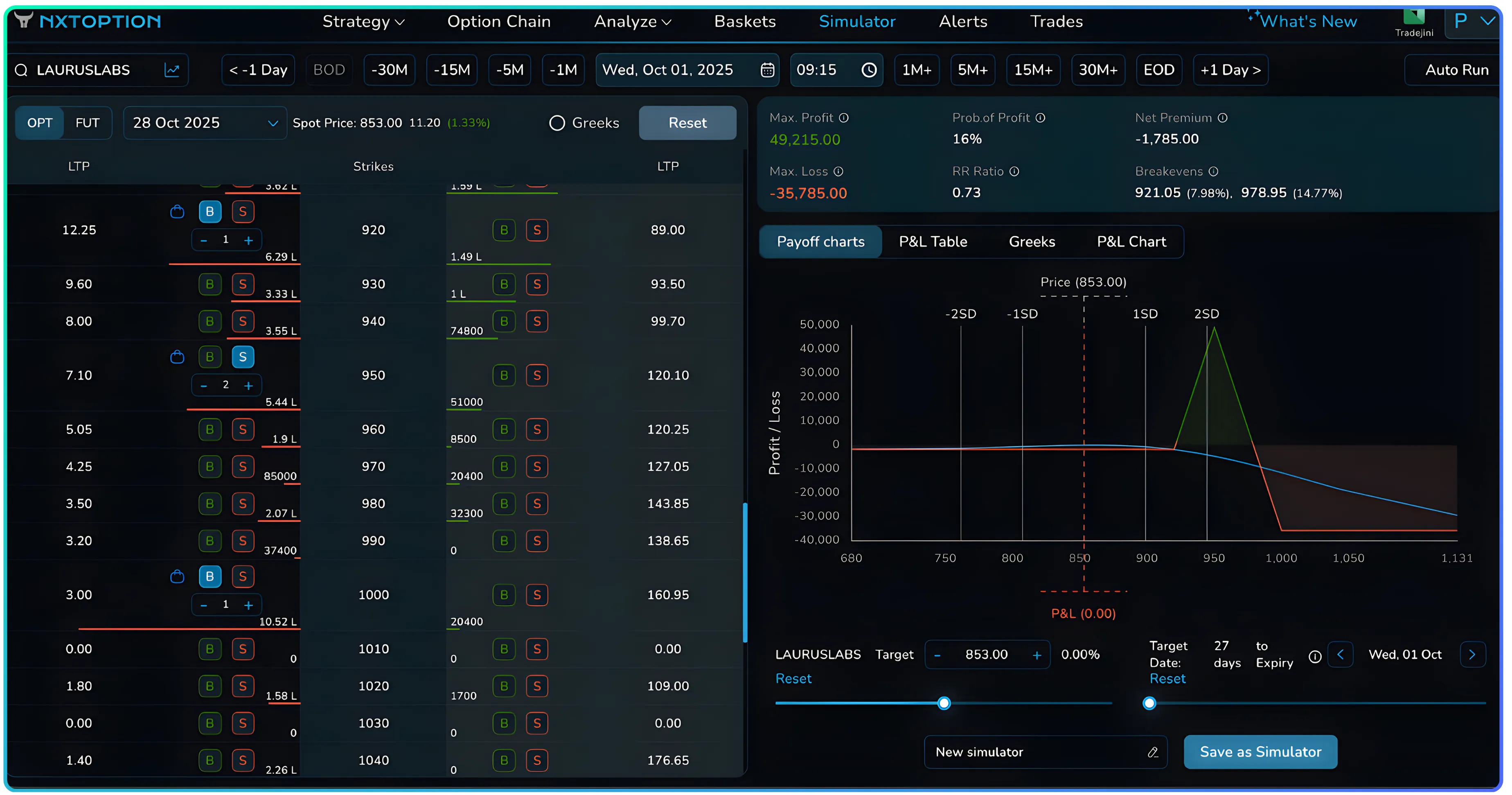
Date of Entry: 1st October 2025
Stock/Index: LAURUSLABS
Current Price: ₹853.00
Legs of the Strategy:
- Buy 1 920 CE @ ₹12.25
- Sell 2 950 CE @ ₹7.10
- Buy 1 1000 CE @ ₹3.00
Trade Metrics:
- Net Debit: ₹1,785
- Maximum Profit: ₹49,215 (occurs near ₹950)
- Maximum Loss: ₹35,785 (if LAURUSLABS moves beyond ₹1,000)
- Breakevens: ₹921.05 and ₹978.95
Outcome:
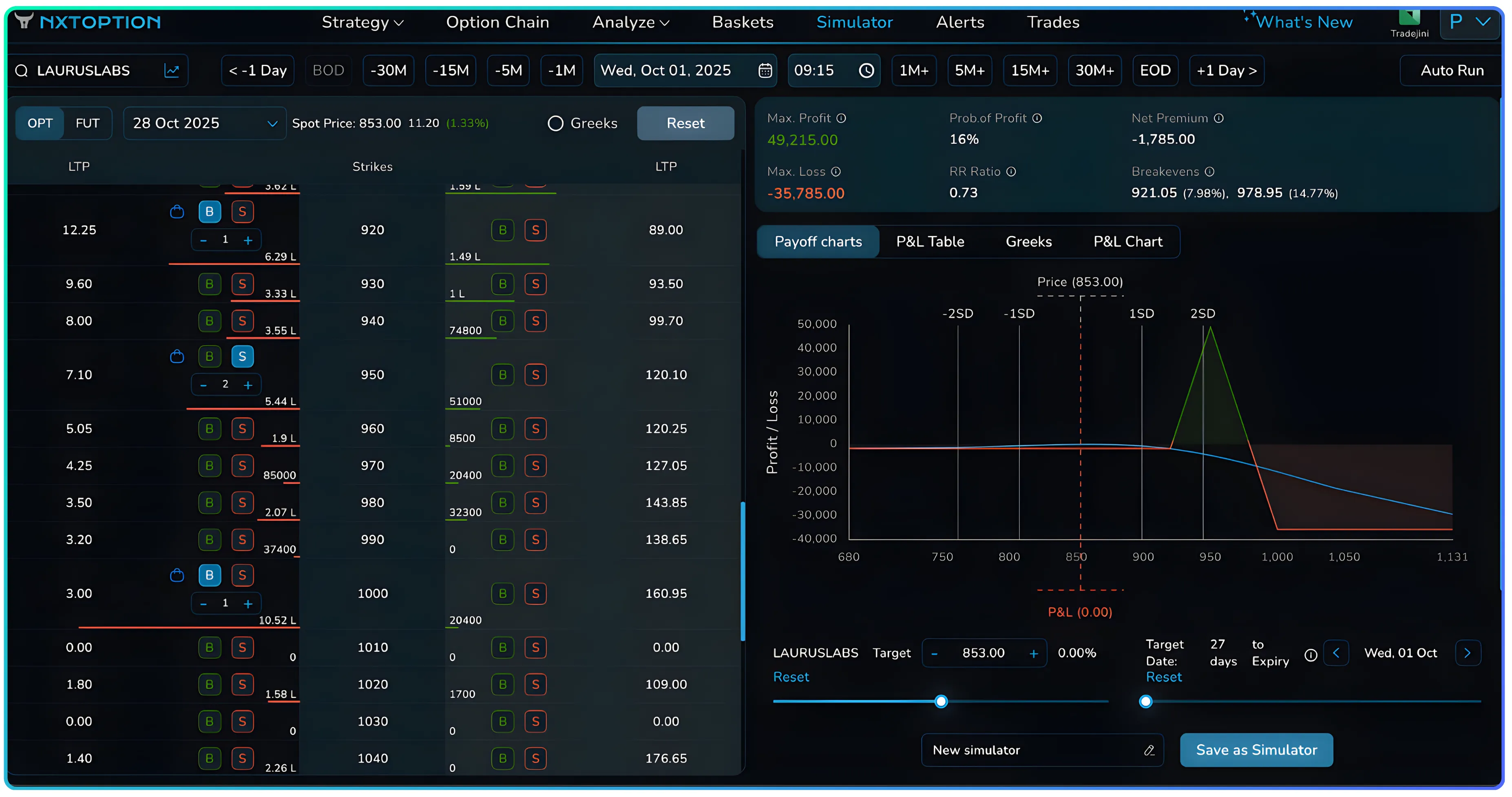
Expiry: 28th October 2025
Closing Price: ₹942.40
Actual P&L: ₹27,455 profit
Analysis:
This Unbalanced Call Butterfly bullish strategy on LAURUSLABS began near ₹853 anticipating a gradual rise toward ₹950. The setup used a wider upper wing (920–950–1000), producing a 1:2 inner-outer distance ratio. As price drifted higher, short 950 Calls decayed faster while the long 920 Call retained value, creating strong theta gains. About 55% of maximum potential profit was realized before expiry with defined risk intact.
Unbalanced Put Butterfly Example
Trade Setup:
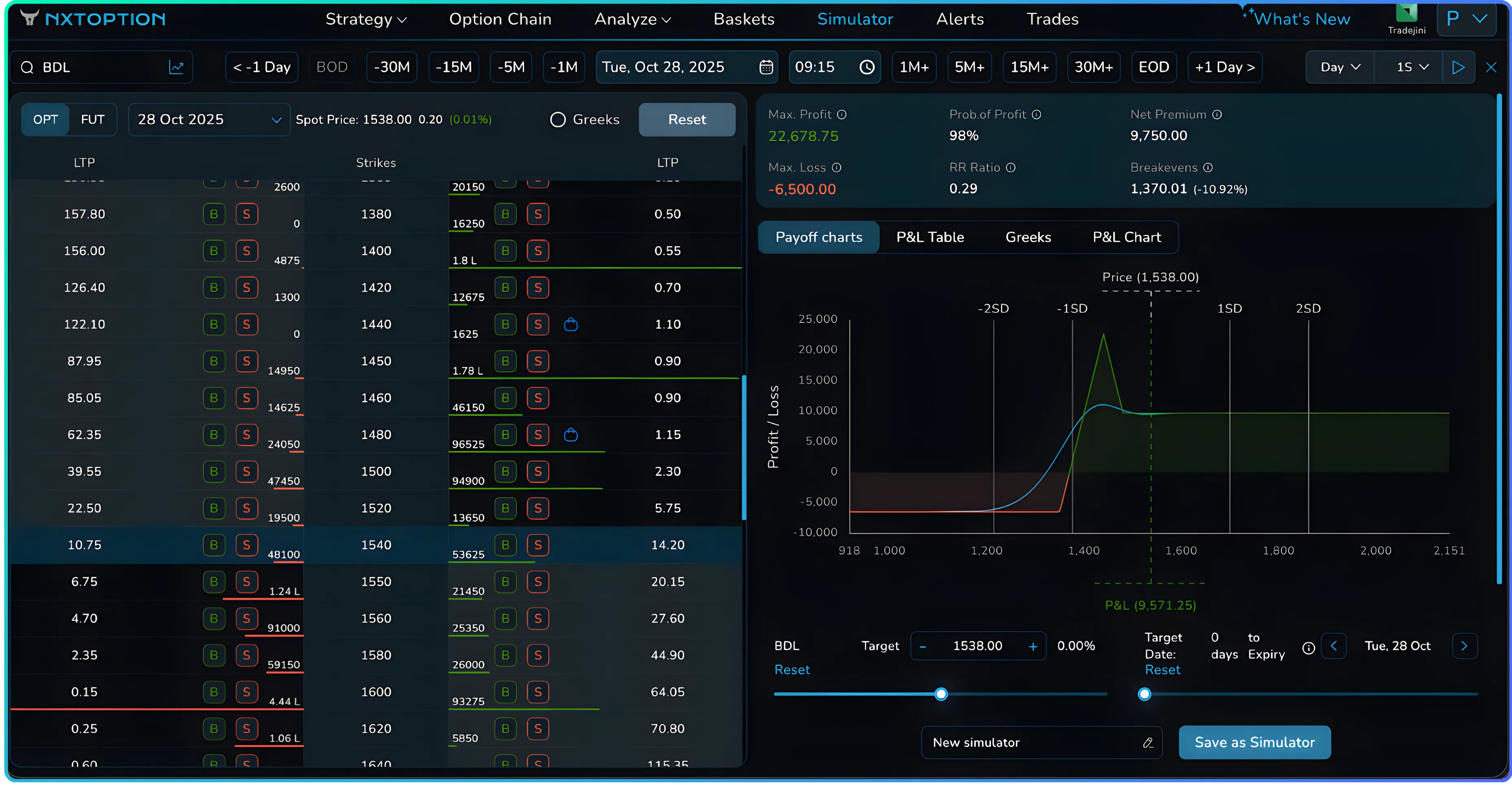
- Date of Entry: 1st October 2025
- Stock/Index: BDL (Bharat Dynamics Ltd)
- Current Price: ₹1,488.00
Trade Metrics:
- Net Credit: ₹9,750.00
- Maximum Profit: ₹22,678.75 (occurs near ₹1,420–₹1,480)
- Maximum Loss: ₹6,500.00 (if BDL drops sharply below ₹1,350 or rises beyond ₹1,540)
- Breakevens: ₹1,370.01
Outcome:
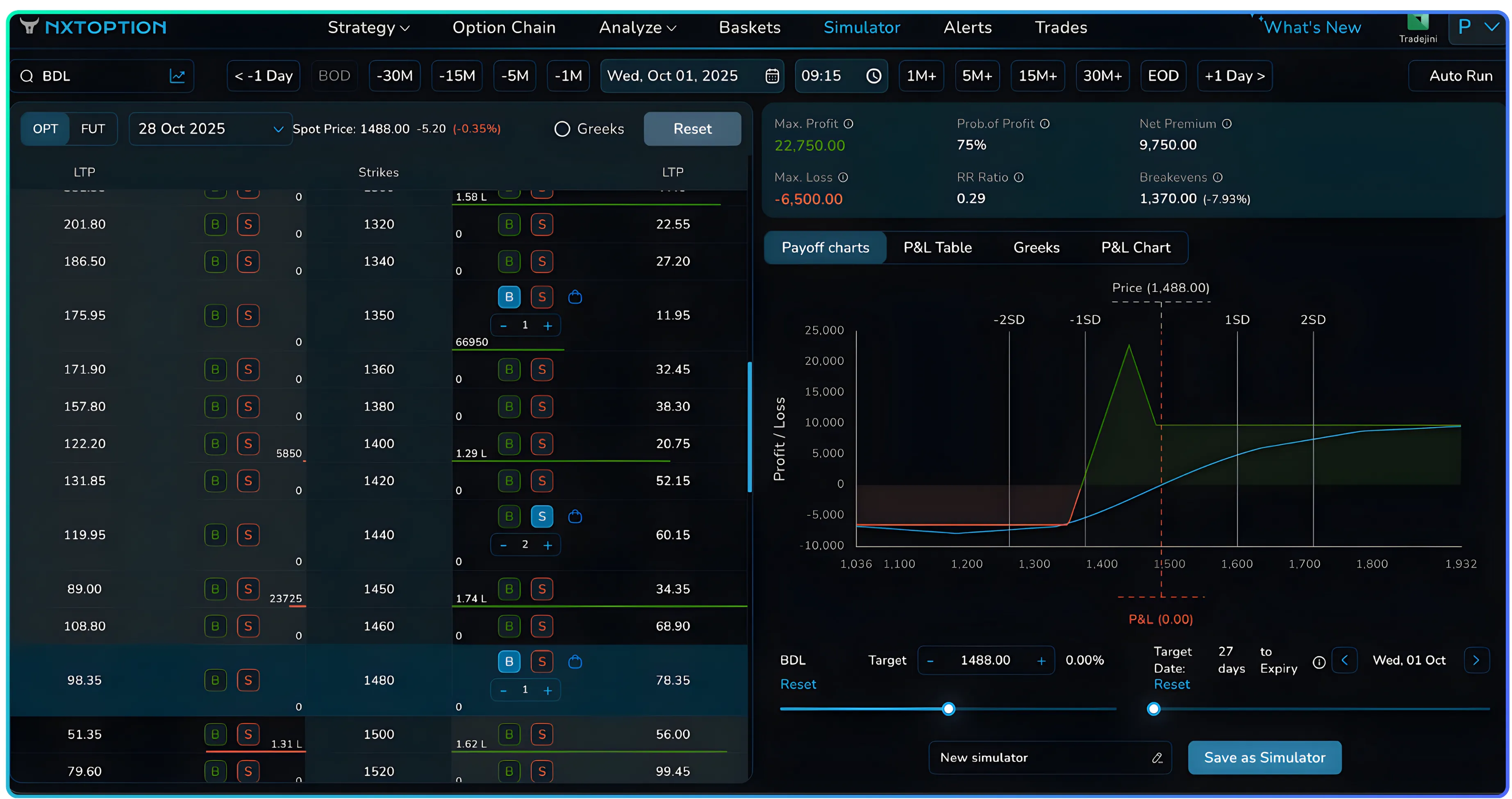
- Expiry Date: 28th October 2025
- Closing Price: ₹1,538.00
- Actual P&L: ₹9,571.25 profit
Analysis:
This Unbalanced Put Butterfly was executed with a 1350–1480–1540 structure to capture mild downside movement while keeping risk strictly defined. The lower wing (130-point distance) was tighter than the upper wing (60 points), giving the trade a 1:2.1 strike spacing ratio and a bearish theta-positive profile.
At expiry, BDL closed at ₹1,538, close to the upper breakeven. The short 1480 PEs decayed faster than the long protection legs, allowing the trader to retain most of the initial credit. The result was a high-probability 98% win-rate structure, yielding near-max profit with limited downside exposure. This trade demonstrates how unbalanced butterflies can generate income efficiently when price remains near the short strike band under controlled volatility.
Risk Management
The key risk in the Unbalanced Butterfly options strategy arises when price moves sharply beyond the skewed side, effectively “breaking” the wing and amplifying losses compared to a standard butterfly.
Primary Risks:
- In a bullish (Call) version, a sudden rally beyond the farthest call strike accelerates losses.
- In a bearish (Put) version, a steep drop below the skipped strike increases risk.
Mitigation Techniques:
Strike Selection: Keep skipped legs within 200–300 points of the middle strike for indices like NIFTY or BANKNIFTY to control exposure.
Exit Triggers: Close when price breaches the outer strike or moves ±1.5% beyond center.
Rolling: If price nears the risk edge, roll the outer leg outward and reduce one short position.
Position Sizing: Limit risk to 1–2% of capital per trade.
Hedging Option: If volatility expands, offset delta using small opposite-side spreads
When Not to Use:
Avoid during earnings or high IV spikes, unbalanced structures lose edge under volatility expansion.
Advanced Technique:
Seasoned traders may dynamically hedge delta or re-center shorts to evolve the setup into a ratio spread when conditions change.
Greeks Interpretation
| Greek | Unbalanced Call Butterfly (Laurus Labs) | Unbalanced Put Butterfly (BDL) |
|---|---|---|
| Delta | +0.01 – almost neutral but slightly bullish, meaning minor gains if price rises gradually toward ₹950 | 0.00 – perfectly neutral with mild bearish sensitivity, stable against small moves in either direction |
| Theta | +0.03 – positive; time decay contributes steady gains as long as price remains near the short 950 calls | +4.97 – strongly positive; significant theta inflow as short 1440 PEs lose value faster than long legs |
| Gamma | –0.0003 – low and asymmetric; exposure increases on fast rallies beyond ₹1000 | +0.0004 – low; structure remains stable with minor curvature risk in sharp downward moves |
| Vega | –0.06 – short volatility; profits if implied volatility contracts post-event | –0.01 – slightly short volatility; benefits from IV decline but less sensitive than the call side |
Interpretation:
The Laurus Labs Call Butterfly is marginally delta-positive, theta-positive, and vega-negative, aligning with a mild bullish bias and a preference for stable or declining volatility. The BDL Put Butterfly, on the other hand, is nearly delta-neutral, strongly theta-positive, and slightly vega-short, making it ideal for time decay-driven income when the price stays range-bound. Both are defined-risk, theta-positive structures that perform best in low-volatility, sideways-to-controlled-trend environments. Effective management involves monitoring gamma expansion near expiry and rolling or closing positions if price nears breakevens.
Strategic Positioning
The Unbalanced Butterfly options strategy is the ideal middle ground between conviction and caution. It provides defined losses, controlled risk, and consistent theta income for traders expecting modest directional movement. Unlike ratio spreads that amplify delta, this structure fine-tunes it for stability.
It fits intermediate traders who understand multi-leg mechanics and seek directional options bias call put exposure without excess risk. The setup excels during moderate trends with falling volatility, rewarding skill in strike selection and timing rather than brute momentum bets.
Conclusion
The Unbalanced Butterfly turns a symmetric butterfly into a flexible directional instrument with defined risk. The Call version suits moderate bullish outlooks, while the Put version fits mild bearish expectations. Both variants maintain limited losses and offer income through theta positive options strategies.
When choosing between them, consider:
Are you trading for controlled directionality or neutral decay?
Do you prefer credit entry or speculative movement?
Can you manage asymmetric gamma risk if price overshoots?
Mastering Options Greeks Unbalanced Butterfly dynamics is essential. With careful strike planning and exit discipline, this structure offers steady returns across trending but controlled markets.
Use the Nxtoption Strategy Builder to simulate payoffs and monitor Greeks in real time before executing on CubePlus for live tracking and position management.
Disclaimer: The information provided in our blogs is for informational purposes only and should not be construed as financial, investment, or trading advice. Trading and investing in the securities market carries risk. Always conduct your own research and consult with a qualified financial advisor before making any investment decisions. Past performance is not indicative of future results. Copyrighted and original content for your trading and investing needs.
© 2025 — Tradejini. All Rights Reserved.


