Imagine a world where your trades execute in milliseconds, emotions do not cloud your decisions, and you do not need to sit in front of the screen all day. Welcome to the world of algorithmic trading, or algo trading—where technology and finance blend seamlessly to create smarter trading opportunities.
With over 46 million demat accounts added in 2024 alone, India’s stock market participation is soaring. But as competition intensifies, traditional trading methods are struggling to keep up. Algo trading, once reserved for institutional investors, is now accessible to retail traders, offering precision, speed, and efficiency like never before. Learn algorithmic trading and also the best automated trading platforms from the article.
So, how do you get started?
What is Algo Trading and Why is Everyone Talking About It?
At its core, algo trading uses computer programs to execute trades based on predefined rules. This means you set your strategy, and the system does the rest—no emotions, no panic, just disciplined execution.
Imagine this: A stock suddenly breaks out of a key resistance level at 10:05 AM. A manual trader might miss it, hesitate, or enter late. But an algorithm spots the move in milliseconds and executes the trade instantly locking in the advantage before others react. Curious how this happened? The trader set a prebuilt strategy once the resistance was broken, the system instantly executed the buy order without hesitation. Isn’t that cool?
The biggest advantage? Time is no longer a constraint. Whether you are an active trader or a full-time professional, algo trading ensures you never miss an opportunity.
Let’s breakdown the steps required to start Algo trading for beginners
Step 1: Setting Up Your Trading Account
Before diving into algo trading, you need a demat and trading account. But that is just the beginning. You will also need access to an algo trading platform that allows automation. Platforms like CubePlus offer API-based setups for seamless execution.
Step 2: Choosing Your Approach—Are You a Coder or a Strategist?
There are two ways to approach algo trading:
For Tech-Savvy Traders – If you know programming, you can build and customize your own strategies to adapt to market conditions.
For Non-Coders – No programming knowledge? No problem. Many platforms offer APIs and user-friendly interfaces where you can define logic without writing a single line of code.
Even if coding is not your forte, algo trading is still within reach.
Step 3: Subscription-Based Algo Trading—Let the Experts Do the Work
If designing strategies is overwhelming, subscription-based platforms offer a ready-made solution. These SEBI-approved platforms provide predefined trading strategies that run on autopilot. Performance metrics below provides you to evaluate the effectiveness before you deploy capital. The best way to play safe.
- Return on Investment (ROI)
- Drawdown and Maximum Drawdown
- Risk-to-Reward Ratio
Step 4: No-Code and Low-Code Trading Platforms
Want the benefits of algo trading without the complexity? No-code platforms offer drag-and-drop interfaces to build trading strategies. Some of the most popular options include:
- Tradetron – A visual platform for strategy creation.
- Algotest – Backtest and automate strategies without coding.
These platforms are perfect for traders who want to leverage automation without deep technical expertise.
Step 5: Exploring Pre-Built Strategies—Plug and Play Trading
Many brokers and algo trading platforms offer pre-built strategies that require minimal setup. Some notable ones include:
- Stoxxo by Algobaba – Ready-to-use trading strategies.
- Third-Party Signal Providers – Subscribe to TradingView signals designed by professionals.
If you prefer a blend of manual and automated trading, semi-systematic platforms like Trademate and Tradeflow offer a balance between control and automation.
Why is Algo Trading the Future?
- Speed & Efficiency – Trades execute in milliseconds, far faster than human reaction times.
- Real-Time Execution – Orders are placed instantly when conditions are met.
- Eliminates Emotional Trading – No more fear-driven exits or greedy entries.
- Multiple Strategies – From scalping to arbitrage, algo trading supports diverse approaches.
- Structured Trading Process – Say goodbye to guesswork; follow a predefined system.
How Does Algo Trading Work?
Think of it like a self-driving car for trading. It follows a workflow:
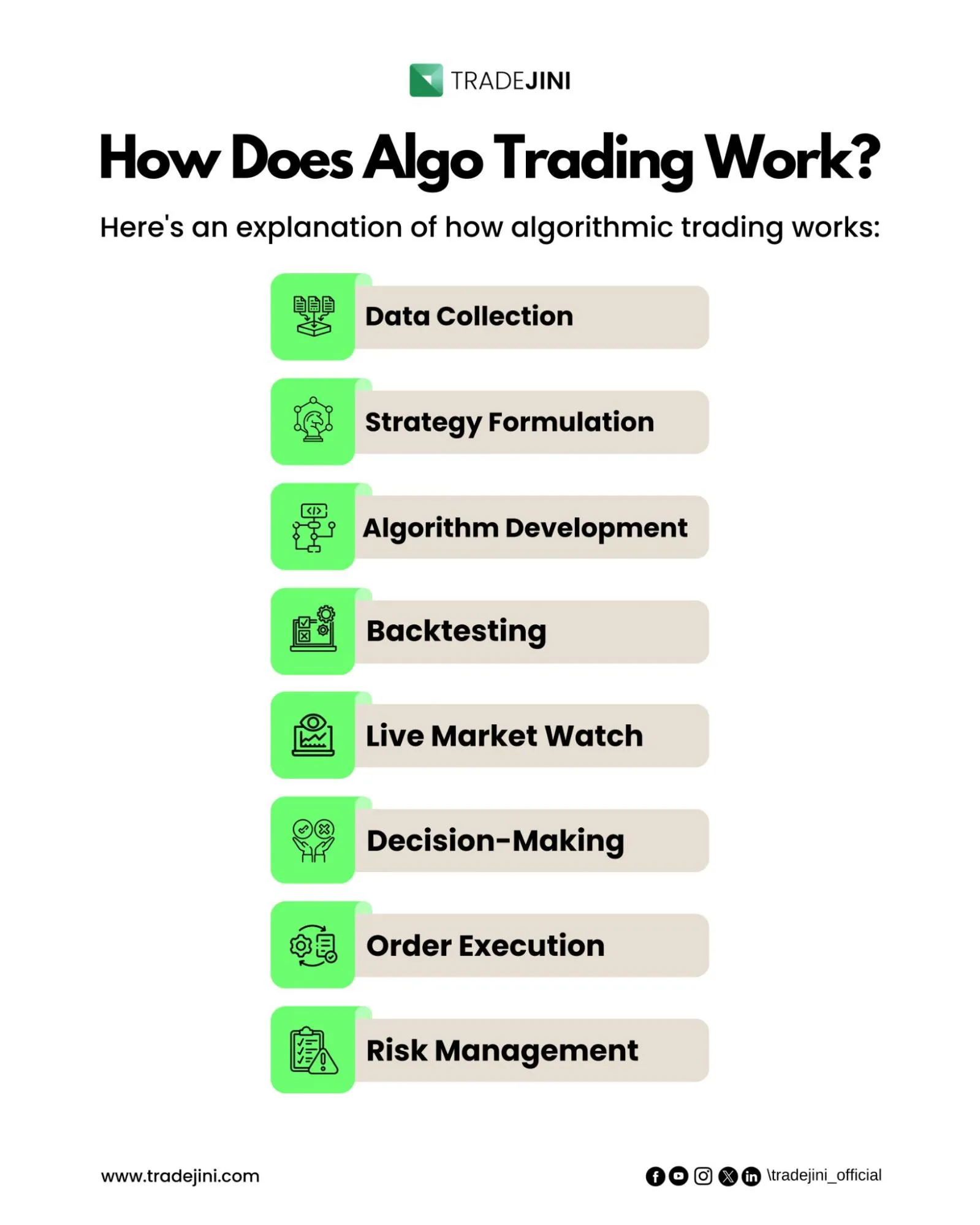
And if you are a novice, an algo trading guide can be a game-changer. Learning market signals, backtesting strategies, and avoiding common pitfalls (like overfitting strategies) will set you up for long-term success.
Getting Started with Tradejini’s Free API Integration
To simplify the transition into algo trading, Tradejini offers free API integration. This allows traders to connect with multiple algo platforms effortlessly, automating strategies with minimal technical input. And also next series chapter of algo will provide the algorithmic trading platform.
Final Thoughts:
Algo trading is not a shortcut to wealth but a structured, disciplined approach to trading. While automation enhances efficiency, success still depends on strategy robustness, continuous backtesting, and adaptation to market conditions. For beginners, starting with rule-based strategies and gradually refining them is the best approach. Algo trading is as much about learning and improving as it is about profits. With the right mindset and tools, it can be an enriching and efficient way to participate in India’s evolving financial markets.
.webp%3Falt%3Dmedia%26token%3D0ead9799-20bc-4d1e-ae8f-d75ab18921b5&w=3840&q=75)