

Imagine you own a pizza with three friends. Each of you owns 25% of the pizza. One day, you decide to bring in another friend and give them a slice without increasing the size of the pizza. Suddenly, your share becomes smaller.
Something similar happens in the stock market through a process called share dilution. For investors, understanding dilution is important because it can directly affect ownership, earnings per share (EPS), and long-term returns.
What Is Share Dilution?
Share dilution occurs when a company issues additional shares, increasing the total number of outstanding shares in the market.
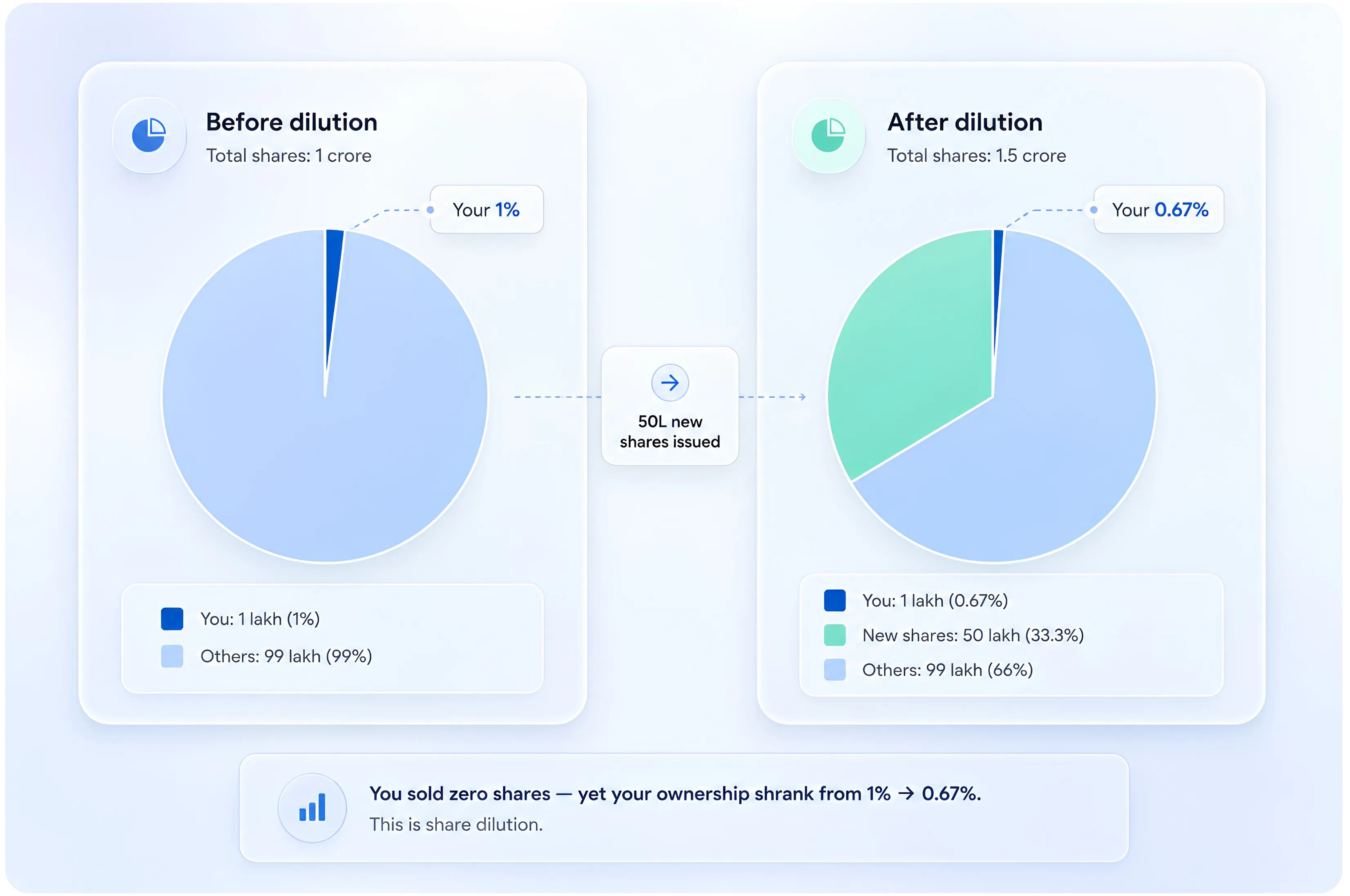
When new shares are issued, existing shareholders continue to own the same number of shares, but their percentage ownership in the company decreases.
In simple terms, your slice of the company becomes smaller because the total number of slices has increased. This reduction in ownership is often referred to as share dilution ownership.
Dilution of Shares: Example
Why Do Companies Dilute Shares?
Dilution is not always a bad thing. Companies often issue new shares to support growth and expansion. Understanding why companies issue new shares can help investors evaluate whether dilution is likely to create value or reduce shareholder returns.
1. Raising Capital: Instead of taking loans, companies may issue fresh shares to raise money for new projects, factories, acquisitions, or business expansion. For example, a renewable energy company may issue shares to fund a new solar power project rather than borrowing heavily from banks.
2. Funding Acquisitions: Companies sometimes use shares as currency to acquire another business. Instead of paying cash, they issue shares to the owners of the target company.
3. Employee Stock Options (ESOPs): Many listed companies offer stock options to employees as part of compensation packages. When these options are exercised, new shares may be issued, resulting in dilution. This is commonly known as ESOP dilution India.
4. Convertible Securities: Some financial instruments such as convertible debentures and convertible preference shares can eventually be converted into equity shares. This increases the total number of shares outstanding.
How Dilution Affects Investors?
Lower Ownership Percentage: The most direct impact is a reduction in ownership. Even though the number of shares you hold remains unchanged, your stake in the company decreases.
Impact on Earnings Per Share (EPS): EPS is calculated by dividing a company's profit by the total number of outstanding shares. If profits remain the same but the number of shares increases, EPS falls.
For example:
Company profit: ₹100 crore
Shares outstanding: 10 crore
EPS = ₹10
If the company issues another 5 crore shares:
New shares outstanding = 15 crore
EPS = ₹6.67
A lower EPS can sometimes impact stock valuations.
Reduced Voting Power: Shareholders often have voting rights in important company decisions.Dilution reduces the percentage of voting power held by existing investors.
Does Dilution Always Mean Bad News?
Not necessarily. The key question is: ‘What is the company doing with the money it raises?’
If the capital is used productively and generates higher profits in the future, dilution can actually create value for shareholders.
For example, if a company raises ₹2,000 crore through a share issue and uses it to build new manufacturing facilities that significantly increase future profits, investors may benefit despite the dilution.
On the other hand, repeated dilution without meaningful business growth can hurt shareholders. ‘For share dilution investors India, the purpose behind the dilution is often more important than the dilution itself’.
Example……..
Many Indian companies have used Qualified Institutional Placements (QIPs), Follow-on Public Offers (FPOs), and rights issues to raise capital.
Consider a bank that wants to strengthen its capital base to support future lending growth. It may issue new shares to institutional investors through a QIP. Existing shareholders experience dilution, but if the additional capital helps the bank expand its loan book and increase profits over time, the long-term impact may be positive. This is why investors should evaluate both the dilution and the purpose behind it.
What Is Anti-Dilution Protection?
Large investors, venture capital firms, and private equity investors sometimes negotiate anti-dilution clauses. These provisions help protect their ownership percentage if the company issues additional shares in the future. However, such protections are generally not available to regular retail investors in public markets.

Share dilution is a normal part of corporate finance and business growth. It simply means that a company has increased the number of shares outstanding, reducing the ownership percentage of existing shareholders. However, dilution should not be viewed in isolation. Investors should focus on why the company is issuing new shares and whether the funds raised are likely to generate higher profits in the future. In India, share issuances are regulated by the Securities and Exchange Board of India (SEBI), which oversees the process to ensure transparency and protect investor interests. SEBI's guidelines govern key mechanisms such as QIPs, FPOs, and rights issues, making it essential for investors to stay informed about regulatory disclosures and compliance requirements before making investment decisions.
A small dilution that fuels significant growth can benefit shareholders. But repeated dilution without corresponding business performance may be a warning sign. As an investor, understanding dilution can help you make better decisions and avoid being surprised when your ownership stake or earnings per share changes over time.
Disclaimer: The information provided in our blogs is for informational purposes only and should not be construed as financial, investment, or trading advice. Trading and investing in the securities market carries risk. Always conduct your own research and consult with a qualified financial advisor before making any investment decisions. Past performance is not indicative of future results. Copyrighted and original content for your trading and investing needs.
© 2026 — Tradejini. All Rights Reserved.
.webp%3Falt%3Dmedia%26token%3D0ead9799-20bc-4d1e-ae8f-d75ab18921b5&w=3840&q=75)