Platform companies are businesses that connect two or more groups; buyers and sellers, customers and service providers through a digital app or website. Companies like Amazon, Uber, Netflix, Swiggy, and Paytm are all platform companies. What they sell is not just a product or service. What they really sell is convenience. Before these platforms existed, buying groceries meant going to a store. Booking a cab meant standing on the road. Paying a bill meant visiting a bank. Watching a movie meant going to a theatre or waiting for a TV slot. Platform companies replaced all of this with a few taps on a smartphone.This is the foundation of the convenience economy in India, where digital platforms have become the new india digital middlemen between consumers and businesses."
In doing so, they did not just change consumer habits. They disrupted entire industries; retail, food, transport, entertainment, financial services, and travel and made themselves the new middlemen between consumers and businesses. Traditional businesses that once dealt directly with customers now increasingly depend on these platforms for visibility, orders, payments, and logistics.
India's Digital Convenience Revolution
India became one of the biggest markets for platform companies because of a rare combination of factors that came together at the same time. The launch of Reliance Jio in 2016 dropped mobile data prices by nearly 90%, making the internet affordable for hundreds of millions of people for the first time. Cheap smartphones followed. Jio's entry into the internet in India transformed the country from one with limited internet access to one of the largest mobile internet markets in the world within a few years."
The government's Unified Payments Interface, or UPI, made India's UPI digital payments instant, free, and easy. Anyone with a bank account and a phone could pay or receive money in seconds. This removed the biggest friction in online commerce — payment — and allowed platform companies to scale rapidly.
Add to this a young population, rapid urbanisation, a growing middle class with rising incomes, and a generation of consumers who grew up with smartphones and had little patience for slow or complicated services. India was the perfect market for convenience-based platforms, and the industry grew accordingly.
The Rise of Platform Companies in India
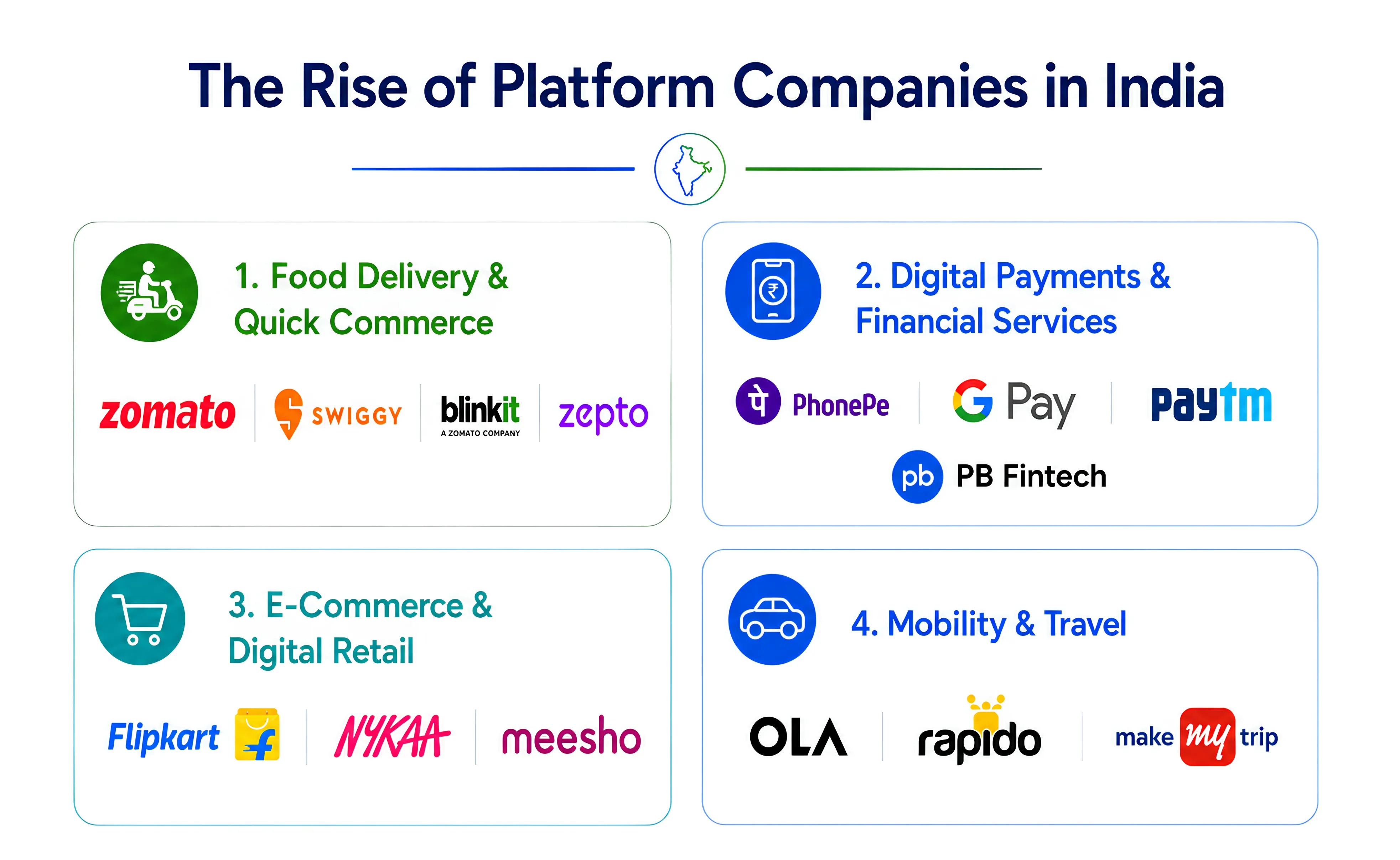
Food Delivery and Quick Commerce
Zomato Swiggy business model is built on connecting restaurants with customers and managing the delivery. Their revenue comes from delivery fees, commissions charged to restaurants, advertising, and membership subscriptions.
Blinkit and Zepto's quick commerce model, delivering groceries and essentials within 10 to 20 minutes, was the next evolution. They operate small local warehouses called dark stores stocked with high-demand products. This segment is capital-heavy but growing fast as consumers get comfortable ordering everyday items by phone.
Digital Payments and Financial Services
Paytm, PhonePe, and Google Pay dominate India's digital payments through UPI. Since UPI transactions are free, their revenue comes from other financial products; loans, insurance, credit cards, and merchant services. PB Fintech, which runs Policybazaar and Paisabazaar, simplified how Indians compare and buy insurance and loans online.
E-Commerce and Digital Retail
Flipkart and Meesho's ecommerce models changed how Indians shop, with Flipkart dominating electronics and fashion and Meesho building a model for smaller towns and cities, letting individuals resell products through social media with no inventory investment. The Nykaa business model focused on beauty and wellness and became one of the few Indian platform companies to list profitably.
Mobility and Travel
Ola and Rapido's ride hailing in India changed urban transport through app-based cab and bike booking. The MakeMyTrip travel platform made flight, hotel, and train booking fully digital, replacing travel agents for most consumers. All of these platforms depend on high repeat usage; the more people use them, the more useful and dominant they become.
Also Read: Decoding The Real Drivers Of IT Stock Valuations
How Platform Companies Changed Consumer Behaviour
Platform companies did not just offer a better product. They changed what consumers expect as normal.
Speed is the clearest example. A decade ago, two-day delivery was considered fast. Today, same-day delivery is standard, and ten-minute grocery delivery exists. Each time a platform raises the bar on speed or convenience, it resets consumer expectations and any competitor that cannot match it loses credibility.
Cashless payment is another. Once consumers experienced instant UPI payments, carrying cash began to feel unnecessary. This is the kind of behaviour shift platforms depend on and not just adoption of a new tool, but a change in preference that makes the old way feel inconvenient.
To attract users in the first place, platforms spend heavily on discounts and promotions. In business terms, this is called Customer Acquisition Cost, or CAC; the money spent to bring one new user onto the platform. The bet is that, over time, each user will spend enough on the platform to generate a Lifetime Value, or LTV, that is much higher than what was spent to acquire them. This is why platforms accept losses early because they believe that they are buying future revenue at today's prices.
Once users are on a platform, the goal is to keep them there. This is helped by network effects; the more restaurants on Zomato, the more useful it is for customers; the more customers, the more attractive it is for restaurants. The platform grows stronger as it gets bigger, making it harder for a new competitor to displace it.
Switching costs lock users in further. Over time, a user's payment details, saved addresses, order history, preferences, and loyalty points are all stored inside one platform. Switching to a competitor means starting over. Platforms design this deliberately because the more embedded a user becomes, the less likely they are to leave.
The Interdependency Between Platforms and Traditional Businesses
One of the most important and often overlooked aspects of the platform economy is the deep two-way dependency that has developed between platform companies and traditional businesses.
Restaurants are the clearest example. A mid-sized restaurant in Bengaluru or Mumbai today may get 40 to 60 percent of its orders through Zomato or Swiggy. These platforms gave restaurants access to customers they could never have reached on their own; people ordering from home, from offices, from areas far from the restaurant's location. For many small restaurants, listing on a delivery platform is no longer optional. It is a survival requirement.
But this dependency runs both ways. Zomato and Swiggy need restaurants to fill their platforms. Without variety and quality on the supply side, users have no reason to open the app. This mutual need is real, but it is not equal. The platform controls pricing visibility, search ranking, customer data, and promotional placement. A restaurant that falls out of favour with the algorithm or cannot afford to pay for visibility, can see its orders drop sharply overnight. The platform holds the power in this relationship.
In quick commerce, a similar dynamic plays out with local kirana stores and small FMCG brands. Platforms like Blinkit and Zepto work with brands to stock their dark stores, giving those brands near-instant reach to urban consumers. For smaller brands, this is a distribution channel they could not build themselves. But again, the platform decides which products get stocked, how prominently they are displayed, and what pricing is offered and charges brands for advertising placement within the app.
In e-commerce, hundreds of thousands of small sellers across India now run their entire businesses through Flipkart, Meesho, etc. These platforms gave them access to customers across the country without needing to build a website, handle logistics, or manage payments. The trade-off is total dependence on the platform's rules, fees, and algorithms. A policy change or fee increase by the platform directly affects the seller's livelihood.
In financial services, traditional banks initially saw Paytm and PhonePe as threats. Today, many banks partner with fintech platforms to reach customers they cannot serve efficiently themselves particularly in rural and semi-urban areas. The banks provide the licensed infrastructure; the platform provides the distribution. Both need each other, but the platform owns the customer relationship.
This interdependency has important implications. It means platform companies are not just businesses serving consumers they have become infrastructure for entire categories of traditional business. It also concentrates significant economic power in the hands of a small number of platforms, which is one of the reasons regulators are paying increasing attention to how these companies behave.
Why These Companies Are Valued So Highly Despite Losses
The most common question about platform companies and India stocks is simple: how can a company losing money be worth billions? The answer is that stock markets do not value companies based on what they earn today. They value companies based on what investors believe they will earn in the future.
Platform companies are valued on their potential, not their current profits. Investors look at the total addressable market in India the company is operating in, or TAM, and ask: if this platform captures a significant share of that market, how much will it earn? India still has low penetration in e-commerce, food delivery, digital insurance, and online financial services. That leaves a large runway for growth.
Operating leverage is another reason investors are patient with losses. Most of a platform's costs are technology, brand, and core infrastructure, but they are fixed costs. Once those are covered, each additional order or transaction costs very little to handle. This means as revenue grows, profits grow even faster. A platform losing money at one million orders a month may be highly profitable at five million orders, using almost the same infrastructure.
Data is a less visible but equally important asset. Every interaction on a platform, every search, order, payment, and review, generates information that makes the platform better at recommendations, delivery, and advertising. Over time, a platform with years of consumer data has a structural advantage over any new competitor. It also earns advertising revenue by helping brands target specific consumers precisely, which is a high-margin business.
All of this is why investors are willing to hold loss-making platform stocks. They are not buying the business as it is today. They are buying the business as it could be at scale once habits are built, infrastructure is paid for, and monetisation is in full swing.
Why Many Platform Companies Operate at Losses Today
Platform company losses in India are often deliberate, at least in the early stages. The strategy is called 'scale before profits'; build the largest possible user base and market share first, then worry about profitability later.
The logic is straightforward. In most platform markets, two or three players will eventually dominate. The company that gets there first, with the largest network and deepest consumer habits, will be extremely hard to displace. The cost of getting there; subsidised delivery, customer discounts, technology investment, geographic expansion, shows up as losses. But the resulting market position is the real asset.
Burn rate refers to how fast a company is spending its cash reserves. A high burn rate is acceptable if the spending is building measurable growth, more users, better economics per order, stronger market position. The critical test is whether the loss per transaction is shrinking over time even as total losses grow. If it is, the business is on track. If not, the spending is not converting into durable value.
Amazon spent over a decade reporting minimal profits while building its logistics network, Prime membership, and AWS cloud business. Those investments looked expensive at the time. In hindsight, they were the foundation of one of the most profitable businesses ever built. India's platform companies are making the same argument, though the catch is that not all of them will survive to prove it.
Can These Companies Become Profitable?
Some already are, and the rest have a credible path, provided they execute well and competitive intensity moderates.
Zomato has reached operating profitability in its food delivery business by improving delivery efficiency, reducing customer discounts, and growing advertising revenue from restaurant partners. Nykaa listed profitably from the start by focusing on a niche and managing its inventory model carefully. These are real proof points that the model can work.
The main levers for profitability are reducing customer acquisition costs as brand recognition grows and organic usage increases, improving delivery efficiency through better route planning and higher order density in urban areas; growing advertising revenue which carries high margins, and building subscription models that create predictable, recurring revenue from loyal users.
The honest counterpoint is that profitability is not guaranteed. India's consumers are price-sensitive. Heavy discounts build user bases quickly, but those same users may reduce usage when prices normalise. Competition keeps fees low and spending high. And expansion into smaller cities which is necessary for long-term growth often comes with weaker economics than the major metros where these platforms first succeeded.
The realistic path is gradual improvement over several years, not a sudden flip to profitability. Companies that manage this transition carefully, investing where economics are favourable and pulling back where they are not, will be better positioned than those chasing growth for its own sake.
Challenges, Risks, and Future Uncertainties
Cash Burn and Funding Dependency
Many platform companies still depend on external funding to sustain operations. When investor sentiment turns negative, as it did in 2022-23, when global interest rates rose sharply and loss-making companies face real pressure. Several Indian startups went through significant cost-cutting and layoffs during that period. Companies that have not yet achieved positive cash flow are vulnerable to funding cycles they cannot control.
Price-Sensitive Consumers and Discount Dependency
A large share of Indian platform users came for the discounts, not just the convenience. When subsidies are reduced, some of these users reduce usage or switch to whichever platform is currently offering better deals. Building loyalty that survives a price increase requires delivering genuinely superior service which is slower and harder than simply offering the lowest price.
Intense Competition and Margin Pressure
Food delivery, quick commerce, payments, and e-commerce all have multiple large, well-funded players fighting for the same customers. This keeps fees low and spending high, which delays profitability across the board. In digital payments specifically, UPI is free to use, which means platforms must find their revenue in adjacent services like lending and insurance rather than in the core product.
Regulatory and Antitrust Risks
As platform companies become dominant in their sectors, they attract regulatory scrutiny. India's Competition Commission has investigated several platform companies for alleged anti-competitive practices. Data privacy regulation is evolving. Platforms that have built advantages through exclusive arrangements or preferential treatment of their own products face increasing legal risk as regulators catch up with the industry.
Weak Economics Outside Major Cities
Most platforms generate their best economics in large cities where order density is high and delivery is efficient. Smaller cities and towns have lower order volumes, higher delivery costs relative to revenue, and greater price sensitivity. Expansion into these markets is necessary for growth but often dilutes the overall economics of the business.
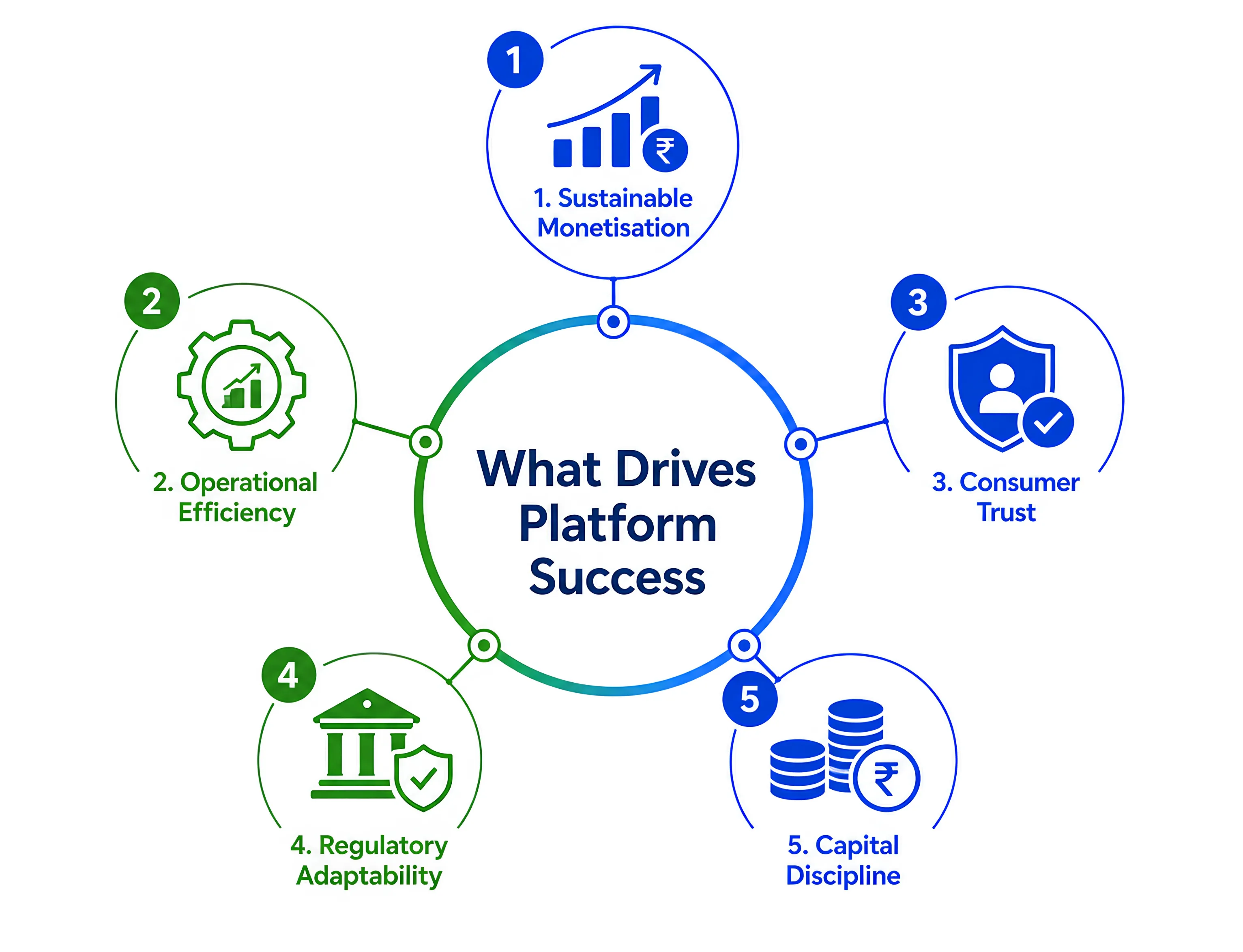
Key Factors That Will Decide Long-Term Success
Sustainable Monetisation: Shifting from discount-driven growth to fee-based, subscription, and advertising revenue that users are willing to pay for without incentives.
Operational Efficiency: Reducing cost per delivery or transaction through technology, better route planning, and higher order density and not just growing volume but improving the economics of each transaction.
Consumer Trust: Particularly in financial services and healthcare, users share sensitive data with platforms. Companies that handle this well will retain users more effectively than those that do not.
Regulatory Adaptability: Platforms that engage constructively with regulators and build compliance into their operations will face fewer disruptions than those that treat regulation as a threat to be resisted.
Capital Discipline: Investing where unit economics are favourable and not chasing scale in categories where the numbers do not work. Many platforms that failed during the 2022-23 funding correction had simply spent without enough discipline.
Also Read: Why Low Valuation Metrics Often Signal Financial Danger
The Long-Term Bet
India's new app-based platforms have completely transformed daily life by changing how millions of people shop, order food, travel, and handle money. These digital companies have become the essential middleman that traditional businesses like local restaurants, banks, and shops must rely on just to reach their customers. While many of these platform companies in India are not highly profitable yet, investors are pouring money into them because they are betting on the massive network of loyal users and data being built for the future. Ultimately, the long-term success of these India app based platforms will depend on how well they run their businesses and whether everyday Indian consumers are willing to keep paying a premium for pure convenience once the early discounts and subsidies disappear.
Disclaimer: The information provided in our blogs is for informational purposes only and should not be construed as financial, investment, or trading advice. Trading and investing in the securities market carries risk. Always conduct your own research and consult with a qualified financial advisor before making any investment decisions. Past performance is not indicative of future results. Copyrighted and original content for your trading and investing needs.
© 2026 — Tradejini. All Rights Reserved.

.webp%3Falt%3Dmedia%26token%3D0ead9799-20bc-4d1e-ae8f-d75ab18921b5&w=3840&q=75)