_11zon.webp%3Falt%3Dmedia%26token%3Ddb093c1c-21ed-462d-94ed-475134a20932&w=3840&q=85)
Call Ratio Spread is an option strategy used when you expect a limited upside in a stock or index. It’s considered premium-neutral, meaning you don’t pay much (or sometimes anything) upfront to enter the trade.
How it works
This strategy involves buying one call option at a lower strike price and selling two (or more) call options at a higher strike price, all with the same expiry and on the same stock or index.
When to use it
Traders typically use the Call Ratio Spread when they expect a moderate rise in the price of the stock or index. It’s ideal after a sharp fall, when a pullback rally is expected. The profit potential is limited, usually up to the strike of the sold calls, but the strategy helps lower your upfront cost.
When to use it
Traders typically use the Call Ratio Spread when they expect a moderate rise in the price of the stock or index. It’s ideal after a sharp fall, when a pullback rally is expected. The profit potential is limited, usually up to the strike of the sold calls, but the strategy helps lower your upfront cost.
Constructing the Call Ratio Spread
To implement the Call Ratio Spread, one undertakes the following steps:
Buy 1 In-the-Money (ITM) or At-the-Money (ATM) Call: This involves purchasing one call option with a strike price that closely mirrors the current market price of the underlying asset.
Sell 2 Out-of-The-Money (OTM) Call Options: Simultaneously, sell two call options with strike prices that are higher and, more importantly, out of the money. The number of options sold is twice the number bought.
Also read: Praveg Ltd. Positioned for Margin Expansion and Long-Term Profitability
Illustrating with an Example
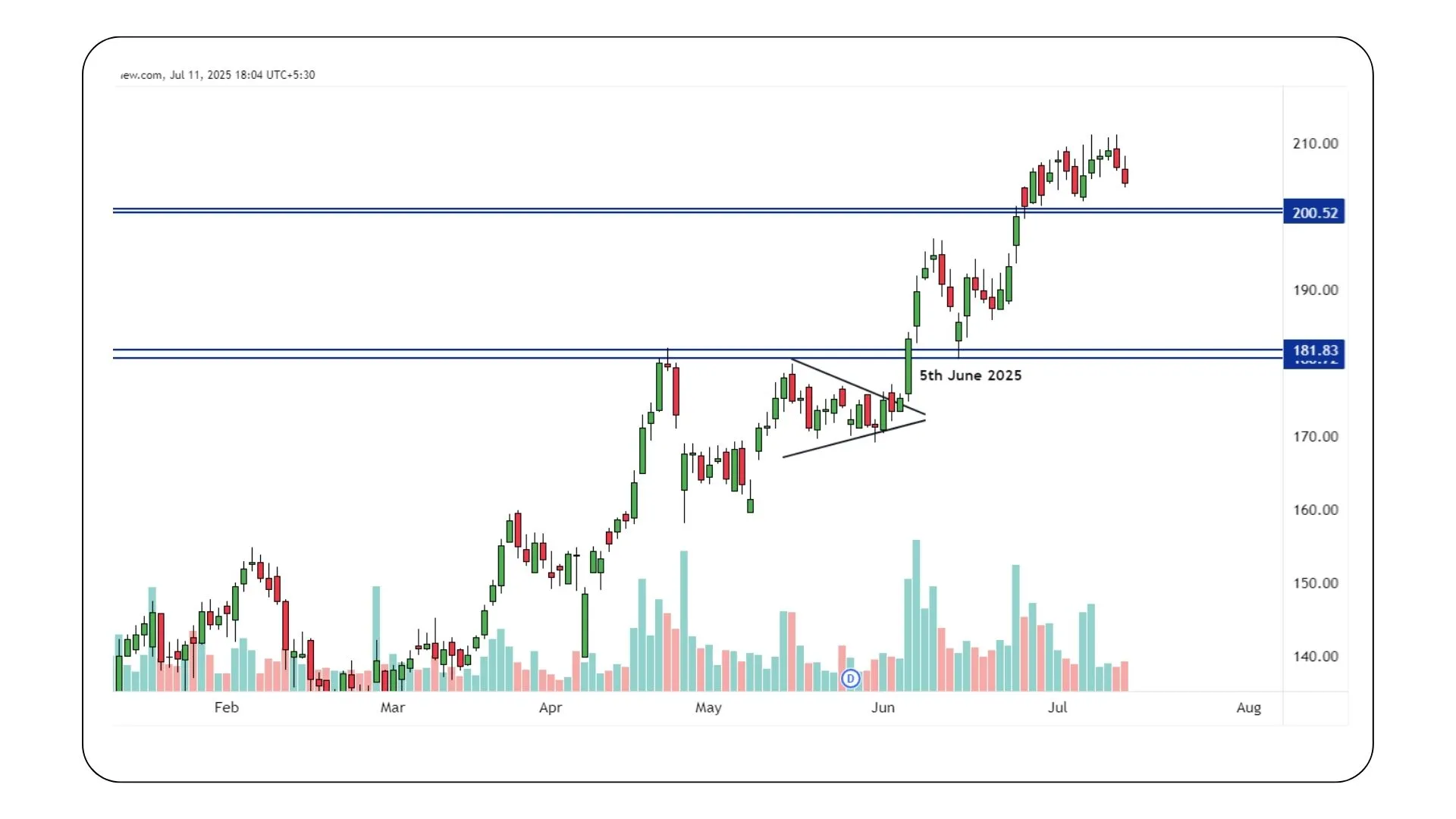
On 5th June, 2025, L&T Finance (LFT) , which had broken 181. Notably, mutual funds and index funds were actively adding to this portfolio, suggesting a strong interest from institutional investors. These conditions indicated the potential for a significant upward rally, with a target price of around toward 200 level. Given these circumstances, LTF seemed to be an ideal candidate for deploying a Bull Call Ratio Spread. This strategy would allow traders to take advantage of the anticipated price increase while managing risk effectively, making it a strategic choice for capturing potential gains in this bullish scenario.
Strategy deployment
Date: 5th June 2025, LTF spot price 182.41
A Bull Call Ratio Spread was initiated on June 5th, 2025, using options expiring on June 26th. As part of this strategy, the trader bought one lot of the 180 Call Option at ₹6.70 per unit and simultaneously sold two lots of the 200 Call Option at ₹1.05 per unit. This resulted in a net debit of ₹20,748 (₹30,118 paid for the long call and ₹9,370 received from the short calls).
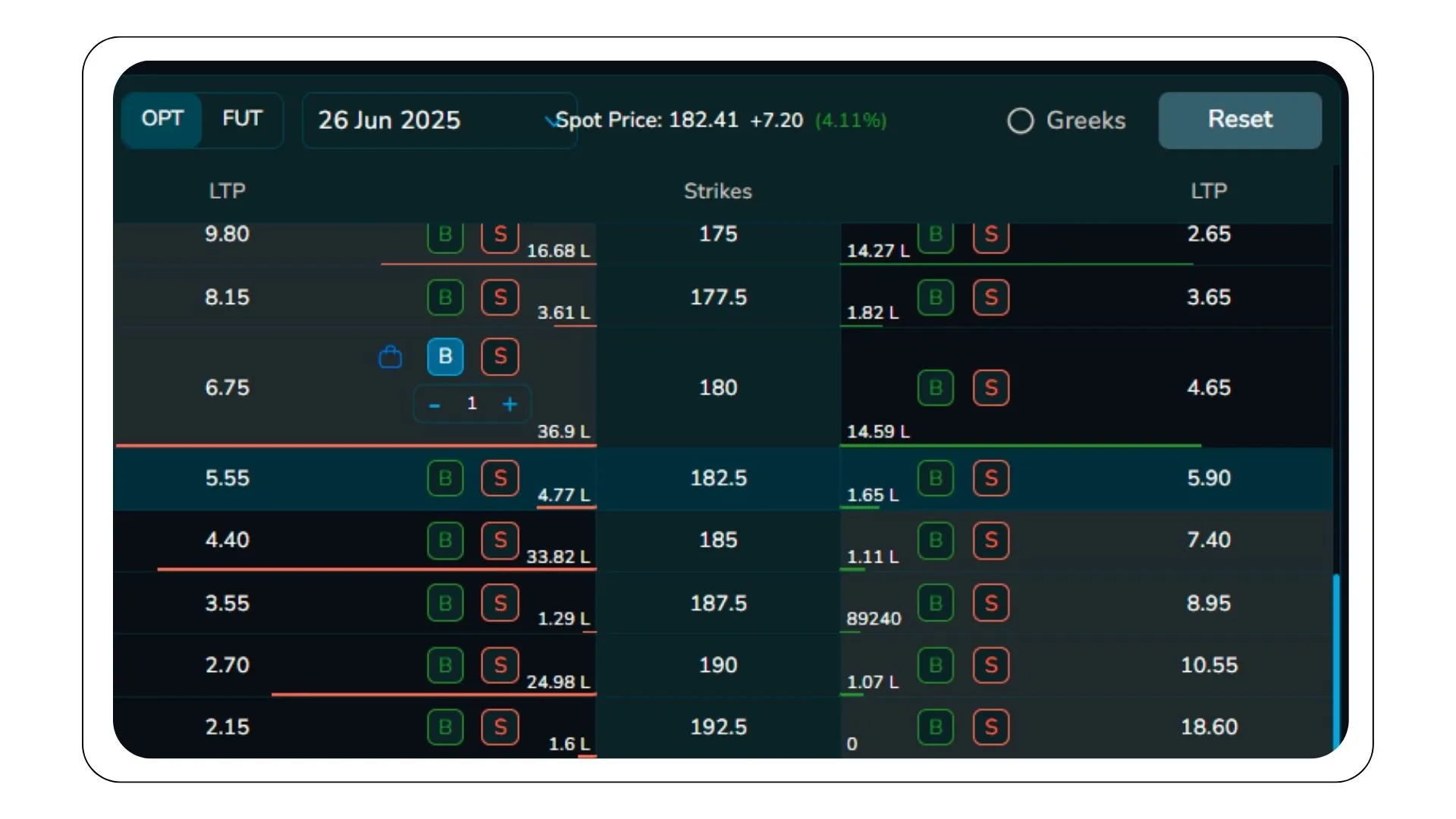
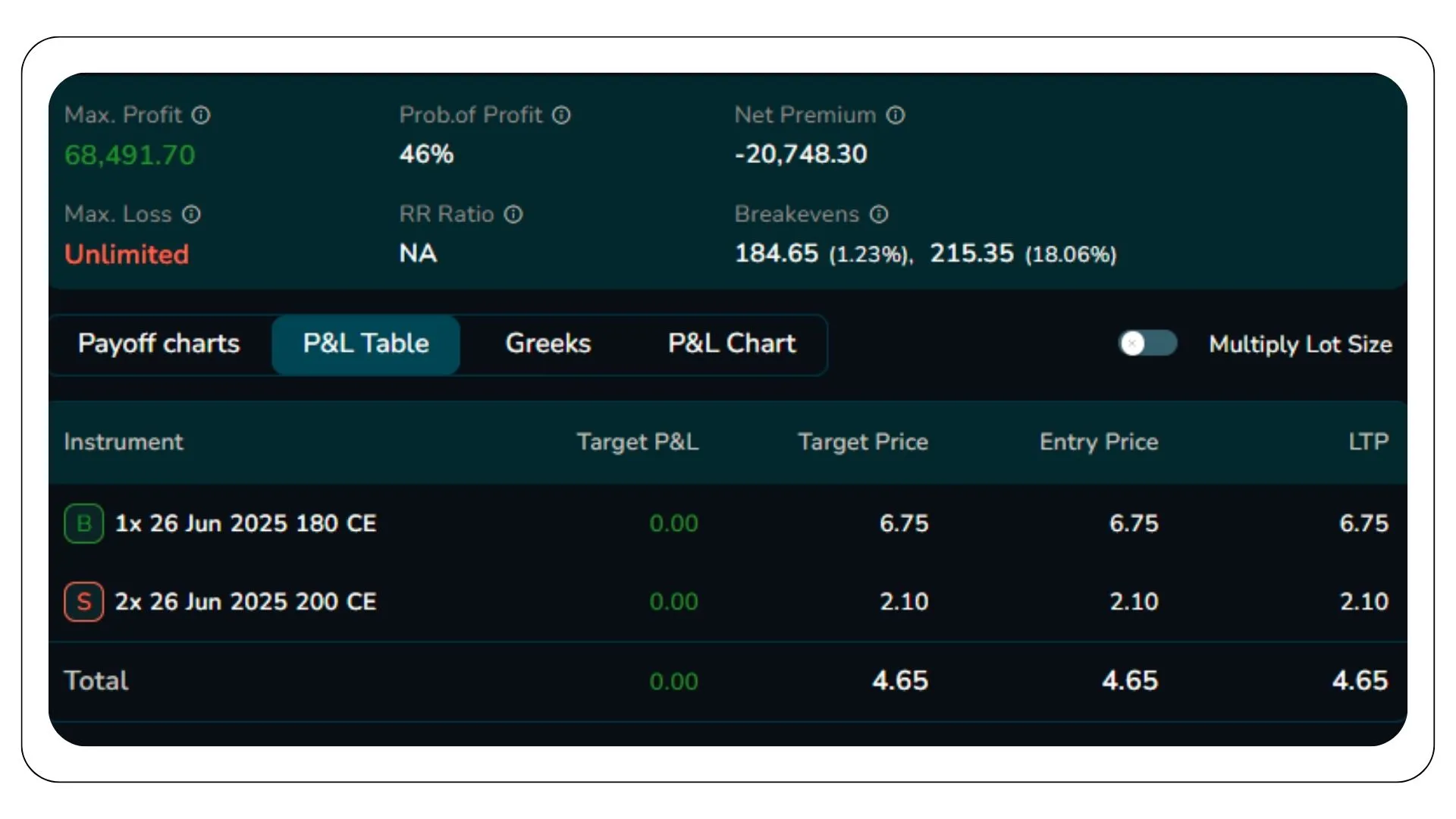
As shown in the image below:
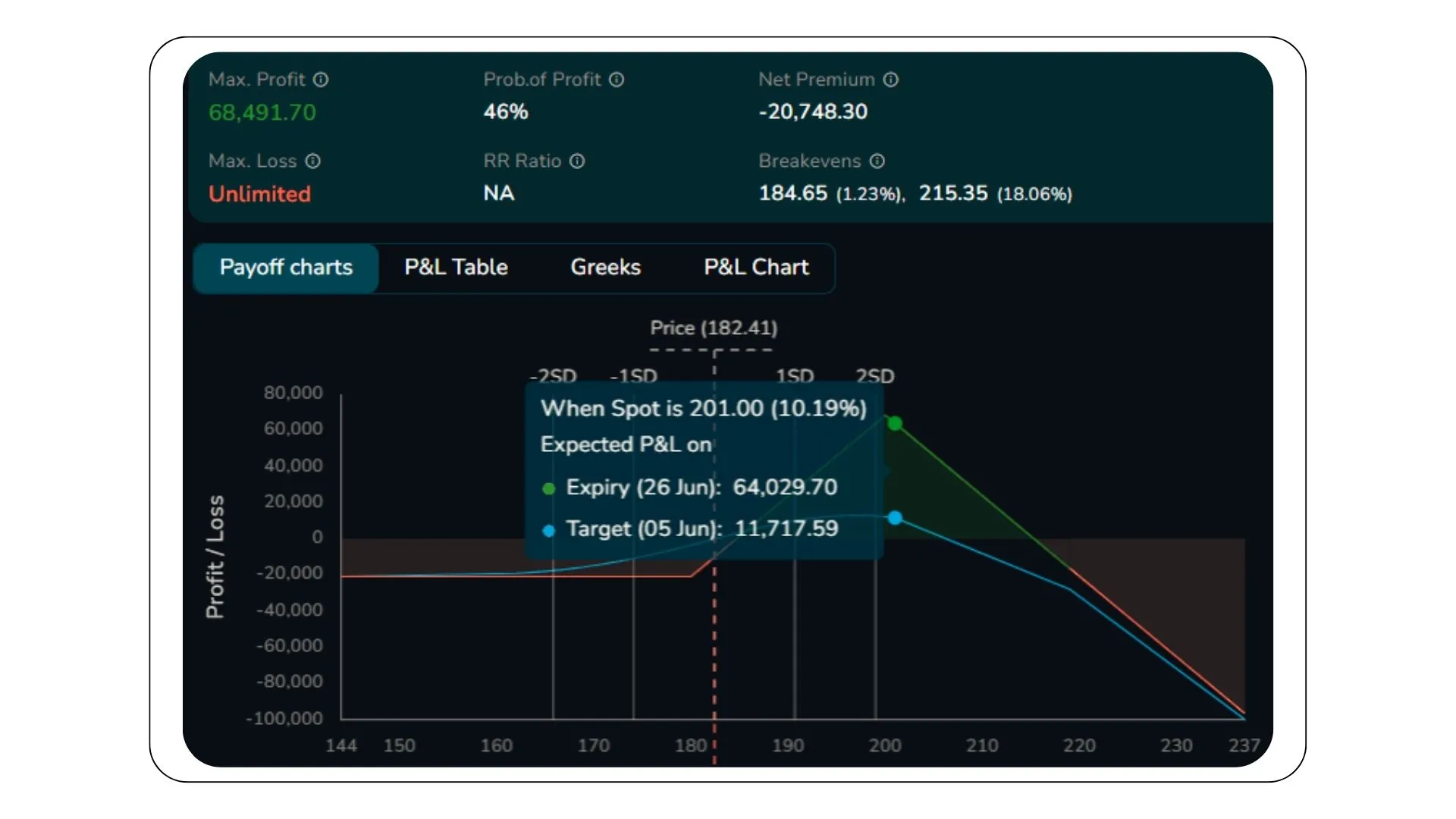
This position has a maximum potential profit of ₹68,491, which occurs if the underlying stock closes precisely at the 200 strike price on expiry. The breakeven levels are at ₹184.65 (lower) and ₹215.35 (upper). Beyond this range, the strategy begins to lose money, and risk becomes unlimited above ₹215.35 due to the uncovered short call. The Bull Call Ratio Spread is best suited for a moderately bullish view with low volatility expectations. It's important to note that traders are not required to wait until expiry, they can exit at any point to lock in profits or manage risk. Margin is required for this position due to the additional uncovered short call.
Greeks Insight
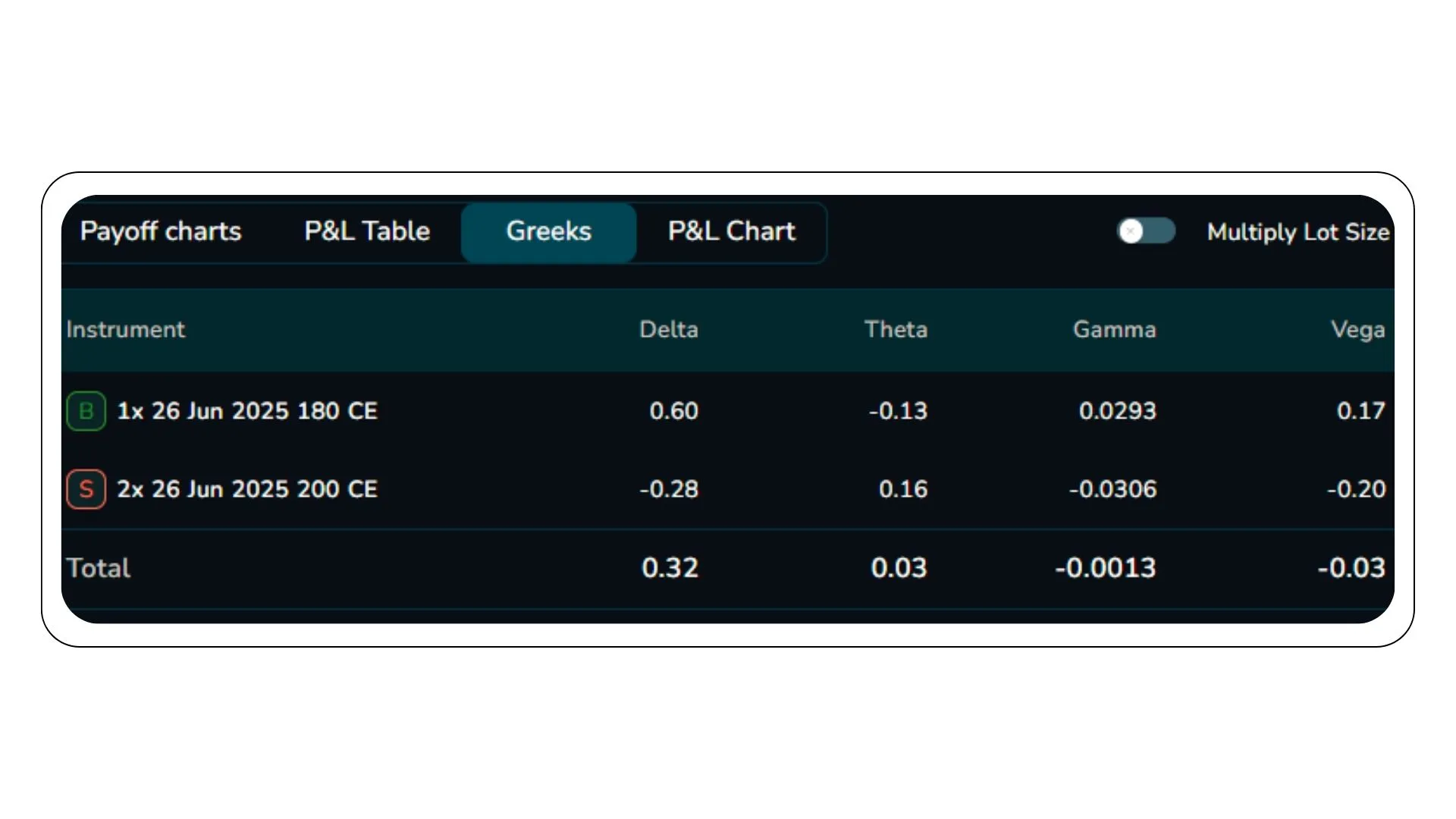
- From a Greek's perspective, the Bull Call Ratio Spread on LTF reflects a moderately bullish bias, with a net Delta of 0.32, meaning the position is expected to gain or lose approximately ₹0.32 for every 1-point move in the underlying price. The Theta is 0.03, indicating minimal time decay impact, making the position nearly time-neutral. The Gamma is very low at 0.00013, which suggests that Delta will not change drastically as the underlying moves, so the position is unlikely to become aggressively bullish or bearish. Meanwhile, the Vega is slightly positive at 0.03, implying a small potential gain if implied volatility rises. Overall, the trade structure remains stable, with controlled exposure to time and volatility, making it suitable for a low-volatility, moderately bullish outlook.
Also read: Acutaas Chemicals Ltd on a Growth Track in Specialty Chemicals and CDMO
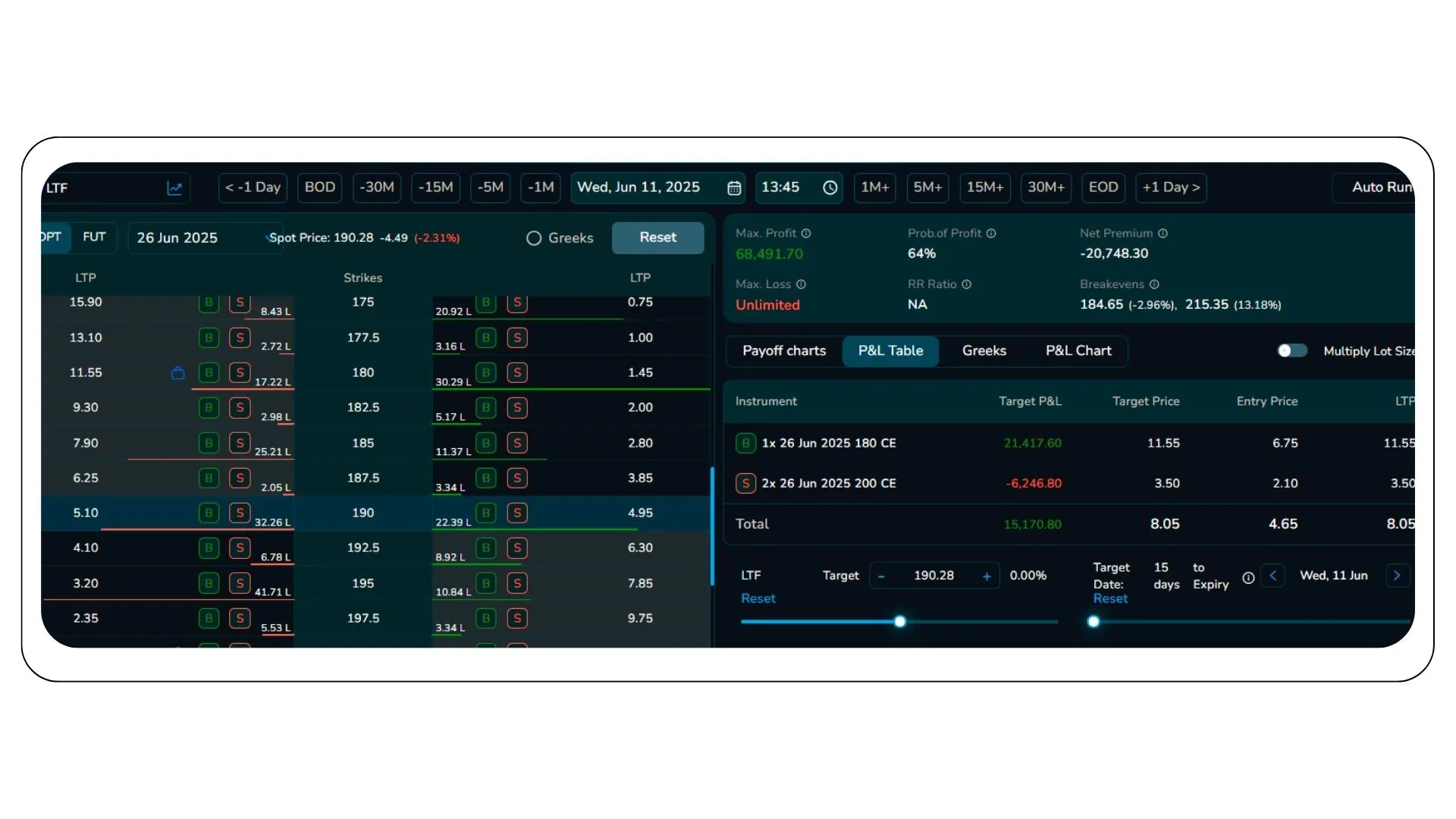
11th June LTF sport market price @ 190.28
The 180 CE (Call Option) bought at ₹6.75 had appreciated significantly to ₹11.55. Meanwhile, the 200 CEs (two lots) sold at ₹2.10 were trading at ₹3.50, which capped further upside but ensured the position remained comfortably in profit, with an unrealized gain of ₹15,170.
It's important to remember that traders are not obligated to hold such strategies until expiry. They can choose to exit the position at any time to lock in profits or manage risk.
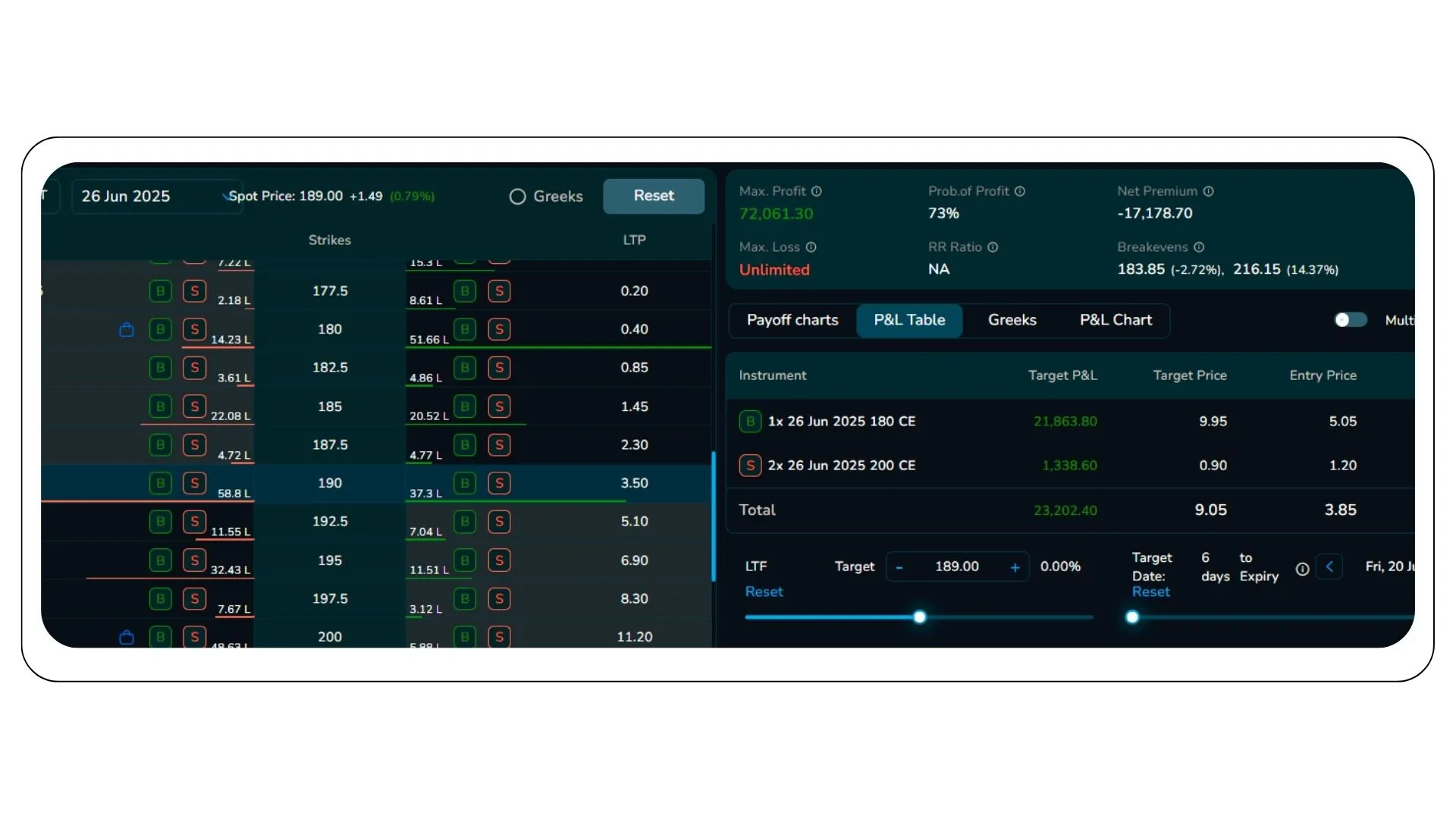
19th June 2025 spot market price @ 186.60
As of June 19th, the Bull Call Ratio Spread was showing an impressive unrealized profit of ₹10,039. The 180 CE was trading at ₹7.70, while the 200 CE sold at ₹2.10, was trading at ₹0.80. Despite the fall in spot price, the trade remained profitable with a gain of ₹10,039.
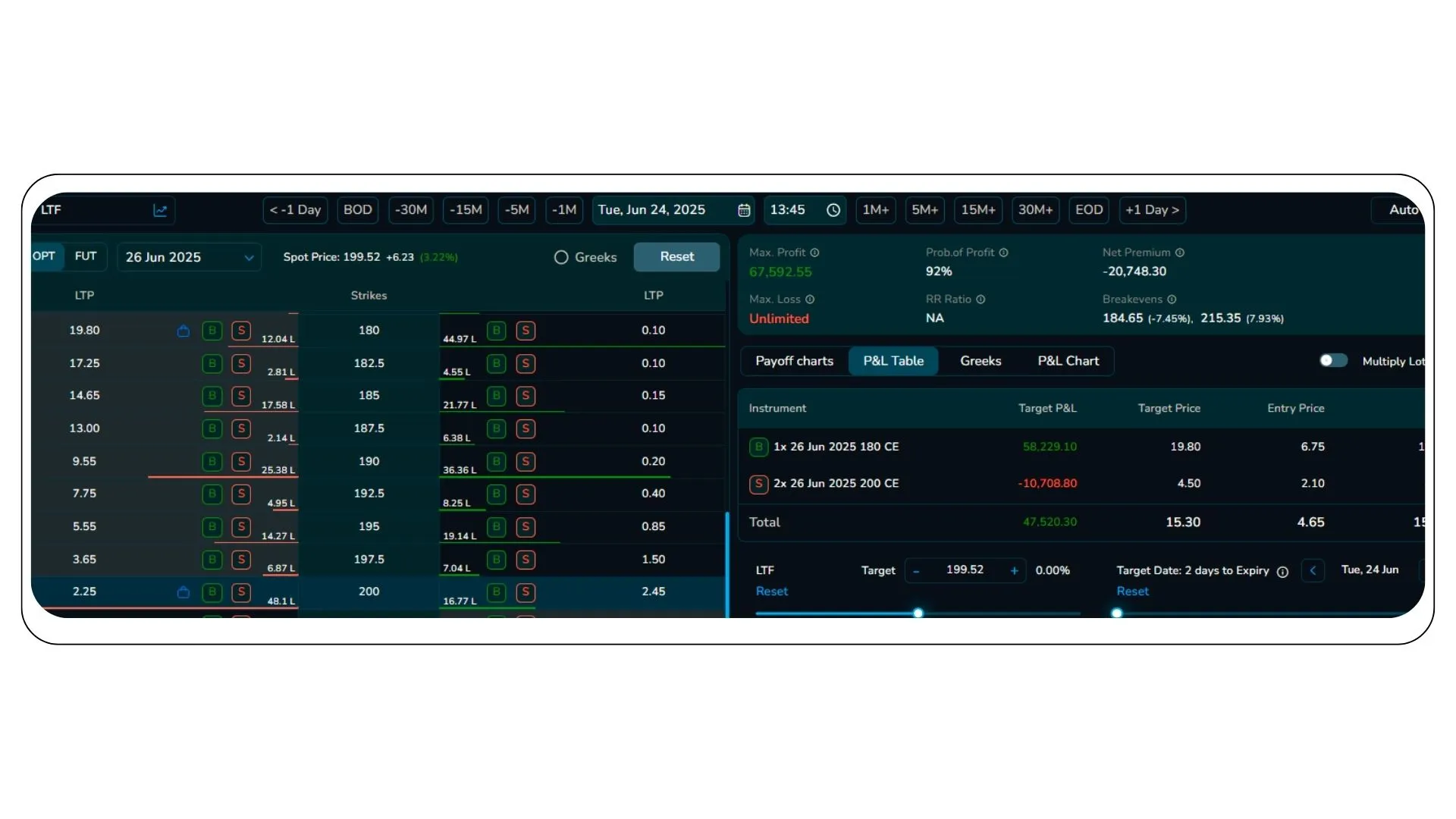
24th June 2025 spot market price @ 199.52
As of June 24th, just two days before expiry, the Bull Call Ratio Spread is delivering an unrealized profit of ₹47,520. The 180 CE, bought at ₹6.75, is now trading at ₹19.80, while the 200 CEs, sold at ₹2.10, are trading at ₹4.50. With most of the profit already locked in, this is a sensible point to book profits and close the position.
Mastering the Call Ratio Spread isn’t just about setting up the trade—it’s about knowing how it behaves as price, time, and volatility shift. When used with clarity and timing, it becomes a powerful strategy for traders looking to express a directional view with built-in risk management. It rewards patience, demands discipline, and offers an edge when executed with precision. Like any strategy, its real value lies in how well you understand its moving parts. In Nxt Option, the Call Ratio Spread strategy offers traders the flexibility to tailor strike prices according to their market outlook and risk preference, making it a valuable tool in moderately bullish scenarios with subdued volatility.
Also read: How RateGain is Unlocking ₹2000 Cr Potential
Recall of concepts
| Aspect | Details |
|---|---|
| Market Outlook | Moderately bullish with lower volatility |
| Upper Breakeven | Short Call Strike + Net Premium Paid/Received |
| Lower Breakeven | Long Call Strike + Net Premium Paid/Received |
| Risk | Unlimited (If the price rises significantly beyond the short call strike) |
| Reward | Limited: Max profit when the underlying equals the short call strike |
| Margin Required | Yes: Due to naked short calls beyond the long position |
Disclaimer: The information provided in our blogs is for informational purposes only and should not be construed as financial, investment, or trading advice. Trading and investing in the securities market carries risk. Always conduct your own research and consult with a qualified financial advisor before making any investment decisions. Past performance is not indicative of future results. Copyrighted and original content for your trading and investing needs.
© 2025 — Tradejini. All Rights Reserved.