Many investors tend to evaluate mutual funds solely based on returns, assuming that higher returns automatically indicate a better fund. However, two funds can deliver similar long-term returns while offering very different investment experiences. One may be relatively stable and focused on capital protection, while the other may be far more volatile. This distinction becomes evident in how funds behave during market rises and declines, a phenomenon that the Capture Ratio helps highlight by showing the extent to which a fund participates in the market’s upside and downside.
What Is Capture Ratio?
Capture Ratio is a performance metric that evaluates how effectively a mutual fund tracks or outperforms its benchmark across different market conditions. It measures the extent to which a fund tracks the benchmark’s movements, both during market advances and declines. The capture ratio is assessed through two key components:
Upside Capture Ratio: Indicates how much of the benchmark’s gains a fund captures during rising markets.
Downside Capture Ratio: Indicates how much of the benchmark’s losses a fund experiences during falling markets.
Viewed together, these metrics provide insight into whether a fund participates meaningfully in market upswings and preserves capital during periods of market stress. Capture ratios help investors move beyond headline returns and understand a fund’s behaviour across full market cycles.
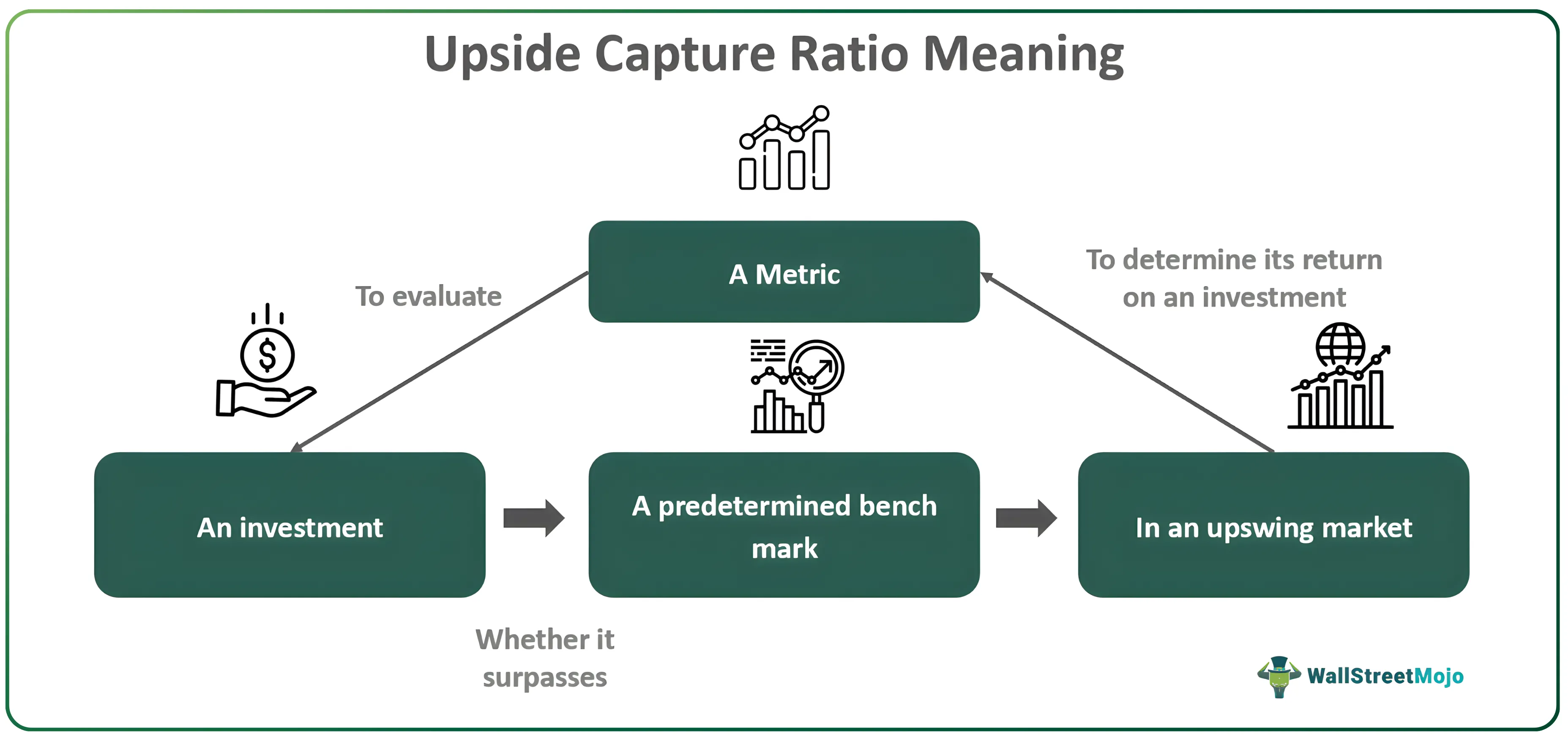
The Upside Capture Ratio shows how a fund performs when the benchmark delivers positive returns.
How to Interpret It
Above 100% → The fund outperforms the benchmark in up markets
Below 100% → The fund underperforms in market rallies
For example, if the index rises 10% and the fund rises 12%, the upside capture is 120%. This means the fund is more aggressive during bullish phases.
A high upside capture is attractive, but it should always be viewed along with downside capture.
Downside Capture Ratio
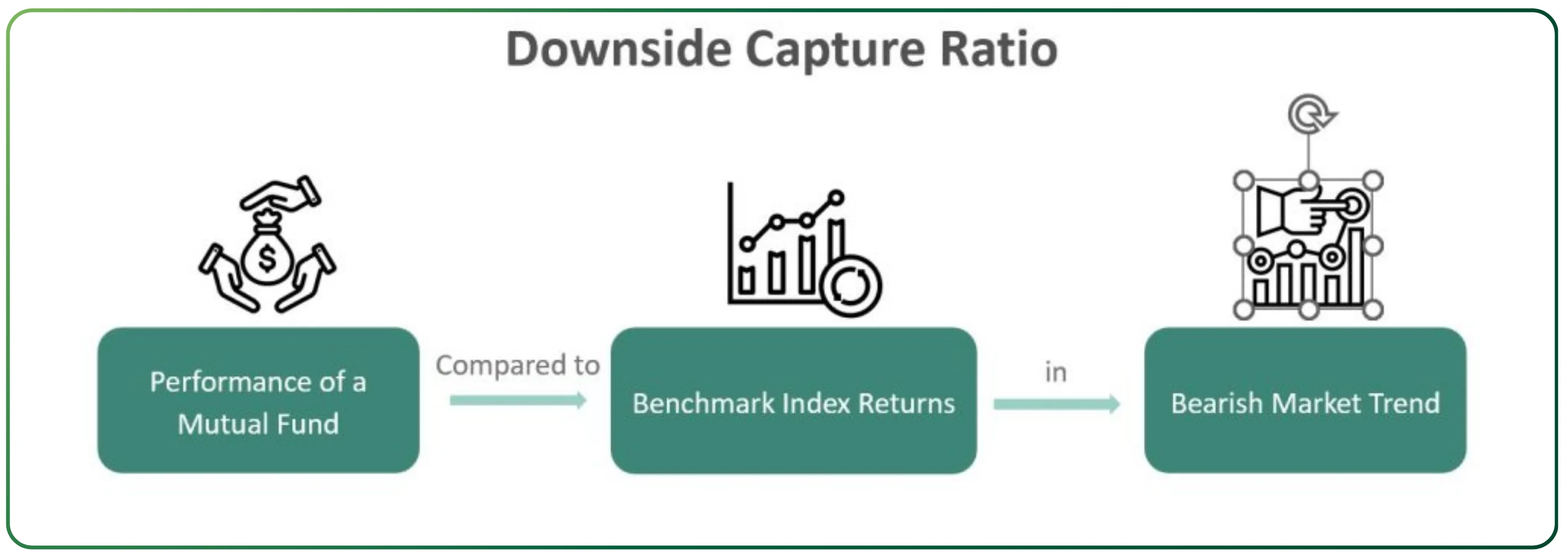
Downside Capture Ratio shows how much of the benchmark’s losses a fund experiences during market declines.
How to Interpret It
Below 100% → The fund loses less than the benchmark
Above 100% → The fund falls more than the market
For instance, if the index falls by 10% and the fund falls by only 6%, the downside capture is 60%. This indicates better downside protection.
For long-term investors, lower downside capture is often more important than high upside capture, because avoiding deep losses helps compounding work better.
Mutual Fund Behaviour in Bull and Bear Markets
In bull markets, mutual funds typically rise as market prices increase, aiming to capture the majority of the gains. However, their true strength is tested in bear markets. Some funds protect capital by limiting losses, while others may experience sharp declines. The Capture Ratio measures this behaviour by quantifying how much of the market’s upside a fund participates in relative to how much downside it endures. A high Capture Ratio indicates a fund that gains strongly in up markets while minimising losses in downturns, providing a balanced ride through market cycles.
Also Read: The Importance of Regular Mutual Fund Portfolio Reviews
Why Capture Ratio Matters to Investors
Returns tell investors the final result, but capture ratios explain the path a fund takes to get there. A fund does not need to rise the most during strong market rallies to be successful over the long term. Often, a fund that gains slightly less when markets are rising but loses far less during market declines can deliver better long-term results. This is because smaller losses allow the fund to recover faster and reduce the damage caused by deep drawdowns. Capture ratios help investors compare funds more meaningfully within the same category by showing how each fund behaves in different market conditions. They also offer insight into a fund manager’s style, whether the approach is aggressive or more defensive. Most importantly, capture ratios help investors choose funds that match their own risk tolerance, rather than relying only on past returns.
Ideal Capture Ratio Combination
There is no single “perfect” capture ratio that suits every fund or every investor. However, most investors tend to prefer funds that are able to capture a large portion of market gains while limiting losses during market declines. In practical terms, this means an upside capture ratio that is close to or slightly above the benchmark, combined with a downside capture ratio that is well below it. Such a balance indicates that the fund participates reasonably well when markets rise, while also offering better protection of capital during periods of volatility or downturns. This combination often leads to smoother performance and more consistent long-term outcomes for investors.
Limitations of the Capture Ratio
While the capture ratio is a useful tool, it does have its limitations. Its usefulness depends heavily on the benchmark chosen, as different benchmarks can lead to different interpretations of the same fund’s performance. Capture ratios can also change over time, meaning a fund that performs well in one market cycle may behave differently in another. For this reason, the capture ratio should not be viewed as a standalone measure. It works best when used alongside other indicators such as rolling returns, volatility, and drawdown analysis, which together provide a more complete picture of a fund’s risk and performance.
Start yours with smart investing on CubePlus and take control of your financial goals. Click here to sign up.
Disclaimer: The information provided in our blogs is for informational purposes only and should not be construed as financial, investment, or trading advice. Trading and investing in the securities market carries risk. Always conduct your own research and consult with a qualified financial advisor before making any investment decisions. Past performance is not indicative of future results. Copyrighted and original content for your trading and investing needs.
© 2025 — Tradejini. All Rights Reserved.