In the ever-evolving world of options trading, the Long Calendar Spread, also known as a Time Spread or Horizontal Spread, is a versatile strategy that helps traders to benefit from time decay and implied volatility shifts while maintaining limited risk. This article explains how the strategy can be applied in Indian markets, drawing on practical trading experience.
Understanding the long calendar spread
The Long Calendar Spread is a two-legged options strategy where a trader buys a longer-term option and simultaneously sells a near-month option, both at the same strike price on the same underlying asset.
For example, assume that on 1 August 2025, SBI is trading around 788–800 with a neutral outlook
- Buy 30 Sept 2025 SBIN 800 call option
- Sell 30 Aug 2025 SBIN 800 call option
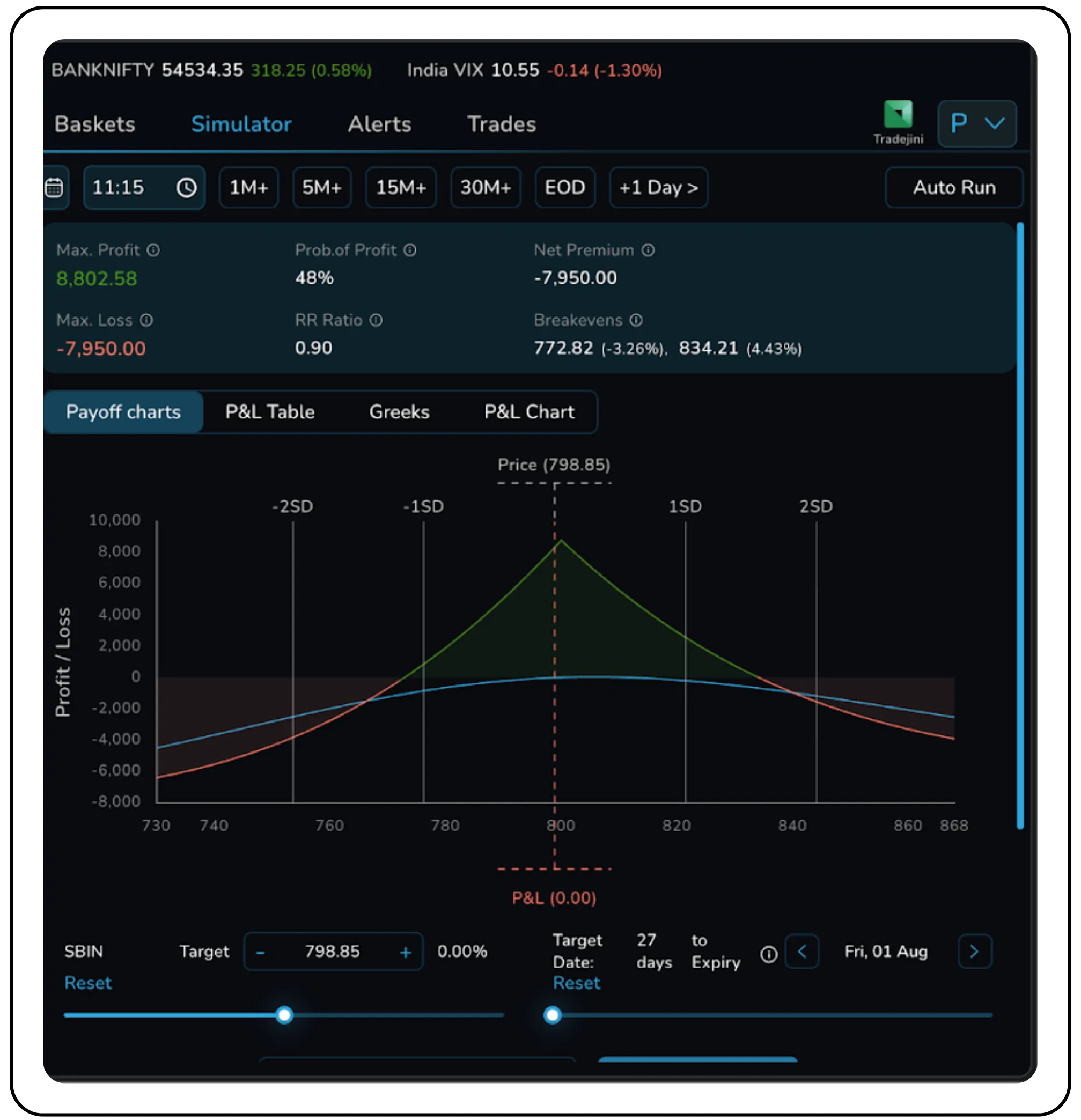
The strategy leverages time decay in options and can be effective when timed correctly.
Also Read: The Difference Between Historical and Implied Volatility Explained
Setting the stage
The following key points serve as a roadmap for effectively utilizing this strategy:
IV Percentile: Start by looking for opportunities when the Implied Volatility(IV) Percentile is low, typically below 40%. A Low IV Percentile implies that options are relatively cheap, making it an opportune time to enter this strategy .Since a calendar spread is net long Vega (you own more Vega than you short), it generally benefits if IV rises later.
Option Selection: Buy a long-term At-the-Money (ATM) call option with a duration of more than 1 month. This serves as the foundation of the strategy. Simultaneously, sell a shorter-term ATM call option with an expiration period of 15-30 days.
The net debit or premium paid for the trade should be lower, as this debit paid represents your maximum loss and maximum risk.
Rolling the Short Call: On expiration of the short option, traders may either close the position or roll it into a later month to collect additional premium. This roll can be repeated to generate additional income.
Practical example with SBI
As mentioned earlier we expected a neutral outlook in SBI trading around 788–800 and deployed a long calendar spread on 1st August
- Buying 30th Sept 2025 SBIN 800 call option
- Selling 28th Aug 2025 SBIN 800 call option
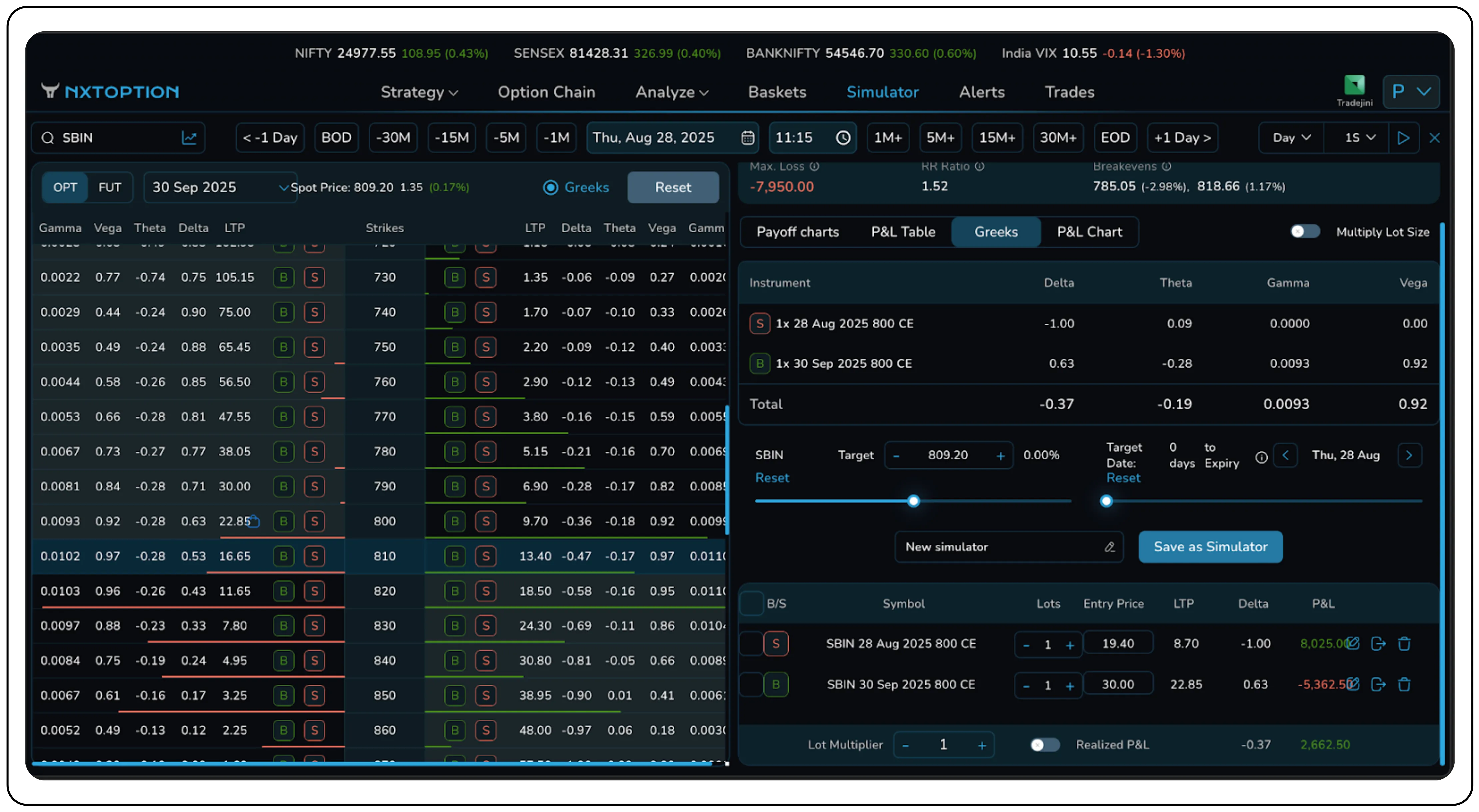
The decay in the front-month option generated gains. We closed both the positions at the expiry of the front leg and realized a ₹2,662 profit. This demonstrates how time decay can be effectively harvested when the strategy is properly executed.
Greeks Interpretation in calendar spreads
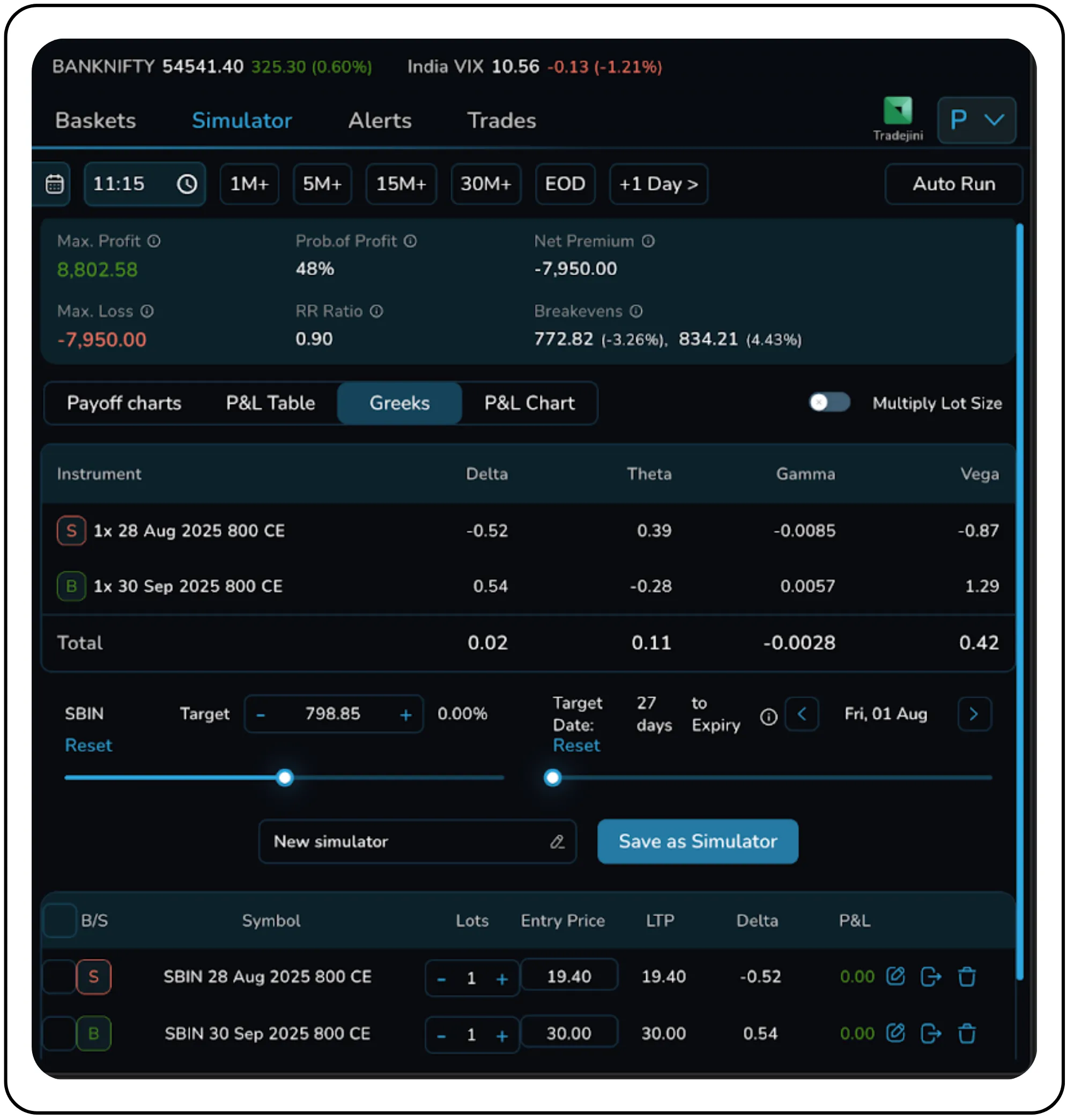
Understanding the Greeks is essential for managing long calendar spreads effectively:
Theta (time decay): This is the primary source of income for the position. In the above image, we can see that there is a positive theta of 0.11, which indicates that the front leg decay exceeds the long leg decay while both options are active. This differential time decay is what generates consistent income.
Vega (volatility sensitivity): The positive vega of 0.42 means the trade benefits if implied volatility moves across different expiration months. This makes calendars excellent for event-driven setups where volatility expansion and contraction is expected.
Delta (directional exposure): The small delta of 0.02 shows extremely neutral directional bias. However, traders should monitor this closely if the underlying trends strongly move in either direction.
Gamma (acceleration risk): The negative gamma of -0.0028 indicates that sudden large moves can hurt the position, especially near the short option’s expiry. This requires active risk management.
Profit potential and Vega sensitivity
One of the distinctive features of the Long Calendar Spread is its Vega sensitivity. The far-month option has a higher Vega than the near-month option at the same strike, making the strategy Vega positive. As Implied Volatility (IV) increases, the profit potential increases by widening the range of favorable outcomes.
Ideal deployment times
The long calendar spread is best deployed under specific market conditions that maximize its effectiveness:
Low Implied Volatility (IV) in near-term options: Calendar spreads benefit when IV expands after entry.
Neutral / range-bound market expectation: Strategy profits when the underlying settles near strike at front-month expiry.
Anticipation of volatility expansion: Place ahead of known events expected after near-term expiry
Optimal Exit Rules
Monitor the profit zone closely and consider closing or rolling the short call if the price goes out of the profit zone, either at break-even or with a small loss. Traders often exit the short call after capturing 50–70% of potential profit.
It is advisable to close the entire trade when the long call has less than 14 days to expiration.
Advantages of the long calendar spread
- Limited risk: The strategy has a clearly defined risk profile, making it suitable for risk-averse traders.
- Time Decay and IV Benefits: It allows traders to benefit from both time decay and potential IV increases, enhancing the strategy’s profitability. Versatility: The Long Calendar Spread can be applied to put options as well, offering flexibility in trading different market conditions.
Exploring Beyond
The Long Calendar Spread is a versatile tool that extends its utility to various trading scenarios. It can be used directionally, for earnings plays, or in double calendar spreads to capture multiple scenarios.
In conclusion, the Long Calendar Spread is a valuable addition to an options trader’s toolkit. When executed with precision and in alignment with the principles outlined here, it can be a reliable strategy to generate income from the shifting dynamics of options markets. Open a demat account with Tradejini now and deploy calendar spread using Nxtoption now.
Disclaimer: The information provided in our blogs is for informational purposes only and should not be construed as financial, investment, or trading advice. Trading and investing in the securities market carries risk. Always conduct your own research and consult with a qualified financial advisor before making any investment decisions. Past performance is not indicative of future results. Copyrighted and original content for your trading and investing needs.
© 2025 — Tradejini. All Rights Reserved.