Most people spend hours negotiating their annual CTC and almost no time asking how their Employees' Provident Fund, or EPF, is actually calculated. That single detail, buried somewhere in the appointment letter, can matter more to your retirement than the raise you fought so hard for.
Here is why. EPF contributions are meant to be 12 percent of your basic salary, matched by your employer. But many companies calculate this on the statutory wage ceiling of Rs 15,000 a month rather than on your real basic pay, simply because the law allows them to. Two employees with the identical CTC can end up with wildly different retirement corpus purely because of this one choice.
What EPF and VPF actually mean
Before going further, it helps to define the terms plainly, since a lot of salaried employees have heard both words without knowing exactly what separates them.
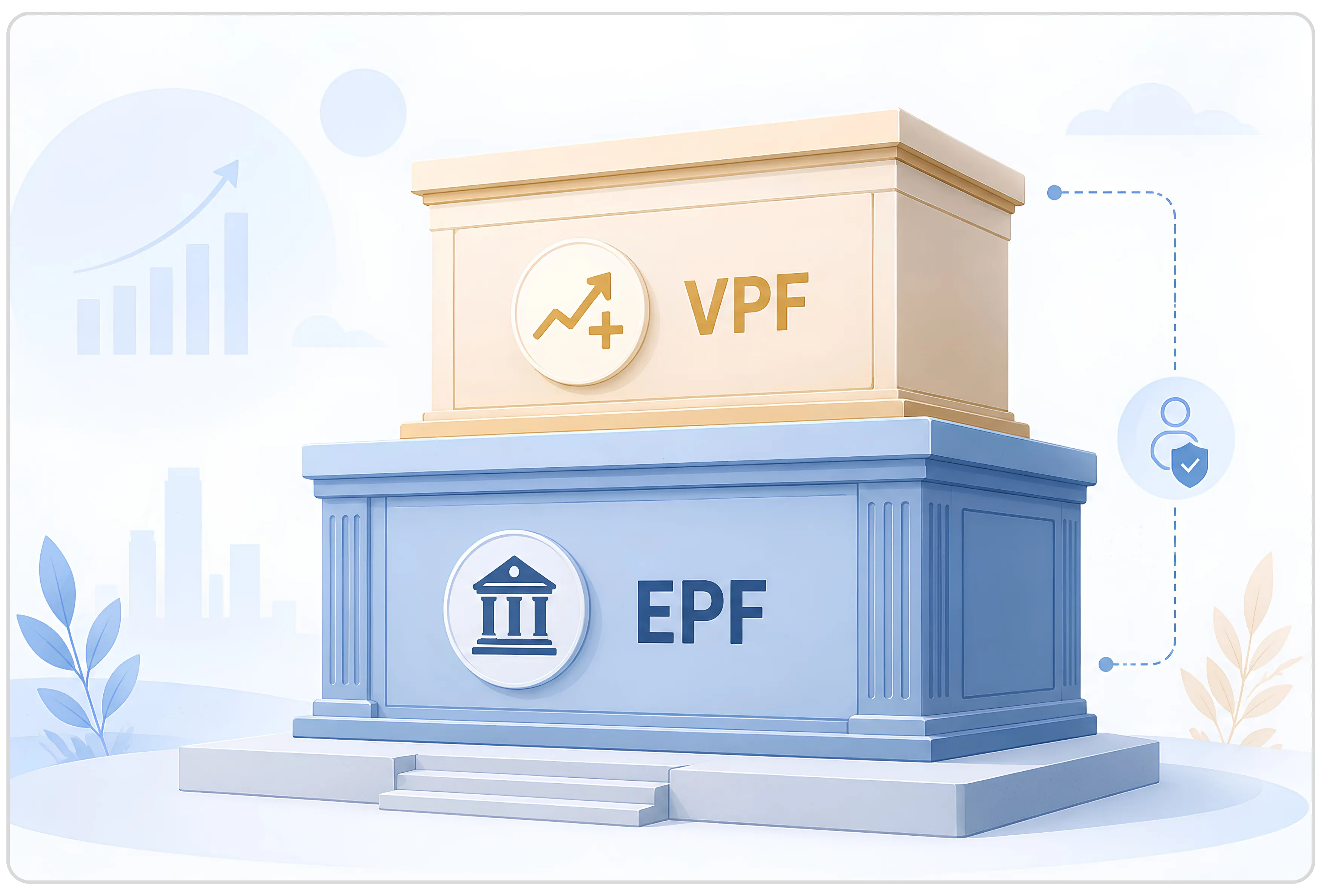
EPF, or Employees' Provident Fund, is the mandatory retirement savings scheme every eligible salaried employee is enrolled in. Both the employee and employer contribute a fixed percentage of basic salary every month, and the government declares an annual interest rate on the accumulated balance.
VPF, or Voluntary Provident Fund, is not a separate scheme. It sits inside the same EPF account and lets an employee contribute more than the mandatory 12 percent, entirely at their own discretion, up to their full basic salary and dearness allowance. It earns the same interest rate as EPF and enjoys similar tax treatment, but the employer is under no obligation to match it.
EPF is the base that every salaried employee gets by default. VPF is the extra amount you choose to add on top of that same base, if you want a bigger retirement fund.
Three employees, one CTC, three very different outcomes
Consider three employees, each with the same annual CTC of Rs 14 lakh, each working for 30 years, and each earning the same assumed EPF interest rate of 8.25% per annum.
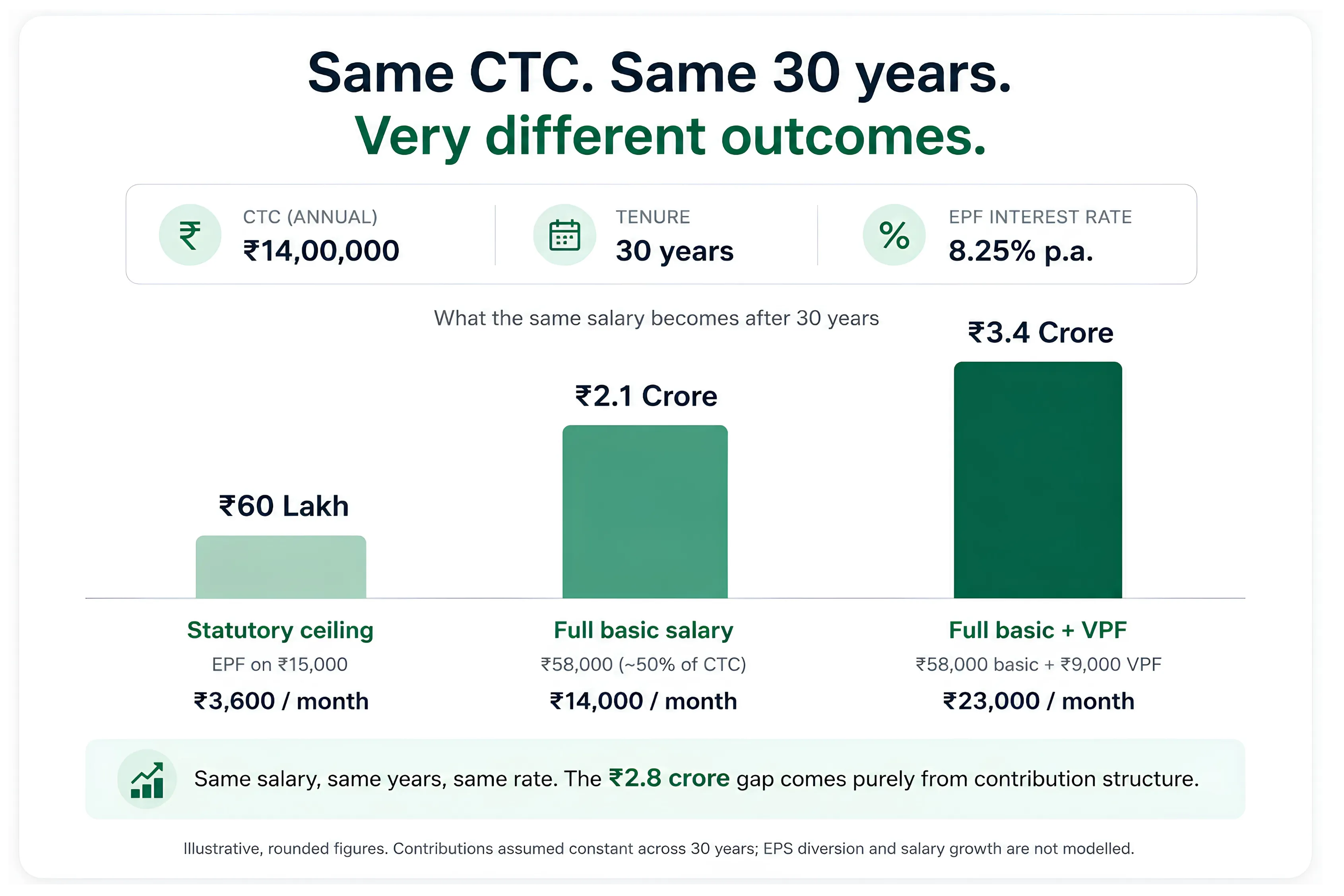
The first employee's company contributes EPF strictly to the statutory wage ceiling of Rs 15,000 a month. The combined employee and employer contributions amount to roughly Rs 3,600 per month. Left to compound for three decades, this builds a retirement corpus of approximately Rs 60 lakh.
The second employee works at a company that calculates EPF on the actual basic salary, which in this case comes to Rs 58,000 a month, or about 50% of CTC. Employee and employer contributions together now total close to Rs 14,000 a month. Over the same 30-year period, this alone grows to a corpus of roughly Rs 2.1 crore.
The third employee has the same basic salary as the second but additionally chooses to route Rs 9,000 a month into VPF on top of the mandatory contribution. The total monthly savings jump to around Rs 23,000. Compounded over 30 years at the same rate, the corpus crosses Rs 3.4 crore.
Three employees. Identical CTC. Identical tenure. A difference of nearly Rs 2.8 crore purely because of how contributions were structured.
Also Read: The True Cost of Buying a Used Car on Loan
The real reason for the gap
None of these employees earned a different interest rate. The gap exists entirely because a bigger number was allowed to compound for longer. Retirement savings work quietly in the background for 25 to 30 years, and every extra rupee contributed in the early years has decades to grow. This is why a seemingly small monthly difference of a few thousand rupees, sustained over a working lifetime, turns into a difference measured in crores rather than lakhs.
What to check before you accept your next offer
It is worth asking your HR team, during onboarding or at your next appraisal, whether EPF is calculated on the Rs 15,000 ceiling or on your actual basic salary. It is equally worth checking what proportion of your CTC is structured as basic pay, since that number directly decides your EPF contribution. If your basic salary is on the lower side and your employer will not change that, VPF remains available to you as a way of closing the gap yourself.
A word of caution
Contributing more to EPF or VPF does reduce your take-home pay, since that money gets locked away until retirement with limited withdrawal options. It makes sense to first secure short-term needs such as an emergency fund and any high-cost debt before committing a larger share of income to a long-horizon, low-liquidity instrument like this.
Where this fits into a bigger financial picture
EPF and VPF are useful precisely because they are boring. Government-backed, low-risk, and largely untouched by market swings, they form a dependable floor for retirement. But that same safety comes with trade-offs. Returns are capped near the government-declared rate, the money is locked in for decades, and there is little room to adjust your strategy as your goals change over the years.
This is usually where a second, more flexible layer of savings becomes useful. Money that does not need to sit untouched for 30 years, whether meant for a house down payment in 10 years, a child's education in 15, or simply building wealth faster than a fixed rate allows, tends to benefit from being invested rather than locked away. Equity, mutual funds, and other market-linked instruments carry their own risks, but they also offer the kind of flexibility and growth potential that EPF and VPF, by design, cannot.
The two are not competing ideas. A well-built financial plan usually rests on both the steady, compounding safety of EPF and VPF for the long, non-negotiable retirement goal and a more active, market-linked approach for everything else you are saving towards. Understanding how your EPF is structured today is simply the first step in figuring out how the rest of your money should be working alongside it.
Disclaimer: The information provided in our blogs is for informational purposes only and should not be construed as financial, investment, or trading advice. Trading and investing in the securities market carries risk. Always conduct your own research and consult with a qualified financial advisor before making any investment decisions. Past performance is not indicative of future results. Copyrighted and original content for your trading and investing needs.
© 2026 — Tradejini. All Rights Reserved.