

Large-cap mutual funds saw their first monthly net outflow in more than 2.5 years in July 2026, according to data from the Association of Mutual Funds in India (AMFI). Investors withdrew ₹1,322 crore from large-cap funds during the month, compared with an inflow of ₹2,067 crore in June. This came even as the Nifty 50 gained around 2% in July. At the same time, small-cap funds attracted ₹7,768 crore, while mid-cap funds received ₹6,192 crore. Overall, equity mutual fund inflows declined nearly 15% to ₹24,697 crore from ₹28,973 crore in June. So, what does this shift tell us about mutual fund investing?
‘Not every mutual fund headline tells the full story. In this blog, we’ll show you how to read the news beyond the headline, understand what the numbers actually mean, and see how these changes can affect mutual fund investors.’
What Is Profit Booking in Mutual Funds?
Profit booking simply means selling an investment after it has gained in value to lock in those gains. Suppose you invested ₹1 lakh in a large-cap mutual fund and its value increased to ₹1.20 lakh. If you redeem your investment, the ₹20,000 gain is effectively booked. Investors may do this when they feel valuations have risen, when they want to rebalance their portfolio, or when they see better opportunities elsewhere.
This appears to be one factor behind the recent outflows from large-cap funds. AMFI attributed the July movement to a combination of profit booking and portfolio reallocation towards mid- and small-cap funds.
But here’s the important part…an outflow from a mutual fund category does not automatically mean investors have lost confidence in it.
Investors can withdraw money for several reasons. Some may be booking profits after a strong run, while others may simply be moving money from one category to another to change their asset allocation.
Net Inflow vs Net Outflow
When you read that a mutual fund category received ₹7,768 crore in inflows or saw an outflow of ₹1,322 crore, the number refers to its net flow.
Net inflow = Fresh investments − Redemptions
If investors put ₹5,000 crore into a category but withdraw ₹6,000 crore during the same period, the category records a net outflow of ₹1,000 crore.
This is why a net outflow should not be confused with the entire amount being sold from a fund's portfolio. It represents the difference between money coming into and leaving the category.
In July, large-cap funds saw fresh mobilization of ₹4,746 crore, while redemptions stood at ₹6,068 crore, resulting in the ₹1,322 crore net outflow.
Does a Large-Cap Fund Outflow Mean Investors Should Worry?
Not necessarily. One month's fund flow data is only one piece of the puzzle. Mutual fund investors generally need to look at factors such as the fund's investment objective, portfolio performance over an appropriate time period, risk level, expense ratio, and whether it continues to fit their financial goals.
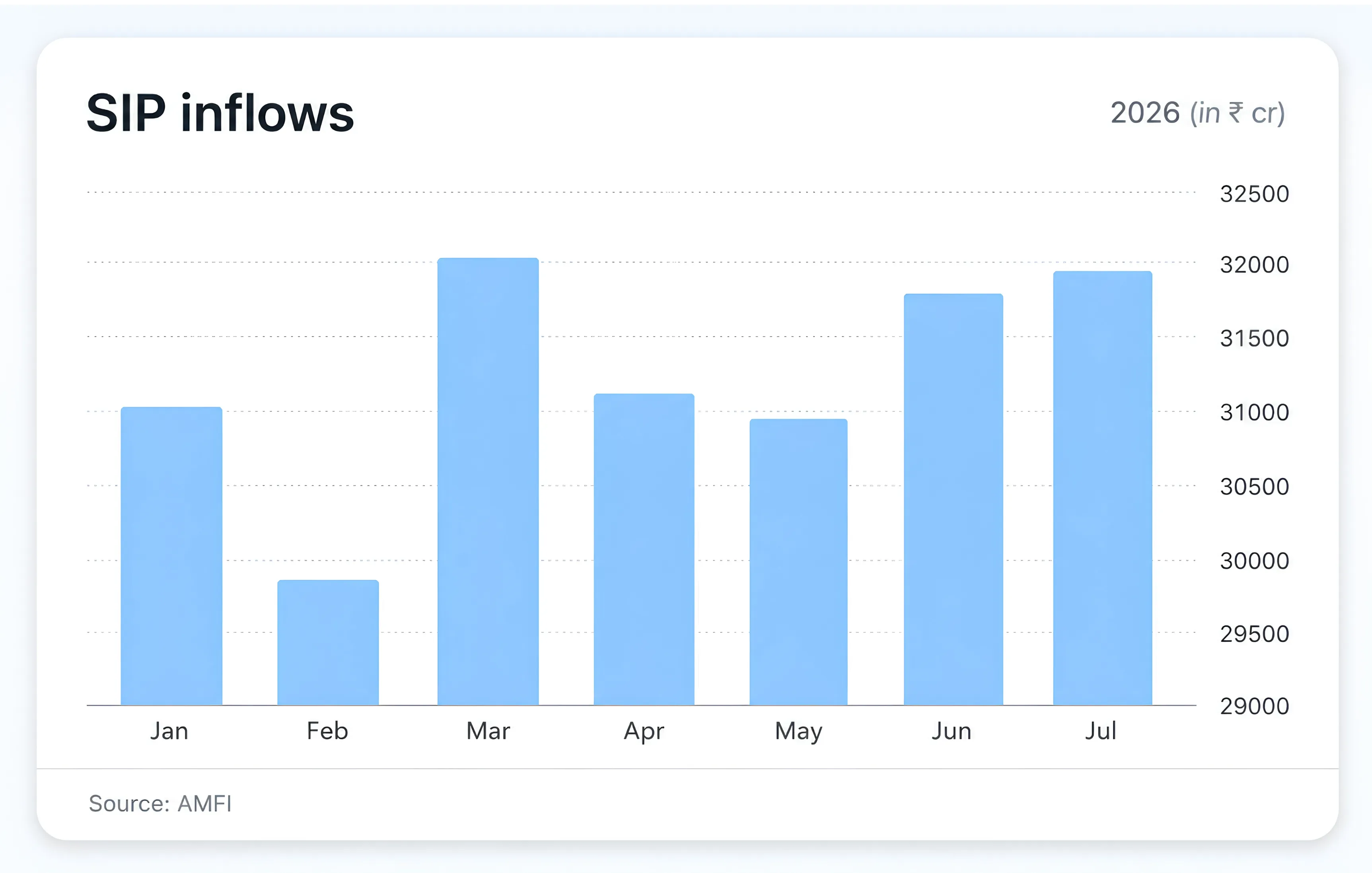
In fact, July 2026 data shows that investors were not moving away from mutual funds altogether. SIP contributions remained resilient at ₹31,961 crore, slightly higher than ₹31,781 crore in June. The number of contributing SIP accounts also rose to 9.90 crore.
This distinction matters. Money moving out of one mutual fund category does not necessarily mean money is moving out of mutual funds as an investment avenue.
Explore Our Mutual Fund Guide
Why Were Mid-Cap and Small-Cap Funds Attracting More Money?
While large-cap funds saw outflows, small-cap and mid-cap funds continued to attract investments in July. Small-cap fund inflows rose from ₹5,602 crore in June to ₹7,768 crore in July, while mid-cap inflows increased from ₹6,090 crore to ₹6,192 crore.
One possible explanation is portfolio reallocation. Investors who have seen gains in one part of their portfolio may choose to shift some money towards another category.
However, mid-cap and small-cap funds generally carry higher risk than large-cap funds because they invest in companies with smaller market capitalizations and can experience greater price fluctuations.
So, higher inflows into these categories should not automatically be interpreted as a signal that investors should move their own money there.
Another Mutual Fund Term to Know, AUM
You may also come across the term AUM, or Assets Under Management, when reading mutual fund data. AUM represents the total market value of the assets managed by a mutual fund or an AMC.
It can change because of two broad factors:
- Fresh investments and redemptions
- Changes in the market value of the securities held by the funds
This means an increase in AUM does not necessarily mean investors have put in the entire additional amount. For example, if a fund's AUM rises from ₹1,000 crore to ₹1,100 crore, the ₹100 crore increase could come partly from fresh investments and partly from an increase in the value of the securities held by the fund.
Now,
The July numbers show that mutual fund flows can change from one category to another even when overall investor participation remains strong. Large-cap funds recorded an outflow, while mid-cap and small-cap funds continued to receive money. At the same time, SIP contributions remained strong, suggesting that regular investing continued despite changes in category-level flows.
For investors, the key takeaway is simple: don't read a single month's inflow or outflow in isolation. Understand why the money is moving, what the fund invests in, and whether the investment still matches your goals and risk appetite.
Source: AMFI
Start your mutual fund journey on CubePlus and take a step towards your financial goals.
👉 Click here to explore Mutual Funds
Disclaimer: The information provided in our blogs is for informational purposes only and should not be construed as financial, investment, or trading advice. Trading and investing in the securities market carries risk. Always conduct your own research and consult with a qualified financial advisor before making any investment decisions. Past performance is not indicative of future results. Copyrighted and original content for your trading and investing needs.
© 2026 — Tradejini. All Rights Reserved.

.webp%3Falt%3Dmedia%26token%3D95b8e400-dddc-4dbb-9213-6caa6b886a90&w=3840&q=75)