Rupee cost averaging lowers the average price paid per unit. It does not remove the risk of loss. AMFI data from FY26 shows how investors behaved when equity prices corrected.
In March 2026, equity mutual fund assets fell 9.7% in a single month, according to AMFI's monthly note, as a correction in equity markets pulled valuations down. Assets held through systematic investment plans (SIPs) fell 9.2% to ₹15.11 lakh crore. In the same month, SIP contributions rose 7.5% to ₹32,087 crore, the first time the monthly figure crossed ₹32,000 crore.
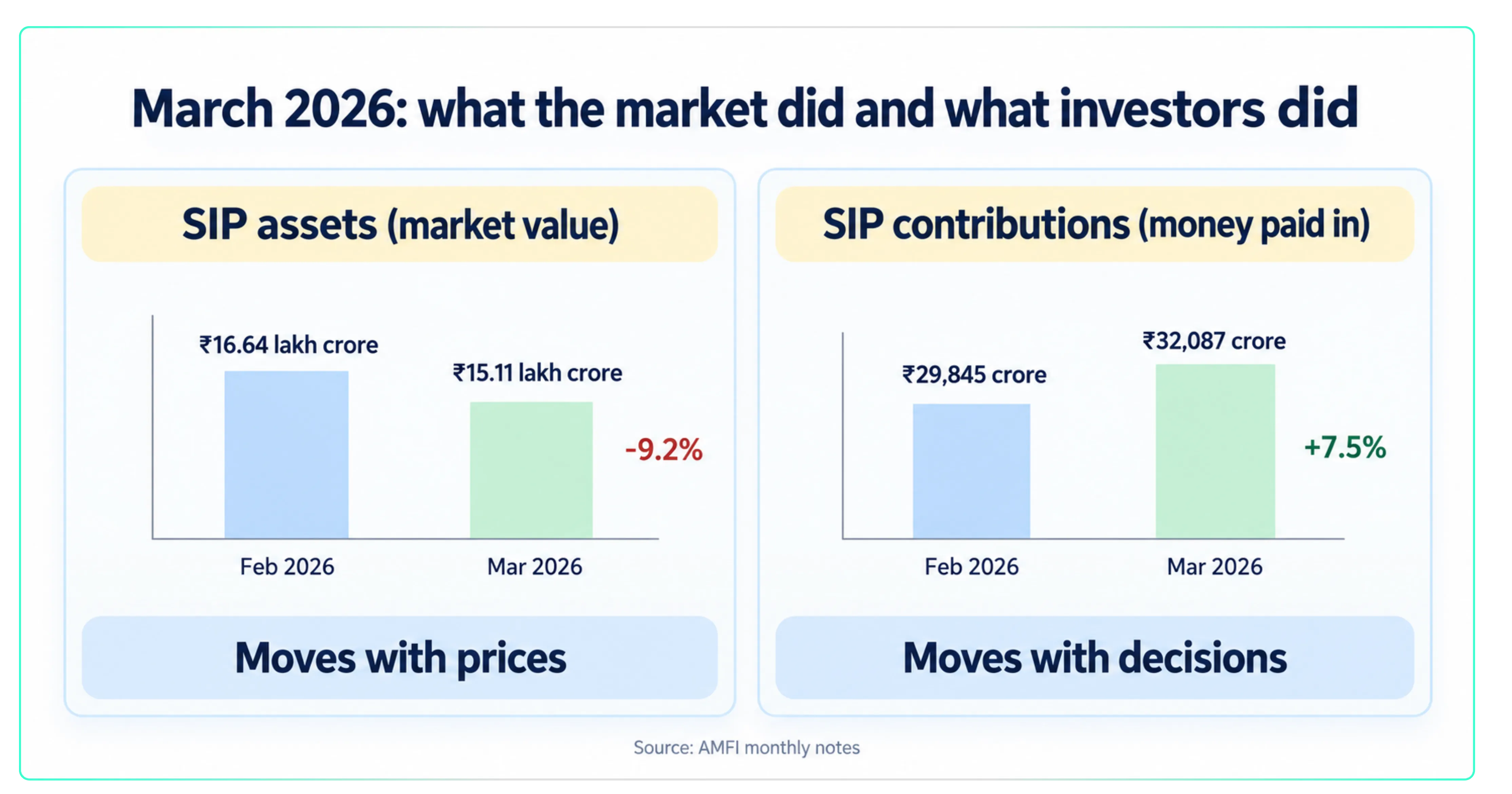
The two numbers measure different things. Assets are the market value of what investors hold, so they move with prices. Contributions are the instalments investors actually paid, so they reflect investor decisions.
So, what happens to a SIP when markets fall?
How a SIP works when the market falls
A SIP moves a fixed sum from a bank account into a mutual fund scheme on a chosen date each month. The amount is fixed, but the price of a unit, the net asset value (NAV), changes. A ₹10,000 instalment buys 100 units when the NAV is ₹100 and 125 units when it is ₹80. More units are accumulated in the months when prices are low.
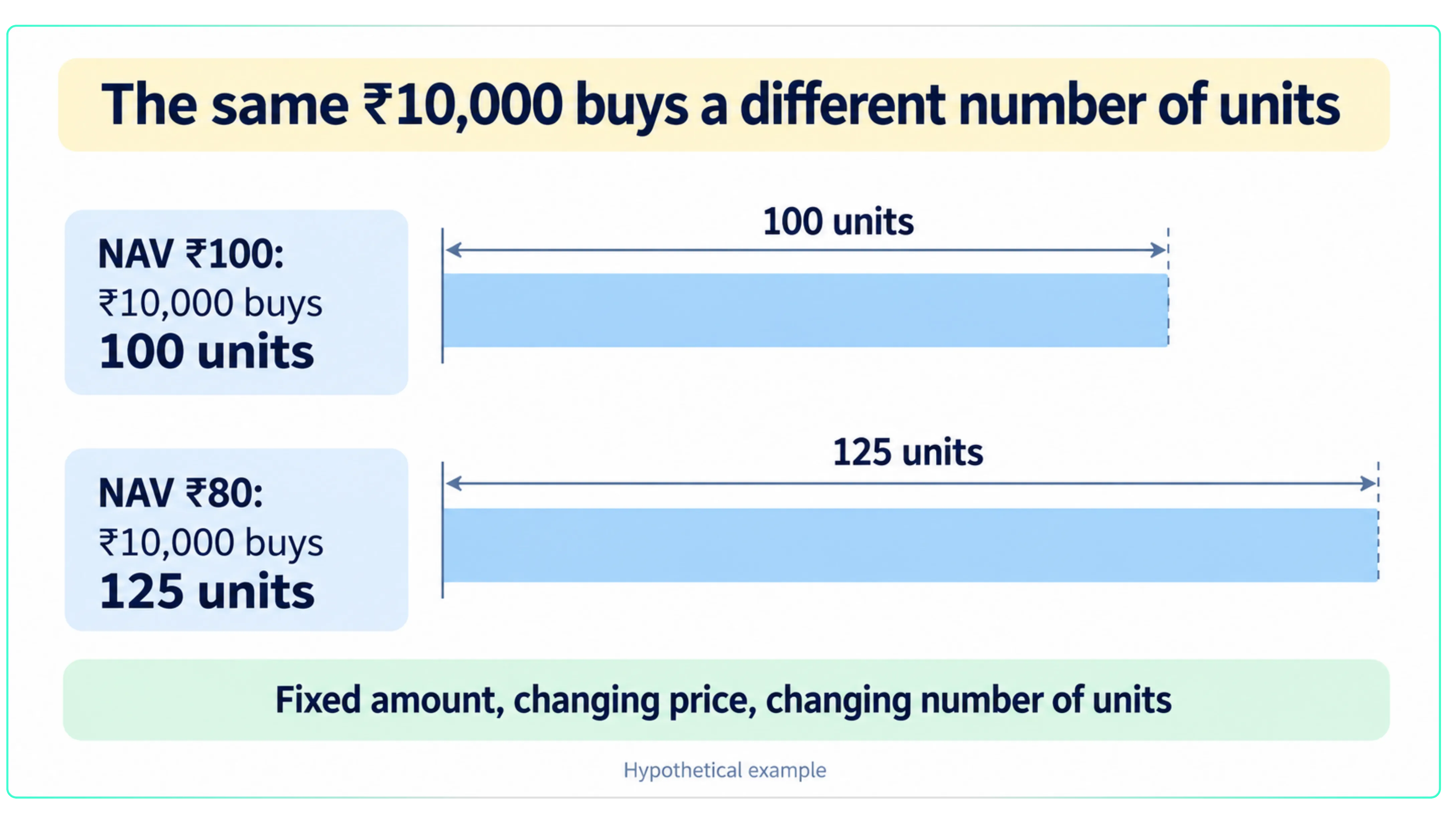
Rupee cost averaging is the name for this effect. A fixed rupee amount buys more units when prices are low and fewer when prices are high. Over time, this can bring down the average cost per unit.
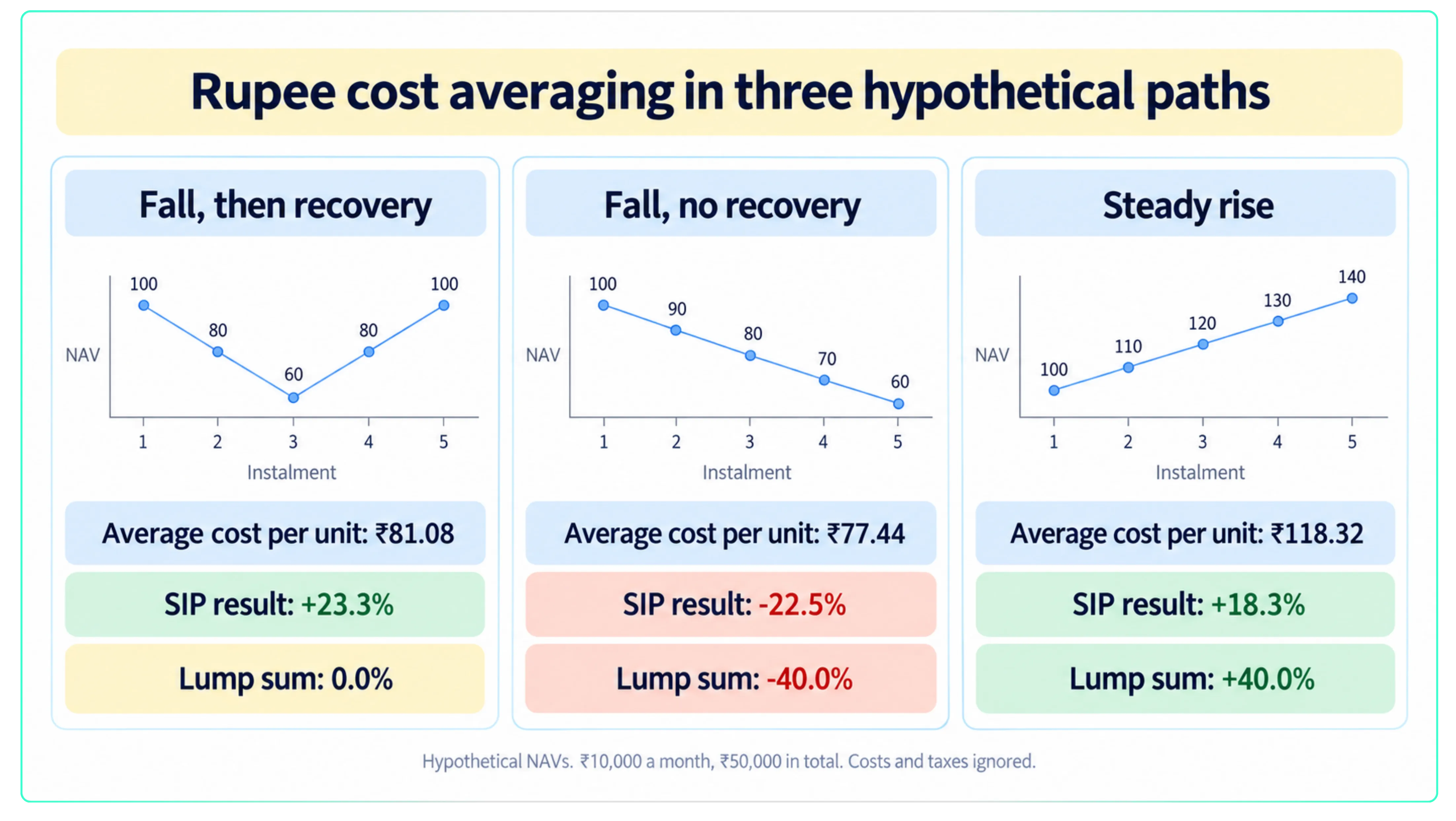
The image shows three hypothetical five-month paths with a ₹10,000 instalment each month, ₹50,000 in all. Expense ratios, exit loads and taxes are ignored. The last column shows what the same ₹50,000, invested in one go at the first NAV, would be worth at the end.
Path 1: Falls and recovers
NAV falls to ₹60 and returns to ₹100. The SIP's average cost is ₹81.08, so the investment ends with a gain even though the NAV returns to where it started.
Path 2: Falls and stays down
NAV falls to ₹60 and stays there. The average cost falls to ₹77.44, but the investment still records a 22.5% loss because the final NAV remains below the average cost.
Path 3: Rises steadily
Later SIP instalments buy fewer units at higher NAVs. In this situation, the lump sum invested at the beginning does better.
The key point is simple: a SIP can lower the average cost of your units, but it cannot remove market risk. What happens to the investment still depends on what the NAV does after you invest.
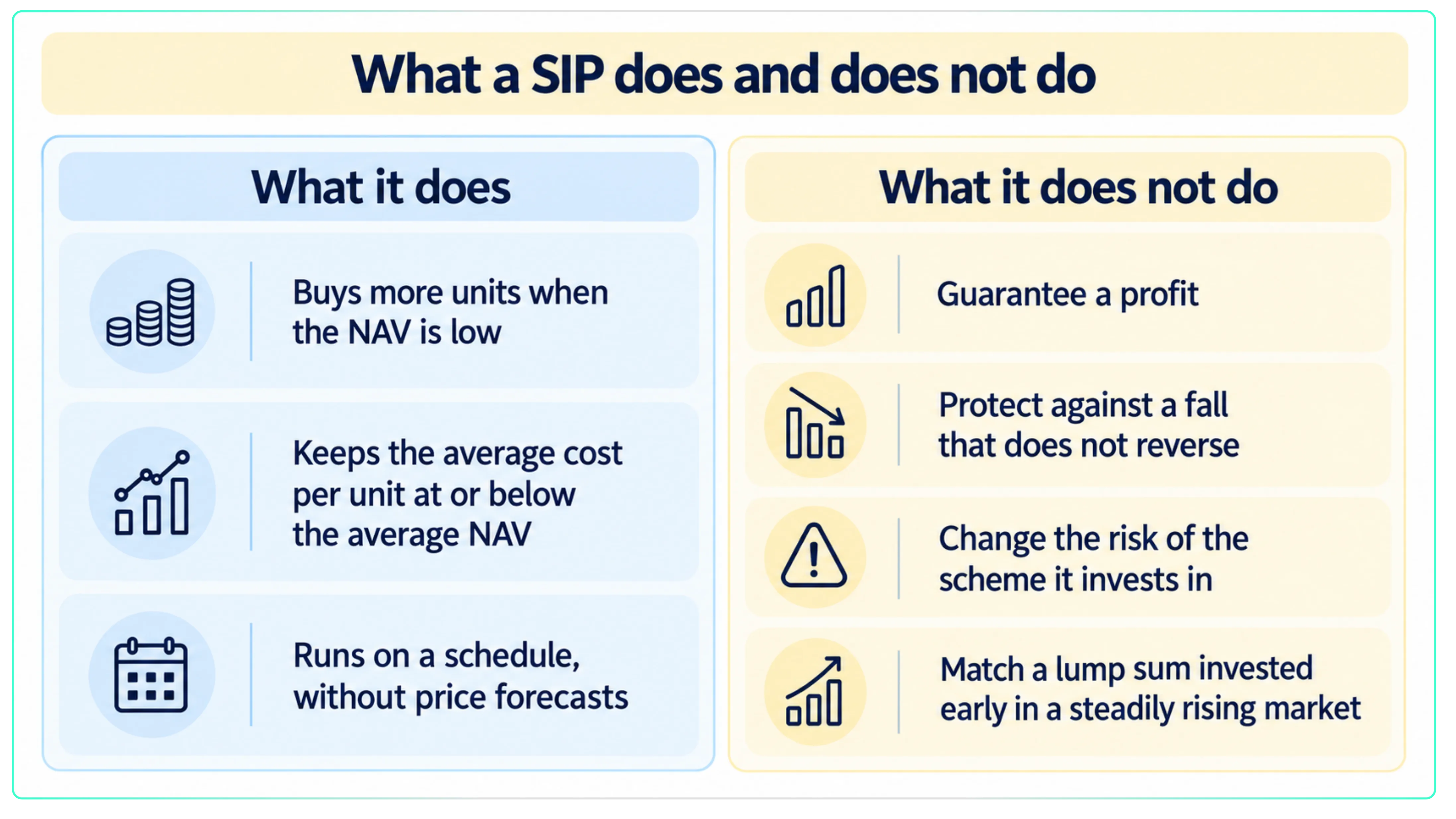
Rupee cost averaging therefore lowers the average price paid. It does not guarantee a profit, it does not protect against a fall that never reverses, and it does not match a lump sum invested early in a steadily rising market. What it offers is a rule that does not depend on forecasting prices.
What stopping a SIP changes
Stopping a SIP has two arithmetic effects. Instalments after the stop are not made, so no further units are bought at whatever the NAV then is. Units already held stay exposed to the fund's later movements unless they are redeemed. Whether that helps or hurts depends on what the NAV does next.
Take the first path above. An investor who stops after the third instalment, at a NAV of ₹60, holds 391.67 units for ₹30,000. When the NAV returns to ₹100 those units are worth ₹39,167, a gain of ₹9,167, or 30.6%.
The investor who continued holds units worth ₹61,667 on ₹50,000, a gain of ₹11,667, or 23.3%. The stopper's percentage return is higher and the rupee gain is lower.
In the second path, stopping after the third instalment leaves a smaller rupee loss, ₹9,833 against ₹11,262, on a smaller amount invested.
No single decision works the same way in every market path. The more important question is why the SIP is being stopped. Ending a SIP because the financial goal has been met is different from stopping because the NAV has fallen.
The FY26 data shows changes in contributions and account numbers, but it cannot tell us why an individual investor stopped a SIP.
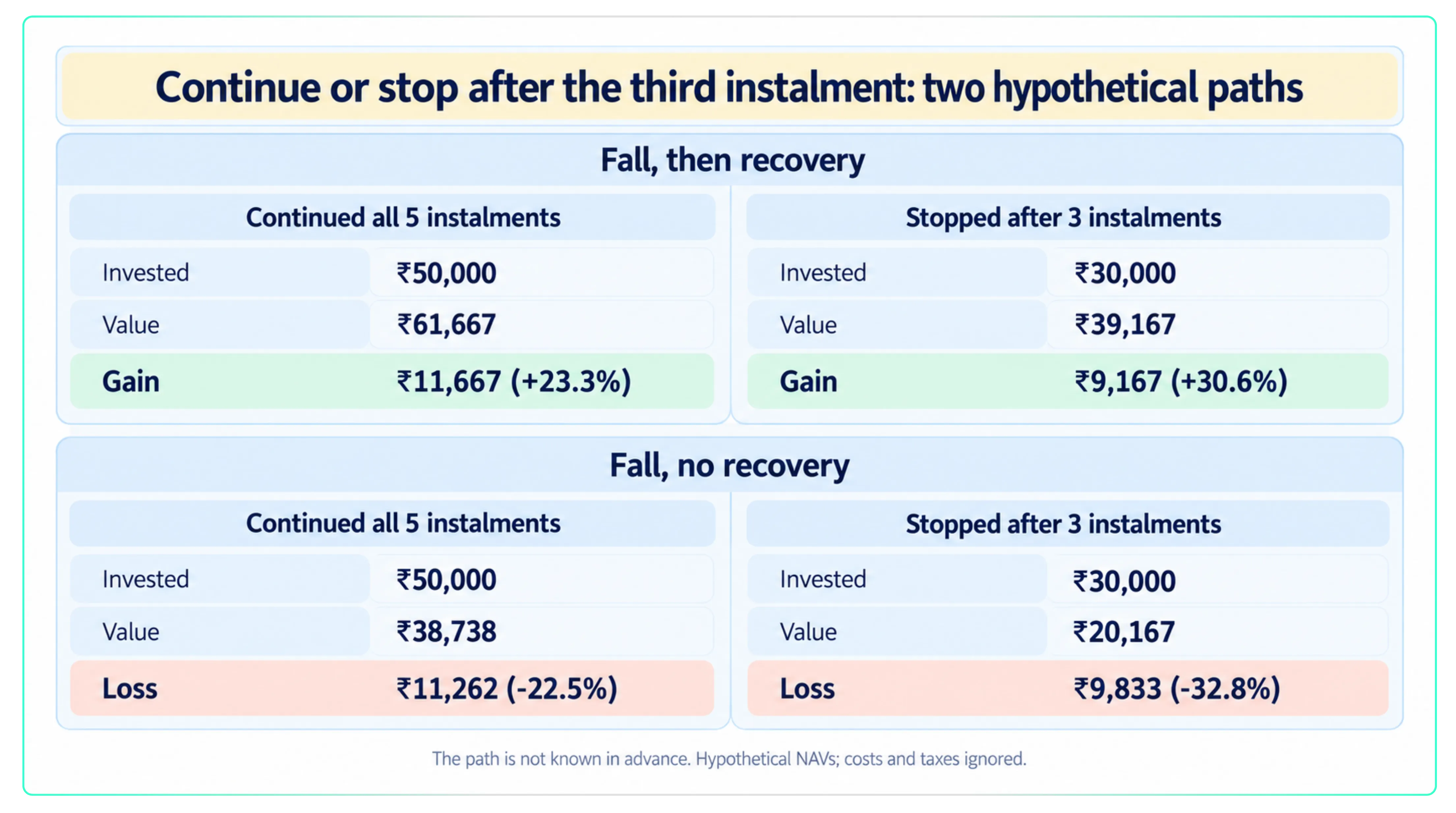
Takeaway: The stopper's percentage return is higher, but the rupee gain is lower because less money was invested.
Continuing the SIP adds more units at the lower NAV and participates in the recovery.
What investors did in FY26
FY26 was a year of subdued returns. According to press reports on SEBI's annual report for 2025-26, the number of direct plans earning more than 10% fell from 304 to 198, while the number with negative returns rose from 243 to 731.
The AMFI monthly notes show what happened to SIP contributions after the March fall.
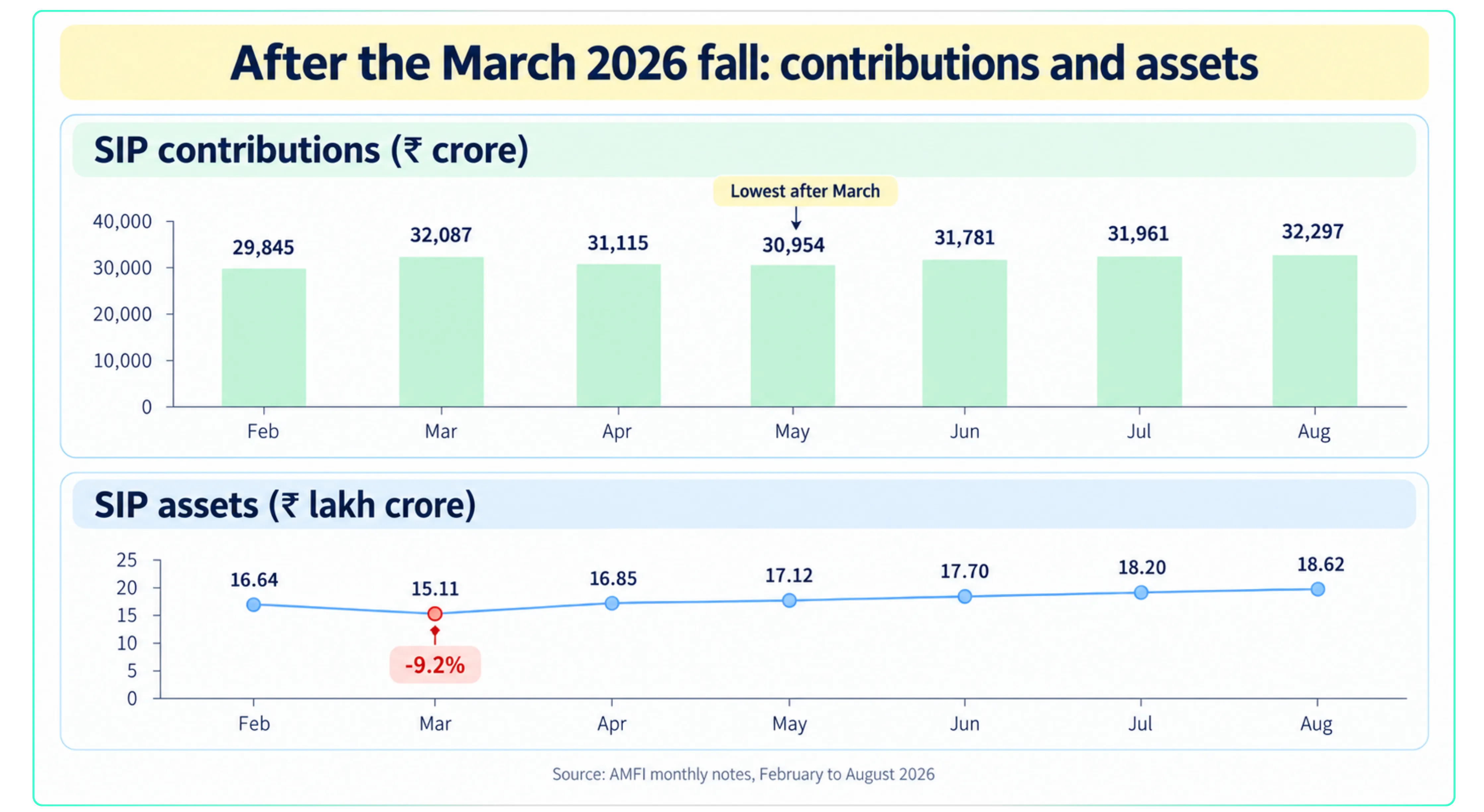
Between March and May, monthly contributions slipped from ₹32,087 crore to ₹30,954 crore, a fall of 3.5%. The number of contributing accounts eased from 9.72 crore to 9.64 crore, a fall of 0.8%. Both had recovered by July. August brought a record ₹32,297 crore and, as AMFI noted, the first time contributing accounts crossed 10 crore. SIP assets rose in every month after March.
What a SIP does not do
A SIP does not choose the scheme, does not match the scheme to the goal, and does not change the risk of the underlying fund. Each instalment into a small-cap fund carries small-cap risk. AMFI's August note shows small-cap funds took the largest equity inflow of the month, ₹7,973 crore, and the Factbook reports that SIP assets made up 55% of the small-cap category's assets in March 2026. The SIP route is a method of entry, not a measure of risk.
The FY26 record is a description of behaviour in one correction. It does not establish what will happen in the next.
The takeaway
A falling market changes the price at which a SIP buys units, not the basic mechanics of the SIP. Lower NAVs can mean more units and a lower average cost, but they do not eliminate losses or make the underlying fund less risky. Whether to continue or stop a SIP depends on the investment goal, the fund and the reason for stopping. A market correction by itself does not change how the SIP works.
Also Read: Every Mutual Fund Term You Keep Skipping Over
Disclaimer: The information provided in our blogs is for informational purposes only and should not be construed as financial, investment, or trading advice. Trading and investing in the securities market carries risk. Always conduct your own research and consult with a qualified financial advisor before making any investment decisions. Past performance is not indicative of future results. Copyrighted and original content for your trading and investing needs.
© 2026 — Tradejini. All Rights Reserved.
.webp%3Falt%3Dmedia%26token%3D95b8e400-dddc-4dbb-9213-6caa6b886a90&w=3840&q=75)