Game theory is the study of decision-making in situations where the outcome for each person depends on what others do. Imagine playing chess, negotiating a deal, or deciding whether to join a friend in a risky adventure—each choice affects not just you, but everyone else involved. Game theory gives us tools to predict and understand these interactions, showing why people sometimes cooperate, compete, or make unexpected moves. It’s not just for mathematicians or economists; it’s a way to make sense of everyday decisions and strategic thinking in life, business, and society.
The concept became widely known thanks to mathematician John Nash, whose groundbreaking work on equilibrium theory reshaped economics and social sciences. His life and ideas were later popularized through the Pulitzer Prize–winning book and Oscar-winning film A Beautiful Mind.
Playing the Market: How Game Theory Explains Market Moves
The stock market is more than numbers—it’s a living, breathing game where every Player, institution, and investor reacts to the moves of others. In the Indian Stock Market, this dynamic is especially complex. Millions of retail investors coexist with domestic institutions, foreign portfolio investors (FPIs), and even high-frequency trading algorithms. Each participant reacts to news, earnings announcements, macroeconomic events, and the perceived actions of other traders.

Here’s a simple story to illustrate: imagine a mid-cap stock scheduled to announce quarterly earnings on a Friday morning. Retail investors, hoping for quick gains, are poised to buy. Mutual funds and institutions plan to adjust their positions gradually. FPIs are weighing their moves based on global cues. Within the first hour of trading, the stock surges or plunges—not just because of the earnings themselves, but because of the strategic interplay of these players.
This is where game theory comes in. Ronald B. Shelton’s Gaming the Market introduced the idea that trading isn’t just about prices—it’s about strategy. Every trade is a move in a larger game where outcomes depend on the anticipated actions of others. In this market, the key is Strategy. While Shelton focused on U.S. markets, his principles apply seamlessly to India with some local twists: F&O expiry days, retail-driven volatility, promoter pledges, and sensitivity to macroeconomic announcements.
If you like exploring how strategy plays out in real businesses, check out IGI India – A Unique Niche Business with Industry Potential.
Understanding Shelton’s Game Theory in Trading
Shelton’s framework is simple at its core: market participants are players in a game, and every decision—buy, hold, sell—is influenced by what they expect others to do. Let’s break down the key concepts in the Indian context.
Players and Payoffs
- Retail investors – Often follow news, social sentiment, or herd behavior.
- Institutions – Mutual funds, insurance companies, and banks, generally with longer-term strategies.
- FPIs / FIIs – Large volumes, sensitive to global cues and regulatory changes.
- High-frequency traders (HFTs) – Algorithms reacting in milliseconds to price changes and order flows.
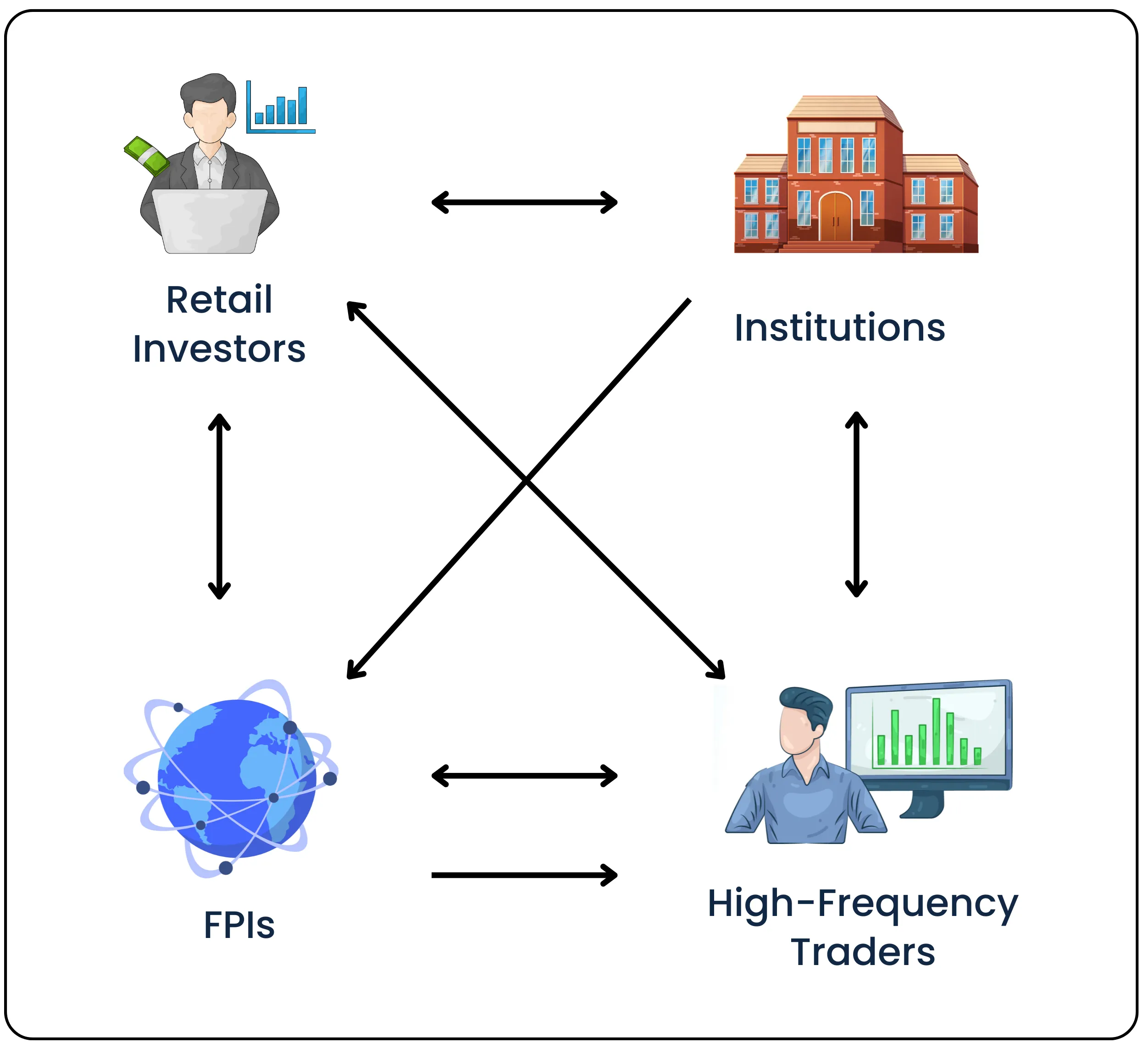
Example: When a mid-cap stock beats earnings expectations, retail investors may rush to buy immediately. Institutions may accumulate gradually to avoid driving the price too high. FPIs might strategically buy larger blocks anticipating further gains. Understanding each player’s payoffs—potential profit or loss—helps anticipate likely moves.
Information Asymmetry
Not everyone reacts at the same speed. Some players have faster access to news or better analytical tools.
- FPIs may respond instantly to RBI policy changes, while retail investors react later.
- Institutions often adjust positions based on promoter share pledges or large block deals.
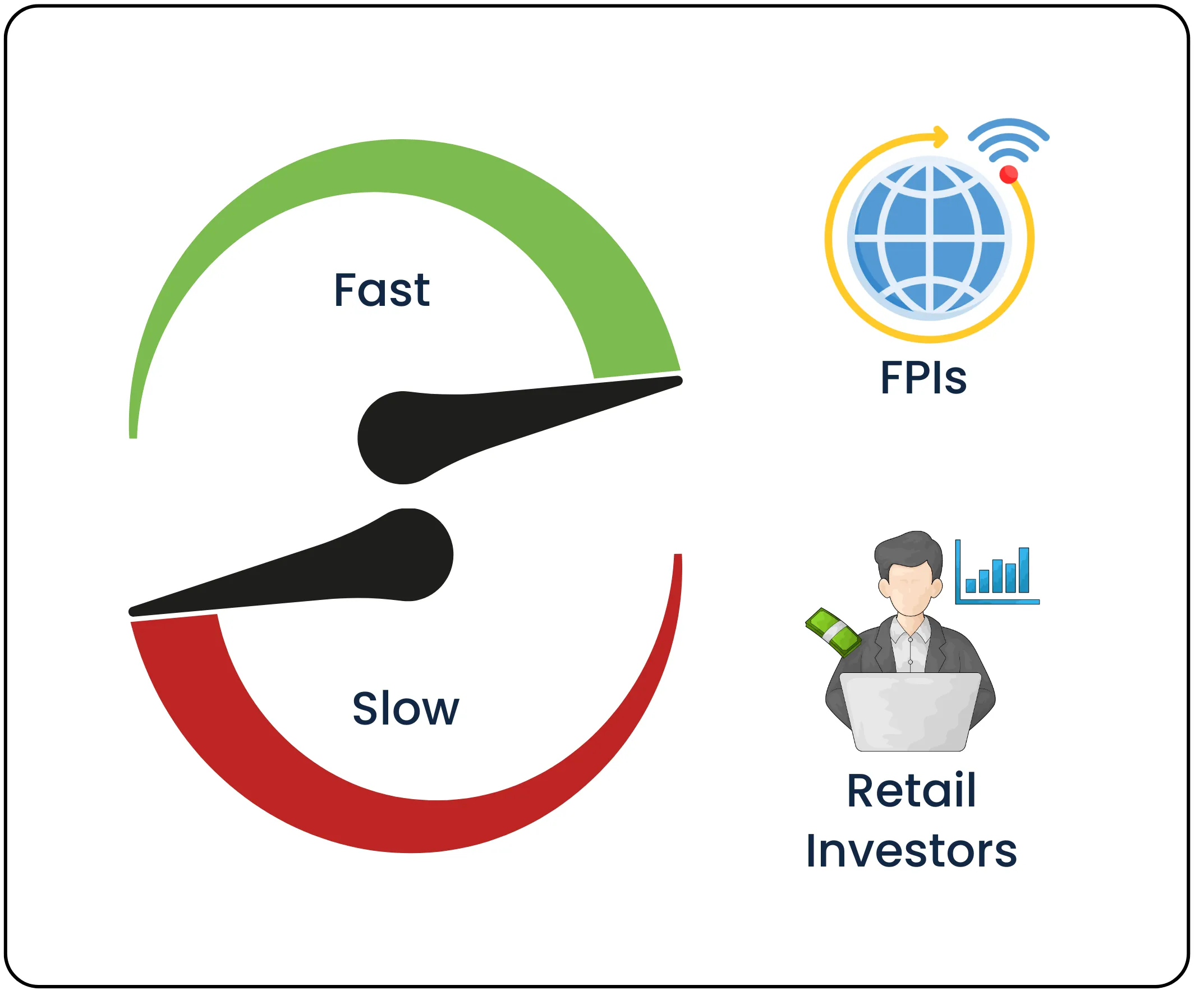
Insight: Knowing who has information first can help predict early price movements.
3. Nash Equilibrium: Predicting Moves
In game theory, a Nash equilibrium is a point where each player’s strategy is optimal, given the strategies of others.

- If FPIs are likely to sell after a negative earnings surprise, retail investors might preemptively sell.
- HFTs may detect volume patterns and accelerate price moves.
The equilibrium concept helps traders position themselves ahead of the crowd, rather than reacting after the fact.
Repeated Games and Behavioral Patterns
Markets are not one-off events. Repeated interactions shape how players behave.
- Retail investors often react similarly during quarterly earnings.
- Institutional strategies follow patterns based on portfolio rules.
- FPIs consistently respond to global macro trends.
Observing these repeated behaviors allows traders to predict likely reactions in future scenarios.
Payoff Matrices: Mapping Strategic Scenarios
One of Shelton’s most practical tools is the payoff matrix. It maps possible actions of players against outcomes, creating a structured way to analyze market moves.
Scenario: Quarterly Earnings Announcement for a Mid-Cap Stock
| Player \ Scenario | Positive Earnings | In-Line Earnings | Negative Earnings |
|---|---|---|---|
| Retail Investors | Buy → High gain (+10%) Hold → Moderate gain (+5%) |
Buy → Small gain (+2%) Hold → No change (0%) |
Sell → Limit loss (-5%) Hold → Risk loss (-10%) |
| Institutional Investors | Buy → Moderate gain (+5%) Hold → Safe (0%) |
Hold → Stable (0%) Sell → Slight loss (-2%) |
Sell → Cut loss (-3%) Hold → Moderate loss (-5%) |
| FPIs / FIIs | Buy → Strategic accumulation (+3%) Hold → Long-term gain (+5%) |
Hold → Maintain position (0%) | Sell → Protect portfolio (-2%) Hold → Accept minor loss (-1%) |
How to read it:
- Each cell shows expected gain/loss for a player in each scenario.
- Player actions are interdependent; e.g., if FPIs sell after a negative surprise, retail investors may anticipate the drop and sell first.
- This visual tool allows traders to think strategically before acting.
If the idea of strategic decisions shaping real-world outcomes interests you, you might also enjoy The Business of Sustainability: Inside India’s Recycling Boom
Applying Game Theory to the Indian Stock Market Scenario
Let’s apply this to a normal trading day:
- Event: Mid-cap stock earnings report on a Friday
- Market Context: Retail investors, institutions, FPIs, and HFTs all active
- Potential Scenarios: Positive surprise, in-line, or negative earnings
Step 1: Define the game
- Players: Retail, Institutions, FPIs
- Actions: Buy, Hold, Sell
- Information: Earnings report, news, F&O positions, volume spikes
- Payoffs: Potential gains/losses depending on others’ actions
Step 2: Anticipate reactions
- Positive Surprise: Retail buys immediately → price surges; Institutions accumulate gradually → moderate rise; FPIs buy strategically → sustained rally
- In-line: Price remains stable; minor profit/loss; minimal volatility
- Negative Surprise: Panic-selling by retail; institutions offload moderately; FPIs exit strategically → sharp decline, amplified by F&O expiry
Step 3: Include F&O expiry dynamics
- Expiry days magnify volatility as traders adjust positions.
- Large open interest can influence the stock price, adding another strategic layer to the “game.”
Step 4: Consider repeated-game behavior
- Retail patterns in earnings season are predictable.
- Institutional adjustments follow portfolio strategies.
- FPIs respond consistently to global macro trends.
Step 5: Strategic insight
- Map out all potential actions using the payoff matrix.
- Anticipate the most likely moves based on market context.
- Position yourself strategically rather than reacting.
- Adjust dynamically as new information arrives.
Think Strategically, Not Reactively

The Stock Market is a dynamic game where every participant’s move affects everyone else. Shelton’s game theory framework doesn’t predict exact prices—it maps strategic possibilities. By understanding players, payoffs, and likely equilibrium points, traders gain clarity and can navigate volatility intelligently.
Every earnings report, Futures & Options expiry, or macro announcement is a strategic interaction. Observing repeated patterns and anticipating reactions allows you to play the market smarter than the crowd.
Actionable Tip: Next time a stock spikes or dips after an earnings announcement, pause and ask: Who are the players? What moves are they making? How might their actions affect the market? Thinking strategically transforms noise into insight—and turns reactive trading into informed decision-making.
Turn research into action and explore smarter investing opportunities with CubePlus.
Disclaimer: The information provided in our blogs is for informational purposes only and should not be construed as financial, investment, or trading advice. Trading and investing in the securities market carries risk. Always conduct your own research and consult with a qualified financial advisor before making any investment decisions. Past performance is not indicative of future results. Copyrighted and original content for your trading and investing needs.
© 2025 — Tradejini. All Rights Reserved.
.webp%3Falt%3Dmedia%26token%3D0ead9799-20bc-4d1e-ae8f-d75ab18921b5&w=3840&q=75)