India and the United States share a dynamic trade relationship, valued at $131.84 billion in fiscal year 2024-25. India exports pharmaceuticals, auto components, software, and specialty chemicals, while the U.S. supplies aircraft, machinery, and soybeans. Historically, U.S. tariffs, like those in 2018–19, disrupted global markets, with the S&P 500 falling 16% and MSCI Asia ex-Japan dropping 25%. India’s Sensex and Nifty, however, saw milder declines of 5.2% and 4.8%, cushioned by low U.S. trade dependence (2% of GDP). In 2025, India’s markets exhibit resilience, driven by domestic fundamentals and trade diversification.
Trump’s 2025 tariff moves
On April 5, 2025, US President Donald Trump imposed a 10% universal import tariff, per a White House fact sheet. While not BRICS-specific, rhetoric hinted at steeper tariffs on Indian auto parts and chemicals. On April 7, 2025, the Nifty dropped 4.97% (1139 points) to 21757 at opening. The rupee weakened from 85.3 to 85.9 per USD. By May 2025, delayed enforcement stabilized markets, with the rupee recovering to 85.4. On July 7, 2025, For the second time Trump proposed tariffs on pharmaceuticals of 200% and 50% on copper, but with no USTR filing by July 10, 2025, markets remained steady, Nifty fell by only 0.30% and Pharma stocks dipped 0.4% before recovering.
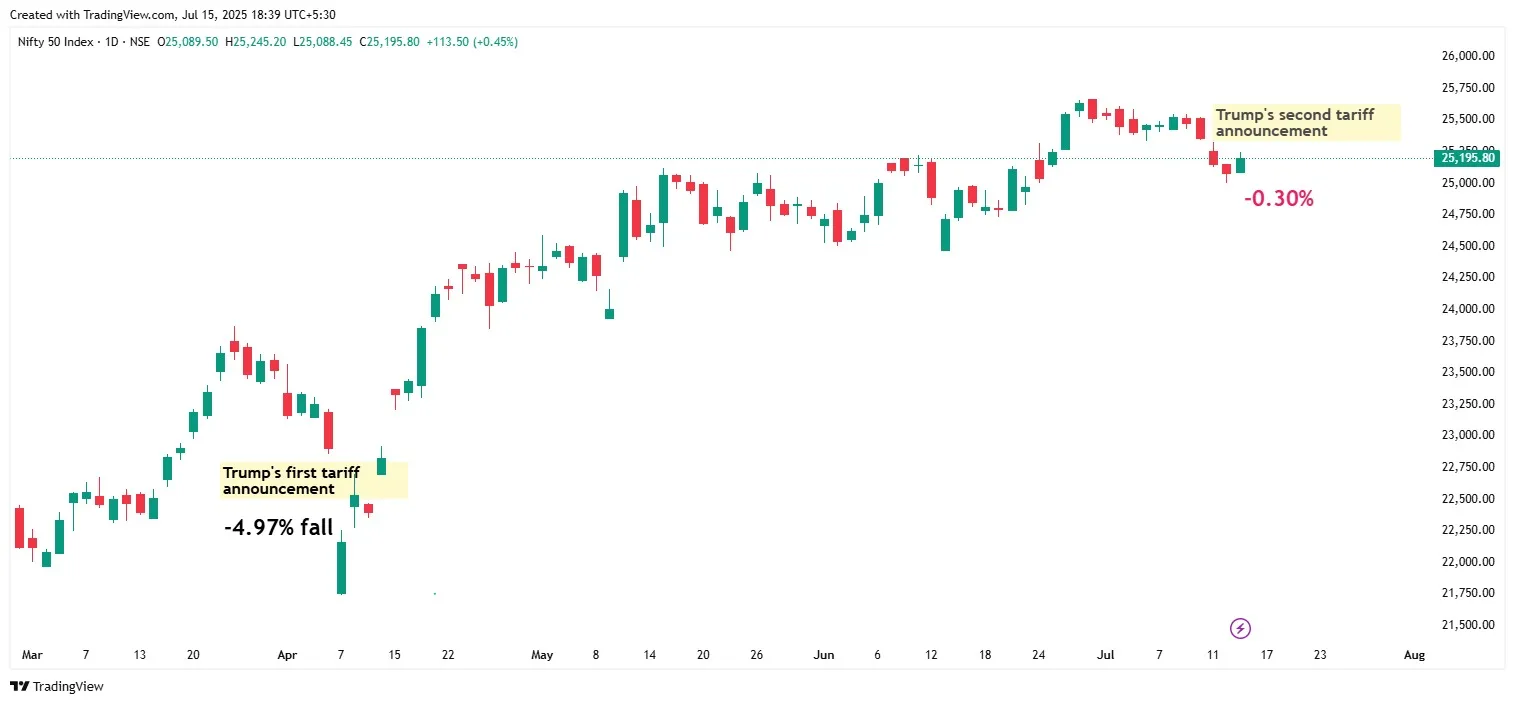
Key Market Impacts (2025)
| Metric | Value | Date |
|---|---|---|
| Nifty Drop (April) |
4.97% (1139 points) to 21757 | April 7, 2025 |
| Rupee Weakening (April) |
85.3 to 85.9/USD | Early April 2025 |
| Metals Sector Decline (April) |
2.3% | April 2025 |
| Auto Sector Decline (April) |
2.1% | April 2025 |
| IT Sector Decline (April) |
1.9% | April 2025 |
| Rupee Recovery (May) |
85.4/USD | May 5, 2025 |
| Rupee Range (July) |
85.4–85.6/USD | July 2025 |
| Pharma Stock Dip (July) |
0.4% (recovered) | July 2025 |
Why Indian markets are resilient
India’s markets have adapted to Trump’s tariff rhetoric. Investors recognize his pattern of delays and negotiations, reducing panic selling. The India VIX fell 12% from April to July 2025, signalling lower volatility. India’s projected 6.8% GDP growth in 2025, driven by banking, infrastructure, and FMCG sectors, supports stability. U.S. exports constitute 17% of India’s total exports in 2024, down from prior years due to diversification. Pharmaceutical exemptions further bolster confidence.
Also read: How Global Economic Environment is Rapidly Changing
Trade diversification strategy
The 2025 BRICS Summit, held in Johannesburg (some sources suggest Rio de Janeiro, July 6-7, 2025, focused on de-dollarization, local currency trade, and the New Development Bank, which has disbursed $33 billion. India’s trade diversification includes ASEAN (22% of exports), Africa (8% export growth to $55.3 billion in 2024), and the UAE (9% of exports). Free trade agreements with the UK (May 6, 2025) and Australia enhance access, though EU FTA talks remain ongoing as of September 2024.
Global markets vs. India’s stability
Global markets reacted to Trump’s 2025 tariff announcements with varying degrees of volatility, while India’s markets remained notably stable, reflecting lower U.S. trade reliance (2% of GDP) and strong domestic consumption. The table below summarizes the market responses to the April 5, 2025, 10% universal import tariff announcement and the July 7, 2025, proposed tariffs on pharmaceuticals (200%) and copper (50%), which lacked a formal USTR filing by July 12, 2025.
| Market Index | April 7, 2025 Decline |
July 10, 2025 Decline |
Key Factors |
|---|---|---|---|
| Taiwan TAIEX | 3.2% | 1.1% | High U.S. trade exposure (4.5% of GDP) |
| Japan Nikkei | 2.8% | 0.8% | Significant U.S. trade dependence |
| Germany DAX | 2.4% | 0.7% | Exposure to U.S. trade markets |
| S&P 500 | 0.9% | 0.3% | Broad U.S. market sensitivity |
| India Nifty | 4.96% | 0.5% | Strong domestic consumption |
| Indian Rupee | 85.3 to 85.9/USD (April) |
85.69/USD (July 10, 2025) |
Stable due to diversification |
India’s muted response, with the Nifty remaining stable in July 2025, contrasts with global markets’ sharper April declines and moderate July dips, underscoring India’s economic resilience.
India’s economic strength
India’s adept handling of Trump’s 2025 tariffs underscores its economic maturity and strategic diversification. With robust domestic demand and expanding global trade networks, India is well-positioned to withstand external shocks. Investors can capitalize on this resilience by targeting growth sectors like renewables and pharmaceuticals while maintaining vigilant risk management to navigate potential volatility.
Disclaimer: The information provided in our blogs is for informational purposes only and should not be construed as financial, investment, or trading advice. Trading and investing in the securities market carries risk. Always conduct your own research and consult with a qualified financial advisor before making any investment decisions. Past performance is not indicative of future results. Copyrighted and original content for your trading and investing needs.
© 2025 — Tradejini. All Rights Reserved.