

For decades, mutual funds have served as a gateway for everyday investors to access the financial markets. Whether you are a first-time investor looking to invest mutual funds or someone seeking to add structure to your portfolio, mutual funds offer a blend of simplicity and strategic depth that few other instruments can match.
This chapter explores what makes mutual funds a preferred investment route in India, and what you need to be mindful of before diving in.
Professional management without the price tag
Not everyone has the time, tools, or expertise to research markets and build a portfolio. That’s where mutual funds step in. Each scheme is managed by qualified fund managers whose job is to make investment decisions on your behalf, balancing risks, reading macroeconomic trends, and shifting allocations as required.
In effect, you get access to full-time market intelligence without the high fees typically associated with private portfolio management.
Diversification
You’ve probably heard it a hundred times, ‘Don’t put all your eggs in one basket.’ It might sound cliché, but it holds true. Mutual funds naturally follow this principle by spreading investments across equities, bonds, money market instruments, and other assets, depending on the fund’s objective.
This diversification helps reduce the impact of a single stock or sector’s poor performance on your overall returns. Here are some of the types of mutual funds available to investors:
| Type of Fund | Typical Holdings | Diversification Level |
|---|---|---|
| Equity Mutual Fund | 40–60 stocks across sectors | High |
| Debt Mutual Fund | Corporate bonds, govt securities | Medium to High |
| Hybrid Funds | Equity + Debt blend | Balanced |
| Thematic/ Sectoral | Stocks from one sector (e.g., Pharma, IT) | Low |
The liquidity
Unlike fixed deposits or insurance products, mutual funds (especially open-ended ones) offer high liquidity. Investors can buy or sell units on any business day at the fund’s prevailing Net Asset Value (NAV). Typically, redemption proceeds hit your bank account within 3–5 working days.
This ease of access is especially valuable in uncertain times when emergency cash might be required.
Your Quick Guide to Investing in Mutual Funds on Tradejini
Affordability that encourages participation
You don’t need lakhs to start investing. Many mutual fund schemes allow you to begin with as little as ₹500, and Systematic Investment Plans (SIPs ) make it even more convenient by automating small, regular contributions. You can easily find a good SIP to invest in based on your budget and goals.
This low entry barrier has helped mutual funds become one of the most inclusive investment options in India.
Convenience and automation
From online onboarding to monthly SIP deductions, the mutual funds investment plans ecosystem is built for user convenience. You can set up:
- Systematic Withdrawal Plans (SWPs )
- Automatic dividend reinvestment
- Portfolio tracking apps
Everything is designed to reduce the friction that typically comes with investing.
Cost efficiency for retail investors
For small investors, mutual funds are a smart way to access professional expertise at a fraction of the cost. Expense ratios for regular plans hover around 1.5% to 2.5%, covering fund management, administration, and distribution.
Since fund houses also pool money from thousands of investors, they enjoy lower transaction fees and better execution rates when buying or selling securities, savings that ultimately benefit the investor.
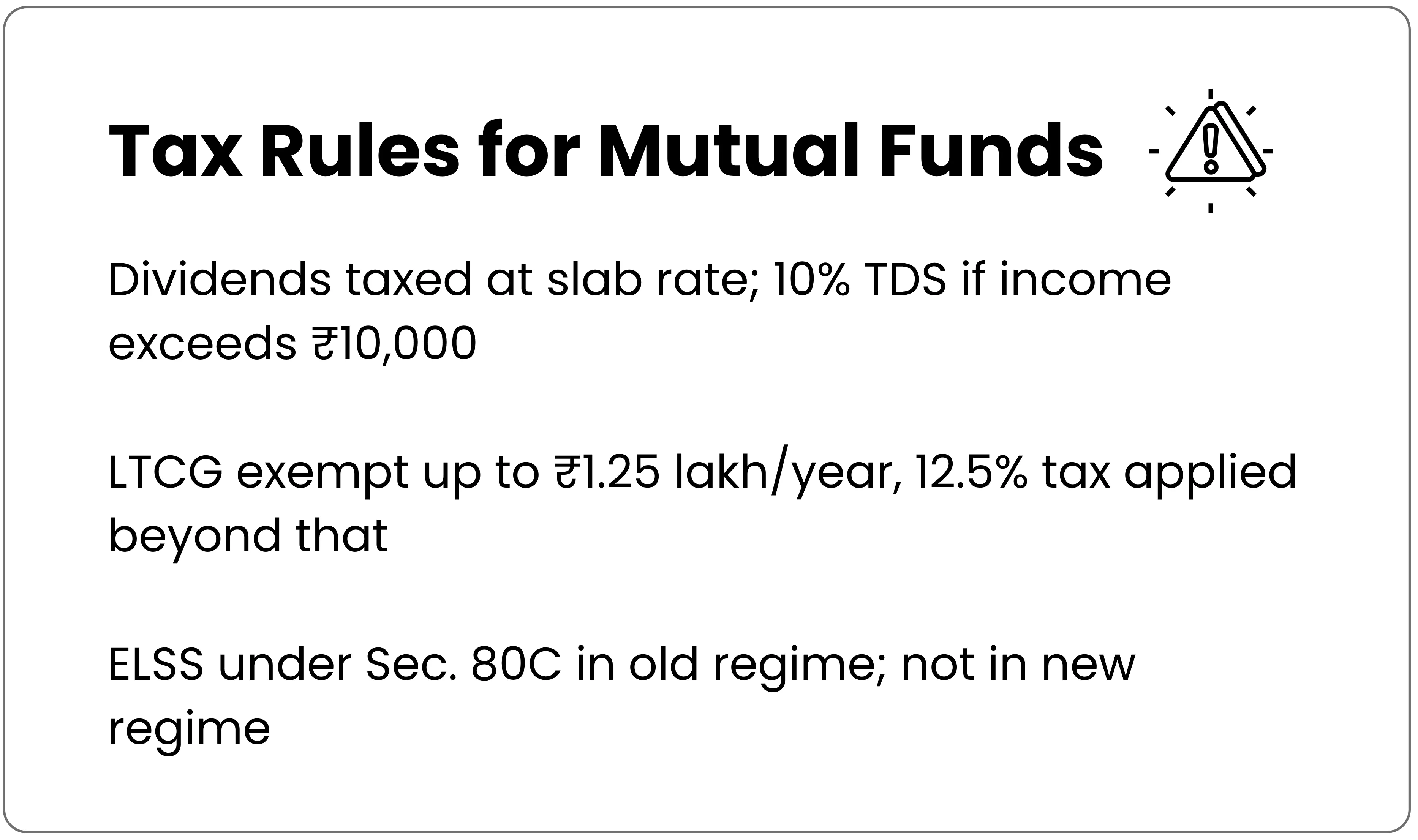
Tax efficiency
These benefits can significantly enhance your post-tax returns, especially if you're planning long-term wealth creation.
The limitations
Mutual funds are not magic bullets. While they offer convenience and diversification, there are a few trade-offs to be aware of.
Costs are incurred regardless of performance
Fund management fees and distribution costs are deducted from the fund’s assets, whether the scheme performs well or not. While expense ratios are capped by SEBI , the returns you earn are net of these costs.
No customisation of portfolio
When you invest in a mutual fund, you are effectively outsourcing your investment decisions to the fund manager. That means you have no control over which specific securities are chosen or when they’re bought and sold. This can be a drawback for investors with specific preferences or strategies in mind.
Too many options can be overwhelming
With hundreds of schemes available, large-cap , small-cap, balanced advantage, and thematic, the sheer variety can confuse a new investor. Selecting the right fund based on your goals, time horizon, and risk appetite often requires guidance from a financial advisor.
Who handles your mutual fund investments? Here’s the answer
Smart investor’s approach
While mutual funds offer a host of advantages, the key lies in making informed choices. Start with your goals, whether it's building an emergency fund, saving for a home, or planning for retirement. Then choose the best mutual fund to invest in that aligns with your time horizon and risk appetite. Monitor performance, but don’t panic over short-term volatility. Remember, mutual funds are long-term vehicles. When used wisely, they can be a core pillar of your financial planning strategy.
Open your CubePlus account today and take control of your mutual fund investments smartly, efficiently, and on your terms.
Disclaimer: The information provided in our blogs is for informational purposes only and should not be construed as financial, investment, or trading advice. Trading and investing in the securities market carries risk. Always conduct your own research and consult with a qualified financial advisor before making any investment decisions. Past performance is not indicative of future results. Copyrighted and original content for your trading and investing needs.
© 2025 — Tradejini. All Rights Reserved.