Have you ever wondered if there is a single index that almost represents the entire Indian stock market? Something that gives you exposure not just to the biggest companies but also to emerging mid cap and small cap names that often drive the next big growth cycle. That is where the Nifty 500 comes in. It is one of the Broadest Indian stock market index in India and covers companies across all major sectors, giving investors a complete picture of the market.
Instead of tracking only the largest stocks, the Nifty 500 includes 500 companies that together represent around 90% to 93% of the total market capitalisation on the National Stock Exchange. When you invest in the Nifty 500, you are not betting on just a few winners. You are participating in India’s larger economic growth story.
Understanding sectoral influence within the Index
The index maintains broad diversification across industries, yet one sector plays a noticeably dominant role. Financial Services, which covers banks, NBFCs and insurance companies, holds the largest share of the index and significantly influences overall performance. Shown below is the Nifty 500 index structure and Nifty 500 sector weightage analysis allocation table.
| Sector | Weight (%) |
|---|---|
| Financial Services | 31.11 |
| Information Technology | 7.81 |
| Oil, Gas & Consumable Fuels | 7.76 |
| Automobile and Auto Components | 7.08 |
| Fast Moving Consumer Goods | 6.37 |
| Capital Goods | 6.30 |
| Healthcare | 6.28 |
| Consumer Services | 3.77 |
| Metals & Mining | 3.68 |
| Telecommunication | 3.45 |
| Power | 3.23 |
| Construction | 2.88 |
| Consumer Durables | 2.76 |
| Construction Materials | 2.00 |
| Chemicals | 1.93 |
| Services | 1.89 |
| Realty | 1.17 |
| Textiles | 0.26 |
| Media, Entertainment & Publication | 0.13 |
| Diversified | 0.09 |
How is the Nifty 500 designed and what makes it unique?
To understand why this index is so meaningful, it helps to know how it is structured.
Here are the key design principles of the Nifty 500:
It is created using the free float market capitalisation method. Only publicly tradable shares are considered for calculating weights.
It includes companies across all three market cap categories.
| Market Cap Segment | Number of Companies |
|---|---|
| Large Cap | Top 100 |
| Mid Cap | Next 150 |
| Small Cap | Remaining 250 |
It undergoes periodic rebalancing so that only relevant and eligible companies remain part of the index.
Stocks included must meet specific criteria related to liquidity, trading frequency, listing history and impact cost.
It covers almost the entire traded value of the market, making it a very representative benchmark of the Indian equity landscape.
The Nifty 500 offers one of the broadest representations of the Indian equity market, covering large cap, mid cap, and small cap companies in a single index. This broad coverage is exactly what makes the Nifty 500 more comprehensive than narrow indices like the Nifty 50 or even the Nifty 100. When you look at a Nifty 500 vs Nifty 50 comparison, the difference becomes clear. The Nifty 50 focuses only on the largest companies, while the Nifty 500 captures the full market ecosystem and provides balanced Large Mid Small Cap index exposure
Why Do Investors Prefer the Nifty 500 Over Narrow Indices?
If you are wondering why someone would choose a 500-stock index instead of just sticking to top large caps, the answer lies in the benefits.
Here are the major benefits of Nifty 500 index investing:
It offers high diversification because it spans many sectors and industries like banking, infrastructure, consumer goods, technology, media, real estate and more.
It includes mid cap and small cap companies which can outperform during strong market phases and add long-term growth potential.
It is transparent because the holdings are rule based. You know exactly which companies the index contains.
Passive investing through a Nifty 500 fund is cost efficient because index funds and ETFs usually have lower expense ratios.
It acts as a good long term wealth building tool since it reflects the overall performance of India’s growing economy.
What risks should you know before investing?
No investment is perfect and the Nifty 500 is no exception. Understanding the risks upfront helps you make better decisions.
Since the index includes mid and small caps, it may experience higher volatility during market corrections.
Index funds or ETFs tracking it can face tracking error. This means returns may slightly differ from the actual index.
Despite having 500 companies, large caps still dominate overall index weight. This means a few big names can influence returns.
The entire index is tied to broad market cycles. If the economy slows down, the index will also reflect the downturn.
So how do you actually invest in the Nifty 500?
The real question now is simple: do you want your portfolio to grow alongside India’s growth story?
If you are new to investing, the easiest way to begin is to start small. Begin with a SIP in a Nifty 500 index fund and let steady, disciplined investing work in your favour. With time and consistency, even small contributions can turn into meaningful long-term wealth.
If the idea of owning an index that represents most of the Indian market appeals to you, the good news is that it is very simple to invest in it.
Here is how:
You can invest through a Nifty 500 index mutual fund. This is ideal if you prefer systematic investing through SIPs.
You can Invest in Nifty 500 ETF fund directly from the stock market if you want the flexibility of intraday trading.
Many investors use the Nifty 500 as the core portion of their long term equity portfolio because it provides broad market exposure.
Periodically reviewing your investment ensures that your chosen fund continues to track the index efficiently and remains cost effective.
Both index funds and ETFs give investors a straightforward way to participate in India’s overall growth rather than betting on individual stocks.
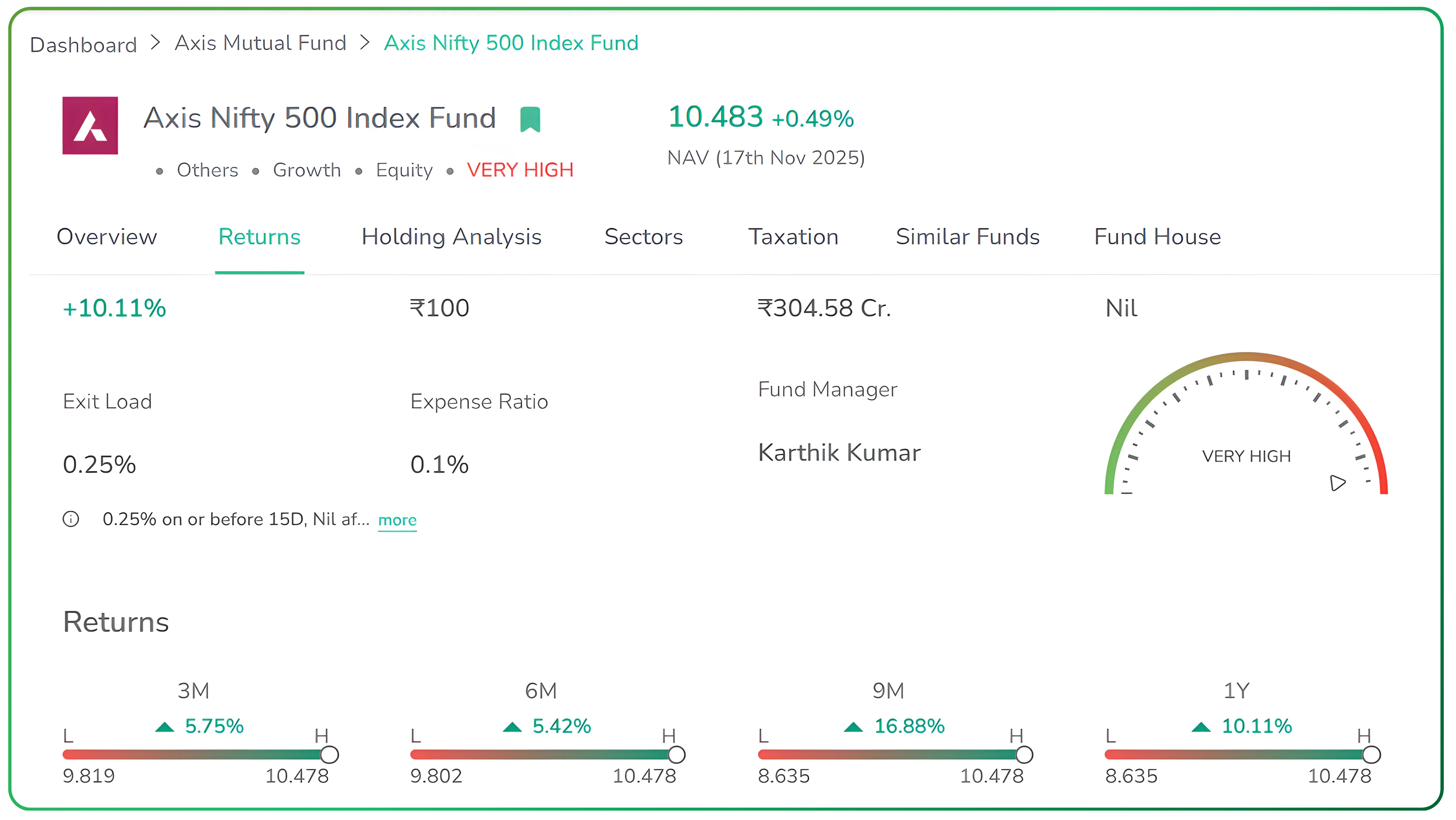
With Tradejini CubePlus, it becomes much easier to explore Nifty 500 mutual funds, compare their performance, review holdings across stocks and sectors, understand taxation, and analyse how they stack up against other funds, all in one place.
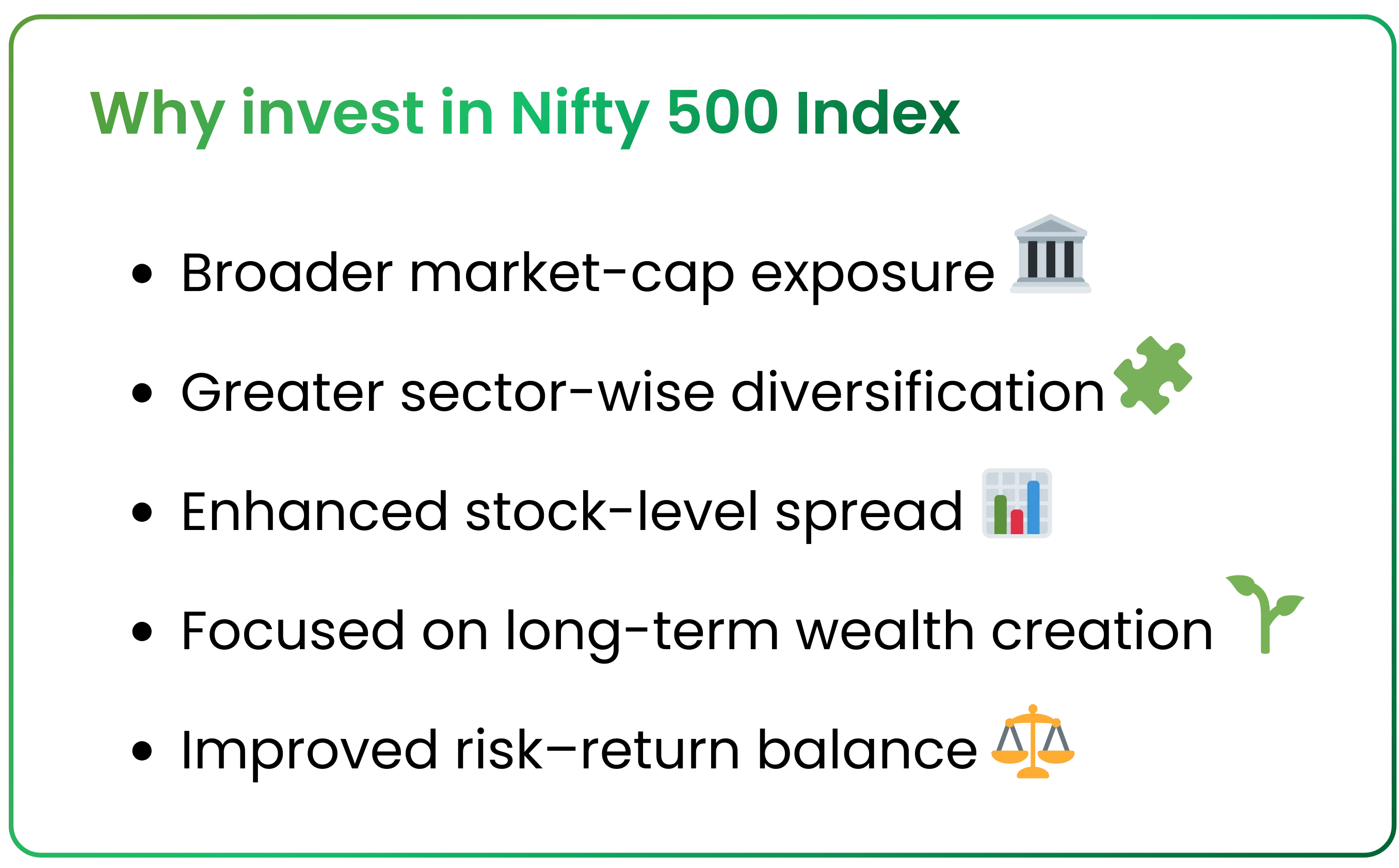
Why invest in Nifty 500 Index
The Nifty 500 in a long-term strategy
If you believe in India’s long term growth and want a single investment that captures the entire market ecosystem, the Nifty 500 is worth serious thought. It spreads your investment across large, mid and small caps, across multiple sectors, and across companies at different stages of the business cycle. This makes it a strong foundation for long term wealth creation.
However, your investment choice should align with your comfort level, financial goals and investment horizon. For many people, pairing a Nifty 500 index fund with a few focused funds or thematic strategies offers a balanced approach.
Also read: https://userguide-cp.tradejini.com/index.html
Disclaimer: The information provided in our blogs is for informational purposes only and should not be construed as financial, investment, or trading advice. Trading and investing in the securities market carries risk. Always conduct your own research and consult with a qualified financial advisor before making any investment decisions. Past performance is not indicative of future results. Copyrighted and original content for your trading and investing needs.
© 2026 — Tradejini. All Rights Reserved.
.webp%3Falt%3Dmedia%26token%3D0ead9799-20bc-4d1e-ae8f-d75ab18921b5&w=3840&q=75)