Most traders hear the phrase statistical arbitrage and assume it belongs only in hedge-fund playbooks. But once you strip away the jargon, the idea is surprisingly intuitive. Markets overreact, related stocks drift away from each other, and that temporary distortion creates an opportunity. Pair trading is the most practical way to use this insight, and it’s one of the cleanest market-neutral strategies out there.
The strategy has strong backing from academic work by Gatev, Goetzmann and Rouwenhorst in the Journal of Finance, as well as models developed by Avellaneda & Lee and popularized through Andrew Pole’s Statistical Arbitrage. In short, this isn’t a fad — it’s one of the most well-researched techniques in quantitative finance.
What’s Really Going On in Statistical Arbitrage
Here’s the thing: markets often treat related stocks as if they’re tied together by an invisible rubber band. When both companies operate in the same sector and react to similar news cycles, their prices tend to move in sync. You see this clearly in Indian markets too — stocks like HDFC Bank and ICICI Bank, UltraTech Cement and Shree Cement, or Tata Steel and JSW Steel usually travel in the same direction because their fundamentals and sector triggers overlap.
Every now and then, one stock races ahead or falls behind. That stretch in the “rubber band” is what pair traders look for. If two stocks are normally close and suddenly diverge more than usual, the odds of them drifting back toward their historical equilibrium are high. You don’t predict the broader market. You only care about the relationship between the two stocks.
The Flow of a Pair Trade
To understand how it works from start to finish, picture this clear sequence:
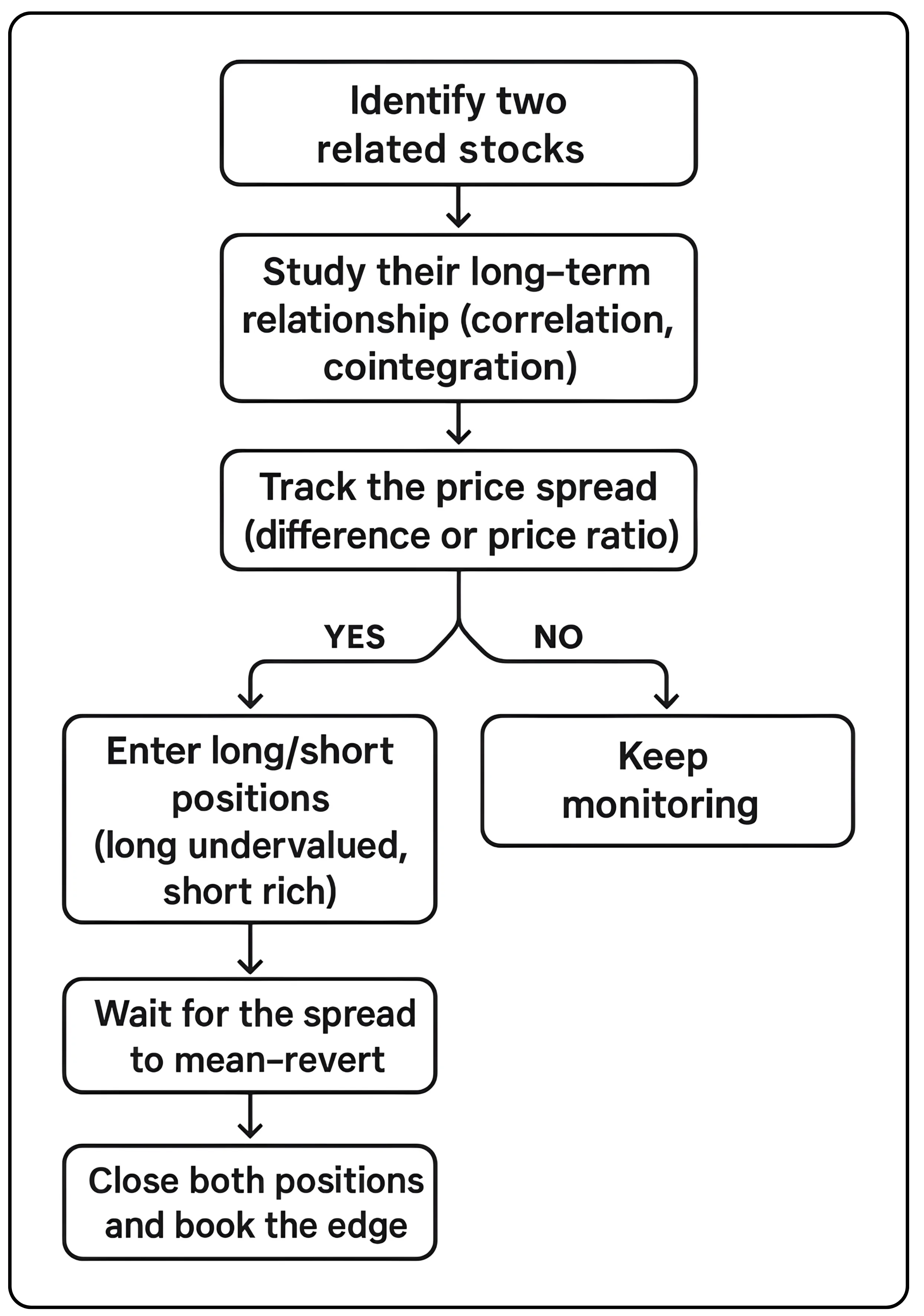
It’s structured, it’s mathematical, and it’s designed to be indifferent to market direction.
A Visual Look at Price Movement
Below is a first chart showing how two synthetic stocks move almost in lockstep over time. This kind of tight co-movement is exactly what traders look for when selecting a pair.
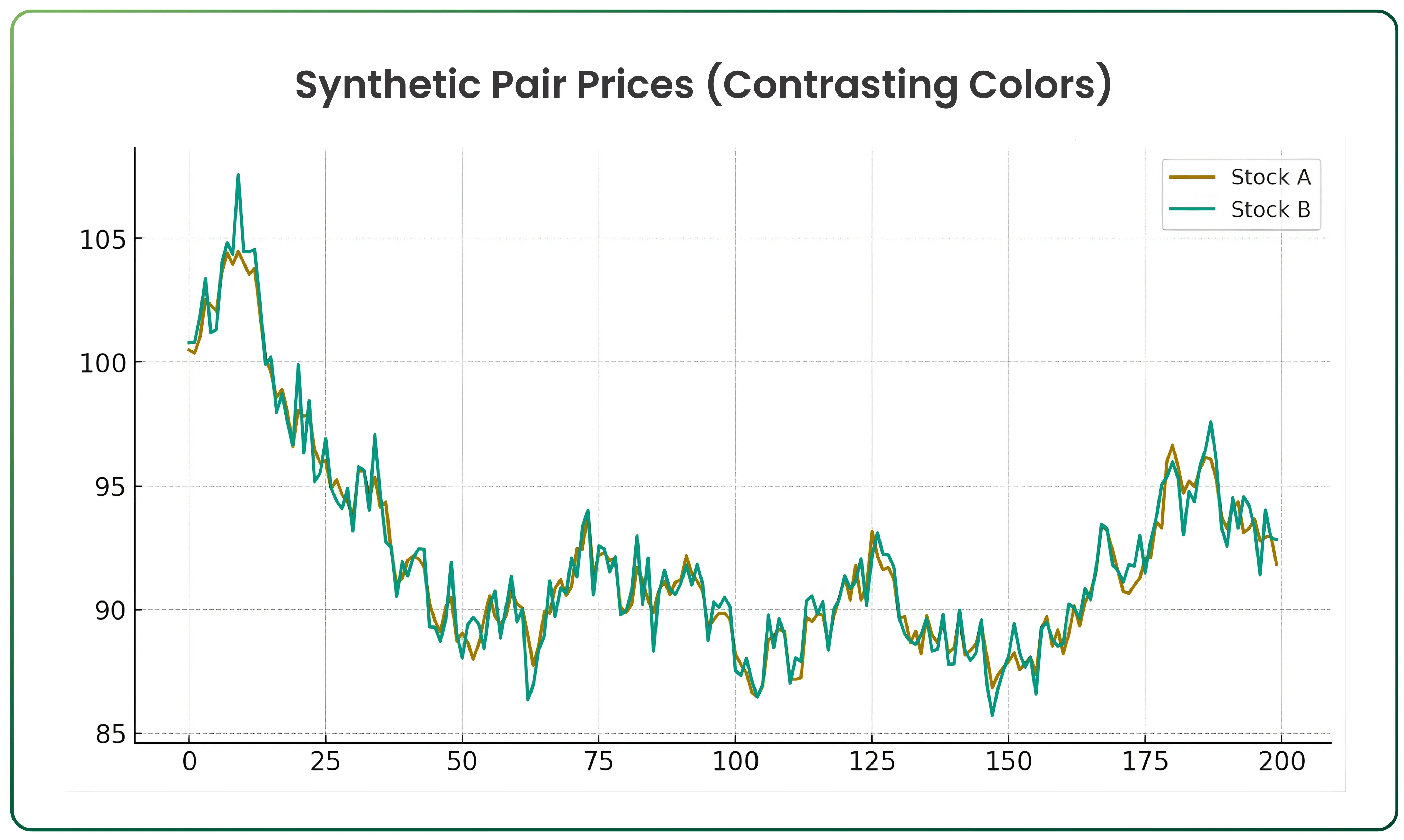
Stock A (blue) and Stock B (red) tend to move together, a key requirement for pair trading.
What this really means is that when one stock suddenly runs ahead, it becomes obvious. The chart makes that relationship easy to spot even before running statistical tests.
Understanding the Spread
The chart below (the spread line) brings the core concept into focus. It shows the difference between the two prices over time. The purple jagged line represents how the spread fluctuates, while the black horizontal line marks its average level.
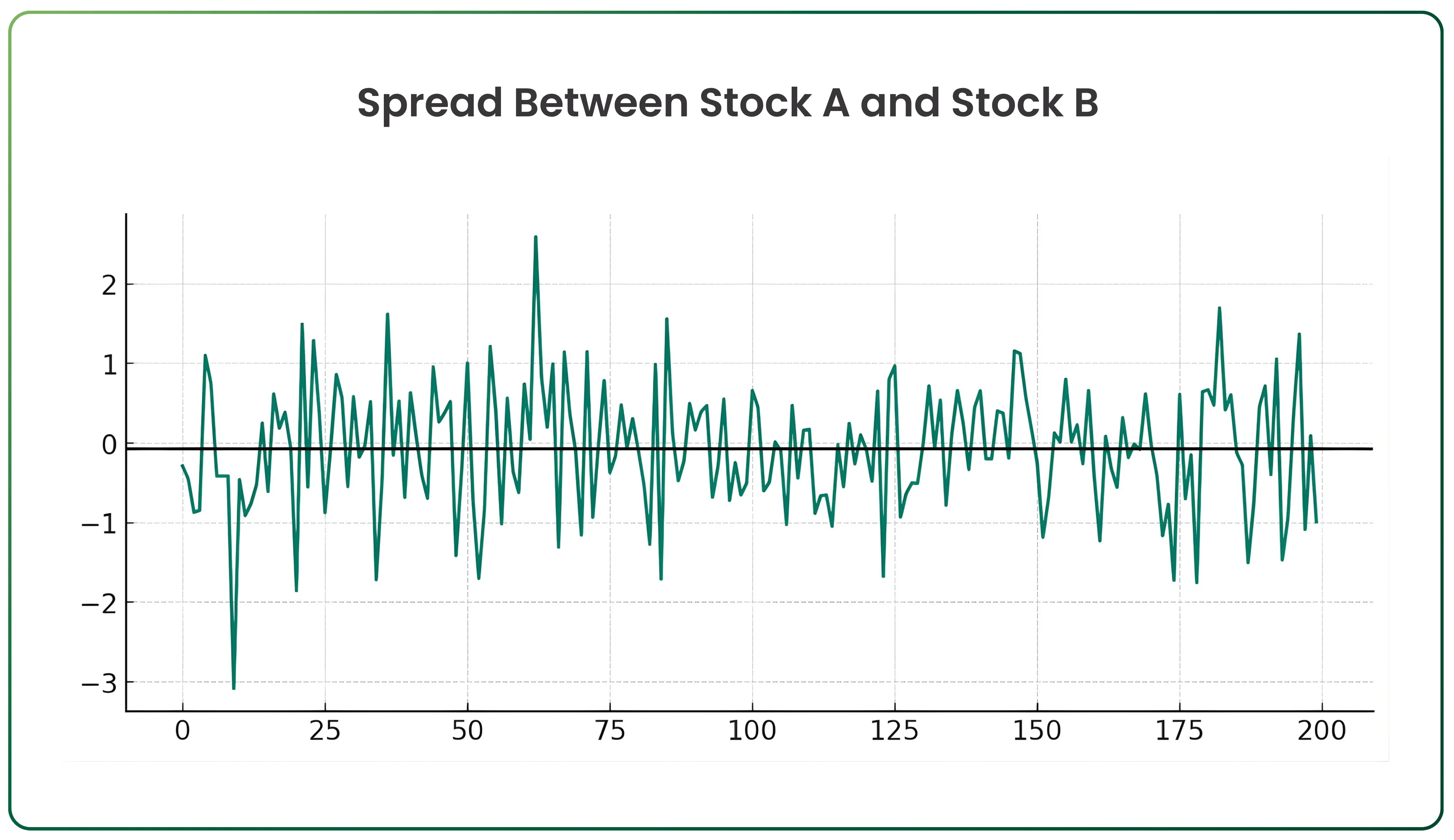
The spread frequently returns toward its average. Deviations above or below that mean often create opportunities.
When the spread spikes far above or dips far below the black line, it signals that one stock is temporarily out of sync. That’s where traders often take positions.
For a different angle on strategy, here’s a quick read on Sun Tzu’s lessons for traders and investors. You can check it out here.
A Simple India-Based Example
Let’s take Tata Steel and JSW Steel, two companies with similar sector drivers and cost structures. Historically, their price movements track each other closely.
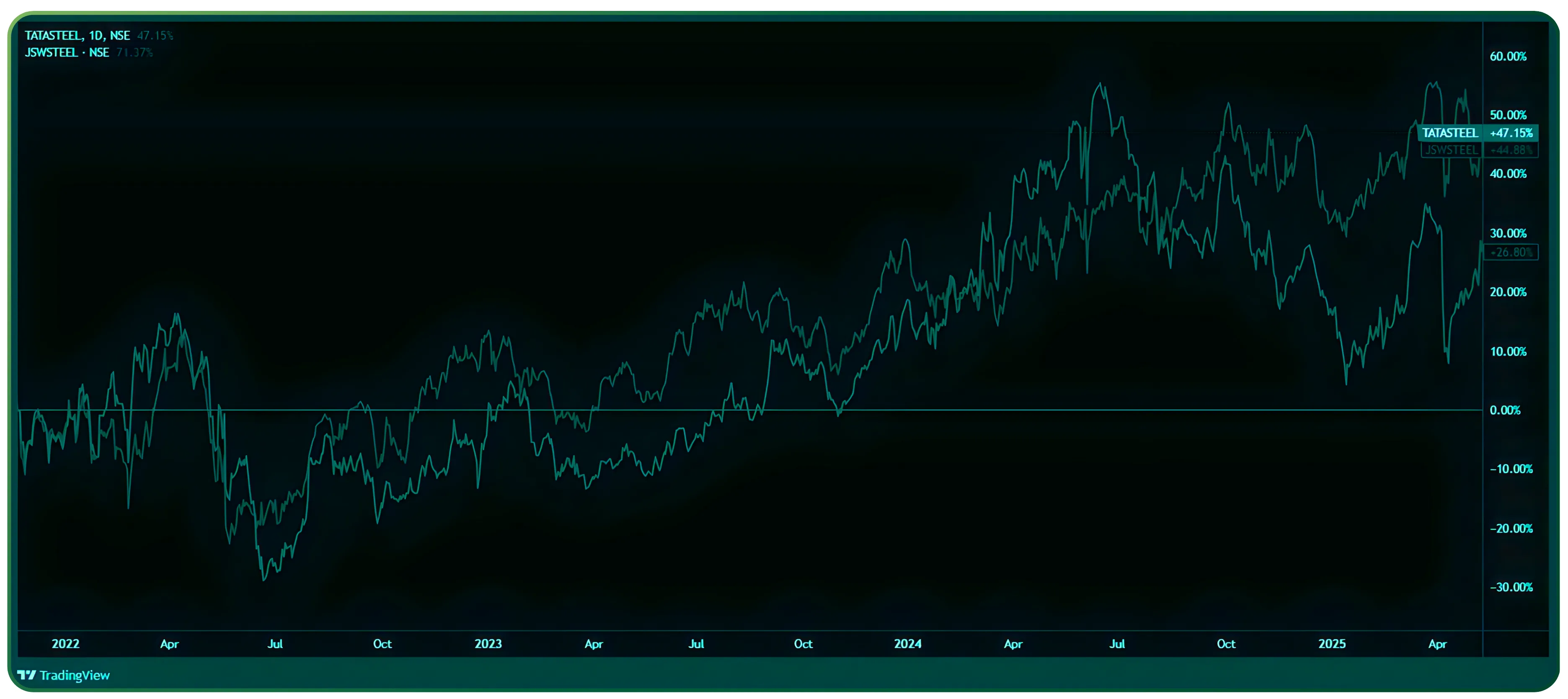
Tata Steel JSW Steel pair trading example
Suppose their price ratio usually sits around 1.18. Suddenly, on a volatile week, Tata Steel rallies sharply while JSW Steel lags, and the ratio shoots to 1.32. A pair trader doesn’t speculate whether cement demand will rise or fall. Instead, they see the distortion itself.
They buy JSW Steel (the laggard). They short Tata Steel (the one that jumped ahead).
When the ratio eases back toward its established zone, they exit both sides and capture the normalization.
Why Pair Trading Still Matters
In a noisy market filled with narratives and sudden sentiment shifts, pair trading brings structure. It doesn’t require predicting interest rates, GDP numbers, or global cues. It only requires understanding how two stocks relate to each other and letting that relationship guide the trade.
Whether you apply it to HDFC–ICICI, UltraTech–Shree, or Tata Steel–JSW, the underlying logic remains the same: prices may wander, but relationships tend to stay anchored.
Turn research into action and explore smarter investing opportunities with CubePlus.
Disclaimer: The information provided in our blogs is for informational purposes only and should not be construed as financial, investment, or trading advice. Trading and investing in the securities market carries risk. Always conduct your own research and consult with a qualified financial advisor before making any investment decisions. Past performance is not indicative of future results. Copyrighted and original content for your trading and investing needs.
© 2025 — Tradejini. All Rights Reserved.
.webp%3Falt%3Dmedia%26token%3D0ead9799-20bc-4d1e-ae8f-d75ab18921b5&w=3840&q=75)