Portfolio Managers are investment decision-makers… In the context of Portfolio Management India, PMS has emerged as a professional wealth management avenue. They devise and implement investment strategies and processes to meet client goals and constraints, construct and manage portfolios, make decisions on what and when to buy and sell investments.
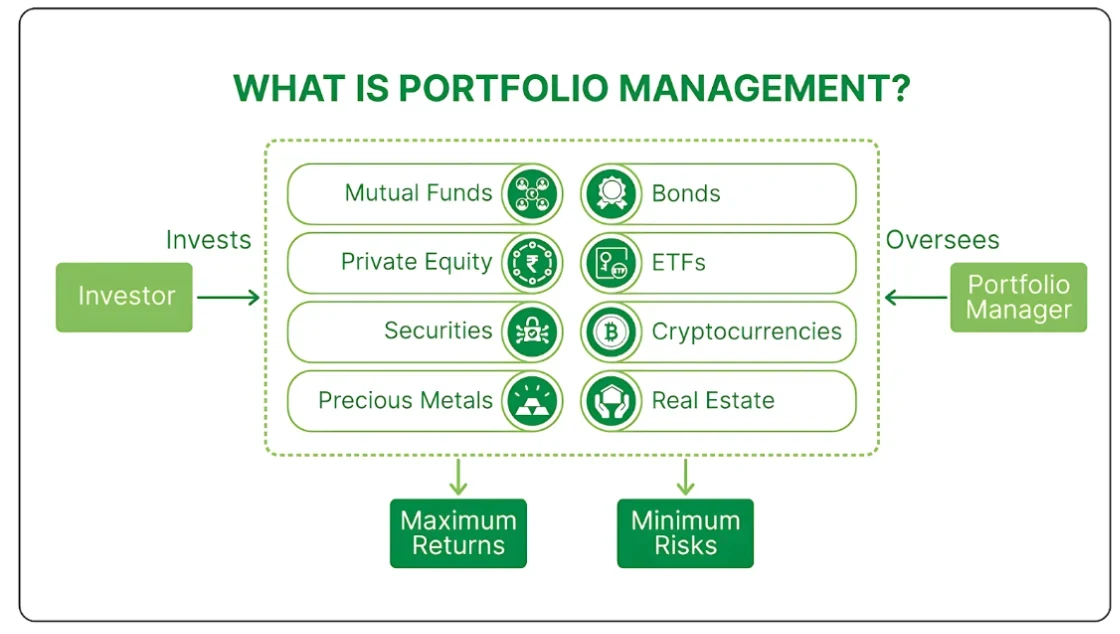
Risk and return are the two key pillars of financial investment. Portfolio management involves designing and managing a basket of assets in such a way that the investor’s risk is minimized while maximizing the potential return.
- The regulation of portfolio managers in India began in January 1993, when SEBI issued the Portfolio Managers Regulations, 1993, even before mutual fund regulations—signifying the importance of PMS to the regulator.
- The regulations were updated and consolidated under SEBI (Portfolio Managers) Regulations, 2020.
- In India, PMS is primarily offered by large brokerage firms, asset management companies (AMCs), and boutique independent PMS houses.
Types of Portfolio Management Services
Service Provider
| Type | Description |
|---|---|
| PMS by Asset Management Companies (AMCs) | Managed by professional fund houses with established research teams and strategies; offers credibility, scale, and structured processes. |
| PMS by Brokerage Houses | Offered by brokerage firms along with trading/advisory services; leverages market access and in-house research; convenient for clients with trading accounts. |
| Boutique/Independent PMS Firms | Specialized firms led by experts; offer niche strategies and personalized attention to clients seeking unique investment approaches. |
Asset Class
| Type | Description |
|---|---|
| Equity-based PMS | Invests in listed equities for long-term capital appreciation; suitable for high-risk, return-seeking investors. |
| Fixed Income-based PMS | Focuses on bonds, debentures, and debt instruments; provides predictable returns and capital preservation. |
| Commodity PMS | Invests in commodities like gold and silver; diversifies portfolios and acts as an inflation hedge. |
| Mutual Fund PMS | Creates a portfolio of carefully selected mutual funds across categories; offers professional diversification. |
| Multi-Asset PMS | Allocates across equity, debt, commodities, and real estate; balances risk and return with broad diversification. |
Service Nature
| Type | Description |
|---|---|
| Discretionary PMS | The most common form of PMS in India, preferred by HNIs. The manager takes full control of investment decisions under a defined strategy; suitable for HNIs and busy investors. |
| Non-Discretionary PMS | Clients retain full control over decisions, making it suitable for active investors. Manager only executes trades as per client’s instructions; ideal for investors who want active involvement. |
| Advisory PMS | Manager provides non-binding advice; client makes and executes all decisions; preferred by institutions and sophisticated investors. |
Structure of PMS in India
- PMS can only be offered by body corporates registered with SEBI.
- A formal contract between client and manager governs the service.
- PMS operates distinctly from mutual funds, as it provides customized portfolios for each client.
Also read: Are Mutual Funds Safe? Who’s Handling My Money and Can I Trust Them
Registration Requirements of a Portfolio Manager
To operate as a portfolio manager, a firm must obtain a SEBI Registration Certificate under PMS Regulations, 2020.
Key requirements:
- Must be a body corporate with adequate infrastructure, compliance officer, and qualified principal officer.
- Net-worth requirement: Minimum ₹5 crore.
- The Principal Officer must have 5+ years of securities market experience and relevant NISM certification.
- Detailed application (Form A) including business plan, financials, dispute records, compliance structure, and draft agreements.
- Certificate remains valid unless suspended/cancelled by SEBI Regulations Governing PMS.
Responsibilities of a Portfolio Manager
- Act in a fiduciary capacity towards clients.
- Maintain segregated accounts for each client’s funds and securities.
- Not accept investments below ₹50 lakh (PMS minimum investment as per SEBI norms).
- Not invest more than 30% of the client portfolio in group/related entities (with written consent).
- Avoid investment in below-investment-grade securities.
- Ensure proper client grievance redressal and compliance with SEBI norms.
Also read: The Importance of RTA Agents in Mutual Fund Management
Costs, Expenses and Fees of PMS
| Type | Description | Example |
|---|---|---|
| Fixed Fee | Flat fee charged irrespective of performance | 1% of AUM |
| Performance Fee | Profit-sharing fee, linked to returns above hurdle rate | 10–20% of profits |
| High Watermark Principle | Fees only charged on gains above the previous highest NAV | Prevents double-charging |
| Hurdle Rate | Minimum return before performance fee applies | e.g., 8% p.a. |
| Catch-up/No Catch-up | Determines if fee applies to entire gains or only above hurdle | Varies by agreement |
Direct Access Facility in PMS
Just like mutual funds offer direct plans without intermediaries, PMS now provides a direct access facility where investors can invest directly with the PMS provider. This eliminates distributor commissions, reduces expenses, and enhances net returns. The management process remains the same as in regular plans, except that costs are lower in direct access.
Role of Investment Advisers:
Investment advisers help clients decide whether PMS is suitable compared to other instruments and guide them on choosing direct access, which can save costs without affecting performance. Depending on the client’s profile, advisers also suggest whether discretionary, non-discretionary, or advisory PMS is more appropriate, ensuring better alignment with financial goals.
Also read: Mutual Funds User Guide
Takeaway
Portfolio Management Services (PMS) play a crucial role in meeting the diverse investment needs of high-net-worth individuals and institutions in India. With options ranging from discretionary, non-discretionary, to advisory models, PMS offers flexibility, customization, and professional expertise beyond traditional investment avenues like mutual funds. Regulated by SEBI, PMS ensures transparency, investor protection, and accountability while allowing tailored strategies across equity, debt, commodities, and multi-asset portfolios. For investors seeking a balance of risk, return, and personalized financial planning, PMS serves as a structured and professional wealth management solution.
Disclaimer: The information provided in our blogs is for informational purposes only and should not be construed as financial, investment, or trading advice. Trading and investing in the securities market carries risk. Always conduct your own research and consult with a qualified financial advisor before making any investment decisions. Past performance is not indicative of future results. Copyrighted and original content for your trading and investing needs.
© 2025 — Tradejini. All Rights Reserved.
.webp%3Falt%3Dmedia%26token%3D0ead9799-20bc-4d1e-ae8f-d75ab18921b5&w=3840&q=75)