The Indian port sector is a foundational pillar of the nation’s trade and logistics ecosystem, handling approximately 95% of India's international trade by volume. Spanning a vast coastline of 7,517 km, the country hosts 13 major ports under central governance and more than 200 minor and private ports under various state jurisdictions and private entities. These ports serve as critical enablers of economic activity, comparable to toll highways in their function of facilitating industrial supply chains and international commerce.
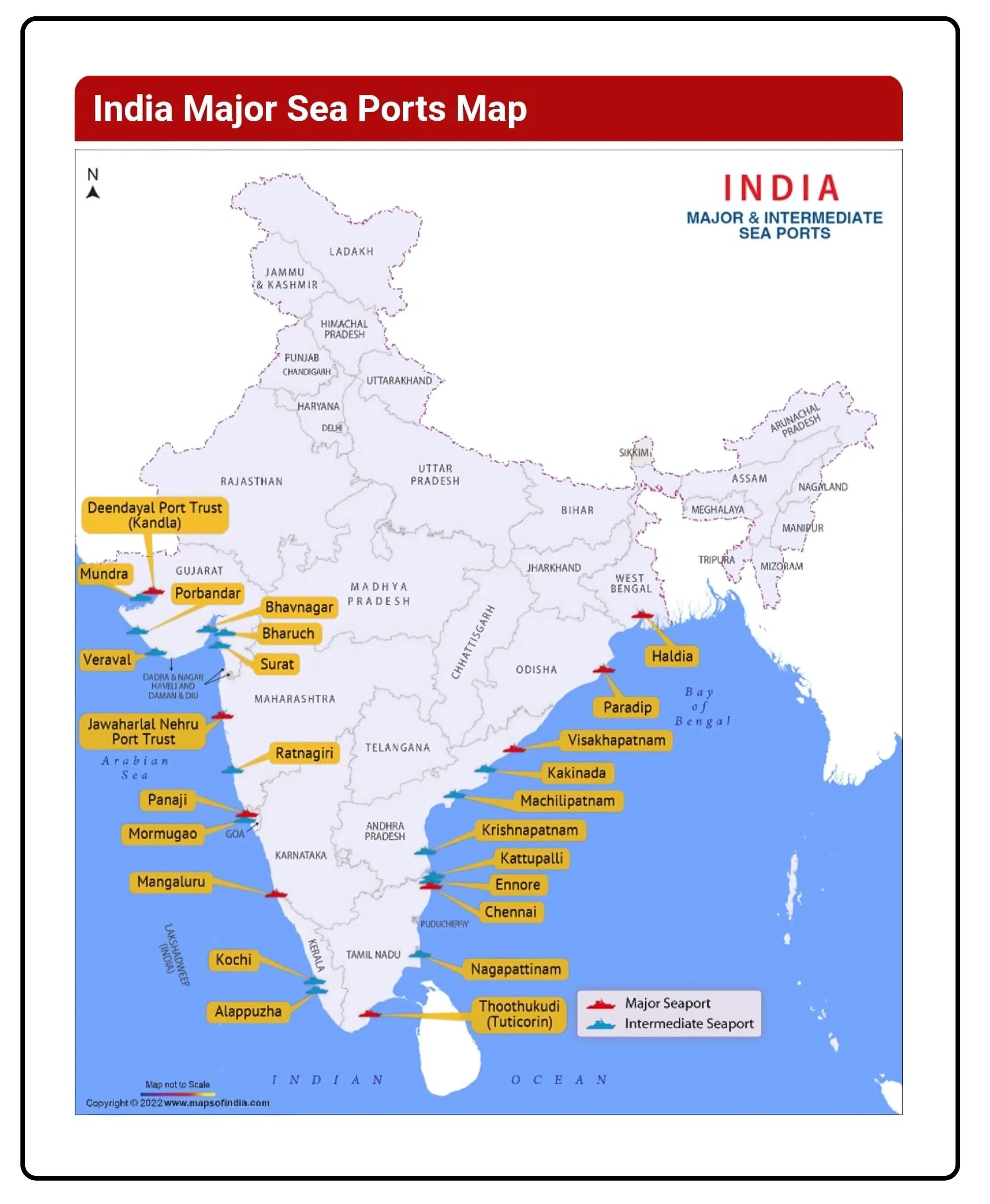
The sector is characterized by capital intensity, high entry barriers, and long gestation periods. These traits result in strong operating margins, particularly in large-scale, integrated operations. Port development in India is governed by a dual operational structure comprising major ports managed centrally and non-major ports governed by state-level authorities or private players. Key operational models include the landlord, service, tool, and hybrid models, depending on regulatory and geographic contexts.
Landlord model: The port authority owns the land and infrastructure but leases terminals to private operators who handle cargo operations. Common in India and Europe.
Service model: The port authority owns and operates all services, from infrastructure to cargo handling. Seen in countries where the government wants full control.
Tool model: The port provides basic infrastructure and equipment (like cranes), but cargo handling is done by private companies.
Hybrid model: A mix of the above, adapted to local needs; for example, government-operated container terminals alongside private bulk cargo terminals.
Market size and growth potential
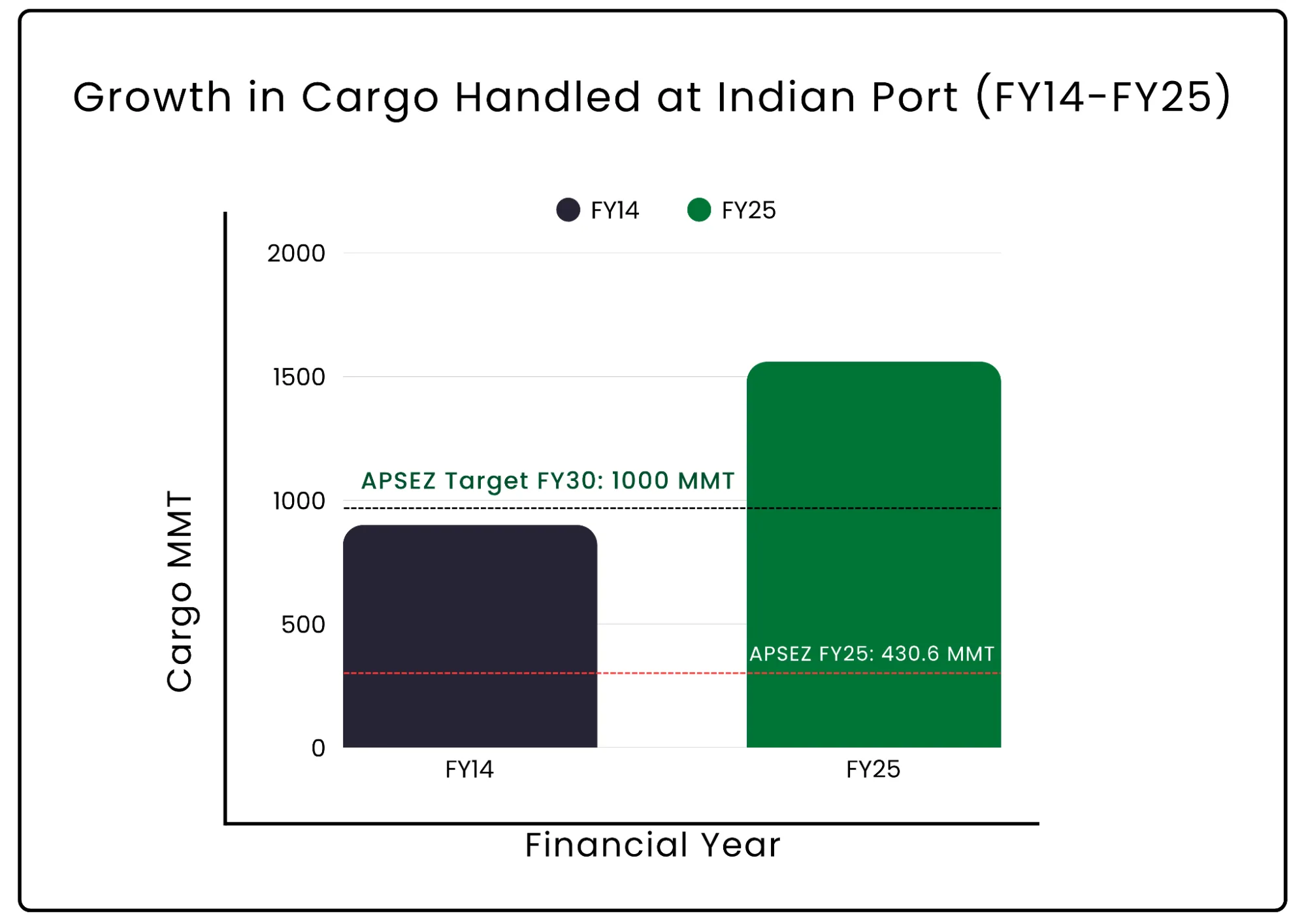
As of FY25, Indian ports handled approximately 1,593 million metric tonnes (MMT) of cargo, up from 972 MMT in FY14, reflecting a 5% compound annual growth rate. Among private operators, Adani Ports and Special Economic Zone (APSEZ) accounted for a significant share, managing 430.6 MMT of cargo. APSEZ aims to scale its capacity to 1 billion metric tonnes by FY30, inclusive of both domestic and international operations.
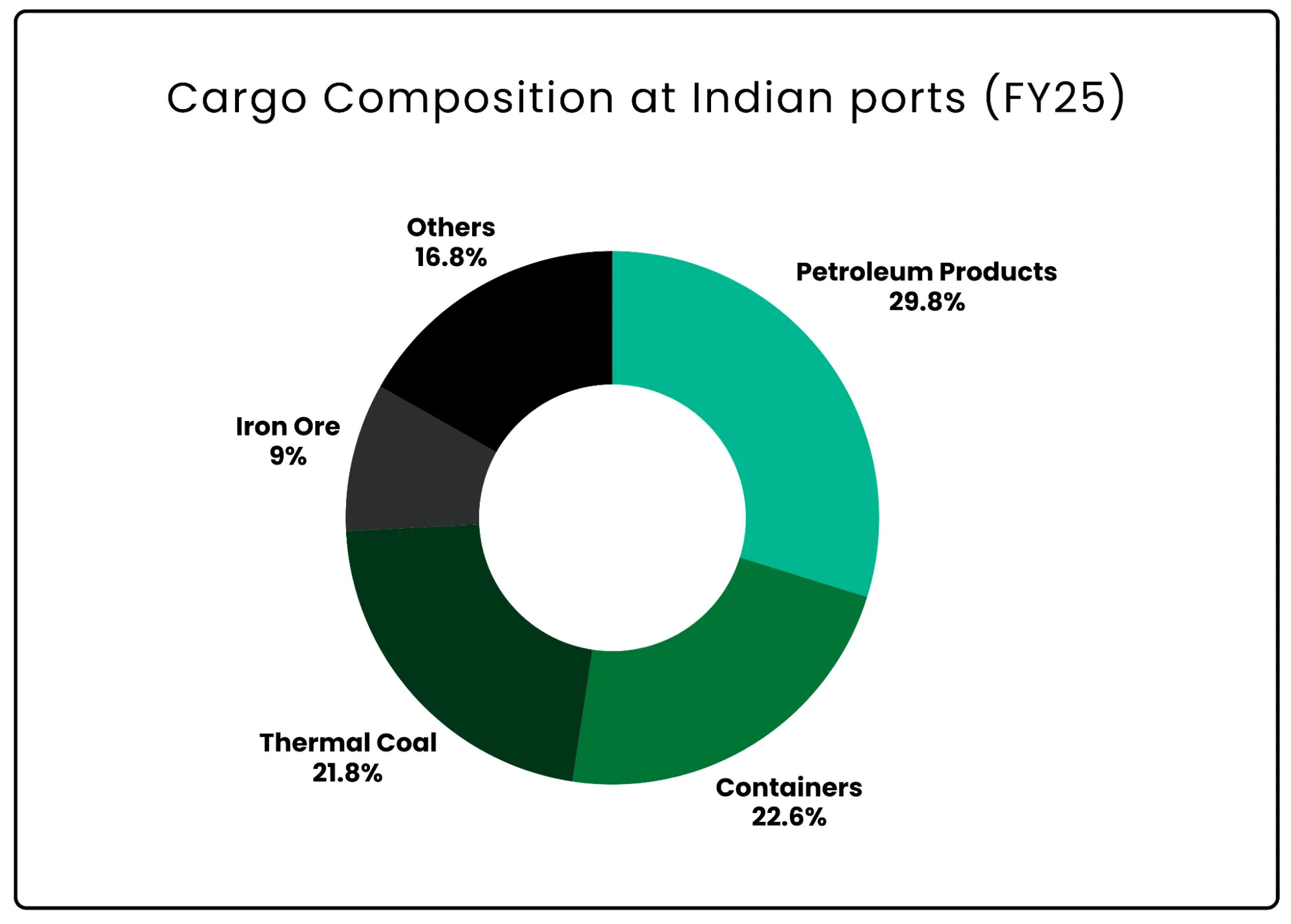
The cargo composition remains diversified across petroleum products (29.8%), containers (22.6%), thermal coal (21.8%), and iron ore (9%). This variety supports trade resilience and ensures that ports cater to both energy security and industrial supply chains. Container cargo, being margin-accretive, is witnessing rapid growth, particularly on the western coastline.
Major players and competitive dynamics
Adani Ports and SEZ stands as India’s largest integrated port logistics operator with a diversified asset base and multimodal capabilities. It operates 17 ports across India and 3 overseas, including strategic locations such as Mundra, Hazira, Gangavaram, Haifa (Israel), and Dar es Salaam (Tanzania). The company’s business model extends from ocean freight services to warehousing, rail, and road logistics, enabling end-to-end solutions.
Other major players include:
JSW Infrastructure, with strong backwards linkages to JSW Steel, is rapidly scaling its port operations and inland logistics.
Essar Ports, focused on captive cargo generation.
DP World India with a global pedigree in container handling.
Public sector ports such as JNPT, Chennai, and Visakhapatnam continue to play vital roles in bulk and container trade.
Also read:Mahindra Logistics Positioned for Transformational Revenue Growth
Government initiatives and policy support
The Indian government has introduced several strategic initiatives to enhance port-led development:
Sagarmala Programme emphasizes capacity augmentation, port modernization, and multimodal connectivity.
PM Gati Shakti promotes integrated infrastructure planning across transportation, logistics, and energy corridors.
National Logistics Policy (2022) aims to reduce logistics costs to 8–10% of GDP, improving trade competitiveness.
Maritime India Vision 2030 targets the development of smart ports, industrial clusters, and logistics hubs through technology and private participation.
These policies align with India’s ambition to become a global maritime and logistics hub, leveraging both geographic advantages and institutional reforms.
Infrastructure and operational integration
The sector is increasingly focused on integrated logistics, combining marine, rail, road, and warehousing infrastructure. The development of land banks, multimodal logistics parks (MMLPs), and industrial clusters contributes to captive cargo generation. Digitization efforts, including AI-powered terminals and real-time cargo tracking, are reshaping port efficiency and transparency.
APSEZ alone owns over 936 trucks, 12 MMLPs, and 3.1 million sq. ft. of warehousing space. It is also India’s largest private marine fleet operator with over 115 vessels.
Financial performance and investment outlook
The port sector’s financial profile is marked by strong margins and efficient capital utilization. Adani ports operate with EBITDA margins exceeding 60%, while logistics sub-segments deliver margins between 50% and 70%.
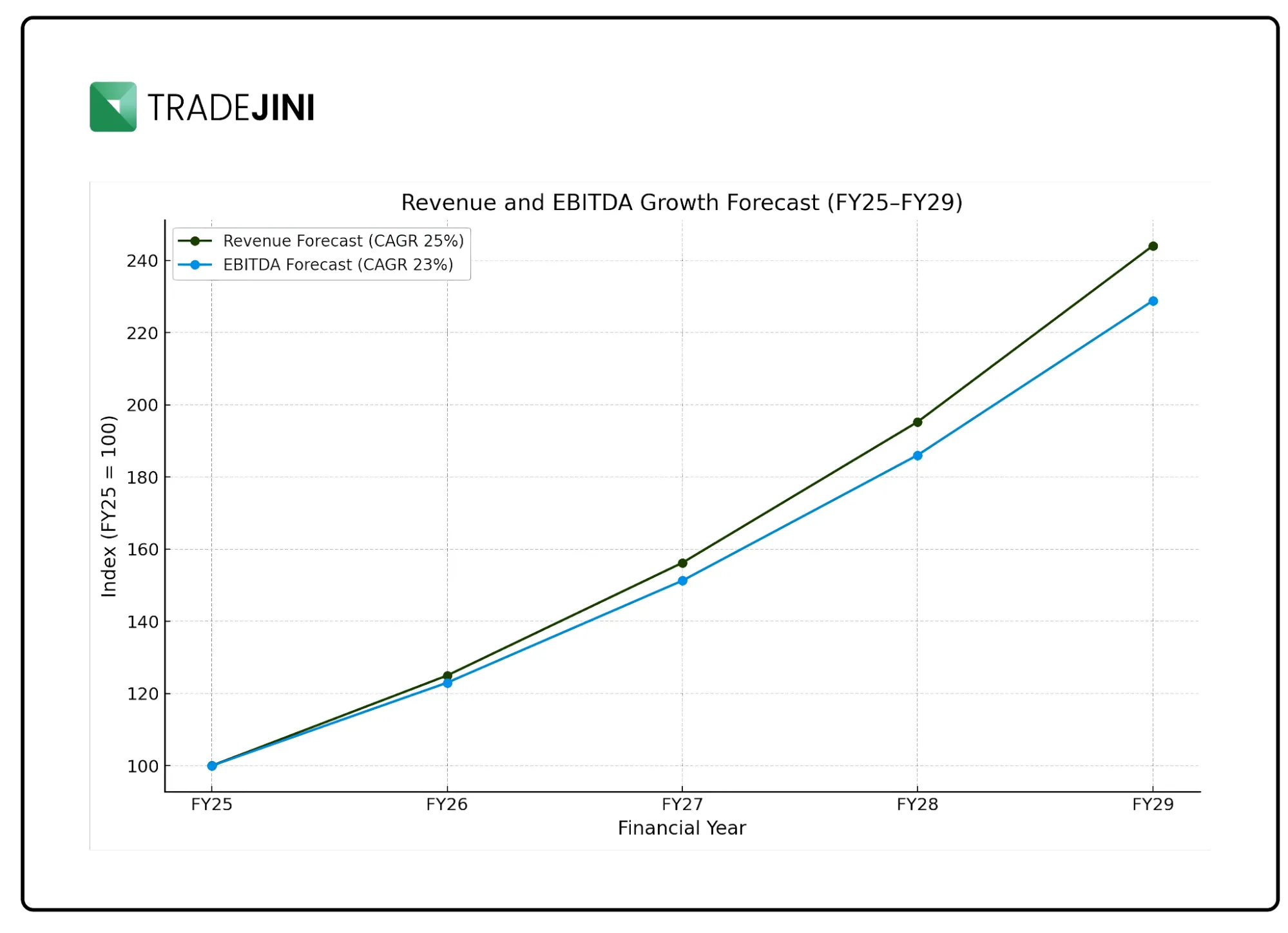
Revenue and EBITDA are forecasted to grow at a CAGR of 25% and 23%, respectively, from FY25 to FY29. APSEZ alone anticipates ₹450–500 billion in capex over the same period. With a falling Net Debt to EBITDA ratio (from 2.3x in FY24 to 1.9x in FY25), the sector remains financially robust and well-positioned for expansion.
Risks and challenges
Despite its potential, the sector faces several headwinds:
Regulatory and environmental approvals often delay projects.
Geopolitical risks can affect international port assets, especially in volatile regions.
Trade and currency fluctuations impact import-export dynamics.
The capital-intensive nature of port infrastructure demands long-term financing and operational resilience.
Specific corporate risks include cargo concentration (as seen with JSW Infrastructure’s reliance on JSW Steel) and lease uncertainties (as seen with Gujarat Pipavav Port’s expiring concession).
Future expansion and internationalization
The Indian port sector is set for rapid expansion in both domestic and global arenas. By FY29, warehousing capacity is expected to increase to 20 million sq. ft., alongside the development of 20 MMLPs and 10 MMT of agri-silo capacity. Internationally, Indian port operators are expanding through strategic acquisitions such as Haifa Port (Israel), NQXT Terminal (Australia), and Colombo Terminal (Sri Lanka). Logistics revenues are projected to grow fivefold by FY29, driven by integrated services and global trade flows.
Also read:India’s CDMO Boom: A Rising Global Powerhouse
Sustainability and ESG commitments
The sector is actively aligning with global sustainability mandates. APSEZ targets carbon neutrality by 2025 and net-zero emissions by 2040. It is investing in 1,000 MW of renewable energy, including 200 MW solar and 52 MW wind.
Recognised in the ‘Leadership’ band by CDP for climate and water risk management, the company maintains a low ESG Risk Rating of 13.7. These initiatives underline the sector’s commitment to sustainable and responsible growth.
Final thoughts
India’s port sector is strategically positioned to act as a catalyst for the country’s economic and industrial transformation. With supportive policy frameworks, high infrastructure potential, and dynamic private sector participation, the sector offers a compelling investment proposition.
Over the next decade, it is expected to grow at a 6–8% CAGR, with private players likely to outperform through operational integration and asset optimization. As India continues its march toward becoming a $5 trillion economy, the port sector will remain an indispensable enabler of trade, industry, and connectivity.
Also read:Watertech Leader Transforming Dirty Water into Liquid Gold
Disclaimer: The information provided in our blogs is for informational purposes only and should not be construed as financial, investment, or trading advice. Trading and investing in the securities market carries risk. Always conduct your own research and consult with a qualified financial advisor before making any investment decisions. Past performance is not indicative of future results. Copyrighted and original content for your trading and investing needs.
©️ 2025 — Tradejini. All Rights Reserved.