

 Concalls
 Annual reports
Tata Communications is executing a comprehensive transformation strategy, repositioning this innovative company from a conventional telecom provider to a comprehensive telco cloud enterprise focused on multi domain solutions. This analysis examines the company's strategic evolution, financial performance trajectory, and its positioning within the expanding digital infrastructure market.
Tata Communications – Digital Fabric of Solutions
Tata Communications uses the term "fabric" to describe the core layers of digital technology and services it provides to businesses worldwide. Each “fabric” is like a foundation block, and together, they form a seamless digital ecosystem for enterprises, governments, and service providers. Here’s what each fabric means for Tata Communications:
Network Fabric: Tata Communications operates one of the world’s largest submarine cable networks and a global Tier-1 IP backbone. This fabric provides secure, high-speed connectivity across countries and regions. It is the backbone for enterprises to connect offices, data centres, cloud platforms, and customers worldwide.
Interaction Fabric: Tata Communication focuses on enabling collaboration and communication. It includes services like global voice solutions, conferencing, unified communications, and digital collaboration platforms. Helps businesses ensure employees, partners, and customers can interact seamlessly, irrespective of their location.
Cloud Fabric: Tata Communications provides multi-cloud connectivity, hybrid cloud solutions, edge computing, and managed cloud services. This enables businesses to scale applications, store data securely, and process workloads efficiently across global markets. Example: Enterprises can run applications on AWS, Azure, or Google Cloud with Tata’s secure interconnections.
IoT Fabric: Tata Communications offers IoT (Internet of Things) solutions for smart cities, logistics, manufacturing, automotive, and utilities. Tata Communications offers platforms to connect, monitor, and analyze data from millions of IoT devices. Example: Smart fleet tracking, connected cars, and industrial IoT networks.
Media and Entertainment Services: Tata Communication provides end-to-end services for media distribution, broadcasting, live streaming, and digital content delivery. Its Media Cloud and Video Connect services are widely used by broadcasters, OTT platforms, and sports leagues to deliver content globally in real time. Example: Delivering global live sports feeds to broadcasters.
Also Read: Honeywell Automation India Positioned for Long-Term Value Creation
Sector Backdrop
The telecommunications industry confronts a structural transformation characterized by declining revenues from traditional voice and connectivity services alongside robust growth in enterprise digital solutions. Legacy telecom services are experiencing persistent price erosion due to commoditization and competitive pressures, while enterprises increasingly demand sophisticated digital infrastructure capabilities.
This market evolution has created substantial opportunities in specialized, high-growth segments. The Secure Access Service Edge (SASE) market, which converges networking and security functions, is projected to exceed $200 billion by 2027. The enterprise communication infrastructure market demonstrates compound annual growth rates exceeding 15%, driven by digital transformation initiatives and advanced collaboration requirements.
These dynamics favor telecommunications providers capable of transitioning from contemporary connectivity services to integrated platform-based solutions that address complex enterprise digital infrastructure needs. Companies successfully executing this transition can capture higher-margin revenue streams while establishing more strategic customer relationships.
Business Snapshot & Evolution
Tata Communications' business operates through two primary segments. Data Services represents the core growth engine, contributing 84% of total revenues. Voice Solutions encompasses the declining legacy international calling business.

The Digital Portfolio within Data Services has emerged as the primary value creation driver, representing 47% of data segment revenues and demonstrating 29.5% year-over-year growth in FY25. Strategic acquisitions, including Kaleyra (Communications Platform as a Service provider) and The Switch (live media production specialist), have expanded capabilities and accelerated market penetration in high-growth segments.
Financial Performance Overview
The company’s financial performance in Fiscal Year 2025 (FY25) clearly reflects its strategic pivot, showcasing strong top-line growth driven by digital services, alongside the margin pressures associated with an intensive investment phase. Tata Communications reported a consolidated revenue of ₹23,109 crore, marking a solid 11.2% year-over-year (YoY) growth. This expansion was overwhelmingly fueled by the Data Services segment, where revenue climbed 13.7% YoY to ₹19,513 crore.
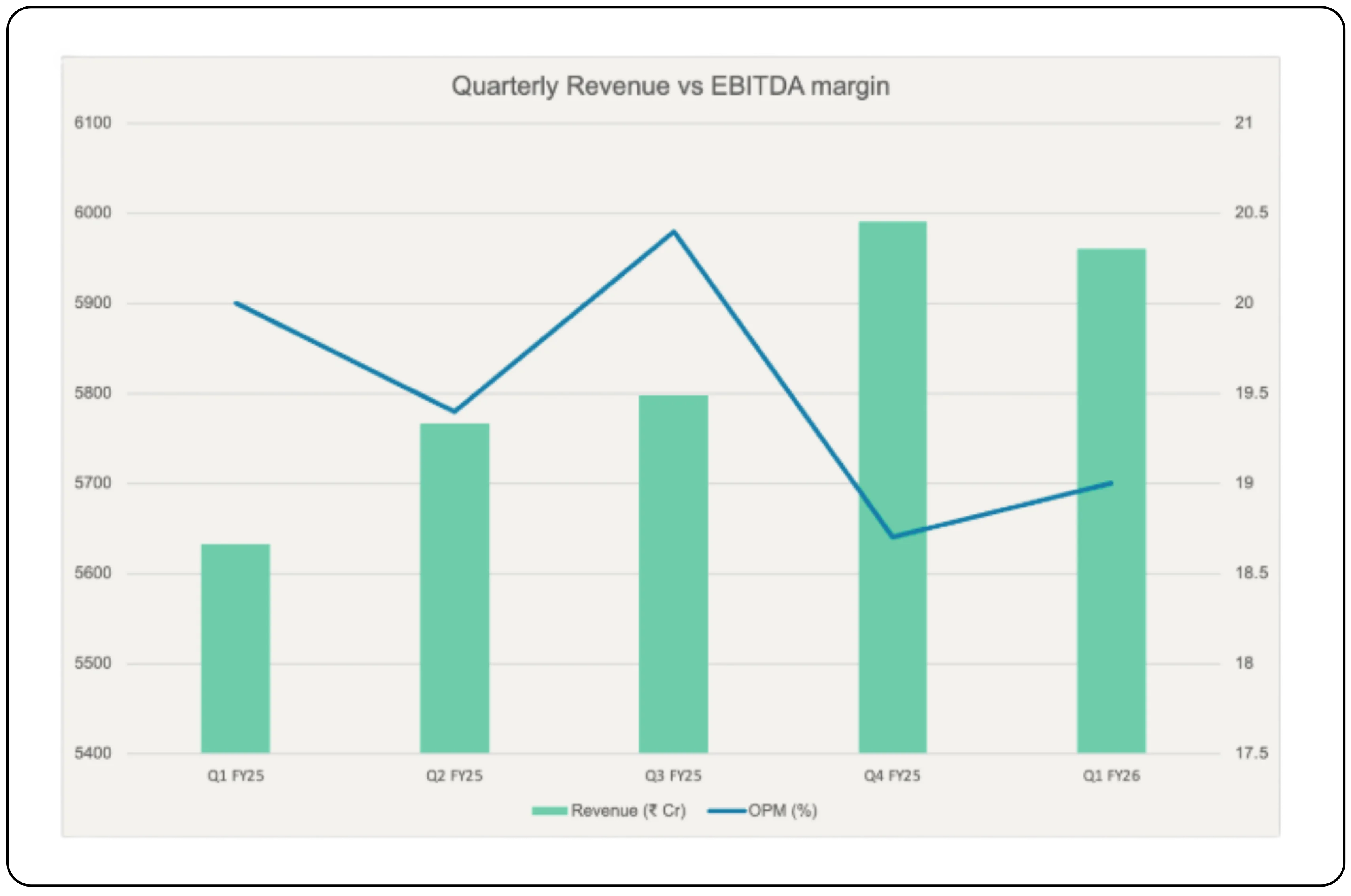
The standout performer was the high-growth Digital Portfolio, where revenues surged by an impressive 29.5% YoY, validating the company’s investment thesis. However, this growth came at a cost of near-term profitability. Consolidated EBITDA margins for the full year dropped to 18.8%, a noticeable decline from the 23-25% range targeted in the medium term. This was mainly due to the addition of the lower-margin Kaleyra business and higher spending on marketing, especially for new products like the Vayu AI Cloud. Full-year Profit After Tax (PAT) was ₹1,836 crore, a significant increase. However, it's important to note that the final quarter's profit was heavily boosted by a one-time exceptional gain of ₹578 crore from a strategic land sale, which masks the underlying pressure on operational profitability.
Business Segments Breakdown
| Fabric/Segment | Flagship Products/Offerings | Core Capabilities |
|---|---|---|
| Cloud & Security Fabric | Vayu Cloud, IZO Multi Cloud, SASE, Managed Security | Hybrid & multi-cloud, secure edge, managed security |
| Next-Gen Connectivity | IZO Hybrid WAN, Global SD-WAN, TGN-IA2 cables, Ethernet/MPLS/IP Transit | Resilient, programmable, global networks, rapid provisioning |
| IoT Fabric | MOVE IoT platform, device orchestration, AI analytics | Mass IoT deployments, smart analytics, edge data management |
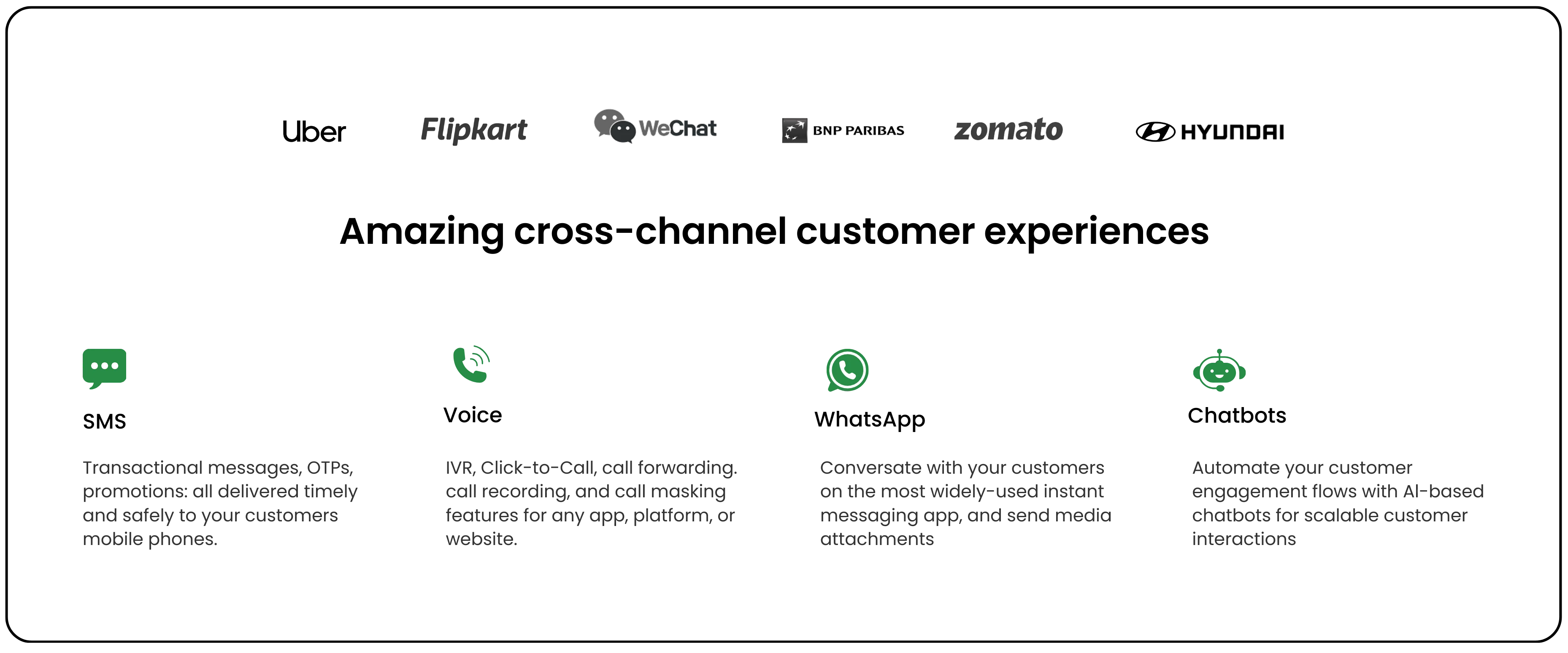
| Interaction Fabric (CPaaS) | Kaleyra.io Platform: programmable SMS/voice/chat, chatbots, API orchestration, omnichannel flows | Customer engagement, automation, omnichannel communications |
| Core Connectivity | MPLS, IP Transit, Ethernet, International Voice, Subsea Cables | Global backbone, legacy telco (declining), fuels expansion |
1. Digital Portfolio – Future Growth Driver
- Focus area for investment and innovation.
- Cloud & Security Fabric → +28.8% YoY growth, driven by large deals and strong pipeline.
- Next-gen Connectivity (IZO Hybrid WAN) → +23.6% YoY growth, strong enterprise demand.
- IoT Fabric (MOVE platform) → +57.4% YoY, higher data use, and new vehicles.
- Interaction Fabric (CPaaS, Kaleyra) → Temporary dip in Q4, but positioned for growth with AI-powered tools.
2. Core Connectivity – Stable Cash Cow
- Still 54% of data revenue.
- The market faces price pressure, but Tata achieved 3.2% YoY growth.
- Stability maintained via market share gains and efficiency improvements.
- Generates steady cash flows to fund Digital Portfolio expansion.
Strategic Moats or Differentiators
In a competitive landscape, Tata Communications is building its long-term advantage on several integrated and hard-to-replicate pillars. Its primary moat is the “Digital Fabric” strategy itself. By offering a holistic, unified platform that combines connectivity, cloud, security, and interaction capabilities, the company provides a solution that standalone service providers struggle to match. This integrated approach simplifies complexity for enterprises and creates stickier, more embedded customer relationships.
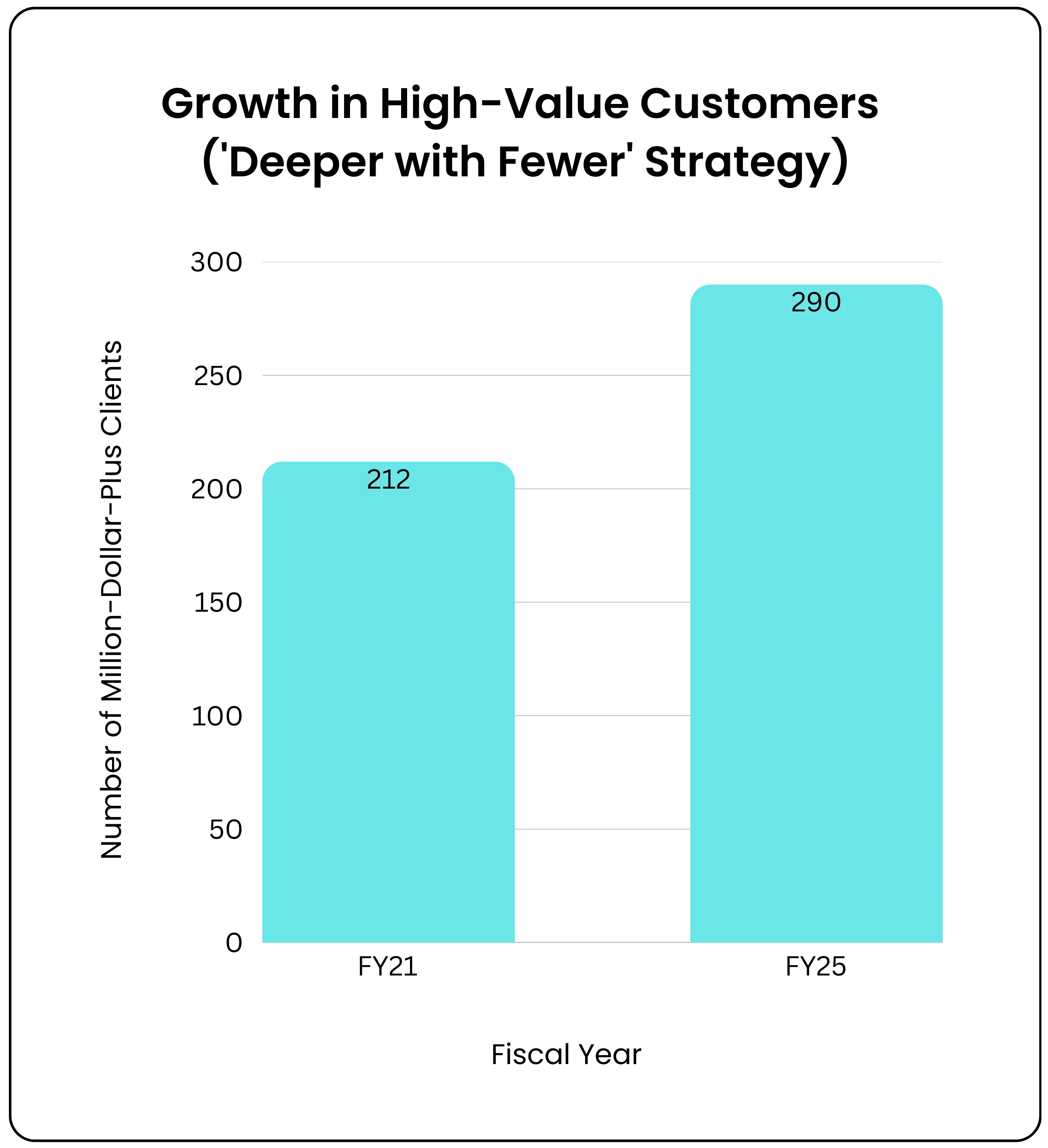
This is reinforced by a go-to-market strategy termed “Deeper with Fewer.” Instead of a broad-brush approach, the company focuses on deepening its engagement with a select group of large enterprise clients. This strategy has yielded tangible results, successfully increasing the number of million-dollar clients as seen in the following figure and driving the adoption of multiple “fabrics” within this customer base.
Furthermore, Tata Communications is embedding relentless innovation and AI at its core. Recent launches like the Vayu AI Cloud, a GPU-as-a-service platform, and Kaleyra.AI, an intelligent customer interaction tool, are not just new products but clear signals of the company’s intent to lead with technology and differentiate its portfolio in a rapidly evolving market.
This is all supported by its extensive global network infrastructure and a disciplined financial strategy of monetizing non-core assets to sharpen focus and fund growth.
Growth Drivers & Expansion Plans
Management has set a clear and ambitious goal: to double its data revenues to ₹28,000 crore by FY27. This target is predicated on the continued high-growth trajectory of its Digital Portfolio. To achieve this, the company is committed to strategic capital expenditure, which stood at ₹2,205 crore in FY25. These investments are sharply focused on future-proofing the business, including expanding its fiber network into Tier 2 and 3 towns in India to capture new enterprise demand and investing in the AI infrastructure required to power its new Vayu cloud platform.
Growth will also be fueled by new product innovation. The recent launches of Tata Communications Vayu and Kaleyra.AI are designed to capture emerging, high-growth market segments and provide higher-margin revenue streams. While the company’s primary focus remains on driving organic growth through these initiatives, management has indicated that it remains open to strategic tuck-in M&A to acquire new capabilities and accelerate its expansion into new markets or technologies.
Risks & Industry Headwinds
Despite its clear strategy, Tata Communications operates in a challenging environment and faces several material risks. The business is exposed to macroeconomic uncertainties that can slow enterprise IT spending and delay large-scale transformation projects.
Geopolitical conflicts pose a direct operational risk, as starkly demonstrated by the Red Sea cable cuts in FY25, which disrupted services for customers and incurred significant, unplanned repair costs. Closer to home, there’s also the persistent shadow of India’s telecom regulatory landscape, including legacy issues like the Adjusted Gross Revenue (AGR) dues. While Tata Communications’ situation is not as acute as some mobile peers, periodic headlines and regulatory reviews around historical AGR liabilities continue to be a distraction and a potential overhang for investor sentiment.
Structurally, the company’s legacy Core Connectivity business faces persistent price erosion of 10–15% annually, a powerful headwind that requires constant efforts to gain market share just to maintain a stable revenue base. Furthermore, the company faces intense and multifaceted competition. This comes not just from traditional telcos, but also from cloud hyperscalers, global system integrators, and nimble niche technology vendors, all of which put sustained pressure on pricing and margins across their portfolio.
Market View
As of August 2025, Tata Communications trades at a Price-to-Earnings (P/E) ratio of approximately 27x and an Enterprise Value-to-EBITDA (EV/EBITDA) multiple of around 12-14x. While its P/E appears reasonable for a company with its growth ambitions, the EV/EBITDA multiple is at a noticeable discount to pure-play telecom giants like Bharti Airtel, which trades at a multiple closer to 19.6x.

This valuation gap reflects the market's nuanced view of a company in the midst of a major transition. The market is attempting to balance the high-growth potential and future promise of its Digital Portfolio against the tangible margin dilution from recent acquisitions, as seen in the latest quarterly results, and the structural headwinds facing its legacy Core Connectivity business. The current valuation suggests that while the market acknowledges and supports the strategic pivot, it is adopting a "wait-and-see" approach, awaiting consistent, profitable growth from the new digital ventures before it is willing to assign a higher, growth-oriented multiple to the entire enterprise.
Bottom Line
Tata Communications is a compelling and well-defined transformation story. It is shedding its skin as a traditional utility telco and emerging as a re-rating candidate, actively and successfully shifting its revenue mix towards high-growth, higher-margin digital services. The company is in a deliberate and strategic investment phase, where current profitability, as evidenced by the latest Q1 FY26 results, is being sacrificed for future scale and market leadership. Its success now hinges on flawlessly executing this digital pivot and achieving the promised revenue and cost synergies from its recent acquisitions. For investors with a long-term horizon, it represents a robust play on the irreversible trend of global enterprise digitalization and the growing demand for transformation of communications services.
Disclaimer: The information provided in our blogs is for informational purposes only and should not be construed as financial, investment, or trading advice. Trading and investing in the securities market carries risk. Always conduct your own research and consult with a qualified financial advisor before making any investment decisions. Past performance is not indicative of future results. Copyrighted and original content for your trading and investing needs.
© 2025 — Tradejini. All Rights Reserved.


