Every Google search, Netflix stream, and ChatGPT exchange is powered by a vast network of data centers, the digital infrastructure backbone enabling artificial intelligence and cloud computing – warehouse-sized complexes housing thousands of servers that use more electricity than whole cities. What started as simple server rooms has now evolved into a $347.6 billion data center market demonstrating rapid growth projected to reach $652 billion by 2030, with a compound annual growth rate of 11.2%, driven by the AI data center boom and growing demand for compute power.
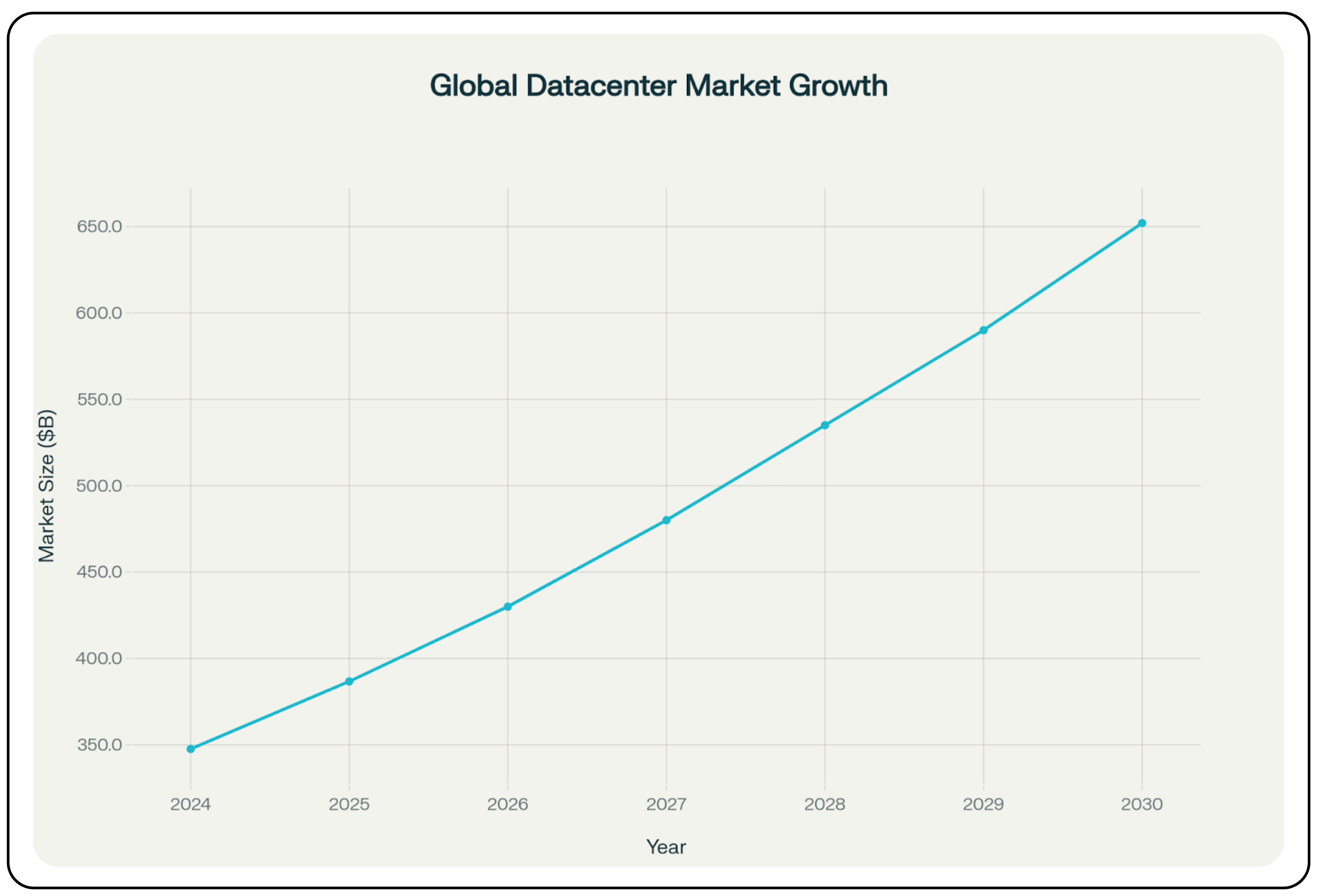
Global Datacenter Market Growth and AI Power Demand 2024-2030
The infrastructure growth is being turbocharged by the datacenter boom fueling AI revolution, with AI technologies and AI workloads transforming compute power demand. Training large language models like GPT-3 consumed 1.29 gigawatt-hours of electricity for large scale data processing, while GPT-4 required over 50 gigawatt-hours, highlighting the compute power growth driven by AI usage and high performance computing requirements, which is roughly equivalent to nearly 0.1% of New York City’s annual electricity consumption.
Two business models driving growth
Hyperscale Datacenters:
Large scale data centers owned by tech giants like Amazon Web Services, Microsoft Azure, and Google Cloud, representing key components of modern AI infrastructure. These facilities exceed 100 megawatts of power capacity; some planned facilities will consume over 1,000 megawatts of processing power, equivalent to nuclear capacity from a nuclear power plant, highlighting energy demand challenges.
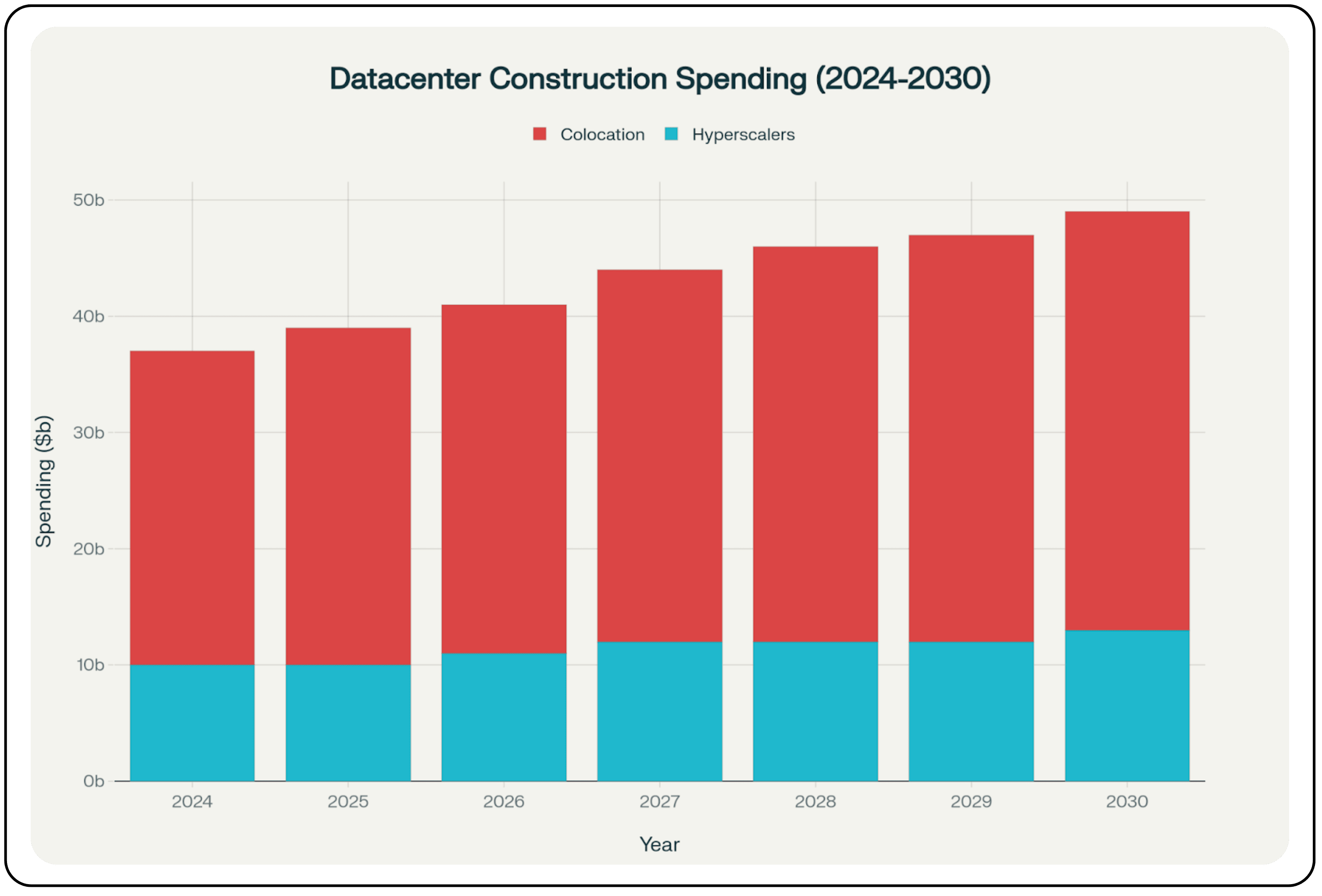
Colocation providers consistently outspend hyperscalers on datacenter construction, representing the majority of industry capex.
Colocation Datacenters:
Third-party data center operators like Digital Realty and Equinix rent space, power, and cooling to multiple tenants. In 2024, colocation companies made substantial investments of $27 billion in data center construction versus $10 billion capital expenditures by hyperscalers to build data centers, representing the majority of data center industry capital investment for development.
The power crisis
Data centers consumed 415 terawatt-hours driving electricity demand globally in 2024, reflecting the energy consumption of the data center boom (1.5% of total global demand), projected to more than double to 945 terawatt-hours by 2030, creating unprecedented power consumption challenges for power infrastructure and grid reliability. IT equipment for AI workloads consumes 45% of total power, while cooling systems account for 35%, representing key factors in data center operations and energy efficiency, which means 80% goes toward computing and preventing overheating.
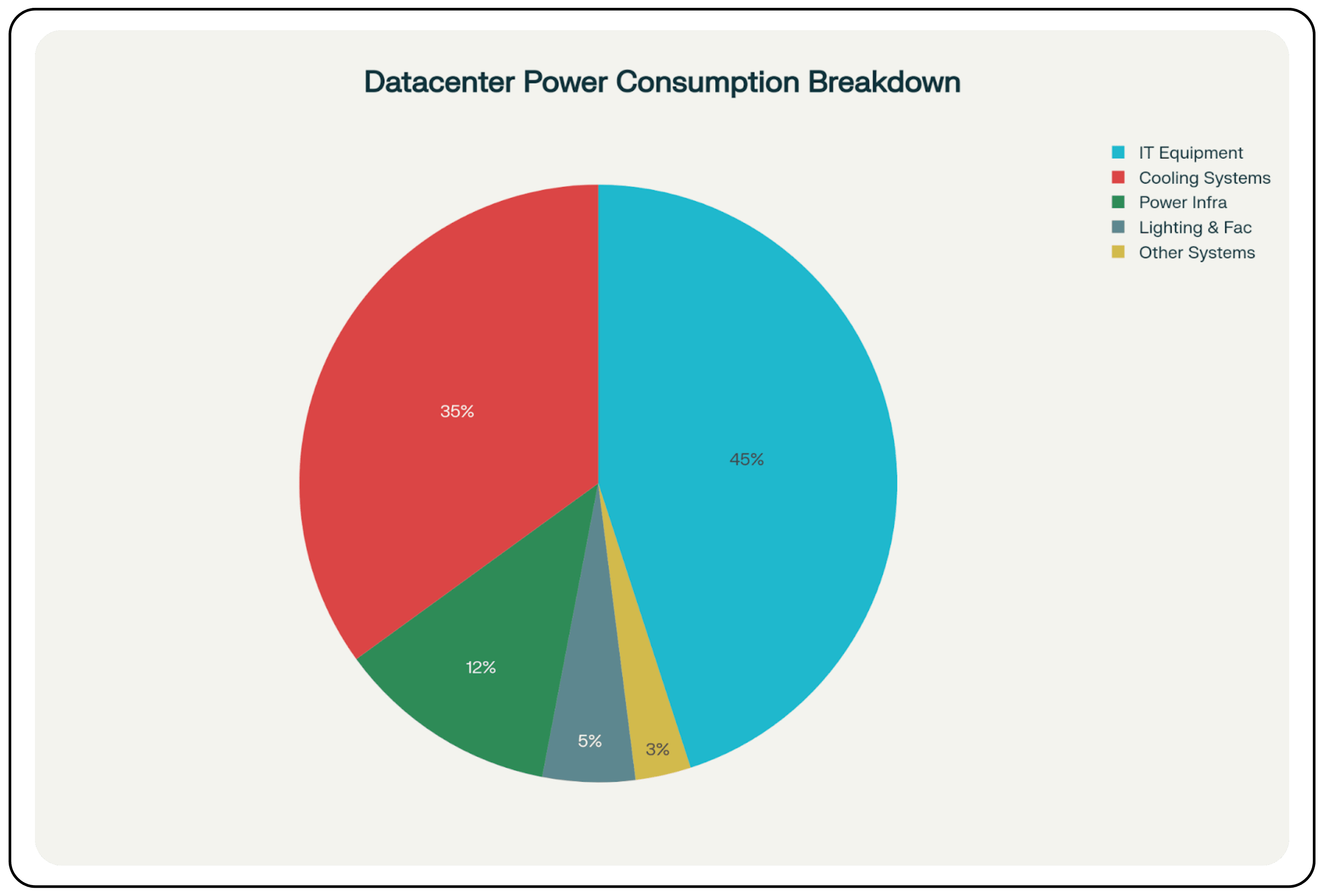
IT equipment and cooling systems account for 80% of total datacenter power consumption
Traditional air cooling is reaching its limits. Modern AI servers for AI infrastructure consume 40-100 kilowatts per rack with higher power densities compared to 10-30 kilowatts for traditional servers. This has sparked massive capital investment in advanced cooling technologies including liquid cooling and immersion cooling solutions, with the market exploding from $2.8 billion in 2024 to a projected $13.1 billion by 2032, driven by energy efficiency requirements and the AI boom. Microsoft is achieving 15% efficiency improvements and efficiency gains with two-phase immersion cooling, demonstrating compute efficiency advances in data center design.
India: the emerging powerhouse
India’s data centre capacity has tripled from 350 megawatts in 2019 to over 1,100 megawatts in 2024. Mumbai’s construction cost of $6.60 per watt compares favorably to Tokyo and Sydney, while the country’s 1.4 billion people and second-largest mobile user base create enormous data processing needs.
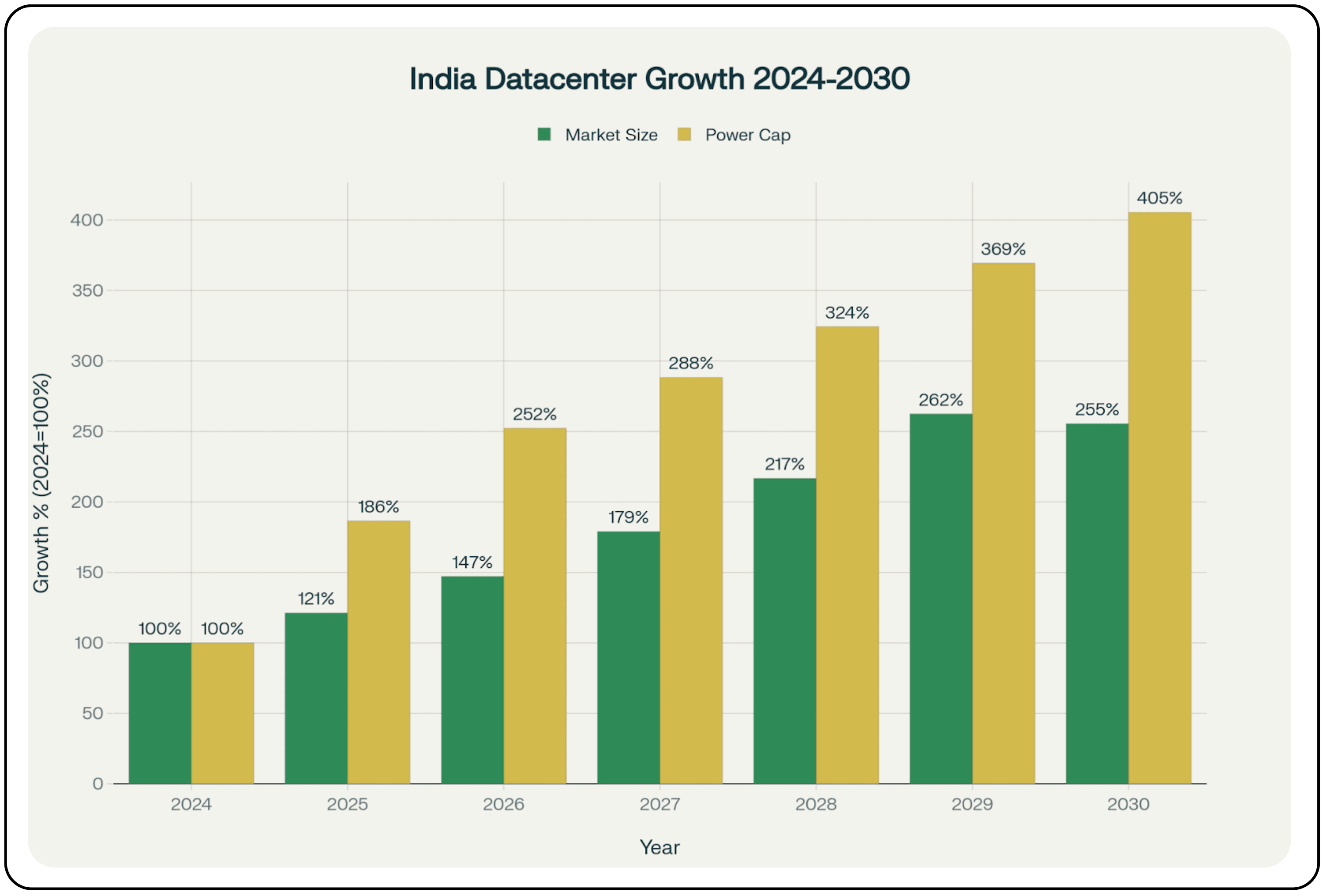
India’s datacenter market is set for explosive growth, with power capacity quadrupling and market size more than doubling by 2030.
Amazon, Microsoft, and Google are collectively investing over $2 billion in Indian datacenter expansion. Local players like AdaniConneX and Yotta Infrastructure are developing massive campuses with investments exceeding $25 billion projected by 2030.
To understand how other Indian companies are capitalizing on sector-specific growth opportunities and commodity trends, read: The Muthoot Model and the Earnings Impact of the Gold Rally
The edge computing revolution
Edge computing, where smaller data centers are located closer to local communities and end users, solves a fundamental physics problem, which is the speed of light. Data travelling from Mumbai to Virginia experiences latency that’s problematic for real-time applications like autonomous vehicles and augmented reality. Edge facilities reduce latency from hundreds of milliseconds to single digits.
The edge datacenter market is projected to grow from $10.4 billion in 2023 to $51 billion by 2033 (19.9% CAGR), driven by IoT, 5G networks, and real-time applications requiring digital transformation and high performance computing capabilities. These facilities must operate with minimal staff in diverse conditions, sparking innovation in modular, prefabricated designs.
Sustainability and investment
Major hyperscale data centers have made ambitious environmental sustainability commitments to reduce carbon emissions: Amazon pledges net-zero carbon emissions by 2040 through renewable energy and sustainable energy solutions, and Google targets 24/7 carbon-free energy by 2030, integrating renewable energy into their energy mix and power infrastructure. Hyperscale data centers are now among the world's largest corporate purchasers of renewable energy, driving sustainable energy solutions and reducing reliance on natural gas and nuclear plants.
In 2024, global data center capital expenditures reached $430 billion for data center construction and infrastructure development. The industry has attracted massive institutional investment, with pension funds and sovereign wealth funds treating datacenters as essential infrastructure assets similar to utilities.
Future outlook
The datacenter sector presents compelling investment characteristics:
- Essential Infrastructure: Data center infrastructure is as critical as electricity networks to modern economic activity, providing digital infrastructure and competitive advantage, along with defensive characteristics and pricing power.
- Secular Growth Drivers: Digital transformation, AI growth, and edge computing represent multi-decade trends sustaining AI infrastructure and compute power demand regardless of economic cycles.
- Geographic Expansion: Emerging markets like India, Southeast Asia, and Latin America offer significant data center market growth and job creation opportunities as digital adoption accelerates.
Challenges include power grid constraints requiring grid connections, regulatory uncertainty, and data center infrastructure risks, and the technical complexity of supporting rapidly evolving workloads. However, data localization laws and geopolitical factors are creating opportunities for domestic providers while fragmenting the global market.
Interested in how Indian startups are scaling in competitive markets through strategic innovation? Learn more: Decoding Rapido's Entry into Food Delivery with 'OWNLY'
The bottom line
The datacenter industry has evolved from niche technology into critical infrastructure underpinning the global economy. As AI reshapes computing requirements and edge computing brings processing closer to users, datacenters will continue growing in scale, sophistication, and importance.
The companies and countries building the most efficient, sustainable, and strategically located datacenter infrastructure will capture disproportionate value in an increasingly digital world. With market size doubling by 2030 and power consumption following suit, the transformation is just beginning.
Turn research into action and explore smarter investing opportunities with CubePlus.
Disclaimer: The information provided in our blogs is for informational purposes only and should not be construed as financial, investment, or trading advice. Trading and investing in the securities market carries risk. Always conduct your own research and consult with a qualified financial advisor before making any investment decisions. Past performance is not indicative of future results. Copyrighted and original content for your trading and investing needs.
© 2025 — Tradejini. All Rights Reserved.