An investment in a mutual fund scheme is a commitment, and just like any contract, there are terms for exiting. The exit load in mutual fund schemes is a strategically implemented charge, or exit fee, imposed by mutual fund houses or asset management companies (AMCs) when an investor redeems their mutual fund units before a specified holding period has been completed. This fee charged is meticulously detailed in the Scheme Information Document (SID) and is vital for understanding the true financial interest of the investment. The core exit load implications are clear: to discourage short term trading and curb frequent trading, thereby ensuring stability within the mutual fund scheme and safeguarding the interests of committed investors.
Exit Load
The exit load is fundamentally a protective tool. Exit loads serve to protect long term investors from the impact of disruptive investor exits which might force fund managers to prematurely liquidate securities. This forced liquidation can increase transaction costs and negatively affect the net asset value (NAV) for those who remain invested. For debt funds, particularly those employing an accrual based investment strategy, the load is critical to reduce interest rate risk by promoting adherence to the holding period of the underlying bonds. Not all funds have this charge, but where it exists, it's a critical factor.
Incase you want to learn how to Invest in Mutual Funds, Index Funds & Exchange Traded Fund, click here
Exit Load in Mutual Funds
The concept of a load in mutual funds, specifically the exit load, is crucial because mutual funds refers to diversified investment pools subject to market risks. By imposing the exit load, mutual fund companies effectively penalize early withdrawals, which is particularly relevant in volatile sectors like equity funds. The exit load levied is often viewed as compensation for the administrative costs associated with processing early withdrawals and maintaining portfolio integrity for the specified period.
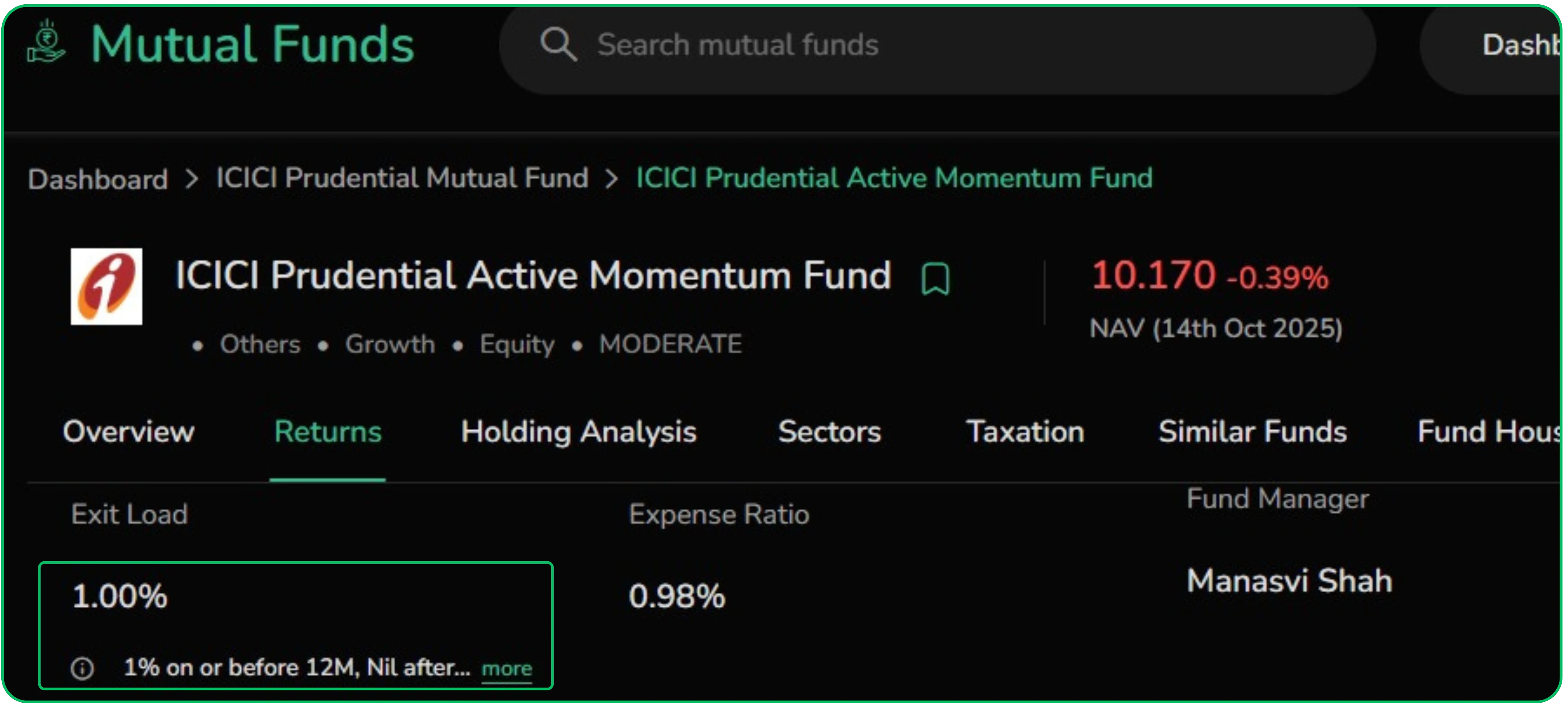
Exit Load Structure
The exit load structure defines the exit load provisions and the manner in which the exit load percentage is applied. The structure generally falls into three main types:
- Fixed Exit Load: A simple fixed exit load percentage (e.g., 1%) is applied if the investor sells mutual fund units within the full exit load period.
- Graded Exit Load: This is often considered a good exit load system. The exit load percentage decreases as the time period of the mutual fund investments increases. This rewards investor patience and minimizes the cost the longer the investor holds the fund.
- Contingent Deferred Sales Charge (CDSC): The Contingent Deferred Sales Charge (CDSC) is a type of graded exit load, commonly used in mutual funds to incentivize investors to complete a predetermined holding period. This fee, calculated as a percentage of the redemption amount, declines annually and eventually reaches zero, thereby creating a strong financial incentive to hold the investment for the entire intended duration.
Also if you want to read about , how to diversify a mutual fund portfolio , click here
Exit Load Levied
The decision regarding the exit load levied varies significantly across mutual fund categories. In equity funds, the fee is typically high for the first year. Conversely, liquid funds, which are designed for short-term cash management, often impose a minimal, graded exit load only for redemptions within the first few days (e.g., 7 days), becoming zero exit load quickly thereafter. Different mutual funds across the debt funds category will have their own rules, emphasizing the need to read scheme related documents carefully.
Exit Load Calculation
The exit load calculated is the exit load percentage applied to the monetary value of the mutual fund units being sold at the time of redemption. This determines the exit load amount that will be deducted from the redemption proceeds.
The mathematical exit load calculation is straightforward but requires precise application of the fund's exit load policy:
Exit Load Amount = Redemption Amount × Applicable Exit Load Percentage
Ex:
| Particulars | Details |
|---|---|
| Invested amount in Oct’19 (Rs) | 1,00,000 |
| NAV (Rs) | 100 |
| Units | 1,00,000 / 100 = 1000 |
| NAV at the time of redemption in Mar’20 (Rs) | 110 (assumed) |
| Value of your investment (Rs) | 110 × 1000 = 1,10,000 |
| Exit load (Rs) | 1% × 1,10,000 = 1,100 |
| Redeemed Value (Rs) | 1,10,000 − 1,100 = 1,08,900 |
Note: The exit load is not the same for all the Mutual funds as different mutual funds have different values to find the exit loads
Crucially, for a Systematic Investment Plan (SIP), the calculation treats every instalment as a separate initial investment with its own exit load period. The oldest cumulative units investment tenure are redeemed first (FIFO - First-In, First-Out). This means only the newest units that are still within the specified period will attract the charge, while older units are already zero exit load.
Fund Managers
The professional fund managers at the asset management companies rely on these exit load provisions to execute their mandate efficiently. By deterring frequent trading, the exit load shields the portfolio from volatility and preserves the stability necessary for a consistent net asset value growth. This stability is essential for the long-term benefit of all mutual fund investors.
Different Mutual Funds and Different Mutual Fund Schemes
The diversity across different mutual fund schemes means the investor must verify the exit load structure for each product. The fixed exit load is common in equity funds (often 1% for 1 year), while the graded exit load is prevalent in debt funds. Mutual fund companies use these varying charges to align the product's function with the ideal investor time period. Understanding the exit load terms is a prerequisite for making informed investment decisions.
Avoid Exit Load
The most effective way to avoid exit load is to commit to the investment's objective. Informed investment decisions are those where the investor fully understands the lock in period and plans their investor redeems action only after the exit load period ends. By selling mutual fund units after the specified holding period has passed, the investor exits without having to pay exit load, thereby maximizing their redemption proceeds. Always choose schemes with zero exit load if your investment horizon is genuinely short, but always confirm the exit load terms in the scheme related documents carefully.
Conclusion
The exit load in a mutual fund scheme is a protective fee applied to early redemptions, strategically designed to discourage short-term trading, stabilize the portfolio, and safeguard the interests of committed, long-term investors by mitigating the adverse effects of forced asset liquidation on the Net Asset Value (NAV). Detailed in the Scheme Information Document (SID), this charge varies in structure, including Fixed, Graded, and Contingent Deferred Sales Charge (CDSC), with the applicable percentage dependent on the fund category and holding tenure. The exit load amount is calculated as a percentage of the redemption value, with SIP calculations following a First-In, First-Out (FIFO) method; therefore, the most effective way for an investor to avoid this fee and maximize returns is to plan their exit to occur after the specified lock-in period.
Disclaimer: The information provided in our blogs is for informational purposes only and should not be construed as financial, investment, or trading advice. Trading and investing in the securities market carries risk. Always conduct your own research and consult with a qualified financial advisor before making any investment decisions. Past performance is not indicative of future results. Copyrighted and original content for your trading and investing needs.
© 2025 — Tradejini. All Rights Reserved.