What is equilibrium price? Does it actually matter in the Indian stock market?
The Indian stock market is a vibrant and dynamic ecosystem, with prices fluctuating every second. These price changes result from the constant interaction of buyers and sellers—what economists call market forces. One term that traders often encounter in this context is the Pre-Market Equilibrium Price (PMEP). But what exactly does this mean? How does it relate to equilibrium price, equilibrium quantity, and other economic concepts like general equilibrium and intertemporal equilibrium? Most importantly, does it have any real impact on your trading decisions?
In this article, we will break down the concept of equilibrium price, show how to calculate equilibrium price, and explore its relevance in the Indian stock market, especially during the pre-open session on the NSE and BSE.
Equilibrium price
The equilibrium price is the price at which the quantity of a stock (or any security) that buyers want to purchase equals the quantity that sellers are willing to sell. It is often referred to as the market clearing price, as it ensures that no excess supply or demand exists at that price.
If the price is above equilibrium, the market experiences an oversupply (more sellers than buyers).
If the price is below equilibrium, there is an undersupply or shortage (more buyers than sellers).
In the Indian stock market, the concept of equilibrium price is particularly relevant during the pre-open session, where the exchanges determine the PMEP before the market officially opens.
The graphic plots price (₹) on the vertical axis and quantity (shares) on the horizontal axis with a downward-sloping demand curve and an upward-sloping supply curve. Their intersection marks the equilibrium point labeled Equilibrium Price (P*) and Equilibrium Quantity (Q*) where buy and sell orders match. A PMEP callout and Prev Close line show how the pre-open auction (9:00–9:15 IST) sets the opening price, indicating potential gap-up or gap-down versus yesterday’s close.
Pre-market equilibrium price and Its Importance
What is Pre-Market Equilibrium Price (PMEP)?
The Pre-Market Equilibrium Price is the price level at which the maximum number of buy and sell orders match during the pre-open session. This price sets the tone for the day's trading by establishing a stable opening price.
Pre-Open Session Timings (Indian Context) Timings: 9:00 AM to 9:15 AM (IST) Segments Covered: Equity segment of NSE and BSE
Why is PMEP Important?
- Sets the Opening Price: The PMEP becomes the official opening price of the stock.
- Reduces Volatility: By determining the price where demand and supply intersect, the PMEP helps avoid erratic price movements at the open.
- Helps Gauge Market Sentiment: A PMEP significantly above the previous closing price may indicate bullish sentiment, while a lower PMEP can signal bearishness.
Equilibrium Price and Quantity: Core Concepts
The equilibrium price cannot be understood in isolation. It is intrinsically linked to the equilibrium quantity, which represents the number of shares traded at the equilibrium price.
Also read : Understanding Monetary Policy
What is Equilibrium Quantity?
The equilibrium quantity is the number of units (shares) traded when the market reaches the equilibrium price. At this point, all buyers willing to pay the equilibrium price and all sellers willing to sell at that price can transact without any leftover orders.
How to Calculate Equilibrium Price

Economic Equilibrium in Stock Markets
The concept of equilibrium price ties into the broader idea of economic equilibrium, which is a state where all market forces are balanced.
Microeconomic Equilibrium: Refers to the equilibrium of a single stock or security (like PMEP). General Equilibrium: Encompasses the entire market or economy, considering all sectors and securities.
General Equilibrium and Stock Prices
The Indian stock market doesn't operate in isolation. Factors like interest rates, inflation, currency exchange rates, and global market cues affect general equilibrium. A shift in RBI interest rates, for example, can impact stock valuations and change the equilibrium price of multiple securities.
Intertemporal Equilibrium and Pre-Market Price Movements
Intertemporal equilibrium refers to how expectations of future events influence current prices. In the Indian stock market:
A company announcing strong quarterly earnings may cause its PMEP to rise sharply in anticipation of higher future profits.
Conversely, adverse news (e.g., regulatory penalties) can lower the PMEP even before trading starts.
Thus, the PMEP often reflects market participants' forward-looking expectations.
Also read : How India’s Securities Market Channels Capital into Growth
Does Equilibrium Price Actually Matter?
- Intraday Traders For intraday traders, the equilibrium price is a vital early signal—it condenses market sentiment before the opening bell, flags the likelihood of gap-up or gap-down starts, and surfaces emerging demand–supply imbalances so you can plan entries, exits, and risk with greater confidence.
- Short-Term Traders Traders engaged in derivatives (like futures and options) also benefit from monitoring the PMEP, as it helps set the direction for index levels like Nifty 50 and Sensex.
- Long-Term Investors For long-term investors, day-to-day shifts in the equilibrium price matter far less because, over time, markets tend to track fundamentals—earnings growth, durable competitive advantages, and broader economic conditions. Still, knowing the equilibrium price is useful: it can flag short-term froth and help you avoid buying at inflated levels driven by temporary volatility, improving entry discipline without distracting from the long-term thesis.
Special considerations economists and analysts watch
Price floors and ceilings, such as the regulatory price bands imposed by the NSE and BSE, act as mechanisms to limit how much a stock’s Provisional Market Equilibrium Price (PMEP) can deviate from its previous close. However, equilibrium price is not a fixed number; it is a dynamic process that changes daily through PMEP adjustments and even intra-day as investors place or cancel orders. Beyond market mechanics, economists also consider broader factors like the scarcity of resources, shifting consumer preferences, and production costs, all of which influence how equilibrium prices are determined and sustained.
NSE and BSE: Indian context
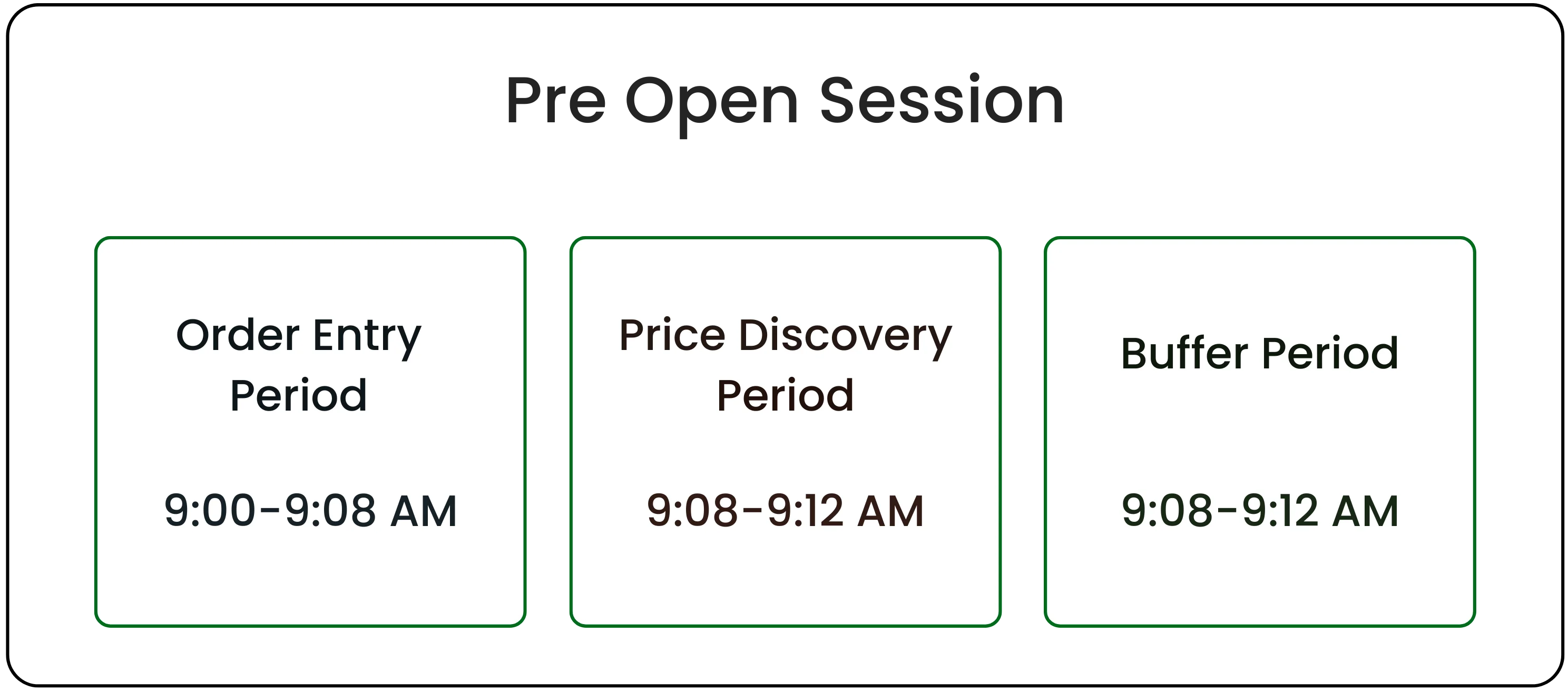
Both the National Stock Exchange (NSE) and the Bombay Stock Exchange (BSE) follow a similar pre-open session process to determine PMEP.
Large Cap Stocks: Particularly important for index heavyweights like Reliance Industries, TCS, and HDFC Bank.
Impact on Indices: Significant institutional orders can move PMEPs of Nifty 50 constituents, influencing broader indices.
For example, if Infosys announces better-than-expected Q1 earnings, demand for the stock surges right from the pre-open session. As a result, the Provisional Market Equilibrium Price (PMEP) rises sharply above the previous close, reflecting strong bullish sentiment. This upward momentum not only drives Infosys higher but can also lift the Nifty IT index and, in turn, influence the broader Nifty 50 benchmark.
Demand curve vs. supply curve: A visual understanding
In the Indian context, imagine a hypothetical situation for HDFC Bank shares:
- At ₹1,500, demand is 1,00,000 shares, and supply is 50,000 shares.
- At ₹1,600, demand is 70,000 shares, and supply is 70,000 shares.
Here, ₹1,600 becomes the equilibrium price because the demand curve intersects the supply curve at this level, resulting in 70,000 shares as the equilibrium quantity.
Real-world applications for traders
- **Gap-Up and Gap-Down Trading:**Monitoring PMEP helps traders plan entries and exits based on expected market opening:
- Gap-Up Opening: When PMEP is significantly higher than the previous close.
- Gap-Down Opening: When PMEP is significantly lower.
Market Stability
By matching orders in advance, PMEP ensures a smooth transition into the trading session, avoiding sharp opening volatility.
Example: commodity and niche markets
The concept of equilibrium price isn’t confined to equities alone—it extends across various markets. In coffee trading, for instance, the PMEP can indicate whether there is oversupply or weaker demand at the open, influencing initial price levels. Similarly, in the diamond industry, pre-market dynamics often reveal demand-supply imbalances that shape pricing trends. These cases highlight the universal applicability of equilibrium price concepts across diverse sectors, making it a fundamental principle in understanding how markets function.
Also read : IMF's role and impact on the global economy
Interest rates and equilibrium price
- Changes in RBI interest rates directly influence:
- Cost of borrowing
- Investor sentiment
- Valuations of stocks and indices
As interest rates rise, the equilibrium price for interest-sensitive sectors (like banking or real estate) may fall, and vice versa.
Key takeaways
- Equilibrium Price and Quantity: Core concepts that balance demand and supply.
- Pre-Market Equilibrium Price: Sets the opening tone and reduces volatility.
- General and Intertemporal Equilibrium: Broader economic factors can shift PMEP.
- Relevance: Crucial for traders, less so for long-term investors but still valuable to understand.
Conclusion: should you track PMEP?
The Pre-Market Equilibrium Price is more than just a number. It is the first indication of market sentiment every trading day in India. For intraday traders, F&O players, and short-term investors, tracking the PMEP can provide a competitive edge.
For long-term investors, daily PMEP changes may not affect your portfolio’s trajectory. However, understanding how equilibrium price works can prevent rash decisions during periods of heightened volatility.
Do you monitor PMEP before placing trades?
If not, it might be time to start. The PMEP not only sets the day’s equilibrium price and quantity but also reflects demand intersect supply dynamics, giving you actionable insights into the market’s opening tone.
Disclaimer: The information provided in our blogs is for informational purposes only and should not be construed as financial, investment, or trading advice. Trading and investing in the securities market carries risk. Always conduct your own research and consult with a qualified financial advisor before making any investment decisions. Past performance is not indicative of future results. Copyrighted and original content for your trading and investing needs.
© 2025 — Tradejini. All Rights Reserved.
.webp%3Falt%3Dmedia%26token%3D0ead9799-20bc-4d1e-ae8f-d75ab18921b5&w=3840&q=75)