

Investing in various assets is a diligent way to build wealth and secure a stable financial future for ourselves and our loved ones. However, while diversification is a core tenet of investing, there is a fine line between protecting your wealth and diluting it. Most investors don't know how many mutual funds to hold. Imagine you waking up one morning to realize that, despite years of investing in random mutual funds, your money is scattered everywhere but isn't moving toward your goals.
This is the reality of over-diversification. Here is a complete breakdown of why investors fall into this trap, how it impacts your returns, and what you can do to fix it. Furthermore, having too many funds exposes you to more hidden costs that keep diluting investment returns
The Trap of Chasing Mutual Fund Returns
Most over-diversified portfolios aren't built by design; they happen by accident. One of the most common mutual fund traps is chasing recent performance.
Investors notice when specific sectors deliver eye-popping returns, such as the surge in healthcare stocks during the pandemic.
Money often pours in largely after the rally has already happened.
This pattern of buying after performance and selling after losses repeats itself with every market cycle, whether it is small-cap funds in bull runs or technology funds during tech booms.
Every time a new theme becomes popular, investors add another fund to their portfolio. Over a few years, a simple investment strategy becomes a cluttered collection with too many mutual funds and overlapping assets.
Also read: Think Like a Turtle | Why You Don’t Need to Predict Markets
How Over-Diversification Dilutes Your Returns
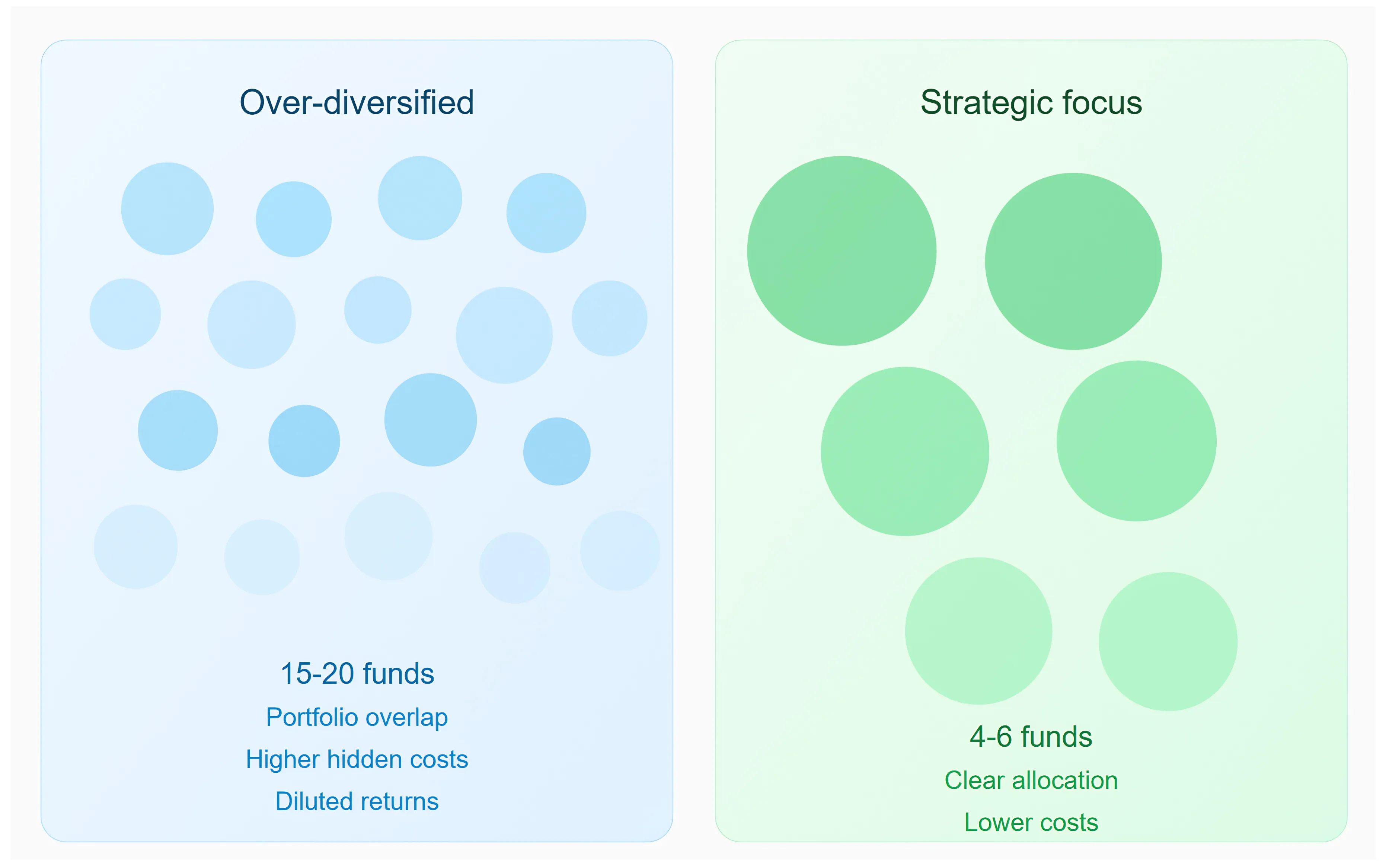
When you own 15 to 20 mutual funds, mutual fund portfolio overlap becomes inevitable, as you are likely holding the same underlying stocks multiple times across different schemes. This overlap means your portfolio essentially mirrors the broader market index, but you are paying higher active management fees for it.
Furthermore, having too many funds exposes you to more hidden costs. If several of your funds actively trade to beat the market, they will have a high Portfolio Turnover Ratio (PTR), which measures how frequently a fund manager buys and sells securities.
High turnover incurs transaction costs like brokerage fees, Securities Transaction Tax (STT), and market impact costs.
These hidden costs are deducted directly from the fund's Net Asset Value (NAV) and can significantly drag down your overall returns over time.
The Behaviour Gap at Play
At its core, over-diversifying is a symptom of the behaviour gap, the difference between what a fund earns and what the investor actually takes home. Our brains are wired for survival, which translates to avoiding immediate pain and chasing immediate reward.
Investors constantly add new funds in an attempt to capture the next big thing or hedge against perceived risks. However, these emotionally-driven decisions made at the wrong time act as a quiet, compounding cost. The gap between investor returns vs fund returns widens when people switch to the hot fund of the year instead of letting their existing investments compound.
How to Fix a Cluttered Portfolio
Streamlining an over-diversified portfolio doesn't have to be complicated. Here is how you can regain control:
Write down your investment thesis: Before you invest, clearly define why you are buying a fund, what your goal is, and when you will exit.
Be cautious with thematic funds: Sector and thematic funds are volatile and heavily marketed at exactly the wrong moments, making them the highest-risk category for the behaviour gap.
Automate and let it run: Set up Systematic Investment Plans (SIPs) and remove the emotional burden of active decision-making.
Measure the right thing: Stop checking your portfolio daily and conduct a mutual fund annual review in the context of your goals, rather than what the market did recently, rather than what the market did recently.
Also read: How Anchoring Bias Affects Your Money Decisions Without you Realising
The Bottom Line
The behaviour gap costs investors more than bad markets ever will. Adding more funds to your portfolio doesn't automatically equal more safety; it often just equals more complexity. The fix is simple: automate your SIPs, stay invested through corrections, and stop measuring your portfolio against last week's news.
Disclaimer: The information provided in our blogs is for informational purposes only and should not be construed as financial, investment, or trading advice. Trading and investing in the securities market carries risk. Always conduct your own research and consult with a qualified financial advisor before making any investment decisions. Past performance is not indicative of future results. Copyrighted and original content for your trading and investing needs.
© 2026 — Tradejini. All Rights Reserved.


.webp%3Falt%3Dmedia%26token%3D95b8e400-dddc-4dbb-9213-6caa6b886a90&w=3840&q=75)
