


If you have ever spent hours guessing where the Nifty will go next week, you are not alone. Every trader, whether a beginner or experienced, wants to know the future. But there’s a hard truth the Turtle Traders understood very early: you don’t need to predict markets to make money. What you actually need is an edge, a small but consistent advantage that plays out over time.
Turtle Philosophy: Don’t Predict, React
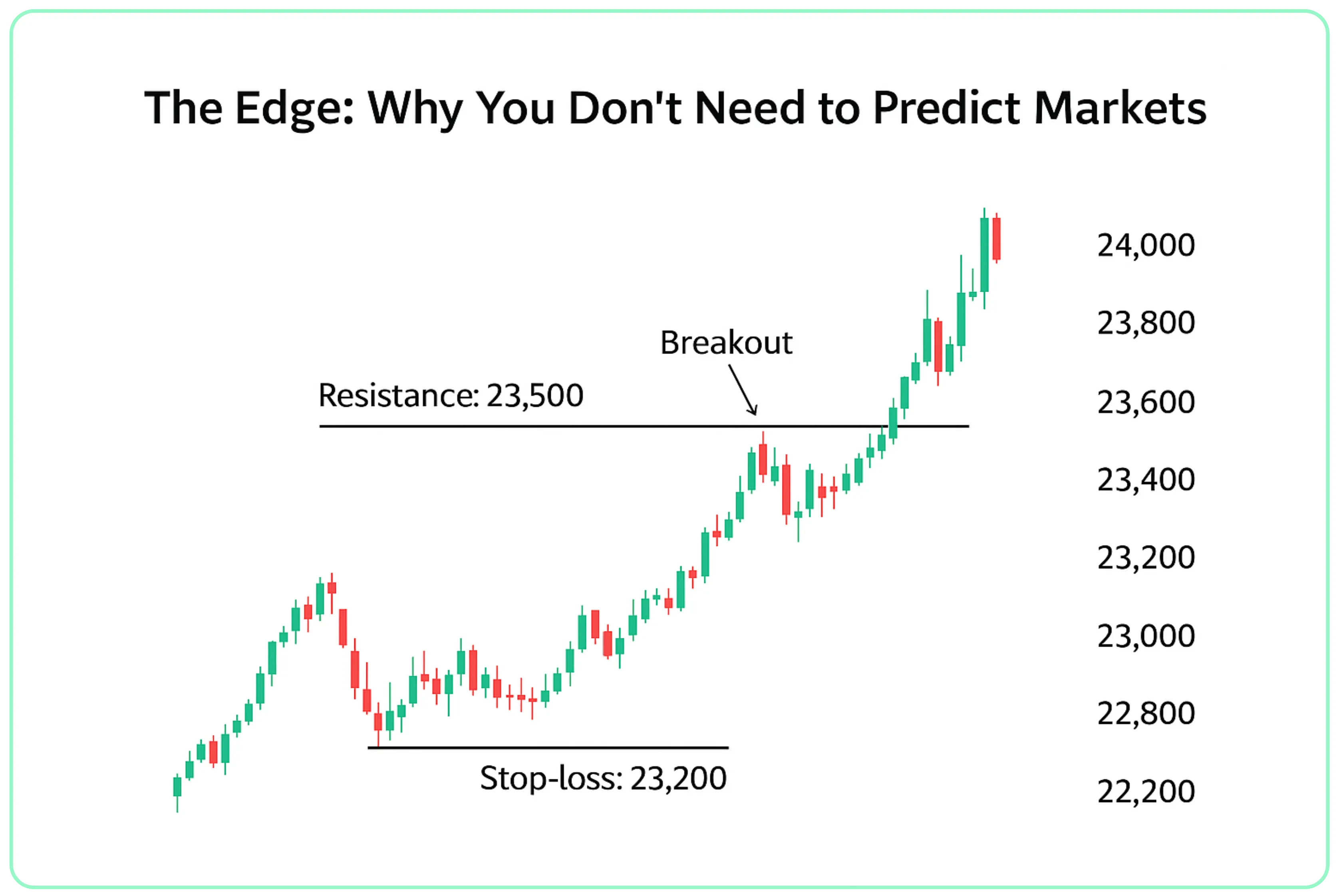
The core of the turtle trading strategy is simple. Do not predict, react. When the original Turtle Traders were trained, they followed strict turtle trading rules and were told to ignore opinions and forecasts. Instead, they focused only on what the market was doing. If the price broke above a certain level, they bought a classic turtle trading breakout approach. If it fell below another level, they sold. They always used stop-losses and always managed risk. They did not try to guess whether gold would rise next month or crude would fall next quarter. They waited for the market to show its direction and then acted. This mechanical and emotion free approach became their real turtle trading edge.
If you have missed part 4, read here: Trading with Rules, Not Emotions
Why Predictions Don’t Work
In today’s Indian markets, predictions are everywhere. Broker reports, Telegram channels, YouTube videos, everyone has a view on where the Nifty is headed next. But in reality, even professional analysts struggle to consistently predict short-term market direction. Markets are influenced by too many variables such as global interest rates, economic data, liquidity flows, and investor sentiment. Predicting them consistently is almost impossible. That is exactly why the Turtles ignored forecasts and focused on probabilities instead, a mindset central to trading psychology in India. A simple breakout system used in nifty breakout trading, is one of the best ways to understand this concept.
The Power of an Edge
An edge is simply a repeatable condition that gives you a slight advantage with any trading system India. It could be a moving average crossover that works 55% of the time, a breakout setup offering a 2:1 reward-to-risk ratio, or a strict stop-loss that limits downside. On its own, this edge may look small. But when applied consistently across many trades, it becomes powerful. As Curtis Faith explained, you don’t need to know what will happen next, you only need to know what you will do if it happens.
Take August 2025, for instance; the Nifty IT index saw a strong breakout after a consolidation phase, leading to a sharp rally over the following weeks. Stocks like Infosys and TCS led the move. At the same time, those who kept predicting a top entered short positions too early and missed the trend entirely. The difference was not intelligence, it was process. Prediction feeds ego, while process drives profits.
Build Your Own ‘Edge System’
| Step | Turtle-Style Rule | Example |
|---|---|---|
| Define entry | Trade only on breakout | Buy above 20-day high |
| Confirm move | Wait for closing price | Enter only after close above level |
| Set stop-loss | Predefined exit | 1–1.5 ATR below entry |
| Position sizing | Fixed risk per trade | Risk 1% of capital |
| No prediction | Follow rules only | Ignore news/opinions |
The biggest mistake many Indian retail traders make is trying to constantly ‘call’ the market. Decisions are often driven by news, tips, or short-term noise. The Turtle approach flips this thinking. You do not need to be right every time. You just need to stay disciplined when you are wrong. That is what allows professional traders to survive for years, while prediction-based traders often disappear after a few bad trades, a key lesson for beginner traders in India.
Up next: Part 6 – Risk Management, the Turtle Way.
Disclaimer: The information provided in our blogs is for informational purposes only and should not be construed as financial, investment, or trading advice. Trading and investing in the securities market carries risk. Always conduct your own research and consult with a qualified financial advisor before making any investment decisions. Past performance is not indicative of future results. Copyrighted and original content for your trading and investing needs.
© 2026 — Tradejini. All Rights Reserved.


