For years, paying through UPI has felt almost invisible. Scan a QR code, enter your PIN and the payment is done. No cash, no card and, for the customer, no additional payment fee.
That part is not changing. What is changing from October 15, 2026, is what happens behind the scenes when you make certain higher-value payments to merchants. A new Merchant Discount Rate (MDR) will apply to some UPI transactions above ₹2,000. The important bit? The customer does not pay the MDR. The merchant does.
So, what exactly is changing?
First, what is MDR?
MDR, or Merchant Discount Rate, is a fee charged for processing a digital payment. In the UPI ecosystem, it is paid by the merchant to the relevant payment partners involved in processing the transaction.
Under the new framework, the standard MDR has been set at 0.4% for merchant transactions above ₹2,000, with a maximum charge of ₹300 per transaction.
| UPI payment | MDR paid by merchant |
|---|---|
| ₹2,000 or below | ₹0 |
| ₹3,000 | ₹12 |
| ₹10,000 | ₹40 |
| ₹50,000 | ₹200 |
| ₹75,000 | ₹300 |
| ₹1,00,000 | ₹300 |
Once a transaction crosses ₹75,000, the MDR does not keep rising. The ₹300 cap kicks in.
But what about you?
For the person making the payment, nothing changes under the standard MDR framework.
Buy something worth ₹1,500 using UPI? No MDR.
Buy something worth ₹3,000? You still pay ₹3,000.
Make a payment of ₹80,000? The customer still does not pay an additional UPI fee; the merchant's MDR is capped at ₹300.
The MDR applies to** Person-to-Merchant (P2M)** transactions. Sending money to a friend or family member through UPI remains outside this MDR framework. That distinction matters because UPI is used for two very different things: paying businesses and transferring money between people.
Not every merchant payment will have a 0.4% MDR
The 0.4% rate is the baseline, but certain categories have separate rates. For categories such as telecom, railways, fuel and insurance, the MDR is set at a flat ₹5 per transaction for payments above ₹2,000.
Utilities such as electricity, water and piped natural gas also have a flat ₹5 structure above the threshold, according to the material supplied for this draft.
Payments below ₹2,000 remain outside the MDR. There is also a much lower rate for transactions involving the capital markets.
What happens when you pay a broker or invest?
For payments to capital market intermediaries, including stockbrokers, dealers, securities firms and mutual fund-related transactions, the MDR has been set at 0.02% of the transaction value, subject to the applicable cap. This is significantly lower than the standard 0.4% rate. For example, a ₹1 lakh payment at 0.02% would work out to ₹20 in MDR for the merchant or intermediary.
Again, this is not an additional fee charged to the customer as a UPI fee.
Why introduce MDR now?
UPI has grown from a convenient payment option into a massive payments network. According to the material supplied for this article, UPI processed 24.51 billion transactions worth ₹29.90 lakh crore in August 2026 alone.
Behind every successful “scan and pay” transaction sits an infrastructure that needs servers, banking systems, telecom connectivity, cybersecurity and payment-processing systems.
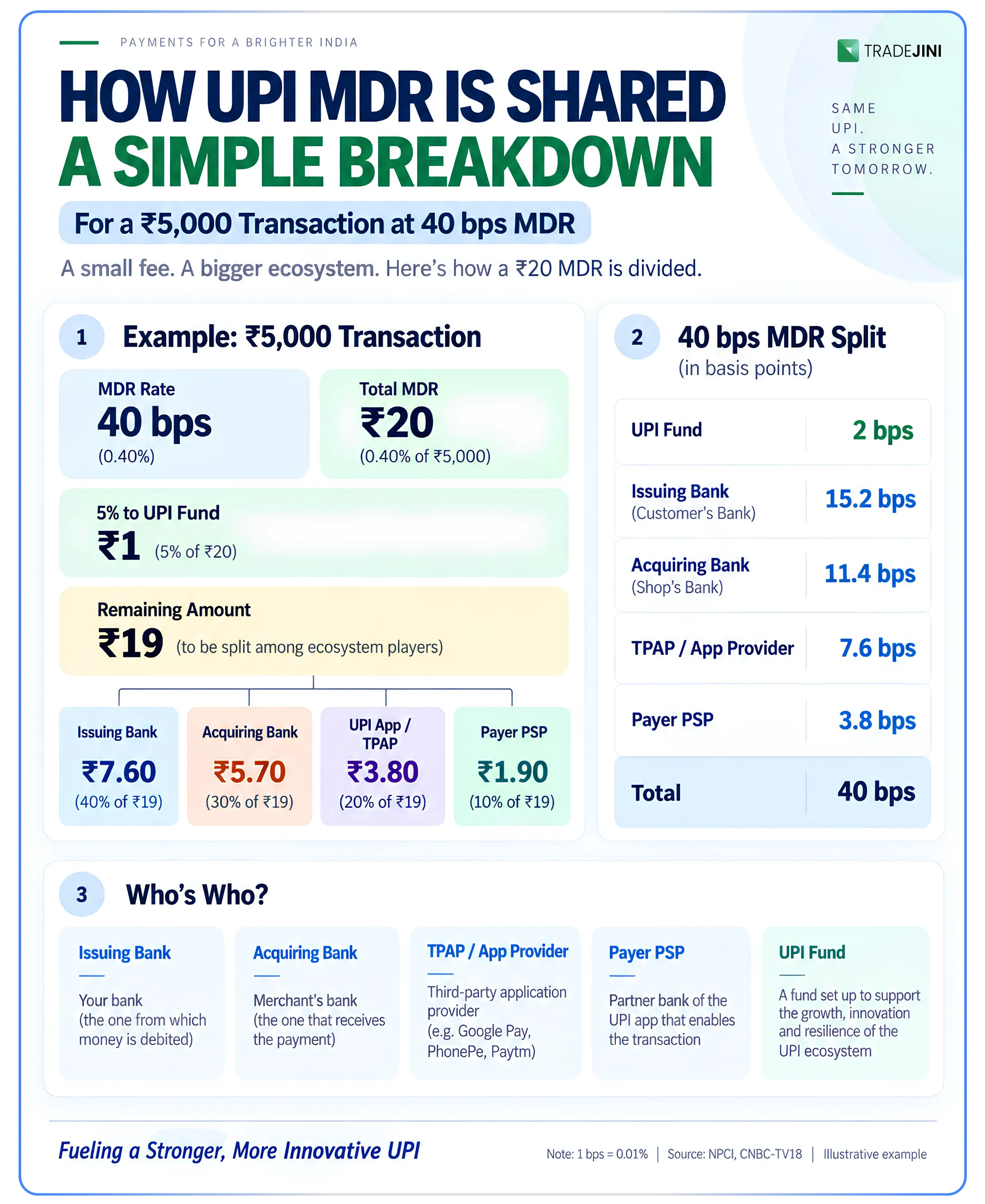
The introduction of MDR is intended to create a revenue stream within the ecosystem and support investments in areas such as infrastructure, security, innovation and customer service.
The money does not go to one single entity. It is distributed across different participants in the payment ecosystem, including banks, payment service providers, acquiring entities and NPCI.
So, is UPI no longer free?
For customers, UPI continues to remain free under the framework described here. The change is primarily about who bears the cost of processing certain merchant transactions.
Think of it this way:
Earlier:
You pay ₹10,000 → Merchant receives the payment → No MDR.
From October 15:
You pay ₹10,000 → Merchant pays the applicable MDR → You still pay ₹10,000.
That does, however, leave one question: Could merchants eventually pass that cost on indirectly?
The government has said merchants cannot add the MDR as a separate UPI fee to the customer's bill. However, merchants may make their own pricing decisions for their products or services.
So while the MDR itself is a merchant-side charge, its broader impact on businesses and prices is something worth watching.
What about UPI AutoPay?
Recurring payments set up through UPI mandates or AutoPay are not covered by the prescribed MDR transaction charges described in the material. That includes recurring payments such as certain utility bills, OTT subscriptions and recurring investments. So your monthly automated payment does not suddenly become more expensive simply because of the new MDR framework.
The bigger picture
The interesting part of this change is not really the ₹12 MDR on a ₹3,000 transaction. It is what happens when you apply a small processing charge to one of the world's largest real-time payment ecosystems. UPI has made digital payments so seamless that most users rarely think about the infrastructure underneath. MDR brings that hidden cost into the conversation.
For customers, the experience largely remains the same: scan, enter your PIN and pay. For merchants, banks, payment apps and other participants in the ecosystem, however, the economics of UPI are about to change.
And that is the part worth watching.
Disclaimer: The information provided in our blogs is for informational purposes only and should not be construed as financial, investment, or trading advice. Trading and investing in the securities market carries risk. Always conduct your own research and consult with a qualified financial advisor before making any investment decisions. Past performance is not indicative of future results. Copyrighted and original content for your trading and investing needs.
© 2026 — Tradejini. All Rights Reserved.