

Wipro is a major IT services company in India that's going through a tough patch; revenues are slightly shrinking, and big client orders are down. The core problem is that Wipro vs AI disruption is no longer a future worry, the tech industry is undergoing a gradual shift toward AI-led delivery models, where companies like Wipro are adapting their services to stay competitive. Wipro is betting on AI by building new AI-powered tools and services (think software that automates work they used to do manually with large teams), and they've landed a couple of impressive AI deals. But here's the big shift happening: The traditional model of deploying large engineering teams is evolving, with AI increasingly taking over repetitive and rule-based tasks. However, core IT services still rely heavily on human expertise for integration, maintenance, and customization. Wipro is trying to be the company that manages and runs AI systems for big global clients, rather than just providing human labour, and that's the core of Wipro's AI strategy today. The worry is that while Wipro has built partnerships with companies like Microsoft and NVIDIA, competitors such as Infosys and Accenture have been more aggressive and visible in scaling these collaborations. The next few quarters will be important in determining whether strong deal momentum begins translating into sustained revenue growth, or whether they're just spending on AI without seeing the payoff yet.
BUSINESS MODEL
The Two Faces of Wipro
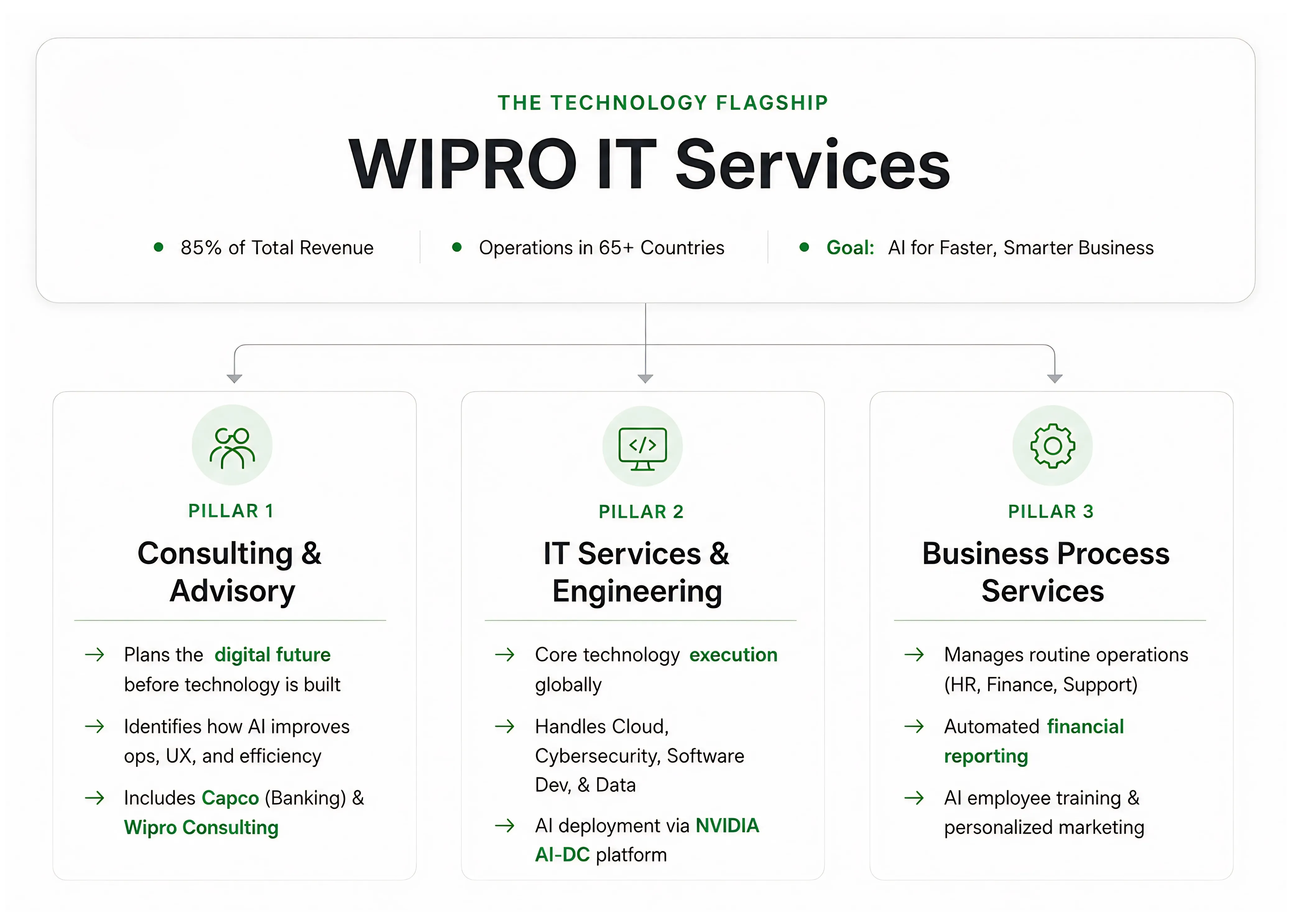
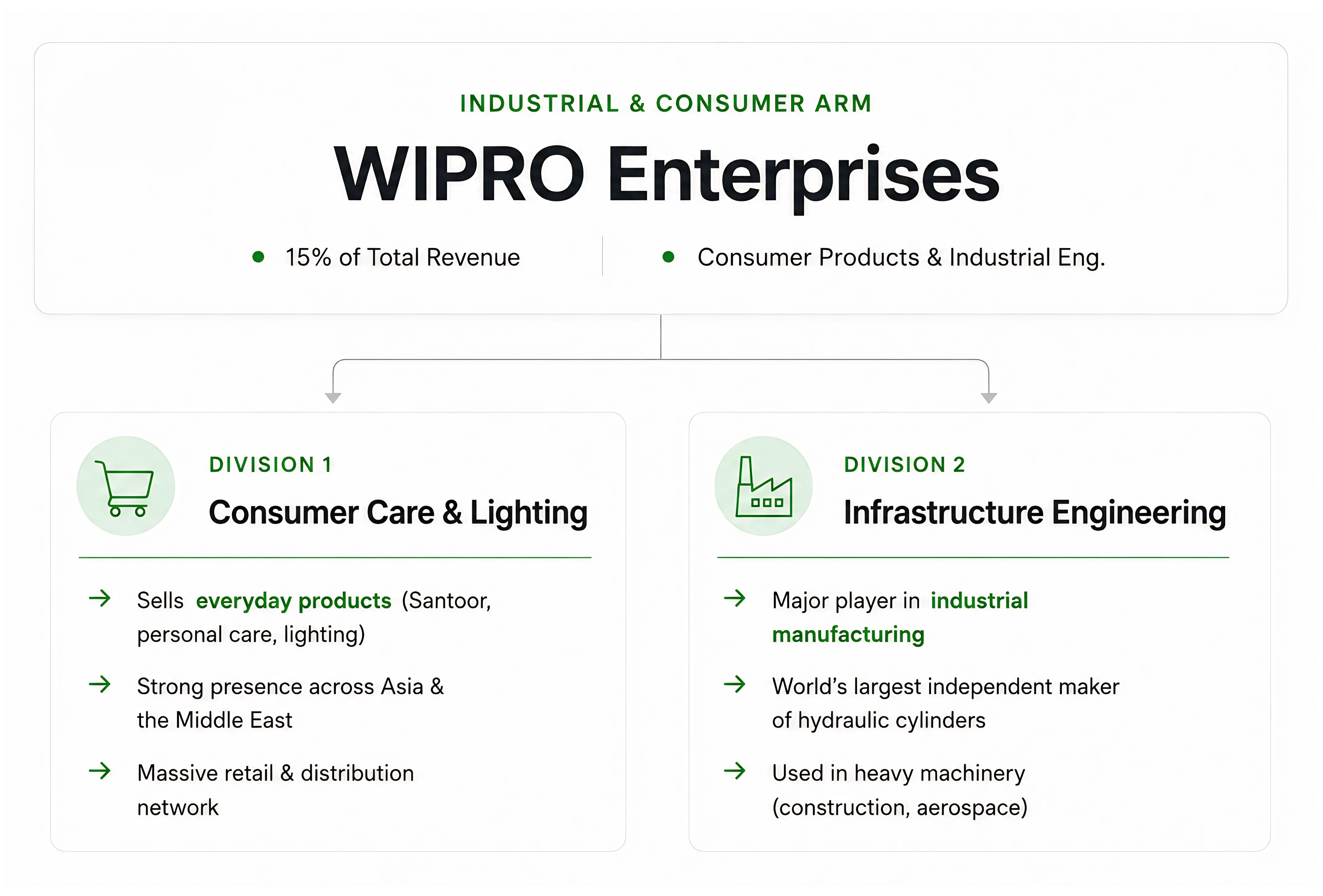
To understand Wipro's business model, you have to look at two very different operations running under the same roof. On one side, it provides technology and AI services to some of the world's largest companies. On the other, it sells everyday consumer products like soaps, lighting products, and personal care items through its non-IT arm, Wipro Enterprises.
The AI Platform Layer - Wipro Intelligence
Wipro has developed a range of internal AI platforms and frameworks to deliver solutions faster without building everything from scratch for each client, which helps the company deliver AI solutions faster without creating everything from scratch for each client.
Some of its key tools include:
WEGA and WINGS — WEGA automates routine business processes and workflows, while WINGS provides predictive insights to help companies make better decisions.
Wipro Agent Marketplace — A collection of ready-made AI tools on Microsoft Azure for tasks like HR and procurement.
Wipro NVIDIA AI-DC — Built with NVIDIA technology to help businesses scale AI projects from testing stages to full deployment.
Revenue Model - IT Services
Wipro is changing how it earns money in the AI age. Earlier, IT companies were mostly paid based on the number of employees working and the hours they spent on projects. Now, Wipro wants to earn by helping companies achieve real business results. This approach is what is called Wipro outcome based pricing, where a company pays based on what actually gets done, not how many people worked on it.
For example, if Wipro helps a company reduce costs, improve speed, or automate tasks using AI, the payment can be linked to those results. Wipro is also moving toward a model where parts of its services are delivered through software-like platforms, combining automation with ongoing human-led consulting and support. The company is also signing bigger long-term AI deals and working closely with Microsoft through the Wipro Microsoft partnership to offer AI tools like Azure and Copilot to businesses.
Revenue Model - Wipro Enterprises
Unlike its technology business, Wipro earns money here mainly by selling physical products and supplying industrial equipment. Its Wipro Consumer Care and Lighting business makes revenue through everyday household products sold across retail stores, while the Wipro Infrastructure Engineering segment earns through long-term supply contracts with industries such as construction, manufacturing, and defense.

This combination gives Wipro a more balanced business model, with stable consumer and industrial revenues supporting its fast-growing technology operations.
Also read: hawkins cookers ltd how the business works
Growth Drivers
Wipro has reinvented itself multiple times over the years: starting from consumer products, then becoming a global IT services company, and now moving toward artificial intelligence-driven business solutions.
The AI-First Shift
Wipro's AI strategy is shifting away from traditional manpower-based IT services and toward AI-powered consulting and automation. Instead of simply providing technical support and software services, the company now aims to help businesses use AI to improve operations and decision-making.
A major step in this transition was the launch of Wipro NVIDIA AI-DC, built with NVIDIA technology. The platform helps companies move from small AI experiments to large-scale real-world deployment. Wipro is also increasingly focusing on services as software, where AI tools and digital agents can automate tasks that previously required large teams of employees.
The Microsoft Partnership
In 2025, Wipro entered into the Wipro Microsoft partnership, a long-term deal to help businesses adopt AI technologies. The partnership combines Microsoft products such as Azure and Copilot with Wipro's consulting and implementation expertise. This is important because it positions Wipro as a key partner helping global companies adopt Microsoft's AI ecosystem.
Large Deal Momentum
One of the strongest signs of future growth for Wipro is the rise in large business contracts. The company recorded strong growth in large deal bookings during FY2025 and continued to see significant momentum in FY2026. These contracts usually run for several years, meaning the full revenue impact may appear gradually over time. This also explains why Wipro's revenue may look flat in the short term even as the company keeps winning bigger deals, the payoff simply takes time to show up.
Four Structural Bets for the Next Decade
Wipro is focusing its future growth around four major long-term strategies.
1. Agentic AI
Wipro agentic AI is about building advanced AI systems that can make decisions, automate workflows, and perform tasks with minimal human involvement. The company wants to become a major partner for businesses moving from basic AI testing to large-scale AI adoption.
2. Structural Reorganisation
Wipro's structural reorganisation in April 2025 divided its operations into four main divisions; Technology Services, Business Process Services, Consulting Services, and Engineering and R&D. This new structure is designed to improve efficiency, accountability, and sharper business focus.
3. Geographic Expansion
Although the United States remains Wipro’s largest market, the company is expanding more aggressively in Europe and the Middle East to reduce dependence on a single region. As part of this strategy, Wipro opened a regional headquarters in Riyadh in 2025 to strengthen its presence in the Middle East.
4. Wipro Ventures & Startups
Through Wipro Ventures, the company has invested heavily in technology startups working in areas such as AI, cybersecurity, and engineering software. These investments help Wipro gain early access to new technologies that could become part of its future business offerings.
Also read: how kpit technologies is rewriting the rules of automotive software
Challenges: The Roadblocks to the AI Future
Competition from Larger Rivals
Wipro is competing against major global IT companies like Accenture and Tata Consultancy Services. While Wipro has been winning large AI-related contracts, many rivals are still growing faster. The biggest challenge is winning projects where AI is the core business solution rather than just an additional feature.
The Reskilling Challenge
Wipro has a workforce of more than 250,000 employees, and the company must train a large part of its staff in newer AI technologies and consulting skills. This is a major transition because traditional IT services and advanced agentic AI solutions require very different skill sets. If employee training does not keep pace with rapid technology changes, the company could struggle to fully benefit from its AI investments.
Changing the Revenue Model
Traditionally, IT companies earned revenue based on employee working hours. However, AI can complete many tasks much faster than humans. This creates pressure on Wipro to move toward outcome-based pricing, where clients pay for business results rather than time spent. If the transition happens slowly, AI-driven efficiency could reduce revenue from traditional service models.
Dependence on the US Market
A large share of Wipro’s IT revenue comes from the United States, making the company highly sensitive to changes in the US economy and corporate technology spending. Slowdowns in American business investment or higher interest rates can directly affect demand for IT services. To reduce this risk, Wipro is expanding its presence in Europe and the Middle East.
Wipro’s Biggest Transformation Yet
Wipro is entering a new phase where artificial intelligence could shape its future more than traditional IT services. The company is investing in AI platforms, major global partnerships, long-term enterprise deals, and expansion into new markets to stay competitive in a rapidly changing tech industry. However, it also faces tough competition, the challenge of reskilling thousands of employees, and pressure to shift from manpower-based revenue to AI-driven business models. Wipro has successfully reinvented itself several times in the past, and its success in the AI era could define the company’s next decade.
Disclaimer: The information provided in our blogs is for informational purposes only and should not be construed as financial, investment, or trading advice. Trading and investing in the securities market carries risk. Always conduct your own research and consult with a qualified financial advisor before making any investment decisions. Past performance is not indicative of future results. Copyrighted and original content for your trading and investing needs.
© 2026 — Tradejini. All Rights Reserved.


