

This year, IPOs are making headlines on both sides of the globe. From tech giants debuting in the U.S. to fast-growing startups listing in India, investors are watching closely. But how do these markets really compare when it comes to regulations, investor participation, and listing trends? Let’s break down the IPO story of 2025 in the U.S. and India.
U.S. IPO Trends 2025
The U.S. IPO market began 2025 on a cautious note, affected by inflation and interest rate uncertainty. However, the second quarter saw a sharp rebound; IPO volumes increased compared to the same period in 2024, although the total funds raised were slightly lower.
The first half of 2025 marked the strongest recovery since 2021, as investor confidence improved and companies in sectors like technology and healthcare returned to public markets. Analysts expect the revival to continue through late 2025 and into 2026, provided economic conditions remain stable.
Key Drivers and Challenges
What’s driving IPOs in the U.S.:
A steady appetite from institutional investors for growth and tech names.
Companies choosing public markets over extended private fundraising.
A stabilising interest rate environment after a period of volatility.
Challenges faced:
Regulatory reviews by the U.S. SEC can cause delays.
Valuation mismatches between companies and investors often lead to pricing uncertainty.
Volatile markets and cautious investor sentiment may limit first-day listing gains.
Want to know how to apply for an IPO on the CubePlus website by Tradejini click here
Notable IPOs in 2025
One of the prominent U.S. listings in 2025 was Alliance Laundry, which raised around USD 826 million. Several tech and fintech firms also debuted this year, showing high subscription levels but mixed post-listing performance. Overall, U.S. IPO activity in 2025 signals a cautiously optimistic recovery.
Indian IPO Market 2025 (BSE Context)
Market Overview
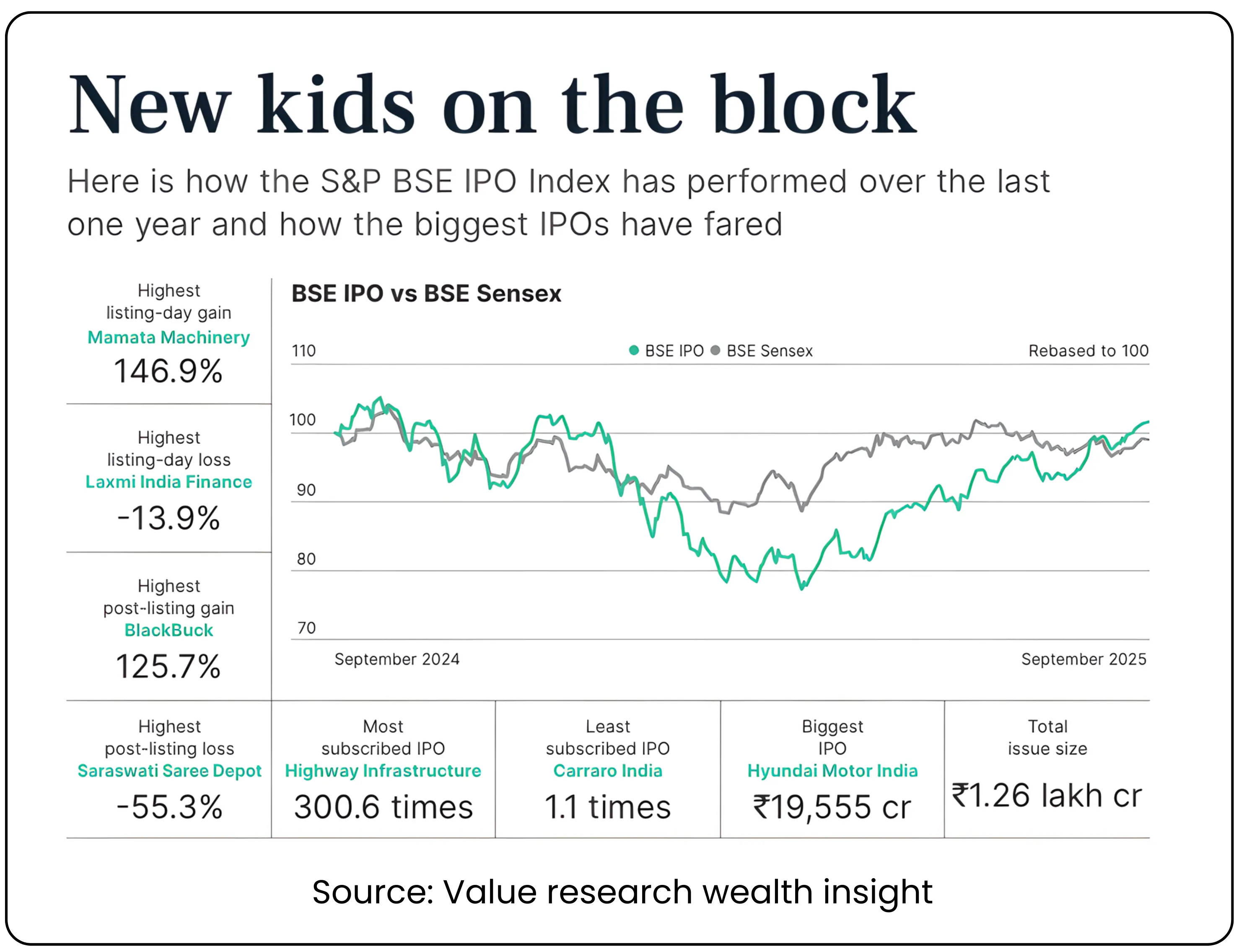
Between January and September 2025, 56 Indian IPOs collectively raised about ₹75,000 crore, compared to roughly ₹64,000 crore during the same period last year. This reflects growing investor participation and a favourable market environment.
Large issues like Tata Capital IPO and LG Electronics India’s IPO made headlines this year. Tata Capital’s listing on 13 October 2025 saw a modest 1–1.2% premium over its issue price, while LG Electronics India’s ₹11,607 crore IPO became one of the most subscribed in recent years.
Analysts estimate that total IPO fundraising in India in 2025 could cross ₹1.5 to ₹1.75 lakh crore, potentially setting a new record.
Regulatory Framework and ASBA System India
In India, IPOs are regulated by the Securities and Exchange Board of India (SEBI). A company planning to list must file a Draft Red Herring Prospectus (DRHP) with SEBI, which reviews it before approval.
The company must also obtain an in-principle nod from stock exchanges like the Bombay Stock Exchange (BSE).
Investors use the ASBA (Application Supported by Blocked Amount) system, which temporarily holds the application money in their bank accounts until the allotment is completed.
In September 2025, SEBI introduced several reforms, simplifying public shareholding rules, improving allotment processes, and allowing smoother participation for foreign and NRI investors.
Strengths and Weaknesses
Strengths:
Strong retail investor participation supported by mutual funds.
Easier and faster digital processes for IPO applications.
Diversification across sectors. financial services, consumer, industrials, and technology.
Challenges:
Some IPOs are aggressively priced, reducing listing gains.
Oversubscription leads to limited allotment for retail investors.
Market volatility can affect listing-day performance.
Initial Public Offering Comparison: IPOs 2025 U.S. vs India
| Aspect | U.S. IPOs | India / BSE IPOs |
|---|---|---|
| Regulator | U.S. SEC | SEBI |
| Main Listing Venue | NYSE / NASDAQ | BSE / NSE |
| Filing Document | S-1 registration | DRHP |
| Pricing Mechanism | Book-building or fixed price | Book-building or fixed price |
| Investor Base | Primarily institutional | Institutional + strong retail participation |
| Application Method | Broker / direct debit | ASBA (funds blocked until allotment) |
| Market Depth | Mature and deep | Rapidly growing |
| Typical Risks | Market volatility, valuation pressure | Overvaluation, retail oversubscription |
Both countries’ IPO systems ensure transparency, investor protection, and fair allocation. Yet, investor behaviour differs; U.S. IPOs tend to focus on institutional flows, while Indian IPOs see a far stronger retail and domestic mutual fund presence.
What Investors Should Keep in Mind
Don’t chase hype: Listing-day performance can be unpredictable.
Read the prospectus: Understand the business model, sector outlook, and financials.
Check valuations: Compare with peers and industry multiples.
Diversify exposure: Avoid putting too much money in one IPO.
Follow post-listing performance : Many IPOs correct after initial enthusiasm.
If you are looking to participate in India’s growth story, now’s the time to explore upcoming IPOs. Apply for your next IPO seamlessly on CubePlus by Tradejini
Disclaimer: The information provided in our blogs is for informational purposes only and should not be construed as financial, investment, or trading advice. Trading and investing in the securities market carries risk. Always conduct your own research and consult with a qualified financial advisor before making any investment decisions. Past performance is not indicative of future results. Copyrighted and original content for your trading and investing needs.
© 2025 — Tradejini. All Rights Reserved.