

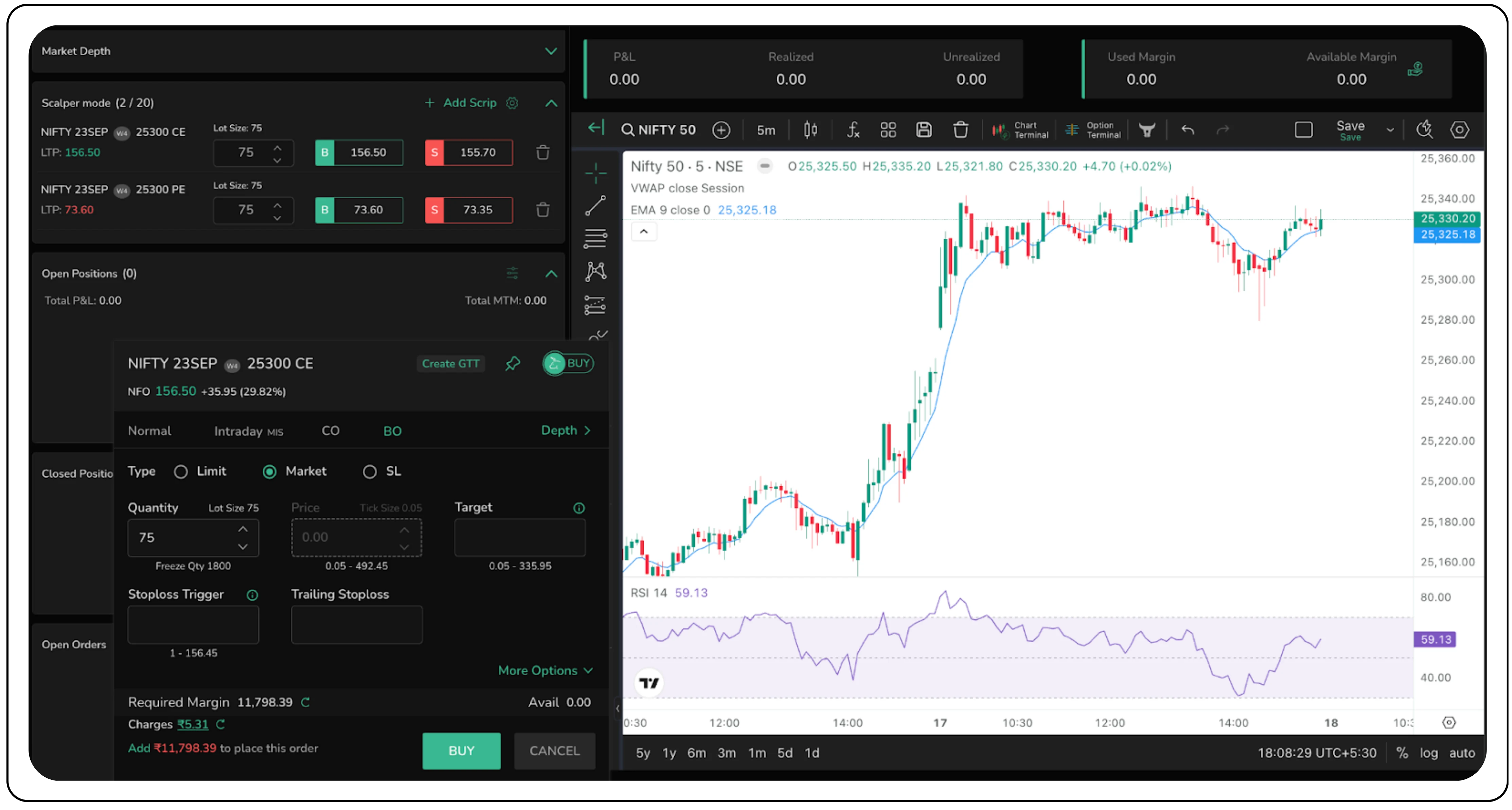
Nifty Scalping strategy in the derivatives market is all about quick trades, careful timing, and strict control over risk. This technical scalping strategy focuses on capturing small, consistent profits from Nifty options trading by combining technical indicators that align with trend, momentum, and institutional sentiment.
Understanding the Framework
Successful Nifty options scalping relies on three core elements working together in this intraday trading strategy:
| Element | Indicator | Purpose |
|---|---|---|
| Trend Direction | 9 EMA (Exponential Moving Average) | Identifies short-term momentum shifts and overall directional bias |
| Institutional Reference | VWAP (Volume Weighted Average Price) | Acts as the fair value benchmark used by large traders for execution |
| Momentum Confirmation | RSI (Relative Strength Index) | Measures the strength of price movements and filters high-probability setups |
Chart Configuration
For scalping, most traders prefer a 5-minute chart as it removes the random noise of 1-minute charts while still catching quick intraday moves. While 1-minute charts may provide more frequent signals, they often lead to false entries, which can hamper profitability over time.
For trading instruments, the focus should remain on At-the-Money (ATM) options, especially weekly Nifty options. Options with deltas between 0.40 and 0.60 are ideal because they move efficiently with the underlying index and maintain good liquidity. This kind of responsiveness is crucial for scalpers who depend on quick execution and small price shifts.
The technical setup combines three core tools to create a disciplined and well-rounded intraday trading approach: 9EMA for immediate momentum and trend filter, VWAP serves as an institutional benchmark for fair value, and RSI (14-period) for momentum confirmation. Together, these tools form a comprehensive intraday trading strategy that avoids isolated signals and maintains trading discipline.
Entry Methodology
A confluence-based approach ensures every trade is supported by trend, momentum, and institutional benchmarks.
For Long Positions, all structural elements must align:
- Price above 9 EMA
- Price above VWAP
- RSI above 55
This confirms both short-term and broader intraday strength. The 9 EMA crossing and holding above it adds validation. A strong bullish candle closing above these two reference levels indicates conviction from market participants. Finally, an RSI reading above 55 signals that momentum is on the buyer’s side. The entry should be executed on the close of this signal candle or on a minor retracement to reduce entry risk.
For Short positions, the criteria are the exact reverse:
- Price below 9 EMA
- Price below VWAP
- RSI below 45
A decisive bearish candle under these levels confirms the trend. An RSI reading below 45 provides momentum validation, and the entry should similarly be executed at the candle close or on a slight pullback.
Practical Example:
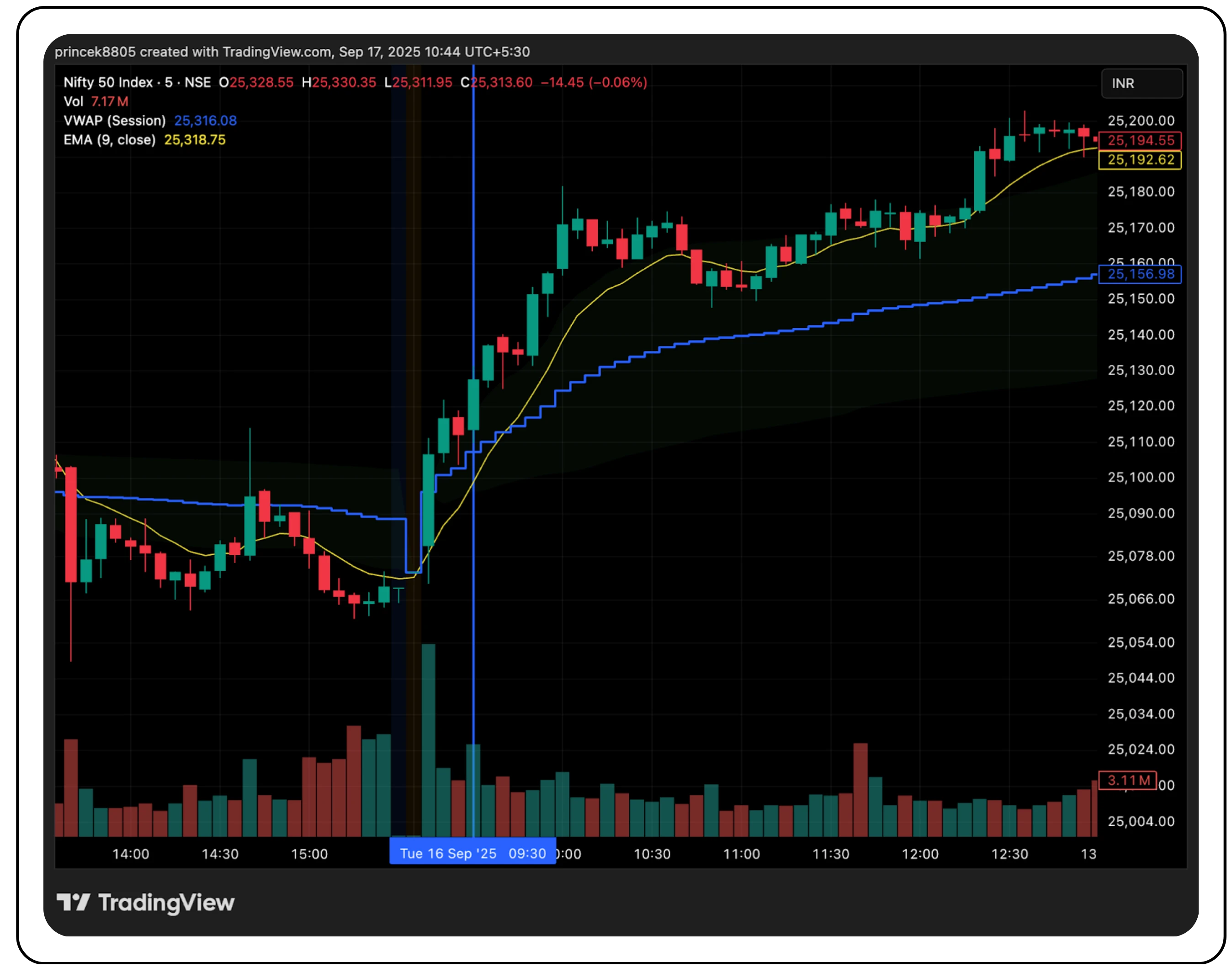
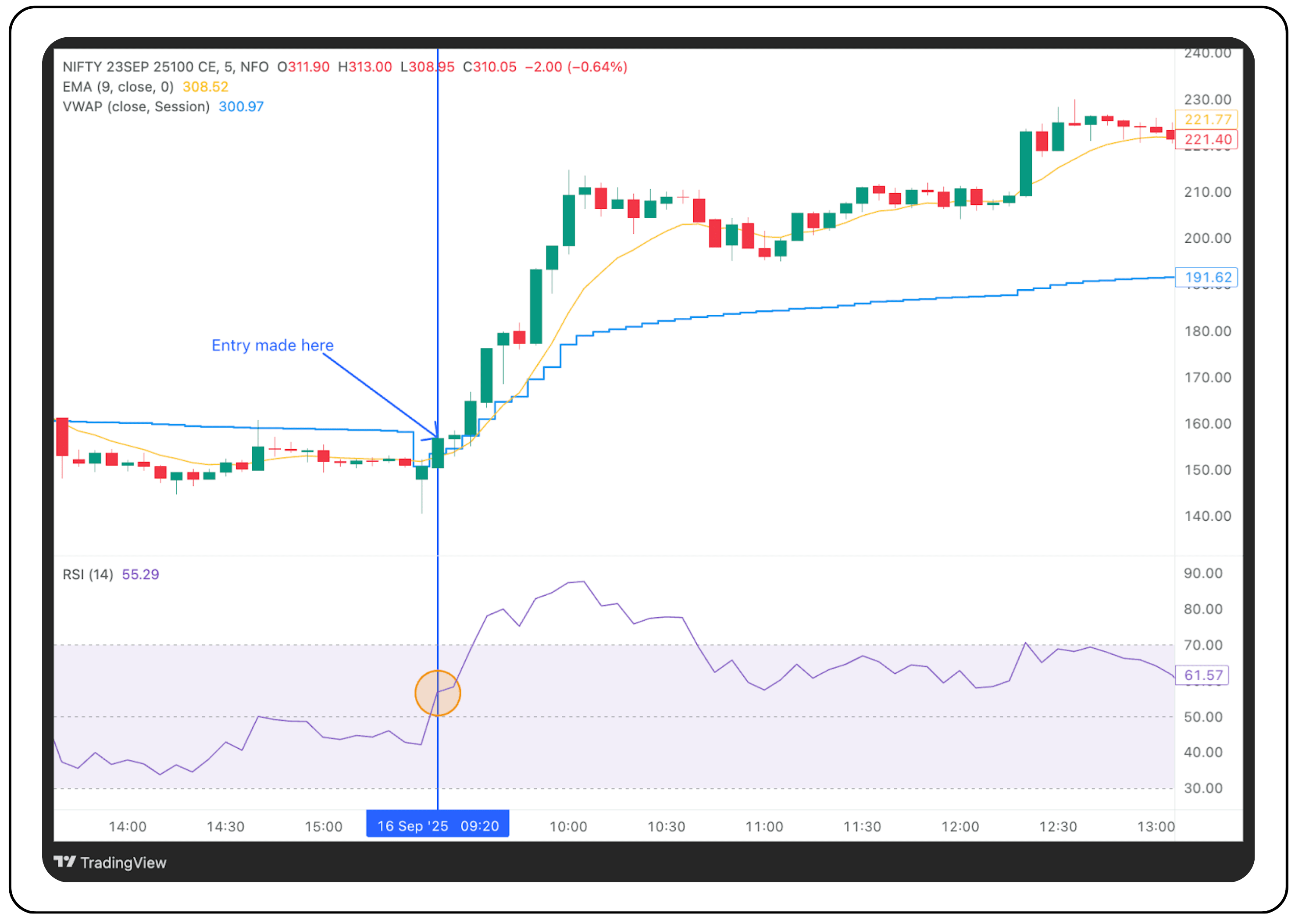
To see how this strategy worked in the live market conditions, let’s walk through a trade taken on 16th September 2025, using a 5-minute chart of Nifty 50 and 25,200 CE option.
The market opened flat, hovering around VWAP in the first 15 minutes. At 9:30 AM, Nifty staged a strong breakout:
- Price action: The breakout candle closed decisively above the 9EMA, and the VWAP.
- The 9 EMA crossed above VWAP, confirming a bullish short-term trend.
- RSI surged to 64.29, comfortably above the 55 threshold, indicating buying strength.
- A clear spike in the volume showed further confirmation.
So let’s see how this trade could be executed.
The instrument chosen is the Nifty 25,100 CE (ATM option). Entry is made around ₹ 157 levels, around the candle closing above the VWAP and the EMA. Stop loss is placed below the candle low around ₹ 150 levels (roughly ₹ 7 per lot), and the target is set at 31 points above our entry at roughly ₹ 187, which translates to a 0.25-0.45% in the underlying, which is NIFTY.
At ₹177, 50% of the position was booked, locking profits. The rest was trailed to cost at ₹157 to capture additional upside if the trend extended. This partial booking and trailing method allows profits to be secured while leaving room to ride the momentum further.
Let's look at the outcome of the trade,
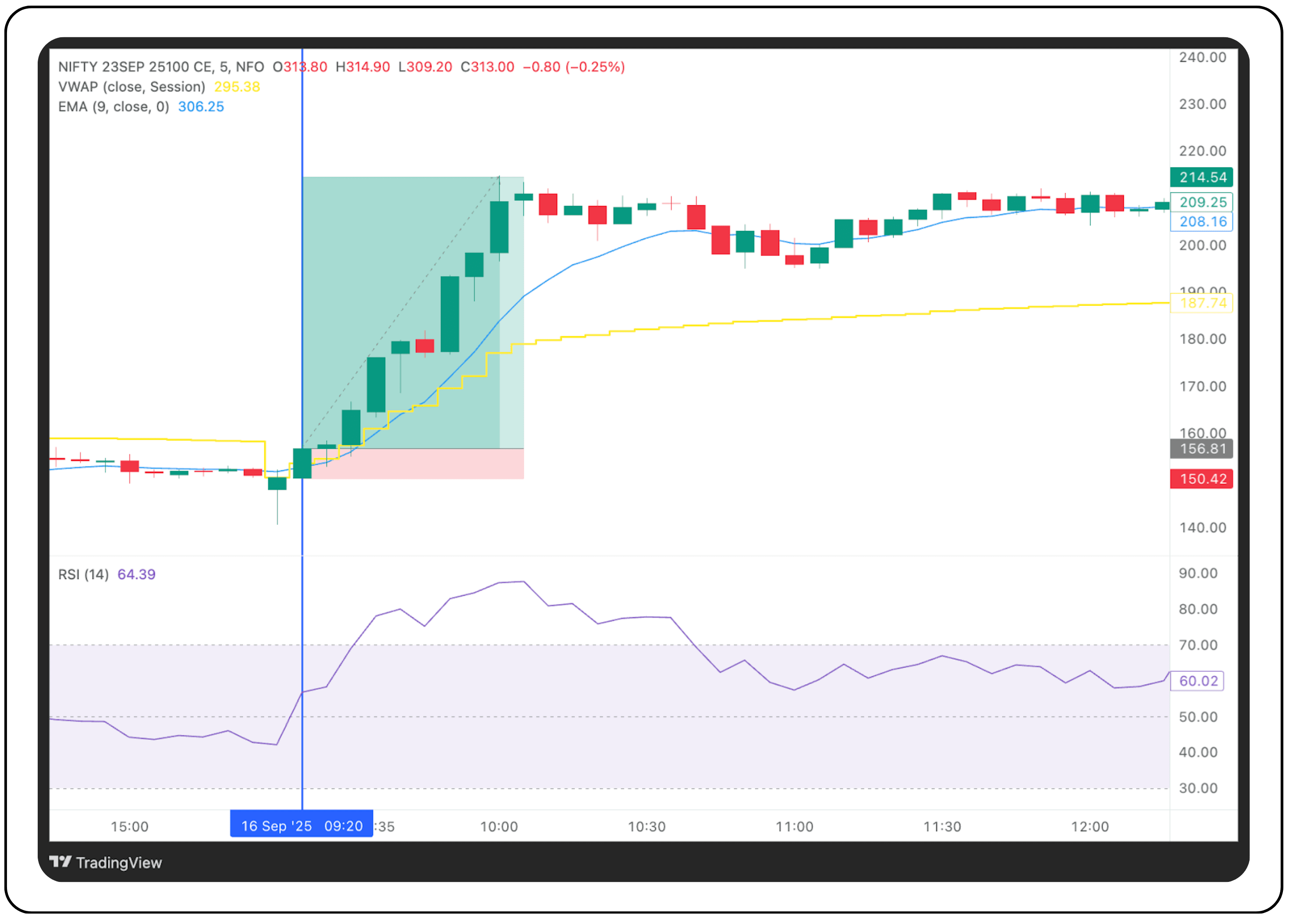
If a two-lot trade was taken, the margin outlay would have been ₹ 23,550 (157 * 75 * 2). At ₹177, we exited one lot, resulting in a profit of ₹ 1,500 (20 * 75) and held the other lot till our target of ₹187, resulting in a total profit of ₹ 3,750 (1,500 + 30 * 75). Had the position been held for the extent of the entire trend, a profit of 57 points could have been captured.
Risk taken was ₹1,050 (7*150), resulting in a Risk to Reward ratio of roughly 1:3.5.
Similarly, let’s take a look at a short position in Nifty using Put options
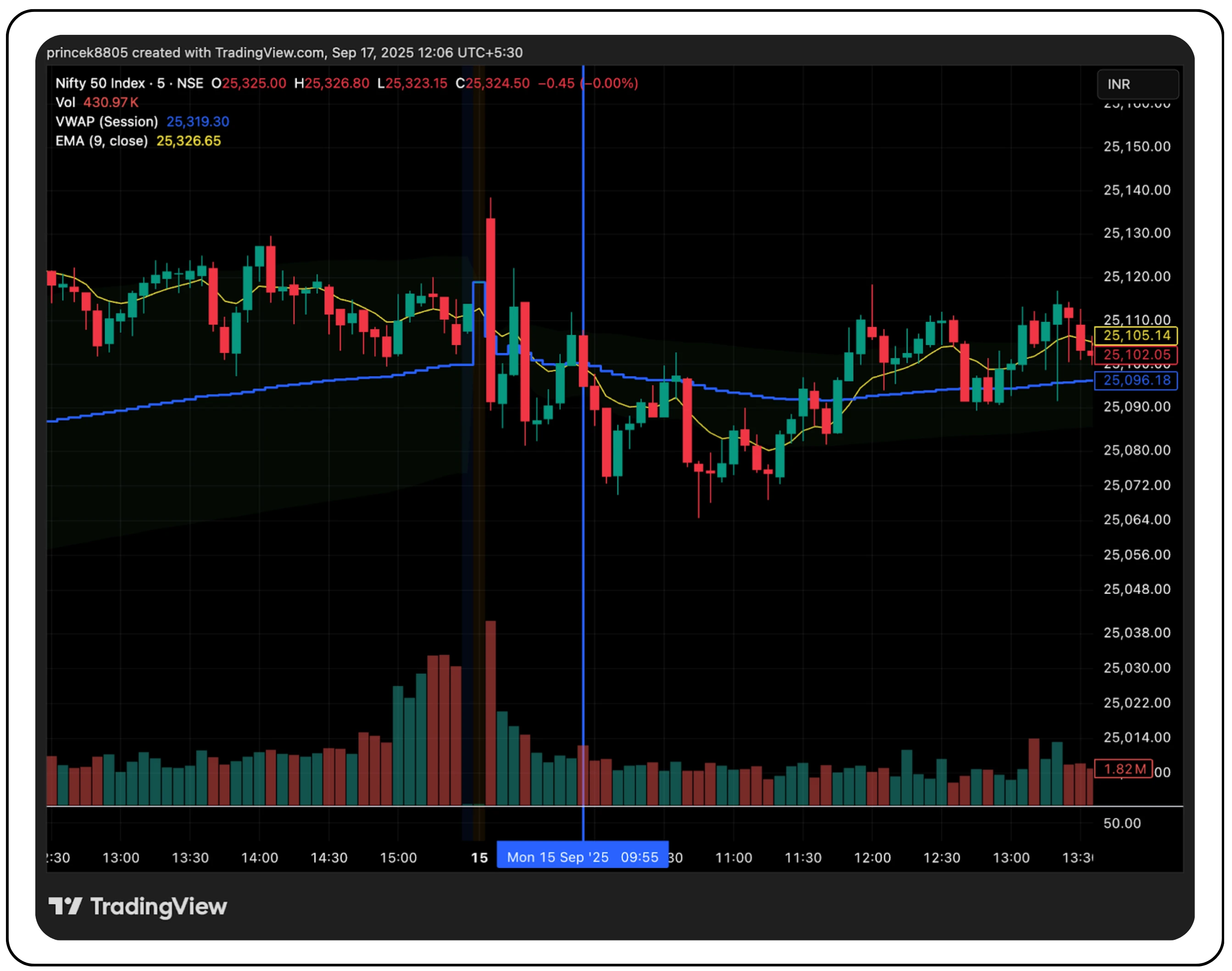
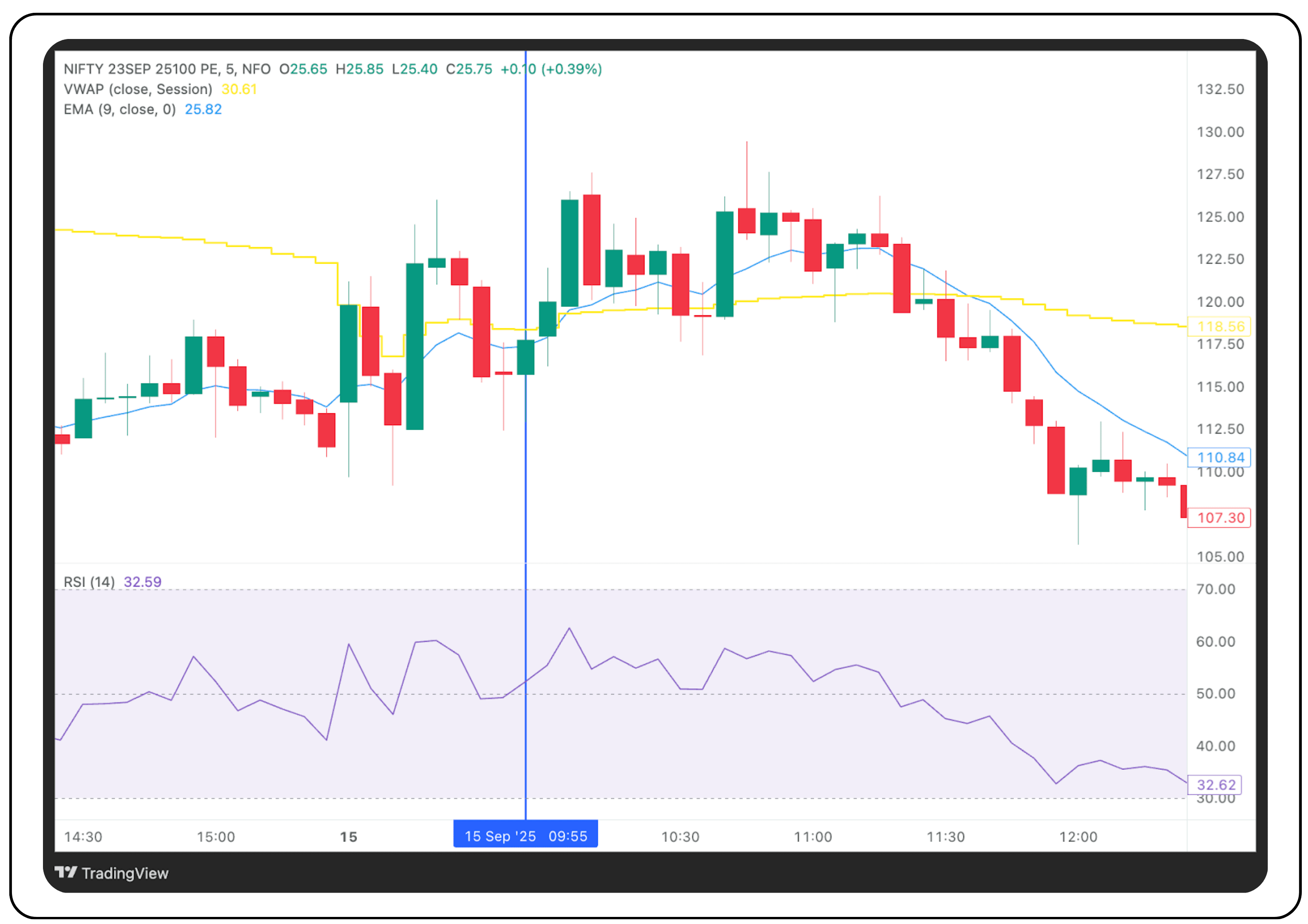
On 15th September 2025, at 9:55 AM, conditions aligned for a long put trade in Nifty 23Sep 25,100 PE.
The Nifty slipped below both the VWAP and EMA, signaling weakness. A bearish candle closed under both the reference points, giving entry alignment, and the RSI hovered around 40, suggesting early bearish momentum.
So let’s see how this trade could be executed.
The instrument chosen is the Nifty 25,100 PE (ATM option). Entry is made around ₹ 120 levels, around the candle closing below the VWAP and the EMA. Stop loss is placed below the candle low around ₹ 115 levels (roughly ₹ 5 per lot), and the target is set at 31 points above our entry at roughly ₹ 151, which translates to a 0.25-0.45% in the underlying, which is NIFTY.
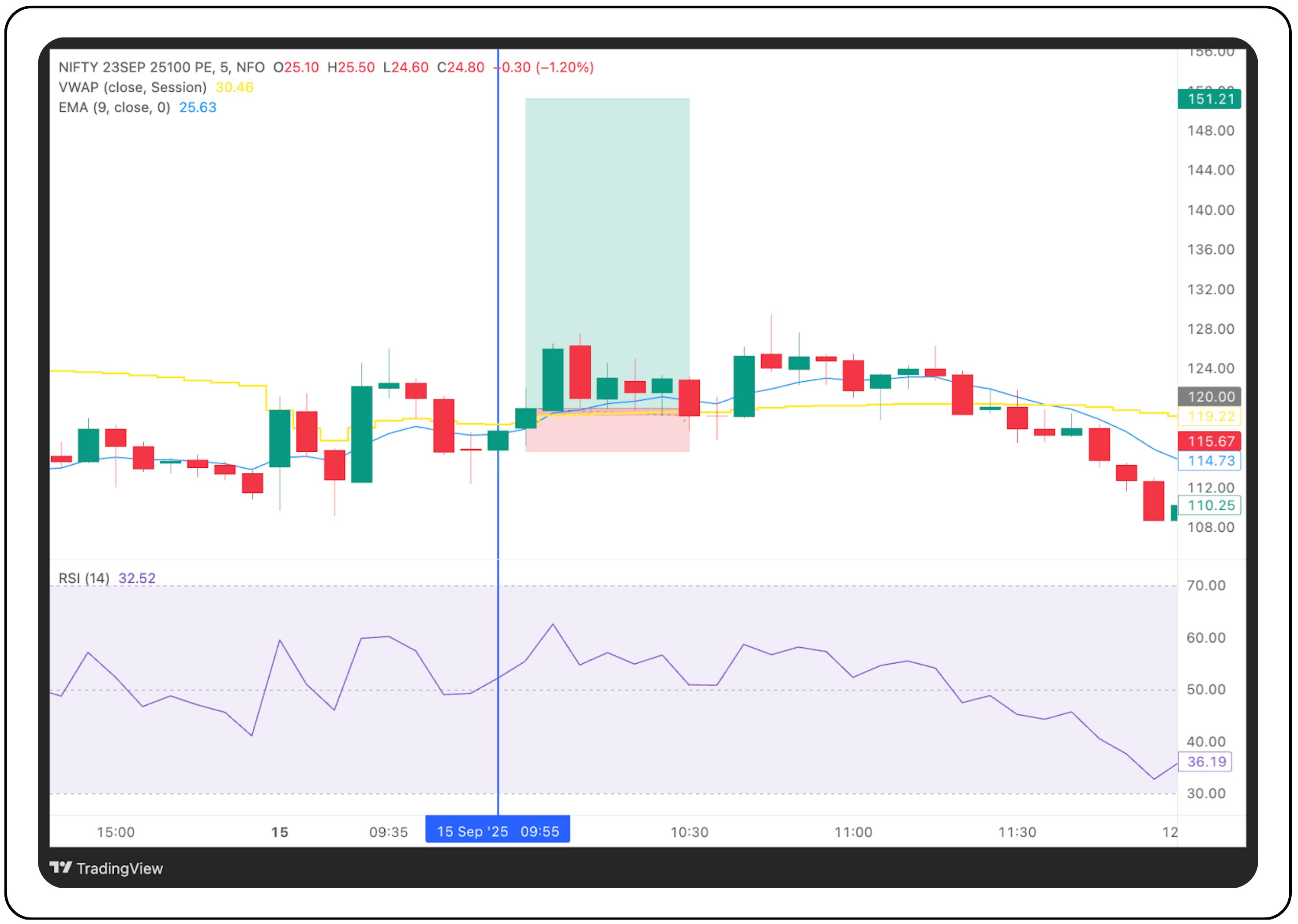
For the first few minutes, price attempted to move higher, but the option premium remained stagnant around ₹118-120, showing no decisive follow-through.
By the 10th minute, RSI slipped back below 55 → 50 → 45, signaling fading momentum. Premiums failed to build volume or cross above the ₹130 mark. With RSI momentum lost and no premium expansion, the setup weakened.
At this point, a time-based exit became the most practical choice. The position closed near ₹ 118, avoiding capital being tied up in a non-performing trade. Although no major loss was incurred, essentially a breakeven, the key benefit was freeing up capital for the next high-probability trade.
Risk Management Framework
Strict risk management in scalping is the backbone of any successful Nifty scalping strategy. Since profits are small but frequent, one big loss can wipe out several winning trades if risk isn’t managed.
Stop-loss placement should be precise. A practical rule is to place stops just beyond the high or low of the entry candle. Alternatively, scalpers can size their stop around 0.15-0.20% of Nifty’s value, adjusting for volatility. This ensures that even a failed setup keeps losses limited.
Profit targets must be clear. The first target is usually 0.25–0.40% of Nifty’s value. Once this is achieved, a disciplined approach is to trail the stop loss to breakeven and let the remainder of the position run. While exiting fully at the target is a safer choice, trailing allows the trader to capture extended moves when momentum sustains. Importantly, no single trade should risk more than 1-2% of total trading capital.
Optimal Trading Windows
Market structure is not uniform throughout the day, and scalpers thrive only during periods of high liquidity and volatility. The first session, from 9:20 AM to 10:45 AM, is the most productive. By then, the opening chaos settles, big players enter the market, and clear moves often appear. The second session, from 1:45 to 3:10 PM, presents another favorable window. As institutions and retail traders position themselves for the close, momentum builds and volumes rise, creating short-lived but sharp moves.
Midday trading, especially from 11:30 AM to 1:30 PM, is best avoided. Thin volumes during this period tend to produce range-bound price action, which can generate false signals and unnecessary losses.
Trade Management Rules
Execution discipline makes the difference between consistent profits and random results. A trade should only be taken when all setup conditions match - entering on half signals usually lowers the success rate. Always look for volume confirmation on breakout candles. Entries without above-average volume often lack the follow-through needed for a meaningful move.
Traders must also remain aware of the news calendar. Sudden announcements or policy decisions can cause unpredictable spikes that break technical setups. Equally important is maintaining a session cap. Stick to 1–2 good trades per session. This keeps focus sharp and avoids the trap of overtrading.
Exit Strategies
Exit decisions in the Nifty scalping strategy should follow clear rules that remove trading psychology biases. There are three common exit triggers while scalping:
- Target Hit- close the trade at the defined profit level.
- Stop-loss triggered- exit without hesitation because averaging down has no place in scalping
- Technical failure- close if the price crosses back over VWAP or 9EMA in the opposite direction of the trade.
Early exits are crucial for maintaining trading discipline and are essential for long-term risk management in scalping success. For example, if RSI momentum fades (dropping below 55 in longs or rising above 40 in shorts), or if volume dries up during what should be a favorable move, exiting early prevents capital erosion. Time-based exits are also effective. If the trade does nothing in 7–10 minutes, it’s better to exit and save capital.
Closing Thoughts
Scalping Nifty options is not about chasing every market move but is about precision, discipline, and consistency. By combining EMA for trend, VWAP for institutional reference, and RSI for momentum, traders can filter noise and focus only on high-probability setups. The practical examples above highlight two important lessons - riding momentum when it is strong, and stepping aside quickly when it fades.
In scalping, risk management is the real edge. Small losses are normal, but with strict exits and trade discipline, steady profits are possible. The goal of this Nifty Scalping strategy isn't winning every trade but protecting capital while overcoming fear and greed in trading.
CubePlus offers a dedicated Scalper Mode with one-click order execution, which ensures trades are placed instantly without missing crucial market moves. Combined with advanced analytics and speed, this feature helps scalpers convert strategy into results.
If you are serious about trading with structure and speed, the right platform makes all the difference. Scalper Terminal on CubePlus is built for traders who demand precision, accuracy, and execution power. Sign up for CubePlus today and take your Nifty scalping to the next level.
Disclaimer: The information provided in our blogs is for informational purposes only and should not be construed as financial, investment, or trading advice. Trading and investing in the securities market carries risk. Always conduct your own research and consult with a qualified financial advisor before making any investment decisions. Past performance is not indicative of future results. Copyrighted and original content for your trading and investing needs.
© 2025 — Tradejini. All Rights Reserved.


