The daily rhythm of India’s capital markets is fundamentally dictated by the strategic movements of two colossal investor groups: Foreign Institutional Investors (FIIs) and Domestic Institutional Investors (DIIs). Their transaction volumes represent far more than mere trading activity; they constitute seismic signals transmitting either global confidence or domestic conviction throughout the financial ecosystem. A comprehensive understanding of market direction necessitates a detailed analysis of their distinct philosophies, capital sources, and market influences.
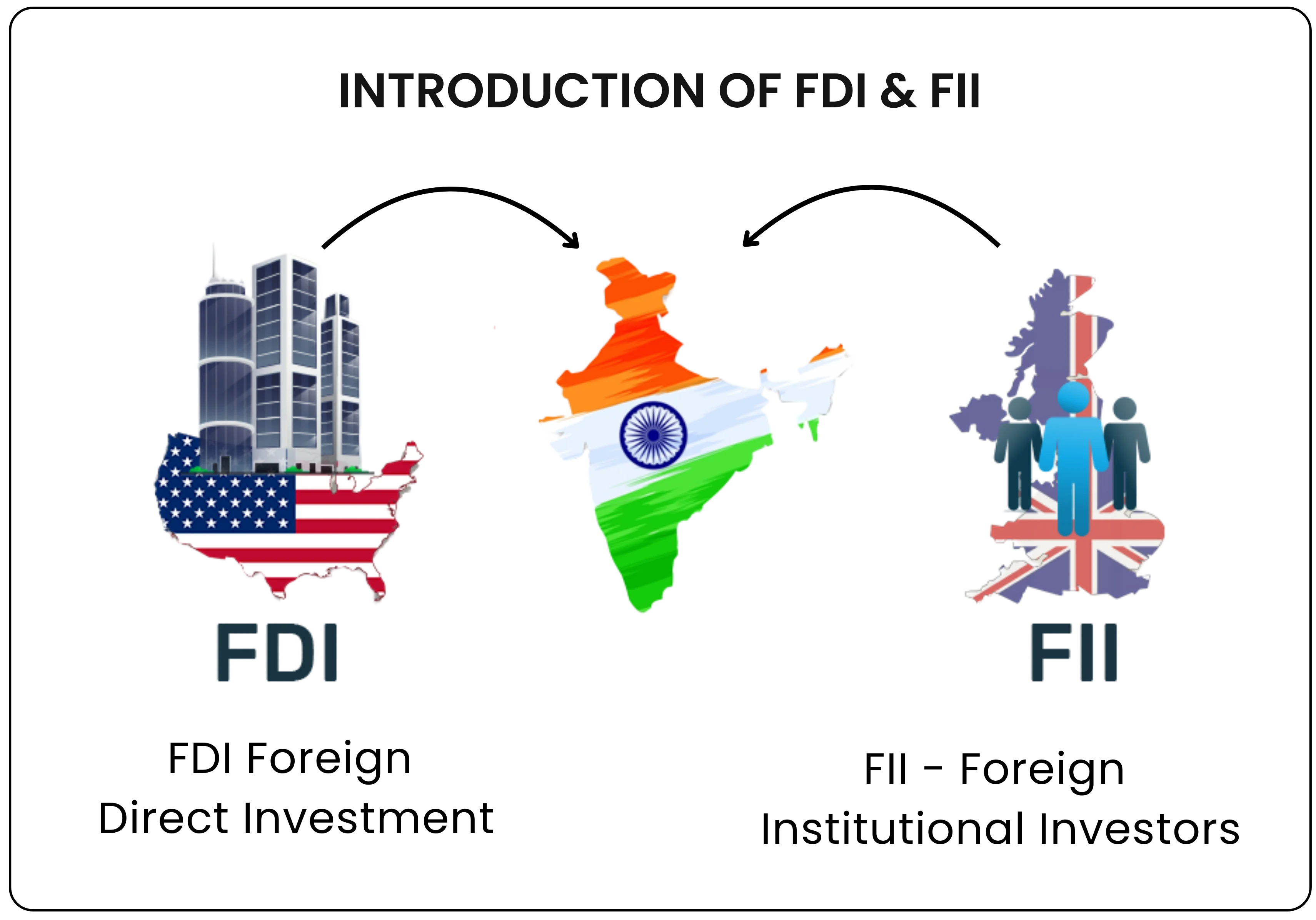
What are FIIs?
Foreign Institutional Investors (FIIs) serve as the primary conduit for international capital into the Indian economy. Their consistent participation is critical, injecting foreign currency, enhancing market liquidity, and globally validating India's investment narrative. However, their decisions are inherently global, rendering their portfolios sensitive to international risk-off events and macro signals.
Categories of FIIs
The sophisticated institutional capital comprising FIIs originates from diverse wealth pools abroad:
- Sovereign Funds: These government-owned funds typically possess a long-term mandate, viewing India as a structural growth investment rather than a short-term trade.
- Global Funds: International pension and mutual funds manage savings for worldwide clients, prioritizing diversification into high-growth emerging economies. Their flows are often driven by a relative value analysis compared to other global markets.
- Tactical Funds: Hedge funds and investment banks represent the agile component of FIIs. Utilizing complex, short-term strategies, their rapid, heavy flows are often responsible for significant, fleeting bursts of market volatility or momentum.
How do FIIs Affect the Indian Stock Market?
FII flows constitute a critical factor in short-term market direction and are essential for large-cap stock performance due to FIIs' heavy concentration in the top indices.
FII Inflows (Net Buying): Strong net buying by FIIs is significantly positive for benchmark indices (Nifty, Sensex), driving up stock prices and surging market liquidity. This activity is a powerful signal of global confidence in India's growth story, strong corporate earnings outlooks, attractive valuations relative to global peers, or easing global risk (e.g., lower US interest rates).
FII Outflows (Net Selling): Sustained selling creates sharp downward pressure on indices and dramatically increases market volatility. Such outflows often signify global risk aversion, a reallocation of capital to developed markets due to higher interest rates, geopolitical instability, or concerns over India's elevated valuations.
Comparison: FDI vs FPI vs FII
| Basis | Foreign Direct Investment (FDI) | Foreign Portfolio Investment (FPI) | Foreign Institutional Investor (FII) |
|---|---|---|---|
| 1. Meaning/Definition | Investment in physical assets or acquiring a lasting interest in a foreign enterprise with the intent to establish control. | Investment in financial assets (stocks, bonds) of a foreign country without seeking management control. | An investor category (e.g., mutual fund, pension fund) that conducts FPI. |
| 2. Investor Intent/Control | High Control. The investor is actively involved in the management and operation of the foreign company. | Passive. The investor has no control or influence over the company's management or operations. | Passive (similar to FPI); focus is purely on portfolio returns. |
| 3. Investment Horizon & Stability | Long-Term & Stable. Difficult to liquidate; considered "sticky capital" that benefits the economy structurally. | Short-Term & Volatile. Highly liquid; often referred to as "hot money" due to ease of exit. | Short to Medium-Term (similar to FPI); contributes significantly to market volatility. |
To read a blog on Specialised Investment Fund, click here
What are DIIs?
DIIs are institutions that operate and invest exclusively within India, deploying capital derived from the aggregated domestic savings pool. They function as the market's crucial stability anchor, consistently providing support and resilience, particularly when global sentiment deteriorates. Their convictions are rooted in local, on-the-ground fundamentals, providing insulation from international economic contagion.
Categories of DIIs
The sustained, compounding power of DIIs is fueled by India's deep and increasing domestic savings:
- Mutual Funds (AMCs): This is the single largest DII segment, driven by the structural discipline of millions of retail investors through Systematic Investment Plans (SIPs). This continuous, counter-cyclical inflow acts as a vital buffer.
- Insurance Companies: Large insurers manage policyholders' long-term savings. Given their decades-long liability profile, their investment philosophy is inherently conservative and focused on steady, long-term capital appreciation.
- Pension and Provident Funds: These institutions manage retirement savings with a non-negotiable mandate for capital security and long-term income generation. Their consistent, low-volatility behavior forms a foundational floor for the market.
- Banks and Financial Institutions: Public and private sector banks, alongside certain Non-Banking Financial Companies (NBFCs), invest their surplus capital and strategic reserves in the financial markets, further adding to the domestic depth.
If you want to read about Commodity Channel Index (CCI), click here
How do DIIs Affect the Indian Stock Market?
DII flows are fundamentally important for long-term market stability and are often counter-cyclical, providing a necessary buffer against FII-led volatility.
- DII Inflows (Net Buying): Strong net buying provides stability and helps cushion market declines. Sustained inflows provide structural support, often strengthening the domestic-facing mid and small-cap segments. This activity signifies strong domestic confidence in the long-term India growth story, increasing formalization of domestic savings, and the local view that market dips represent value-buying opportunities.
- DII Outflows (Net Selling): Significant selling can signal concerns over domestic economic factors (like unexpectedly high inflation or weak corporate earnings), or it may simply represent profit-booking after a strong rally. It is less often indicative of a panic compared to FII outflows, but still signals caution regarding immediate domestic prospects.
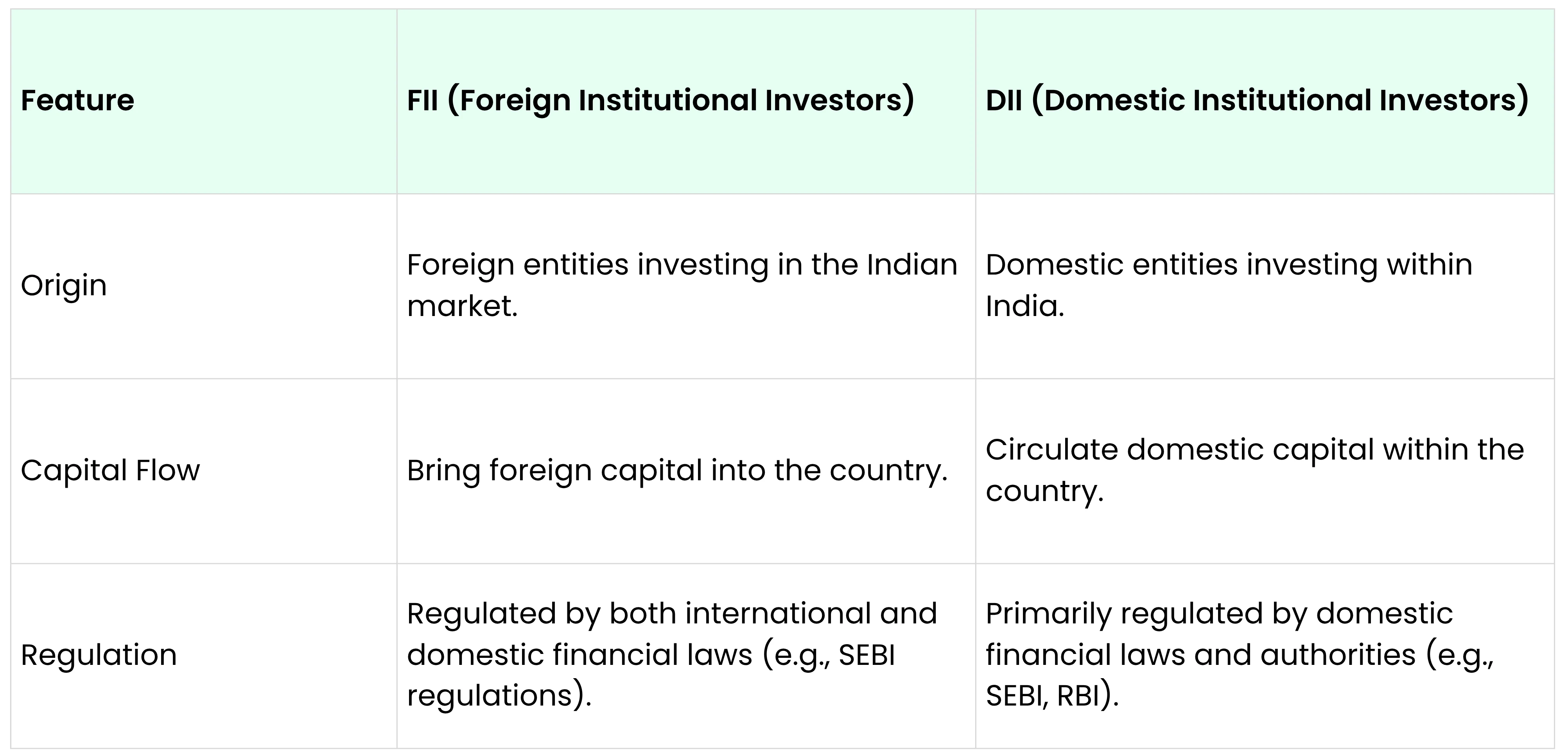
Comparison: FIIs vs DIIs
| Feature | Foreign Institutional Investors (FIIs) / FPIs | Domestic Institutional Investors (DIIs) |
|---|---|---|
| 1. Strategic Focus | Tactical and Opportunistic (Driven by global asset allocation shifts). | Intrinsically Strategic (Driven by long-term domestic growth conviction). |
| 2. Investment Horizon | Short to Medium-Term | Long-Term and Secular |
| 3. Primary Market Impact | Drives Volatility and short-term Momentum in benchmark indices. | Provides Stability and acts as a crucial Counter-Buffer during global sell-offs. |
Disclaimer: The information provided in our blogs is for informational purposes only and should not be construed as financial, investment, or trading advice. Trading and investing in the securities market carries risk. Always conduct your own research and consult with a qualified financial advisor before making any investment decisions. Past performance is not indicative of future results. Copyrighted and original content for your trading and investing needs.
© 2025 — Tradejini. All Rights Reserved.
.webp%3Falt%3Dmedia%26token%3D0ead9799-20bc-4d1e-ae8f-d75ab18921b5&w=3840&q=75)